
Market overview: why Vietnam's confectionery market in 2026 commands attention
Vietnam's confectionery and snack market is one of the few consumer-goods categories to have sustained near-double-digit growth throughout the 2020s. Behind this lies a population of around 100 million, a youthful average age in the early thirties, and a middle class expanding mainly in urban areas. With GDP per capita reaching a level above USD 4,000, confectionery is shifting in standing from an "occasional luxury" to an "everyday indulgence to buy regularly." 2026 is expected to be a milestone year in which this structural change appears clearly as a transition from quantity to quality.
The confectionery market divides broadly into biscuits and cookies, candy and gum, chocolate, cakes and baked goods, and snacks (rice crackers, potato-based). In Vietnam, gift demand centered on Tet (Lunar New Year) strongly governs the market's seasonality, with a substantial share of annual sales concentrated in the few weeks before Tet. This gift culture lifts the sales floor for gift boxes and premium products, while the large peaks and troughs of demand require entrants to design production, inventory and promotion carefully around the seasons.
What is notable is that the market is shifting from a phase of simple expansion to the "threshold of maturity." Low-priced local confectionery still supports the volume base, but the quality of growth is shifting toward premiumization, health orientation and brand experience. For Japanese companies, this means the room to differentiate on quality, safety and storytelling is widening, rather than being worn down by price competition. The key to reading the 2026 market lies in how one captures this "middle class's taste for the refined."
Three major consumption trends: health orientation, premiumization, digitalized gifting
The first trend is health orientation (going healthy). Urban consumers, especially women in their twenties to forties and the parent generation, are rapidly raising their awareness of sugar, fat and additives. Appeals such as low-sugar, additive-free, plant-based, high-protein and gluten-free are no longer niche but becoming part of the mainstream. Snacks made with nuts, dried fruit, brown rice and grains, and functional protein bars are gaining presence on retail shelves. Japan's product philosophy of "gentle on the body" and "making the most of the ingredients" has strong affinity in this context.
The second trend is premiumization. As disposable income rises, consumers have come to choose "something dependable even if a little more expensive." Clearly stated ingredient origins, artisanal methods, refined packaging and brands with a story attract support. In chocolate, bean-to-bar using Vietnamese cacao (especially single-origin from the Mekong Delta) is valued at home and abroad, creating a structure that competes for shelf space with imported premium brands. Japanese ingredients such as Japanese and Western confections, matcha and red beans can become clear differentiation assets in the premium context.
The third trend is the digitalization of gifting and promotion. Tet gift demand remains enormous, but its purchasing touchpoints are rapidly shifting to social media, live commerce and e-commerce. Live selling through TikTok Shop, Shopee and Lazada has influence enough to decide the peak of the seasonal sales battle. Word of mouth originating from influencers (KOL/KOC) drives purchasing, and younger consumers prize the "Instagrammability" of packaging and its appearance as a gift. The era of thinking of product development and promotion separately is over; building digital appeal and gift suitability into the product from the design stage has become indispensable.
Structural change in distribution channels: the three tiers of modern trade, convenience stores and e-commerce
In Vietnam's confectionery distribution, traditional retail (mom-and-pop shops, market stalls, wet markets) still handles a large share of sales volume, while the ratio of modern trade is steadily rising in urban areas. In addition to supermarkets, hypermarkets and drugstore-type outlets, new store openings by convenience stores and mini-supermarkets are intensifying their offensive, and competition for shelf space in major cities such as Ho Chi Minh City, Hanoi and Da Nang is heating up.
What an entrant first faces is the problem of how to conquer this multi-layered structure. Modern trade suits brand building and quality appeal, where negotiating trade terms such as listing fees, shelf fees and promotion-support contributions determines success or failure. Traditional retail can generate volume, but the difficulty of credit, logistics and cash collection is high, making the choice of distributor network decisively important. Because leading local distributors have strengths in specific regions and channels, one must design the optimal combination by region and channel rather than uniformly nationwide.
E-commerce and live commerce have grown into a third pillar of a scale that cannot be ignored. Especially in capturing younger consumers and the urban middle class, e-commerce goes beyond a mere sales channel to function as a place for brand awareness and new-product testing. Bringing small volumes of many varieties to market quickly, identifying the mainstays while watching the data, and rolling out the products that have grown onto modern-trade shelves — this flow of "nurturing on e-commerce and winning in stores" is becoming the standard playbook. Channel strategy should no longer be optimized in isolation but thought of as an omnichannel design that links traditional retail, modern trade and e-commerce.
The competitive landscape: the balance of power among local majors, foreign capital and Japanese players
To understand competition in Vietnam's confectionery market, it helps to view it in three tiers. First is the group of major local manufacturers. Domestic firms that have built nationwide distribution networks and brand assets over many years have an overwhelming presence in the volume segments of biscuits, wafers, candy and traditional confections. They excel in price competitiveness and the ability to secure shelf space, and accurately grasp the gift demand of the Tet sales battle. They are also actively reaching into the emerging premium and health categories, expanding their lineups through M&A and in-house development.
Second are the foreign-capital majors. Multinational confectionery and snack companies deploy powerful global brands in chocolate, potato snacks, gum and candy, making large marketing investments across both TV and digital. They have established local production bases and supply chains early, bringing in a competitive axis of "brand experience" different from the local majors who push on price and volume. Snacks and confections originating in Thailand, South Korea and Malaysia are also steadily expanding share via imports.
Third are the niche-premium players, including Japanese companies. For Japanese firms, the realistic way to fight is to avoid head-on collision in the volume segment and target the upper middle class with distinctive values such as quality, safety, health and seasonality. What matters is to determine at the outset whether one is in the tier that "wins on volume" or the tier that "is chosen on quality." For many Japanese firms the winning path is the latter; a design that narrows the target customer, price band and channel and partners with a player that has local distribution power to cover one's weaknesses is the royal road to making the most of limited resources.
M&A trends: why acquisition becomes a powerful means of entry
What has become prominent in Vietnam's confectionery field in recent years is that M&A and capital participation have emerged as realistic options, rather than pioneering the market from scratch. The reason is clear. The sources of competitive advantage in the confectionery business lie in brand awareness, a nationwide distributor network, production facilities meeting food-safety certification, and skilled personnel. These are extremely hard for a new entrant to build on its own in a short time, making it highly rational to "buy time" through acquisition.
Worth considering as acquisition targets are, first, mid-sized local manufacturers — those with product strength and brands but facing challenges in capital, management control and export know-how. Second are emerging brands that lead in the health-oriented or premium domains and seek growth capital and governance. Third are companies with distribution functions, the idea being to go after the sales channel itself rather than manufacturing. In all cases, the axis of selection is whether one can draw synergy from the standpoint of complementing functions the company itself lacks.
On the other hand, M&A in Vietnam has its own difficulties. Many are unlisted family businesses, with variation in the transparency of financial statements and the application of accounting standards, so thorough due diligence on each of the financial, tax, labor, environmental and food-safety aspects is indispensable. Title to land-use rights, related-party transactions, off-book liabilities and unpaid social insurance are typical pitfalls. Furthermore, how to design the founding family's involvement, and how to reconcile local business customs with the parent's governance in post-merger integration (PMI), affect outcomes even more than the deal's success or failure. Beyond price negotiation, devices such as earn-outs and staged acquisition to draw out the seller's continued commitment are effective.
Choices of entry strategy: deploying export, local production, JV and acquisition
Means of entry can be organized broadly into four. First is export (cross-border sales). Initial investment is small and it suits market testing, but there are walls of import tariffs, customs clearance, shelf-life management and local labeling regulations, and one tends to struggle in price competition and securing shelf space. It is wise to position it as the entrance to a staged strategy: first verify with export the brand's acceptance and which SKUs hit, then deepen investment after gauging the response.
Second is local production (establishing a wholly owned manufacturing base). It has the merits of cost competitiveness, stable supply and quick response to local tastes, but the burdens of capital investment, permits and human-resource development are heavy, and the risk is large without a prospect of demand reaching a certain scale. Third is a joint venture (JV), which can share risk while taking in the local partner's distribution network, government-handling capability and connections. However, getting partner selection and governance design wrong leads to stalled decision-making and conflicts of interest, so the equity ratio, board composition, veto rights and dividend policy must be hammered out precisely at the contract stage.
Fourth is the acquisition and capital participation described in the previous chapter. In practice, these are not mutually exclusive choices but, as a rule, are combined along a time axis. For example, a staged escalation of commitment — "verify demand by export → partner with a strong distributor → minority capital participation in a local brand → majority acquisition and integration of local production" — allows accumulating learning while restraining uncertainty. What matters is to define the entry goal first (market share, supply-chain security, or brand-portfolio expansion) and then work backward to the means that reaches it by the shortest route.
Pitfalls of regulation, permits and practice: from food safety to labeling and tariffs
In entering the confectionery business, the practicalities of regulation and permits govern the project's schedule more than imagined. The food sector is being managed ever more strictly in Vietnam year by year, with multi-layered requirements to meet: conformity declaration and registration for food safety, conformity of ingredient specifications, additive-use standards, and sanitation management of production facilities (operation in line with GMP/HACCP). For imported goods, inspection and customs clearance of imported food, per-product registration, and labeling of shelf life and storage conditions are mandatory, and deficiencies here lead directly to the serious costs of shipment suspension or recall.
Especially easy to overlook is labeling. Mandatory Vietnamese labeling (country of origin, ingredients, nutrition, manufacturer/importer information, production date and shelf life) is in some cases not adequately covered by a sub-label, so local labeling requirements must be built in from the design stage. Allergen labeling and appeals regarding health and functionality must keep the basis and the wording consistent so as not to be deemed exaggerated. Furthermore, if eyeing the Muslim market or export, whether Halal certification can be obtained also becomes a point to consider early.
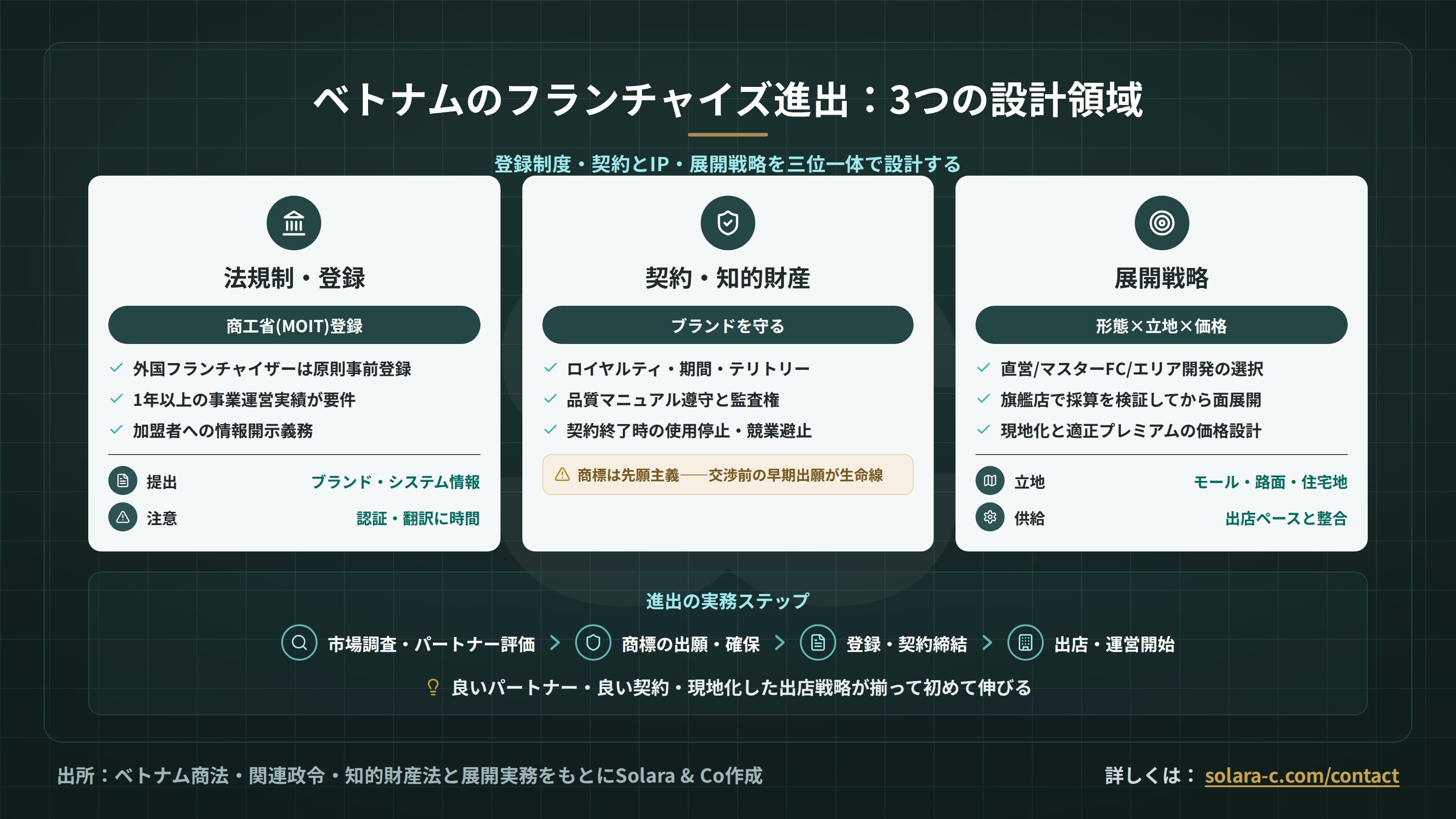
Tariff and origin rules are also directly tied to strategy. Using the various free-trade agreements (such as the CPTPP, RCEP and AJCEP, which are closely relevant to Japanese companies) may curb tariff burdens, but this comes with designing raw-material sourcing to satisfy rules of origin and the practicalities of obtaining certificates of origin. In intellectual property, preemptive trademark filing (bad-faith registration) is prone to occur, so securing trademarks and brand names locally before announcing entry is an iron rule. All these pitfalls share the nature of being "fatal if noticed after starting the business, but avoidable by design if before starting." Involving legal, tax and food-regulation experts early and correctly reflecting permit lead times in the overall schedule closes the gap between a business plan on paper and reality.
An entry checklist and Solara's hands-on support
Finally, here is a practical checklist for considering entry into Vietnam's confectionery market. First, defining the market and customer: are you targeting the volume segment or the health-premium segment? Articulate concretely the target generation, price band and purchase occasion (everyday consumption or Tet gifting). Second, channel design: how to link traditional retail, modern trade and e-commerce/live commerce, and which distributor to partner with by region. Third, product fit: local tastes in flavor, sweetness and texture; the gift suitability and digital appeal of packaging; shelf life and logistics durability.
Fourth, the form of entry: which of export, local production, JV or acquisition to start from, and what staged escalation of commitment to draw. Fifth, regulation and permits: build into the schedule the lead times of food-safety registration, labeling, tariffs and origin, trademarks and IP, and (as needed) Halal. Sixth, due diligence: verify the finances, tax, labor, land title, food safety and off-book liabilities of the acquisition or partnership target, in line with local realities. Seventh, integration and operation: reconciling post-acquisition governance with local management, KPI design, and securing and retaining personnel. Grasping all of these without omission greatly raises the probability of a successful entry.
As an M&A and entry advisory connecting Japan and Vietnam, Solara & Co accompanies you end to end — from market research, target sourcing, valuation, due diligence and contract negotiation to permit handling and post-acquisition business integration. In a field like confectionery, where seasonality is strong and distribution and brand define competitiveness, the presence of a partner who understands both the local network and Japanese quality standards determines success or failure. So as not to miss the 2026 market opportunity, verify on a small scale first, identify a sure winning path, and only then deepen investment — we support you from the design of that very first step.