
In Vietnam, the ability to "collect" matters more than the ability to "sell"
A wall that Japanese companies expanding in the Vietnamese market frequently hit is the situation of "the sale went through, but the money cannot be collected." Attention tends to focus on winning new customers and growing revenue, but if a receivable cannot be collected, that transaction produces a loss rather than a profit. In Vietnam, it is not uncommon for counterparties to be habitually late on payment as a matter of business custom, and because court-ordered enforcement is neither as fast nor as certain as in Japan, the mindset that "it is only revenue once you have collected" is indispensable.
When debt collection is handled as a reactive response—scrambling into action only after a default has occurred—the success rate drops sharply. Collection capability is determined by an accumulated sequence: pre-transaction credit management, careful drafting of clauses at the contract stage, day-to-day receivables monitoring, and staged dunning and legal measures when a default occurs. This article explains, in line with on-the-ground practice in Vietnam, the way of thinking that designs the entire flow from credit assessment through to collection as a single seamless process. For pre-transaction credit investigation, please also refer to Counterparty Credit Investigation and Credit Risk in Vietnam; for the resolution of contract disputes, see Contract Disputes and Arbitration in Vietnam.
Credit management: assessing risk before the transaction begins
Most collection troubles stem from lax credit judgment. "Don't extend credit in the first place to a counterparty you would never be able to collect from"—this is the most reliable collection measure of all.
Counterparty credit investigation
Before a new transaction or an increase in a credit line, verify the counterparty's registration information (ERC), financial condition, status of tax and social-insurance compliance, litigation history, and reputation within the industry. Because corporate-information transparency in Vietnam is not as high as in Japan, in addition to checking registration information, combine reports from local credit-investigation firms with reputation references from the counterparty's banks and industry peers, and evaluate from multiple angles. The details are explained in Counterparty Credit Investigation and Credit Risk in Vietnam.
What deserves particular caution is the reliability of the financial statements presented. At small and medium-sized or owner-run companies, management accounting and tax filings frequently diverge, so judging payment capacity from the financial statements alone is dangerous. Only by layering qualitative information—the size of capital and the actual paid-in status, relationships with group companies, the personal creditworthiness of the manager, and the "track record of payment (whether they have paid properly in the past)"—does the precision of credit judgment improve. Even after the transaction begins, it is important to continuously observe the counterparty's payment behavior and changes in business conditions, and to keep updating the credit evaluation.
Designing credit limits and payment terms
Based on the investigation results, set a credit limit (credit line) and payment terms (prepayment, partial prepayment, days of credit) for each counterparty. For new counterparties whose creditworthiness is not yet established, the standard approach is to require prepayment or an L/C (letter of credit), a security deposit, or a small starting credit line, and then to ease terms in stages according to their track record. An internal rule requiring approval for orders that exceed the credit limit, so as to prevent the sales department from acting unilaterally, is also important.
Building "collection capability" into the contract stage
A contract demonstrates its true worth only when trouble arises. Incorporating, at the outset of the transaction, clauses that put you in an advantageous position for collection determines your later negotiating power and the success or failure of legal measures.
Contract clauses that strengthen collection
Incorporate provisions such as a clear statement of the payment due date and late-payment interest (liquidated damages for delay), a retention-of-title clause (title to the goods remains with the seller until full payment is made), security and guarantees (joint and several guarantors, bank guarantees, mortgages, pledges), and set-off clauses. Retention of title in particular provides grounds for recovering the goods when the buyer falls into insolvency, and is an effective defensive measure in manufacturing and wholesale. Reliably retaining inspection and receipt documentation also connects directly to later proof of "the existence of the debt." In Vietnam, confirming the language of the contract and ancillary documents (whether a Vietnamese version exists) and the person with signing authority is also important, because a contract signed by someone without authority risks having its validity challenged. The consistency of the chain of documents—purchase order, contract, delivery, inspection, and invoice—as a connected body of evidence determines your strength when a dispute actually arises.
Governing law and dispute-resolution clauses
In cross-border transactions, clearly define the governing law and the method of dispute resolution (the Vietnamese courts or arbitration). In Vietnam, arbitration (such as VIAC: the Vietnam International Arbitration Centre) is in many situations preferred over the courts in terms of time, expertise, and enforcement. Because challenges remain in the recognition and enforcement of foreign arbitral awards, it is important to choose, at the contract stage, a dispute-resolution venue that has practical effectiveness. The thinking behind clause design is set out in detail in Contract Disputes and Arbitration in Vietnam.
Receivables management: preventing "bad debt" through daily monitoring
Even when credit and contracts are in order, if day-to-day management grows lax, defaults quietly pile up. In collection, "early detection, early response" is the iron rule.
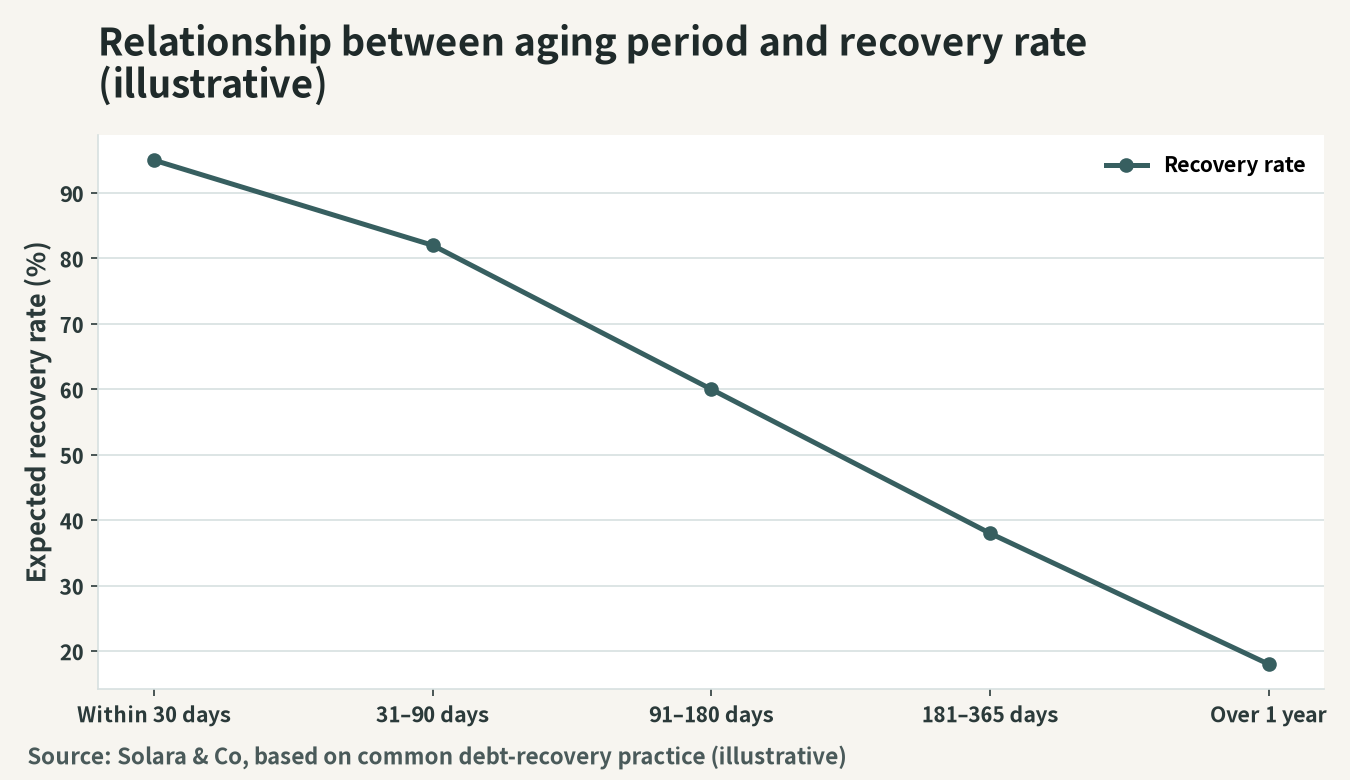
Issue and send invoices reliably, and constantly make the state of overdue accounts visible through aging analysis of receivables. For receivables past their due date, it is important to make contact while the delay is still minor and not to leave them unattended. By managing DSO (days sales outstanding) and the delinquency rate as KPIs, you can catch early on any concentration of credit toward a particular counterparty or signs of delinquency. In the field of collection, the speed of response in the first few weeks greatly influences the ultimate collection rate.
A blind spot here is easily the division of roles between the sales department and the accounting department. Separating the "person who sells" from the "person who collects," and not leaving collection to sales, is the premise of sound receivables management. Because sales tends to prioritize maintaining the relationship and is reluctant to press for payment, it is preferable to have a structure in which an independent credit-management department or accounting handles the setting of credit lines, monitoring, and the initiation of dunning. In addition, putting in writing as internal rules the suspension of shipments once the credit limit is exceeded, and the escalation criteria for receivables overdue beyond a set number of days, prevents collection leakage caused by ad hoc personal judgment. Building such internal controls is also important as part of Governance and Internal Controls of Vietnamese Subsidiaries.
The collection process when a default occurs
Even so, defaults do happen. What matters is to avoid becoming emotional, to raise the pressure in stages, and to strike a balance between maintaining the relationship and achieving collection.
Voluntary collection through dunning and negotiation
Start first with dunning by telephone and in writing, then pursue voluntary collection through agreement on a payment plan (installments), demands for late-payment interest, and advance notice of enforcement against security. Because most receivables can be collected at this stage, the basic approach is to negotiate persistently while keeping records. If the counterparty wishes to continue the trading relationship, negotiation tied to future trading terms is also effective. When dunning, it is important to avoid emotional confrontation while confirming in writing "by when, how much, and how it will be paid," and to document the agreed payment plan. If left as a verbal promise, the counterparty will defer payment and prioritize paying other creditors. Consistent records, together with a clear stance that you will move to the next stage if the promise is not kept, raises the success rate of voluntary collection.
Legal measures—arbitration, litigation, petition for bankruptcy
If voluntary collection fails, move to arbitration or litigation in accordance with the dispute-resolution clause set in the contract. Furthermore, if the debtor is insolvent (in a state of bankruptcy), a petition for bankruptcy is also an option. However, in Vietnam, even after obtaining a favorable judgment or arbitral award, enforcement is not necessarily fast or certain, and if the debtor has no seizable assets, the situation of "winning but not collecting" can occur. Because legal measures take time and cost, judge whether to proceed or pull back by calmly comparing the expected recoverable amount against the expenses.
In practice, rather than filing suit outright, it is not uncommon for payment to move simply by sending a demand letter under a lawyer's name. This is because demonstrating the "seriousness" of intent to proceed to legal measures serves as the final lever for voluntary negotiation. Also, a petition for bankruptcy applies strong pressure on the debtor, but once bankruptcy proceedings begin, the debt is apportioned among the other creditors and ranks below priority claims such as taxes, social insurance, and labor claims, so the recovery rate for unsecured general creditors tends to be low. This is precisely why there is great value in securing collateral or retention of title at the contract stage and building a position from which you can collect on a priority basis.
The "reality" of collection and cost-effectiveness
Debt collection in Vietnam must be designed with an eye not only to the legal system but to the practical effectiveness of enforcement. Even where collection is possible in theory, the risk of not being able to collect in reality is always present.
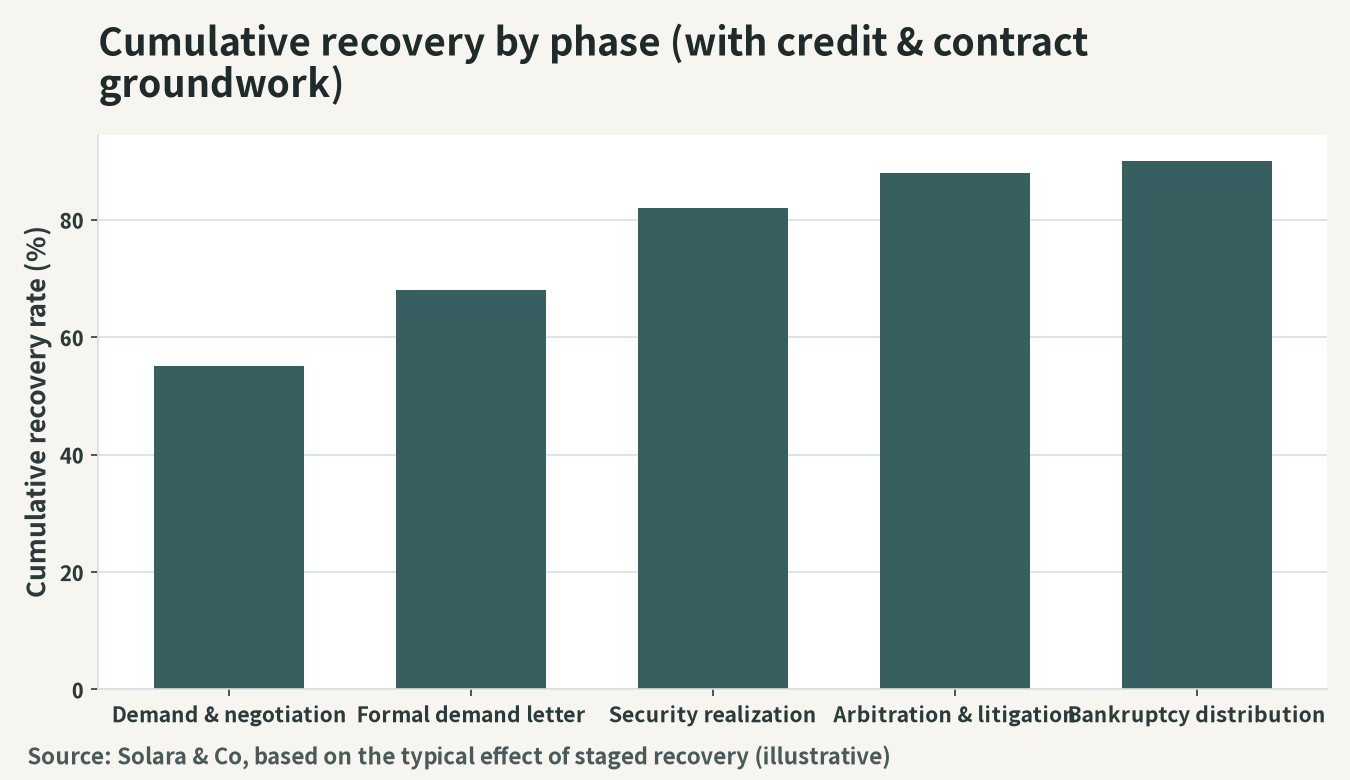
Taking into account the uncertainty of enforcement, the time and cost involved, and the impact on the trading relationship, the greatest collection measure ultimately comes down to a "design that prevents bad debt from arising." That is: screening counterparties through credit assessment, building collateral and clauses into the contract, and catching anomalies early through daily management—this upstream investment dramatically lowers downstream collection costs. It is an iron rule of practice that the collection rate falls rapidly as time passes; the more the initial response from default to action is delayed, the more the counterparty's assets drain away, the more other creditors get ahead of you, and the harder collection becomes. On the premise that "the effort that can be devoted to collection is limited," prioritizing resources on receivables with a high likelihood of recovery, and promptly writing off low-prospect small receivables to crystallize the loss—this kind of decisiveness is also part of sound receivables management. The handling of receivables in a withdrawal or liquidation phase also relates to the perspective of Governance and Internal Controls of Vietnamese Subsidiaries.
Comparison of measures from credit assessment to collection
The main collection measures available when a default occurs, organized by characteristics, time required, cost, and the situations they suit, are as follows. The actual choice is judged based on the amount of the receivable, the debtor's situation, and the contract clauses.
Measure | Characteristics | Time / cost | Suitable situation |
|---|---|---|---|
Dunning / negotiation | Voluntary collection while maintaining the relationship | Short / low | The early stage of most defaults |
Arbitration (VIAC, etc.) | Private, specialized, relatively fast | Medium / medium | The contract has an arbitration clause |
Litigation | A public ruling; obtaining an enforcement title | Long / medium–high | When there is no arbitration clause |
Petition for bankruptcy | Pressure on an insolvent debtor | Long / high | The debtor is insolvent |
Enforcement of security | Exercising a mortgage or retention of title | Medium / medium | Security has already been obtained |
Conclusion: collection capability is determined by "upstream design"
In debt collection in Vietnam, most of the success or failure is determined not by the finesse of legal measures after a default has occurred, but by upstream design: pre-transaction credit assessment, contract-stage clauses, and daily monitoring. Precisely because the practical effectiveness of enforcement is not as high as in Japan, prevention—"not letting bad debt arise"—is the greatest collection measure. Choose your counterparties through credit assessment, firm up your defenses through the contract, nip problems in the bud through early detection, and respond to any defaults that still arise in a staged, rational manner—this seamless design protects the profits of your Vietnamese operations. Solara & Co provides consistent support from the design of credit policy and the development of contract clauses through to collection and dispute response when defaults occur, from both the Japanese and Vietnamese perspectives.