
"If the Site Stops, When and How Do We Rebuild?" — The Moment BCP Is Tested
For Japanese companies that have set up a manufacturing site or a sales/service site in Vietnam, the peacetime challenges are talent and quality, but once an event such as a typhoon, power outage, strike, or fire occurs, what is tested changes to a single point: "how quickly, and from which operations, can we recover." Designing this in advance, from peacetime, is the BCP (Business Continuity Plan).
Even if the Japanese head office has a BCP, it does not necessarily function as is at the Vietnam site. This is because the climate, power situation, labor practices, and legal system all differ, and there are "people to protect on the ground"—the expatriate staff. This article, after organizing why a Vietnam site needs a BCP, explains from a practical standpoint the locally specific risk categories, the building process along the BCM cycle, the key points of initial response and recovery, and the linkage of peacetime risk management (BCM) with internal control and insurance.
Why a BCP Is Indispensable at a Vietnam Site
That a Vietnam site is vulnerable to business interruption has structural reasons. First, grasp that "ease of effect."
The Risk of Dependence on a Single Factory, a Single Site
Many Japanese companies place one main factory in Vietnam and concentrate the production of specific items there. Cost efficiency is high, but on the other hand it is a structure in which, if that single site stops, supply stops entirely. When you have promised delivery dates to global customers, the stoppage of the Vietnam site drags in, in a chain, even the operations in Japan and other countries. Dependence on a single site is the greatest business-continuity risk—one hard to see in peacetime.
Supply-Chain Disruption and Delivery Responsibility
Even if the finished-goods factory is safe, if the second- and third-tier suppliers that supply parts and materials fall into disaster, power outage, or operational stoppage, production stops. Vietnam has many items dependent on imports of parts and materials from China or neighboring countries, and customs congestion or logistics disruption ripples across borders. You must stand on the premise that even if only your own company is safe, the business cannot continue.
The Duty of Care for Expatriates' Safety and Interruption Losses
The company bears a duty to care for the safety of expatriate staff and their accompanying families (the duty of safety care). Without a mechanism to confirm safety and, if necessary, evacuate them in the event of a disaster, epidemic, or security incident, the company carries both the risk to human life and legal liability. In addition, business-interruption losses—lost sales from operational stoppage, fixed costs bleeding out, customer attrition, and recovery costs—tend to grow larger than anticipated.
Knowing the Risk Categories Specific to Vietnam
A BCP begins with rooting out "what can happen to our company." Below is a categorization of the main risks that should realistically be assumed in Vietnam.
Natural-Disaster and Climate Risk
The central and north-central regions are hit by typhoons and torrential rain almost every year, with floods and landslides occurring. In the Mekong Delta of the south, rainy-season flooding, storm surges, and saline intrusion also cannot be ignored. Because the type of threat differs greatly by location, hazards must be assessed site by site.
Power Outages, Power Shortages, and Fire
In industrial-cluster areas, planned outages and momentary voltage drops due to the tightness of power supply and demand in the dry season threaten operations. If cooling, air conditioning, or servers stop, not only production but also quality and data are placed in danger. Furthermore, electrical fires due to aged wiring or overload are a real and recurring threat at factories and warehouses in Vietnam.
Epidemics and Labor Disputes
An epidemic outbreak strikes operations directly through movement restrictions, quarantine, and attendance curbs. Also, labor disputes and strikes (work stoppages) originating in dissatisfaction over wages, bonuses, and treatment occur sporadically in Vietnam, and are a factor that stops production lines. The timing of pay raises and the period around the Lunar New Year (Tet) require particular caution.
Supply Chain, Regulation, Cyber, and Exchange Rates
In addition to the aforementioned supply-chain disruption, sudden changes in regulation and policy (import/export restrictions, licensing requirements, tax changes) can change the premises of the business overnight. Cyberattacks targeting core systems (ransomware, etc.) stop data and operations simultaneously. Furthermore, country risks such as exchange-rate fluctuations and remittance restrictions also govern financial business continuity.
The table below organizes the assumed impacts and representative measures by main risk category. Apply it to your company's location and industry as a starting point for prioritization.
Risk category | Assumed impact | Main direction of measures |
|---|---|---|
Typhoon, flood (central-north) | Inundation, operational stoppage, logistics severance | Site assessment, water blocking, inventory dispersion, alternative transport |
Power outage, power shortage | Production stoppage, quality degradation, data loss | Backup generation, UPS, adjustment of operation plans |
Electrical fire | Equipment burned down, long-term stoppage, human harm | Wiring inspection, fire equipment, evacuation drills |
Epidemic | Attendance curbs, movement restrictions, reduced operation | Remote work, multi-skilling, hygiene measures |
Labor dispute, strike | Line stoppage, production delay | Labor dialogue, fair treatment, early detection |
Supply-chain disruption | Parts shortage, delivery delay | Dual sourcing, safety stock, securing alternatives |
Cyberattack | Operational stoppage, information leakage | Backups, layered defense, recovery procedures |
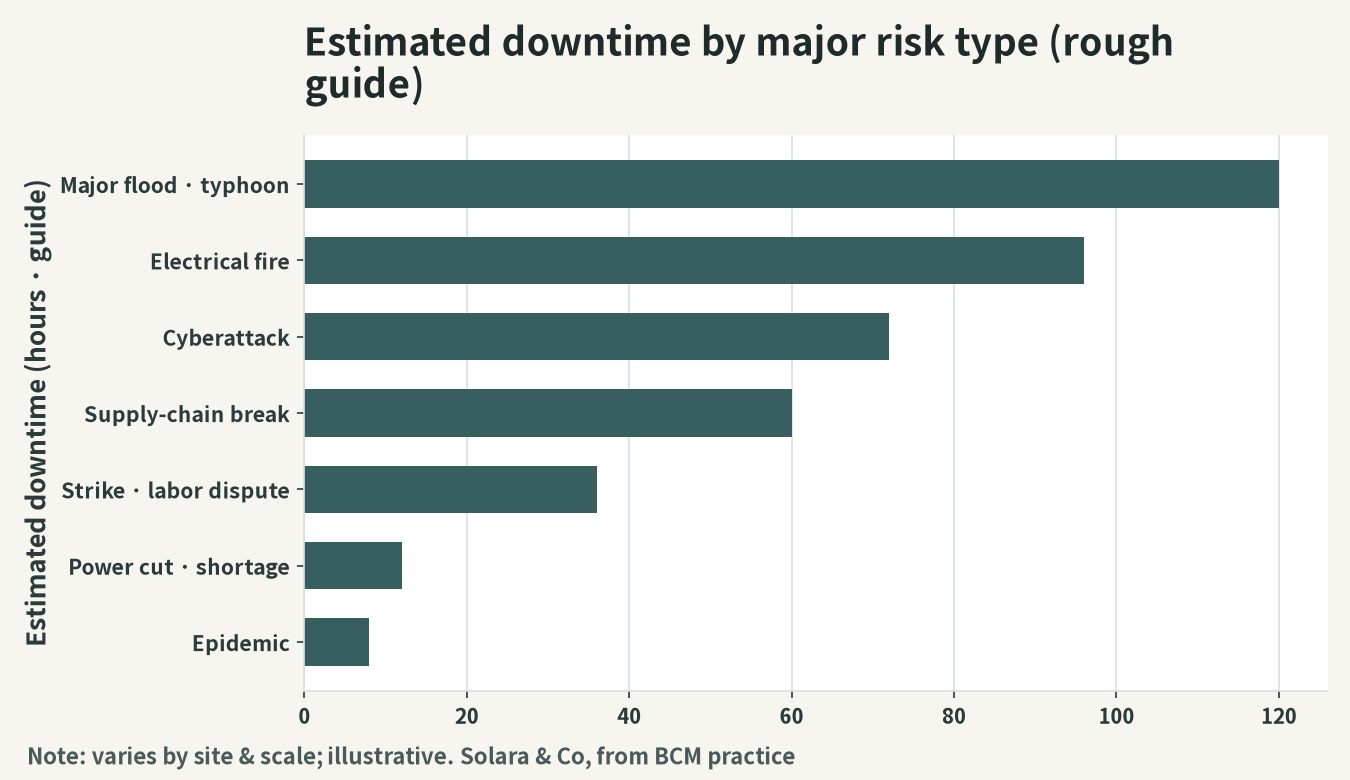
The priority of risks is measured by "frequency of occurrence × degree of impact." A realistic allocation is to invest in measures starting from risks that are both high-frequency and high-impact (such as power outages and labor disputes), while preparing for low-frequency, high-impact risks (large-scale disasters) through insurance or alternative sites. For preparation on the procurement side, please also see Procurement and supplier management in Vietnam; for production dispersion, please also see China + 1 and Vietnam's supply chain.
The BCP-Building Process: Running the BCM Cycle
A BCP is not done once and finished; it is something to be run continuously as BCM (business continuity management). The standard cycle is composed of the following stages.
Risk Assessment
First, root out the risks your site may face, and map them along the two axes of "frequency of occurrence" and "degree of impact." Inspect the location's hazards, the vulnerability of equipment, the concentration of suppliers, and the labor environment, and identify the risks to prepare for as a priority.
Business Impact Analysis (BIA)
Next, conduct a business impact analysis (BIA)—analyzing how much of a blow the stoppage of which operation deals to the business as a whole. Identify the critical operations, and define the "allowable interruption time (RTO = recovery time objective)" and the "target recovery level." For example, setting a concrete target such as "return the main line to 50% capacity within 48 hours" determines the priority of measures and the amount of investment.
Establishing Measures and Systems
Based on the BIA results, put concrete preparations in place: alternative sites and production redundancy, building up safety stock, dual-sourcing from suppliers (including procurement dispersion in the context of China + 1), a safety-confirmation mechanism and emergency contact network, alternative power sources such as backup generation and UPS, and the arrangement of insurance that transfers residual risk. Together with this, decide the structure of the response headquarters that takes command in a disaster and the roles of the initial response.
Documenting the Plan and Assigning Roles
Articulate these into a BCP document, and break it down to the assignment of roles—"who does what, and when." In both Japanese and Vietnamese, the concreteness needed for local staff to act immediately in an emergency is required. Bundle together the contact list, evacuation routes, an initial-response checklist, and recovery procedures. Because the very selection of the site location also affects continuity, incorporate the perspective of Site location strategy in Vietnam as well.
Drills, Exercises, and Periodic Review (PDCA)
A document is meaningless if it cannot be used. Periodically conduct safety-confirmation notification drills, evacuation drills, and tabletop exercises (scenario drills), and reflect the issues found in the plan. By reviewing it each time the organization changes, the site expands, or the law is amended, and continuing to run it as PDCA, the BCP becomes a "living plan."
The Key Points of Initial Response and Recovery: Act with Human Life as the Top Priority
When an event actually occurs, the movements of the first few hours govern the scale of damage. Grasp the principles of initial response and recovery.
Human Life First and Safety Confirmation
Above all, human life comes first. Give top priority to securing the safety of, and confirming the safety of, expatriate staff, local employees, and accompanying families, and carry out evacuation and rescue. For safety confirmation, decide the means from peacetime (apps, SMS, phone trees, etc.) and put them in a form that reliably reaches people in Vietnamese.
Contact with Authorities and the Head Office, and Information Management
Depending on the disaster situation, report to and coordinate with the local authorities (fire, public security, the People's Committee, etc.) and make the first report to the head office in Japan. Amid the tangle of information, information management—separating confirmed information from unconfirmed information and unifying external communications—prevents chaos. Status updates to customers and suppliers are also conducted through a designated point of contact.
Prioritizing Recovery
Along the critical operations and RTOs defined in the BIA, decide the order of recovery. The iron rule is not to try to restore everything at once, but to concentrate the limited people, equipment, and power on the most critical operations. Combining alternative production, alternative sites, and the drawing down of inventory, fulfill the supply responsibility to customers with minimal interruption.
Linking Peacetime Risk Management (BCM) with Internal Control and Insurance
A BCP is not a standalone document; it functions integrated with peacetime governance. Finally, organize that linkage.
Integration with Internal Control and Governance
It is effective to operate risk management as part of the internal-control and compliance system. Events such as fire, fraud, and information leakage often arise from a slackening of everyday control, and the level of peacetime management directly becomes the resilience in an emergency. Locally specific fraud and internal-control risks are dealt with in detail in Internal control and fraud prevention in Vietnam.
Risk Transfer Through Insurance
Residual risk that self-help cannot fully absorb is transferred through insurance. In addition to fire insurance, machinery insurance, and comprehensive corporate property insurance, taking out profit insurance (business interruption insurance) that compensates for lost profit due to operational stoppage supports financial business continuity. Periodically inspect whether the scope of coverage, deductibles, and insured amounts match reality.
Peacetime Management of Labor Risk
Strikes and labor disputes look sudden but mostly originate in peacetime treatment and communication. Everyday labor management—fair wages and evaluation, labor dialogue, and building relationships with the union—is the best preventive measure. Prepare on the institutional side through Vietnam's Labor Law, and on the operational side through daily on-site management.
Solara & Co's End-to-End Support — Accompanying You from Visualizing Risk to Drills
A BCP for a Vietnam site gains real effectiveness only when grounded in the local hazards, power, labor, and legal system. Even transplanting the Japanese head office's plan as is, it will not function if local staff cannot act. The crux is whether you can design end-to-end from a local perspective—from rooting out risk, setting critical operations and RTOs through BIA, establishing measures and systems, and bilingual documentation, to drills and review.
Solara & Co, with bases and human networks on both the Japanese and Vietnamese sides, provides end-to-end support, from site-by-site risk assessment and BIA, the design of alternative production, procurement dispersion, and safety-confirmation systems, linkage with internal control and insurance, and the establishment of an emergency contact network and initial-response manual, to running drills and exercises. We will accompany you in dispersing the risk of single-site dependence and building a system that "does not stop—and, even if it does, comes back quickly."