
Vietnam Is a Promising Market for Franchise Expansion
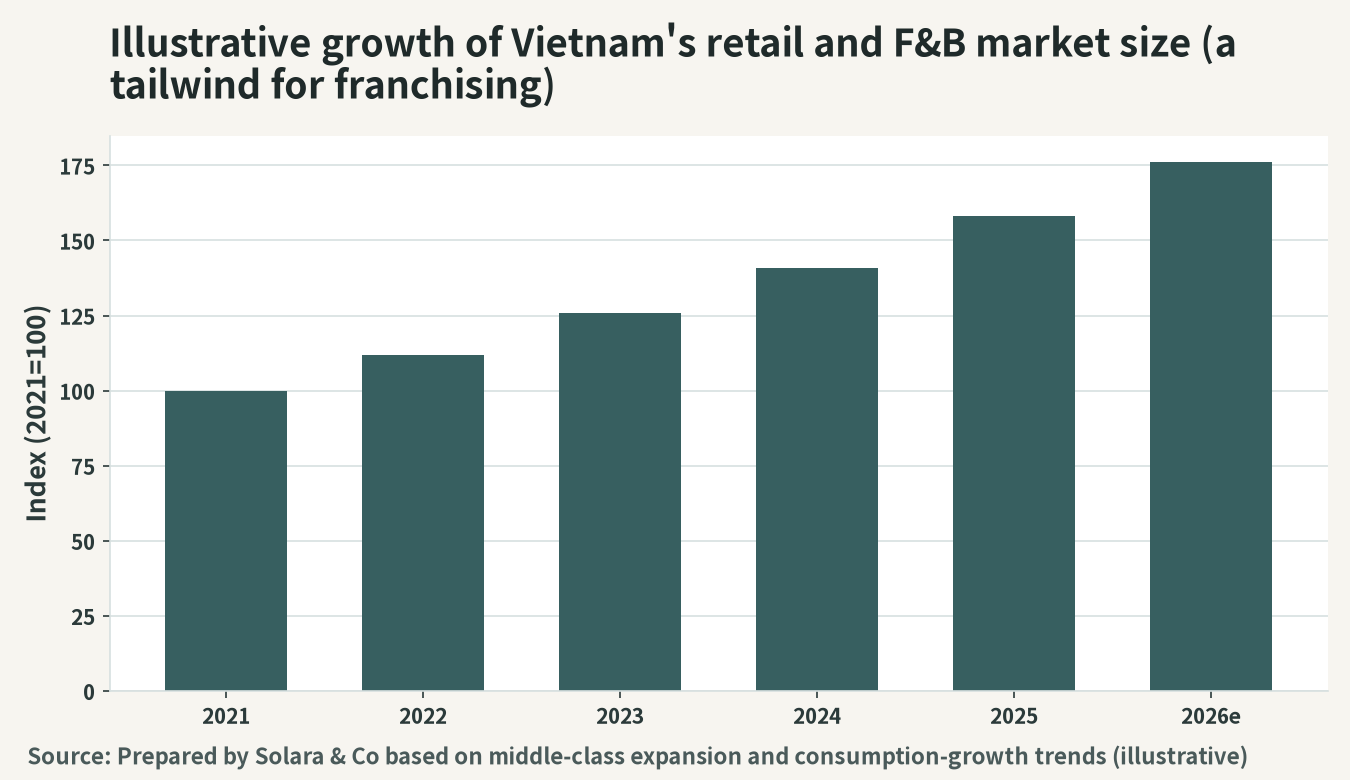
A population of roughly 100 million, a rapidly expanding middle class, and a young generation eager to dine out and spend—Vietnam is one of Asia's foremost growth markets for franchise (FC) expansion in food service, retail, and other services. Japanese restaurant chains, convenience stores, education, beauty, and fitness brands are entering one after another, and the shopping malls in urban areas are packed with domestic and international FC brands. Rather than building a network of outlets from scratch on one's own, franchising—which lets you tap a local partner's capital, people, and real-estate network—is a powerful option for rapid market entry.
At the same time, franchising in Vietnam has its own registration regime, and a misstep in the design of contracts, intellectual property, or quality control can lead to damaged brand value or disputes. This article explains, from the perspective of Japanese brands, the regulations, the key contract points, the choice of entry format, and the expansion strategy involved in franchise expansion in Vietnam, in a systematic way. For market trends in food service, please also see entering Vietnam's food and beverage (F&B) market; for retail channels, please also see Vietnam's distribution and retail channels.
Franchise Regulations—Understanding the Registration Regime
To run a franchise business in Vietnam, you need to understand the regulations under the Commercial Law and related decrees. In particular, the "registration obligation" when expanding from overseas into the country is the starting point.
The Registration Obligation with the Ministry of Industry and Trade (MOIT)
When a foreign business grants a franchise in Vietnam, prior registration with the Ministry of Industry and Trade (MOIT) is, in principle, required. For registration, you submit documents setting out an overview of the franchise, the brand and intellectual property, the business system, information about the franchisor, and so on. It should also be noted that a track record of operating the business for a certain period (generally one year or more) is a requirement. Because granting a franchise without registration can be subject to corrective measures and sanctions, you should confirm whether registration is required and the procedure for it at the early stage of the expansion plan.
Registration may look like a formality, but the authentication and translation of documents (apostille or consular legalization in the home country, and translation into Vietnamese) often take more time than expected, so making an early start—working backward from the store-opening schedule—is indispensable. Because there is also an obligation to notify the authorities when the registered content changes (the brand, the system, the franchisor's information, and so on), registration should be regarded not as "obtain it once and you are done," but as something to be maintained and updated in line with changes in the business.
Exceptions to Registration and the Disclosure Obligation
For transactions between domestic businesses or in some categories, registration may be exempted or simplified, but the judgment as to whether it is required should be made carefully. In addition, regardless of whether registration applies, the franchisor has an obligation to disclose information to a prospective franchisee. Before concluding a contract, the franchisor is required to provide a disclosure document setting out the content, costs, obligations, and risks of the franchise, so that the franchisee can make a decision based on sufficient information. For industries that fall under conditional sectors, a separate business license is also needed, so confirmation together with conditional investment sectors and licensing in Vietnam is indispensable.
Key Points of the Franchise Contract
The success or failure of a franchise depends heavily on the design of the contract. Once you "lend out" your brand, provisions that secure quality and consistency, and that prevent disputes, are essential.
Royalties, Term, and Territory
You should clarify the cost structure—the initial fee (franchise fee), the ongoing royalty (a percentage of sales or a fixed amount), the advertising contribution, and so on. The contract term and renewal conditions, the scope of any exclusive territory (area) granted, and the minimum number of stores (development schedule) are also important points. Because the remittance of royalties involves withholding taxes such as foreign contractor tax (FCT), the tax design must be done as one with the contract. Granting too large a territory robs you of agility in expansion, while too small a one dampens the partner's appetite to invest, so drawing the line in accordance with market size is essential. At the same time, setting a provision to shrink or revoke exclusivity if the minimum store count is not met prevents the risk of a partner "sitting on" the rights and letting the market stagnate. Clearly agreeing from the outset on everything down to the handling at contract termination (disposal of inventory and equipment, immediate cessation of brand use, and non-compete) is the key to avoiding later disputes.
Intellectual Property (IP) and Quality Control
The core of a franchise is the intellectual property—the trademark, the brand, and the know-how. In Vietnam, trademarks follow a first-to-file principle, so filing early before entry is the lifeline that prevents bad-faith registration (a third party grabbing it first). The details are explained in protecting intellectual property rights in Vietnam. The contract should incorporate the standards for brand use, compliance with manuals on store design, operations, and quality, the rights of audit and correction, and the cessation of brand use and restoration to the original state at contract termination, so as to secure the brand's consistency. If quality control is loosened, a problem at a single store damages the reputation of the entire brand.
Choosing the Entry Format—Direct Operation, Master FC, Area Development
Expansion in Vietnam takes several formats, chosen according to the balance among the strength of control, the speed of expansion, and the investment burden. Designing it in accordance with your own management resources and risk tolerance is important.
Direct operation (establishing a local subsidiary yourself to open stores) offers the strongest control, but in return the investment burden and the difficulty of local operation are both high. Master franchising (granting a strong local partner exclusive expansion rights for the whole country or a region) lets you expand all at once by tapping the partner's capital, people, and real-estate network, but in return brand management becomes dependent on the partner. Area development (a franchisee that bears an obligation to develop multiple stores) and direct franchising (individual membership) sit in between. Many Japanese brands take the approach of first building a foothold through direct operation or a master FC, then expanding while watching the results. The thinking on partner selection is also common with selecting a joint-venture partner in Vietnam.
The weightiest decision in choosing the format is whether to go with a master FC. A master FC has great appeal in its speed of expansion and the lightness of the initial investment, but because the partner effectively becomes "the face of the brand in Vietnam," choosing wrongly invites serious situations such as a decline in quality, unpaid royalties, or the partner turning into a competitor after contract termination. Assessing the partner's financial strength, operating capability, integrity, and compatibility with their existing business—with rigor on par with a credit investigation—is indispensable. Moreover, before granting exclusive rights to a single company, first verifying viability in the local market with a flagship directly operated store and establishing the unit economics (the profitability per store) before moving to area-wide expansion ultimately raises the probability of success.
Store Strategy and Localization
Even with the regulations and contract in order, an FC will not turn unless the stores sell. The location strategy and local adaptation (localization) determine the profitability of the business.
Location has a different profit structure for each format—shopping mall, street-front, business district, residential area—so you select by gauging the rent level and the customer base. Localizing the menu and products to suit Vietnamese consumers' tastes, price sensitivity, and eating habits, and accommodating local payment methods (electronic money, QR payment) and delivery (food-delivery apps), also sways competitiveness. Whether to bring the Japanese brand experience in "as is" or to optimize it locally is a balance that must be designed carefully, within a range that does not undermine the essence of the brand. On consumption trends, Vietnam's Gen Z and consumption trends is also a useful reference.
Pricing is also an important point. If you set prices on par with Japan as is, then at the local income level it becomes a "treat for a special occasion," and visit frequency does not grow. Conversely, cutting prices too much undermines the brand's high-quality image and the margins. A price-and-cost strategy that holds down costs by raising the ratio of locally sourced raw materials, while taking an appropriate premium for the added value of Japanese quality, is the key to sustainable profit. Building the supply chain (the stable procurement of ingredients and materials) also becomes the lifeline of the business at the multi-store stage, so the alignment of the store-opening pace with supply capacity needs to be factored in from the planning stage.
Practical Steps and Risks of Entry
Franchise entry is not opening a store on a whim; it proceeds through the stages of research, registration, contracting, and store opening. Managing the risks at each stage prevents failure.
In practice, the flow generally proceeds as: (1) market research and evaluation of candidate partners, (2) trademark filing and securing, (3) franchise registration (where required), (4) contract negotiation and conclusion, and (5) store opening and start of operation. As for sequence, the iron rule is to secure the trademark before entering contract negotiations; disclosing the details of the business to the other party while the brand is unprotected means exposing your know-how and brand defenselessly. The main risks are misjudging the partner's capability and integrity, bad-faith trademark registration, brand damage from lax quality control, the failure to collect royalties, and trouble at contract termination (leakage of know-how, turning into a competitor). These are prevented through contract provisions and day-to-day monitoring.
Comparison of Entry Formats
Organizing the main entry formats by control, speed of expansion, investment burden, and the situations they suit gives the following. The actual choice is judged by the brand's stage and market strategy.
Entry format | Control | Speed of expansion | Investment burden | Situations it suits |
|---|---|---|---|---|
Direct operation | Strong | Slow | Large | Flagship stores, brand-establishment phase |
Master FC | Medium to weak | Fast | Small | Wanting area-wide expansion all at once |
Area development | Medium | Medium | Medium | Concentrated expansion in a promising region |
Direct FC | Medium | Medium | Small to medium | Steady expansion through individual membership |
Conclusion: Design Regulations, Contract, and Expansion Strategy as a Unified Whole
Vietnam's franchise market is a major growth opportunity, but realizing it requires designing three things as a unified whole: responding to the registration regime, designing a contract that protects the brand and quality, and an entry format and expansion strategy that suit your own company. In particular, brand defense through early trademark filing and contract provisions that secure quality control are the very lifeline that protects brand value itself. Only when a good partner, a good contract, and a locally adapted store strategy come together can a Japanese brand grow sustainably in Vietnam. Solara & Co provides consistent support—from market research and partner selection to the design of registration and contracts and the store strategy—from the perspective of both the Japanese and Vietnamese sides.