
Why southern Vietnam's industrial zones are chosen
The southern economic region centered on Ho Chi Minh City — Vietnam's largest economic hub — boasts the most mature industrial cluster in the country. With a history of welcoming foreign investment from an early stage, it has accumulated layer upon layer of industries spanning textiles, food, machinery, electronics, and chemicals. Whereas the north draws its strength from proximity to South China and a concentration of electronics, the south has built its standing as a well-balanced manufacturing base on the strength of industrial diversity, proximity to a deep consumer market, and an abundant labor supply from the Mekong Delta.
That said, even within the south, the character of each province and each industrial zone varies widely. Some provinces are long-established clusters where land has grown scarce; others on the outer rim still have land to spare; and there are coastal areas developed in tandem with deep-water ports. In this article, we compare the major industrial clusters around Ho Chi Minh City by their locational conditions and lay out, from a practical standpoint, how to choose the base that fits your company. For a comparison with the north, see Northern Vietnam's industrial zones; for the steps to set up a factory, see Setting up a factory in Vietnam.
An overview of the southern economic region
The south's industrial clusters spread out in concentric circles with Ho Chi Minh City at the center. Their character differs by distance and direction from the core.
Ho Chi Minh City and the neighboring industrial provinces
The industrial provinces adjacent to Ho Chi Minh City hold the most mature industrial cluster in the south. Infrastructure, talent, and related industries are densely concentrated, giving a high degree of certainty at startup; in return, however, land is scarce, and land prices and labor costs are rising. Thanks to their proximity to the city, sourcing labor is also relatively easy, and being close to the consumer market is a strength. On how to think about office and base location, Office location strategy in Vietnam is also a useful reference.
The emerging industrial provinces on the outer rim
The outer-rim provinces, set a certain distance from Ho Chi Minh City, still have land to spare, allowing large parcels to be secured at relatively low cost. As the expressway network is built out, access to the city center and ports has improved, making these provinces a receptacle for investment spreading outward from the mature provinces.
Coastal and port areas
The south's coastal areas have been developed with clusters of deep-water ports capable of receiving large vessels, suiting industries with heavy import-export volumes or those handling bulky goods. Ports and industrial zones sit close together, maximizing the efficiency of maritime logistics. For an overview of port infrastructure, see Vietnam's port and logistics infrastructure.
Comparing the major industrial clusters
We compare the south's representative industrial clusters by their locational conditions. Each has distinct strengths and weaknesses, and the optimal answer changes with the industry and logistics profile.
Cluster | Main industries | Strengths | Points to note |
|---|---|---|---|
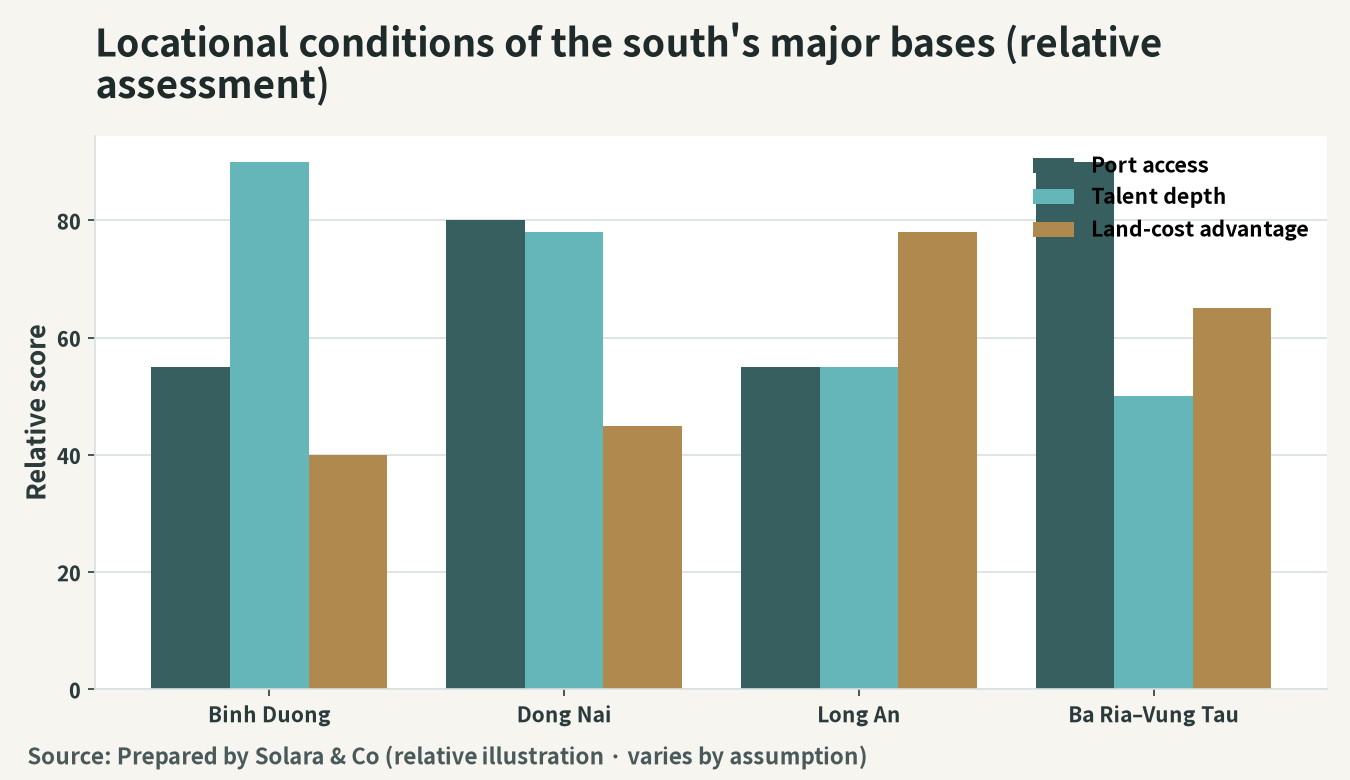
Binh Duong | Electronics, machinery, woodworking, diverse | Most mature, full infrastructure, deep talent pool | Soaring land prices, rising labor costs |
Dong Nai | Textiles, machinery, components and materials | Close to ports and airport, large-scale cluster | Land scarcity advancing |
Long An | Food, light industry | Close to Ho Chi Minh City, land to spare | Infrastructure still being built out |
Ba Ria – Vung Tau | Heavy industry, chemicals, logistics | Integrated with deep-water ports, large parcels | Distant from the city center |
Tay Ninh | Light industry, agricultural processing | Low cost, near the border | Mid-tier name recognition and talent |
Greater Ho Chi Minh City | High value-added, high-tech | High-tech parks, talent, consumer market | Extremely limited land |
Binh Duong is the south's most mature industrial province, drawing a wide range of industries on the strength of full infrastructure and a deep talent pool; in exchange, land prices and labor costs run high. Dong Nai's strengths are its proximity to ports and the airport and its large-scale industrial cluster, but land scarcity is advancing. Long An is close to Ho Chi Minh City, still has land to spare, and is growing as a receptacle for investment overflowing from the mature provinces. Ba Ria – Vung Tau is a coastal area integrated with deep-water ports, suiting heavy industry, chemicals, and logistics. Tay Ninh wields low cost and proximity to the border, while the high-tech parks around Ho Chi Minh City wield talent and proximity to the consumer market.
Reading infrastructure and access
In selecting a location in the south as well, infrastructure and access sway the decision even more than the land itself.
Deep-water ports and import-export
The south's imports and exports pass through the coastal clusters of deep-water ports and the ports around Ho Chi Minh City as their gateways. Development of deep-water ports able to receive large container ships has advanced, raising the efficiency of direct shipping to Europe and the Americas. The higher an industry's export ratio, the more port access and lead time dominate the location decision. Trends in the logistics and warehousing market are covered in Vietnam's logistics and warehousing market.
Airports and high value-added cargo
In addition to Ho Chi Minh City's international airport, a new large international airport is under development in the surrounding area. Once it is in full operation, the south's air-logistics capacity will rise substantially, improving the locational conditions for industries that handle high value-added cargo.
Road networks and labor supply
With the build-out of expressways and ring roads, the connectivity among the city center, ports, and outer-rim industrial provinces has strengthened. The south is also distinctive in being able to draw labor supply from the vast hinterland of the Mekong Delta. Trends in the Mekong Delta economic region are discussed in Vietnam's Mekong Delta economic region.
How to choose a location — the axes of judgment
The optimal industrial zone cannot be decided uniformly. It calls for a comprehensive judgment across multiple axes, weighed against your own business profile. First is the center of gravity of logistics. Whether you mainly export your products or sell them to the domestic market changes whether you should be close to ports, the airport, or the consumer market. Because the south is backed by the country's largest consumer market, it is a particularly good fit for domestic-demand-oriented businesses. Second is the relationship to the industrial cluster: the more you can enter a cluster where related components, materials, and services are in place, the faster the startup.
Third is securing talent. Gauge the depth of the talent pool for the roles you need and the intensity of competition with nearby firms. Fourth is cost: land prices, rents, and labor costs differ by cluster, and the more mature and popular the area, the higher they run. Fifth is incentive schemes and infrastructure maturity. On the context of supply-chain restructuring, Supply-chain restructuring in Vietnam (China + 1) is also a useful reference.
Types of industrial zone and the strength of domestic demand
The south's industrial zones are likewise diverse — public zones, private-developer zones, high-tech parks — with differences in the infrastructure and incentives offered. A major characteristic of the south is that it is backed by the Greater Ho Chi Minh City metropolitan area, the country's largest consumer market. Beyond export processing, it holds high value as a base for domestic-oriented manufacturing and distribution; for food, consumer-goods, and retail-related companies seeking to capture domestic demand, proximity to the consumer market carries decisive meaning. Depending on whether the center of gravity is placed on the export type or the domestic-demand type, the positioning of the optimal zone changes greatly.
On incentive schemes, falling within an encouraged sector or encouraged area can earn incentives such as corporate income tax reductions or exemptions; however, with the introduction of the global minimum tax, the effect of conventional tax incentives is fading, making it important to assess eligibility for newer forms of support such as research and development and human-resource development. In general, the more mature a province, the more limited its incentives tend to be, while the emerging outer-rim provinces tend to offer more generous incentives to attract investment.
Rental factories and phased expansion
In the south as well, the choice between a self-owned factory via land acquisition and a ready-built rental factory (standard factory) shapes the startup. Particularly in mature provinces, where land is scarce, making use of rental factories or existing facilities becomes a realistic option. The flexibility to expand investment in stages while verifying demand is effective for holding down initial risk. If you are looking toward large-scale production over the long term, the strategy of securing a large parcel in an outer-rim province in advance is also an option.
Risks to keep in mind
Locating in the south has its own points that must not be overlooked. First is land scarcity in the mature provinces and the rise in labor and land costs. The more popular the cluster, the higher prices climb, eroding the cost advantage projected at the outset. Second is constraints on electricity and infrastructure: in phases where supply cannot keep up with a surge in demand, stable supply shakes the underlying premise. Third is traffic congestion and variability in lead time. Because this is a major metropolitan area, there are times when logistics transit times become hard to read. Fourth is competition to attract and retain talent: the more a cluster develops, the fiercer the scramble for talent with neighboring firms.
These can be realistically managed by comparing several candidate sites on the ground before entering, confirming the current state of infrastructure and talent, and building relationships with reliable local partners and industrial-zone operators. Precisely because a location, once decided, is hard to move, it is worth spending time on the comparison and study at the entry point.
How to identify the optimal southern base — Solara's perspective
Southern Vietnam's industrial zones have the strength of a well-balanced manufacturing base, backed by a mature industrial cluster, proximity to a deep consumer market, and an abundant labor force. Yet even within the "south" there are diverse options — mature provinces where land has grown scarce, outer-rim provinces with land to spare, coastal areas integrated with deep-water ports — and the optimal answer changes with the combination of logistics center of gravity, industrial cluster, talent, and cost. Especially for businesses seeking to capture domestic demand, closeness to the consumer market carries great meaning.
Solara & Co, building on bases and human networks in both Japan and Vietnam, provides end-to-end support — from market research and the formulation of entry strategy, through the comparison of industrial zones and locations and on-site surveys, support for land-purchase and lease negotiations, and factory-establishment procedures, to building out the operating structure after entry. From among the south's many clusters, we identify the base where your strengths come most fully into play and firmly manage the risks of cost and infrastructure — that is the location strategy we help you build.