
Why companies choose Northern Vietnam's industrial zones
For Japanese companies establishing manufacturing bases in Vietnam, the north is a region of steadily rising prominence. The northern economic sphere centered on the capital, Hanoi, enjoys a geographic advantage: proximity to South China by both land and sea, which makes it easier to preserve continuity across the supply chain. Large-scale investments in electronics, electrical equipment, and precision machinery have arrived one after another, and the cluster of component makers that supports them has grown ever thicker. In the China+1 context, the north has become a strong option for companies seeking a base that is "close to China and able to complement China."
Yet even within "the north," the character varies greatly from province to province and zone to zone. Some are inland provinces where the electronics industry clusters; others are coastal cities developed in tandem with ports — and they differ in land cost, depth of talent, and infrastructure maturity. This article compares the major industrial clusters around Hanoi by their locational conditions and lays out, from a practitioner's perspective, how to choose the base that fits your company. For a comparison with the south, see Southern Vietnam's industrial zones; for the steps to set up a factory, see Setting up a factory in Vietnam.
The big picture of the northern economic sphere
The north's industrial clusters spread out radially with Hanoi at the center. Grasping the geography in broad strokes reveals the underlying structure of how to choose a location.
Hanoi and the neighboring inland industrial provinces
Around Hanoi runs a chain of inland industrial provinces that have drawn large investments in electronics and electrical equipment. These provinces form vertical supply chains, with the massive bases of finished-goods makers at their core and component and parts makers gathered around them. They offer good access to airports and trunk roads and make it relatively easy to secure talent; but precisely because they are popular, land cost and labor cost are on an upward trend. The depth of the electronics and EMS industry is covered in Vietnam's electronics and EMS industry.
The port cities of the northern coast
The port cities of the northern coast, where deep-water ports and industrial zones are developed as an integrated whole, offer outstanding convenience for imports and exports. Large parcels of land are comparatively easy to secure, making them well suited to industries that involve heavy goods or high-volume transport. For the overall picture of port infrastructure, see Vietnam's port and logistics infrastructure.
The frontier provinces near the Chinese border
Provinces near the border with China have strengths in land-based procurement of components and in logistics toward China. For companies that wish to preserve continuity with South China's supply chain, proximity to the border carries practical significance.
Comparing the major industrial clusters
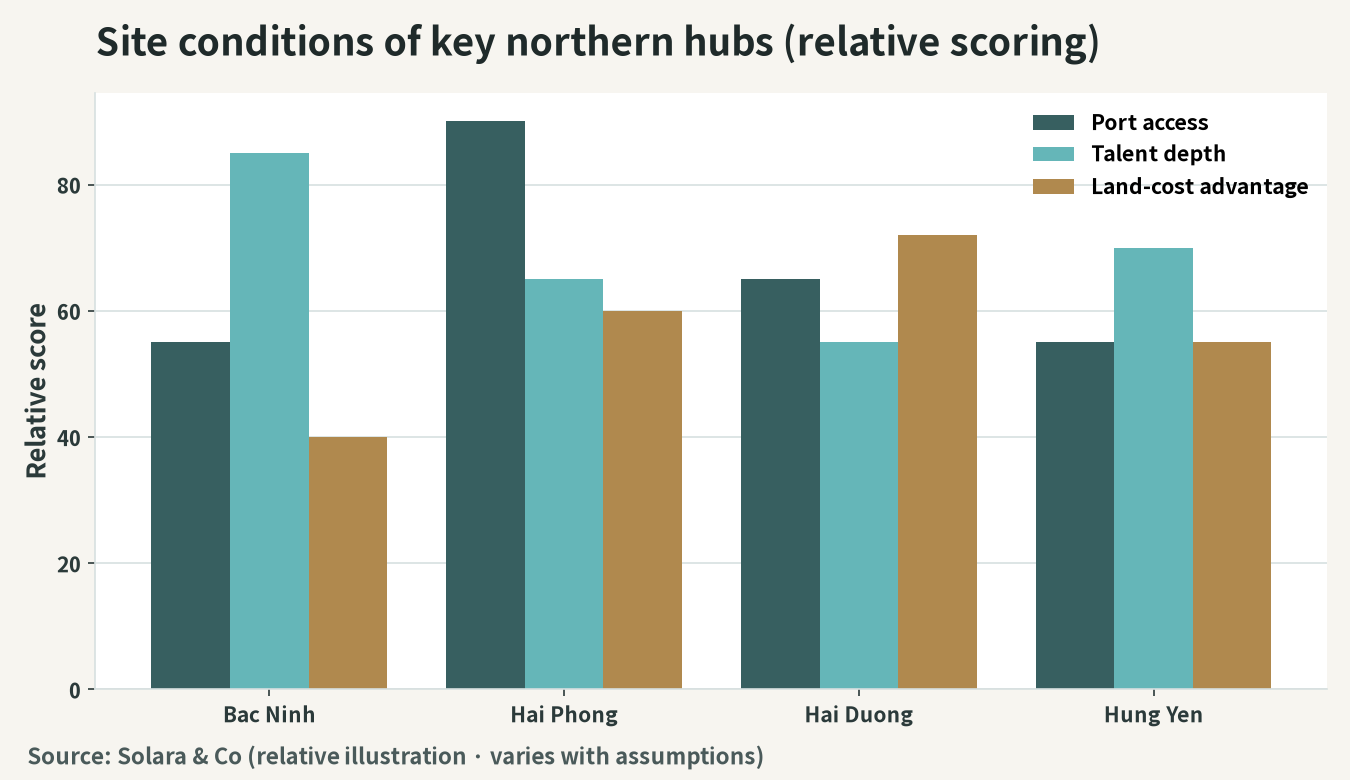
We compare the representative industrial clusters of the north by their locational conditions. Each has different strengths and weaknesses, and the optimal answer shifts with the industry and its logistics characteristics.
Cluster | Main industries | Strengths | Points to note |
|---|---|---|---|
Bac Ninh | Electronics・electrical・precision | Finished-goods majors clustered・component network・near airport | Rising land prices・rising labor costs |
Bac Giang | Electronics・assembly | Room for land・emerging overflow site | Infrastructure still developing |
Hai Phong | Ports・heavy industry・electronics | Integrated deep-water port・large parcels・export convenience | Distant from city center |
Hai Duong | Components・machinery | Midway between Hanoi and ports・balanced cost | Mid-level name recognition |
Vinh Phuc | Automotive・motorcycles・electronics | Automotive cluster・near airport | Limited land options |
Hung Yen | Diverse manufacturing | Close to Hanoi・expressway network | Fierce competition for talent |
Bac Ninh combines the massive bases of finished-goods makers, a thick component supply network, and proximity to the airport, making it the most mature electronics cluster in the north. In return, its land cost and labor cost run high. Bac Giang, as a province adjacent to Bac Ninh, retains room for land and is serving as an emerging overflow site that carries the outward expansion of the cluster. Hai Phong, where a deep-water port and industrial zones are developed as an integrated whole, suits industries that involve a lot of import and export. Hai Duong sits midway between Hanoi and the ports, a choice that strikes a balance between cost and access. Vinh Phuc clusters automotive and motorcycle-related industries, while Hung Yen leverages its proximity to Hanoi and its expressway network to attract a diverse range of manufacturers.
Reading the infrastructure and access
In selecting an industrial zone, the infrastructure and access that surround it carry decisive meaning — more so than the land itself.
Ports and import-export
The north's imports and exports pass through the coastal deep-water port cluster as their gateway. The transport lead time and cost for finished goods and components are heavily influenced by distance from the port. The more an industry relies on maritime transport, the more the quality of port access dominates the locational decision.
Airports and high-value cargo
The international airport near Hanoi is indispensable for transporting lightweight, high-value electronic components and urgent cargo. In the electronics and precision fields, which depend heavily on air transport, airport access becomes an important axis in choosing a base.
The road network and the Chinese border
With the expressway network now in place, access from the Hanoi vicinity to ports, airports, and the Chinese border has improved. For companies that prioritize land-based logistics toward China, the lead time to the border gate is a factor not to be overlooked. The overall picture of supply-chain restructuring is discussed in Vietnam's supply-chain restructuring (China+1).
How to choose a location — the axes of judgment
The optimal industrial zone cannot be decided by a single formula. You make a comprehensive judgment across multiple axes, measured against your company's business characteristics. First is proximity to the supply chain. Whether you procure key components from South China or complete everything locally changes the optimal location. Second is the center of gravity of logistics. Whether your products are mainly exported or sold domestically, and whether transport is by sea or by air, changes the weight given to distance from ports and airports.
Third is securing talent. You must assess how deep the talent pool is for the roles and skills you need, and how fierce the competition for hiring is with rival bases nearby. Fourth is cost. Land prices, rents, and labor costs differ by cluster, and the more mature and popular an area, the higher they run. Fifth is the incentive regime and infrastructure maturity: confirm the quality of the incentives and infrastructure each zone provides. From the angle of clustering semiconductor back-end processes, Vietnam's semiconductor supply chain is also a useful reference.
Types of industrial zone and incentive regimes
Northern industrial zones differ in character depending on their operating entity and locational traits. There are public zones developed by the state or province, private zones developed and operated by developers, and high-tech parks and dedicated zones specialized for a particular industry — and the generosity of the infrastructure, services, and incentives they offer varies. Some zones provide Japanese companies a package that bundles land, standard factories (rental factories), and administrative-procedure support, which greatly lowers the startup burden for first-time entrants. Because the industry mix of resident companies and the quality of operations differ by zone, confirming the lineup of existing tenants is also a useful basis for judgment.
On the incentive front, if you fall under an encouraged sector or an encouraged region, you may be able to receive incentives such as corporate-tax reductions or exemptions and import-duty exemptions. However, with the introduction of the global minimum tax, the effect of conventional tax incentives is fading, and it has become increasingly important to assess eligibility for newer forms of support such as R&D, human-resource development, and infrastructure subsidies. Because the incentives that apply differ by location, careful scrutiny at the zone-selection stage is indispensable.
The rental-factory option
Whether to acquire land and build your own factory or to lease a ready-built rental factory (standard factory) is an important decision that governs initial investment and startup speed. A rental factory has the advantage of a light initial burden and the ability to expand in stages while verifying demand, and its supply is expanding in the north as well. An owned factory, on the other hand, excels in specification freedom and long-term cost efficiency. The realistic approach is to use the two selectively according to the certainty of the project and your capacity to invest.
Risks to keep in mind
Locating in the north also carries issues that must not be overlooked. First is the rise in labor and land costs. The more popular the cluster, the higher prices climb, and the cost advantage assumed at the outset may fade. Second are constraints on power and infrastructure. In phases where supply cannot keep up with a sharp surge in power demand, stable supply can shake the very premise of a location. Third is traffic congestion and lead-time variability; in city outskirts, the time required for logistics can become hard to predict. Fourth is competition for talent; the more the cluster develops, the fiercer the scramble for talent with neighboring companies becomes.
These can be managed realistically by comparing several candidate sites on the ground before entry, verifying the current state of infrastructure and talent, and building relationships with trustworthy local partners and zone operators. Precisely because a location, once decided, is hard to move, it is worth spending time on comparison and deliberation at the entry point.
How to identify the optimal northern base — Solara's perspective
Northern Vietnam's industrial zones, backed by proximity to South China and a cluster of the electronics industry, are highly competitive as manufacturing bases. Yet even within "the north" there are diverse options — a mature electronics cluster, a port-integrated coastal city, an emerging province with room for land — and the optimal answer shifts with the combination of industry, logistics, talent, and cost. What matters is to choose by measuring against your company's supply chain and logistics center of gravity, not by the name recognition on the signboard.
Solara & Co, built on bases and human networks on both the Japanese and Vietnamese sides, provides end-to-end support: from market research and entry-strategy formulation, to comparison of industrial zones and locations and on-the-ground surveys, to negotiation support for land purchase and lease, factory-establishment procedures, and the building of your organization after entry. From among the north's many clusters, we help you pinpoint the base where your strengths come most alive, while steadily managing the risks of cost and infrastructure — that is how we assist with your locational strategy.