
It Doesn't End at "How Much Is Take-Home Pay" — The Real Picture of Payroll in Vietnam
When a Japanese company that has entered Vietnam hires people locally, the first stumbling block tends to be the practical work of payroll and social insurance. Although the structure—"deduct tax and social insurance from gross pay and pay out the take-home amount"—is the same as in Japan, the details are unique to Vietnam and Japanese assumptions do not apply: the contribution rates, the caps on the calculation base, the mandatory enrollment of foreign expatriates, and the withholding rules for personal income tax (PIT). Salaries arise every month, and the deadlines for filing and payment come every month too. The frightening thing about payroll and social-insurance compliance is that, once the design is wrong, back-assessments and corrections pile up month after month.
This article organizes—from the standpoint of the practitioner who actually hires people locally—the overall picture of payroll (gross-to-net), the three pillars of social insurance, the calculation base and caps for contributions, social insurance for foreign expatriates, the withholding of personal income tax, the regional minimum wage and the business custom of the Tet bonus, and practical issues such as electronic filing and double taxation. For the institutional design of employment itself, please also see Practical Points of Vietnam's Labor Law; for the overall sense of labor costs, see The Reality of Labor Costs in Vietnam.
The Overall Picture of Payroll (Gross-to-Net) and the Monthly Cycle
The Difference Between a Gross Contract and a Net Contract
In a Vietnamese employment contract, you must clarify from the outset whether the salary offered is "gross (total pay)" or "net (take-home)." A gross contract promises the total pay amount, from which the employee's share of social insurance and personal income tax is deducted to pay the take-home amount—a method common in Japan as well. A net contract, by contrast, promises the take-home amount, with the company bearing both social insurance and tax and working backward—a method that remains persistently used in Vietnam, mainly among foreign-invested firms.
The Pitfalls of Managing on Net (the Net Contract)
While a net contract is easy for applicants to understand, it is a method with many practical pitfalls. Each time there is a revision to the minimum wage, a change in contribution rates or the cap on the calculation base, or an increase or decrease in dependent deductions, the total cost the company bears fluctuates. Even when take-home pay is constant, the company's burden quietly swells, making the budget hard to read. Furthermore, you must accurately perform the gross-up calculation (working back from net to gross) every month, and a calculation error leads to under-reporting. From the standpoint of cost management and transparency, it is preferable to make the gross contract the basis, and even when using net, to always keep track internally of the gross-equivalent amount.
The Monthly Cycle
Payroll runs on a monthly cycle: tallying attendance → calculating gross pay → deducting social insurance and personal income tax → paying the net amount → filing and paying to the authorities. Because there are monthly (or quarterly) deadlines for paying social insurance and for remitting withheld personal income tax, it is important not to treat paying the salary as the end, but to understand that "one cycle is complete only when filing and payment are finished."
The Three Pillars of the Social Insurance System: BHXH, BHYT, BHTN
Vietnam's social insurance is made up of three pillars—social insurance (BHXH = pension, sickness, maternity, occupational accidents, etc.), health insurance (BHYT), and unemployment insurance (BHTN)—with the employer and the employee each contributing according to the respective rates.
A Breakdown of the Rates
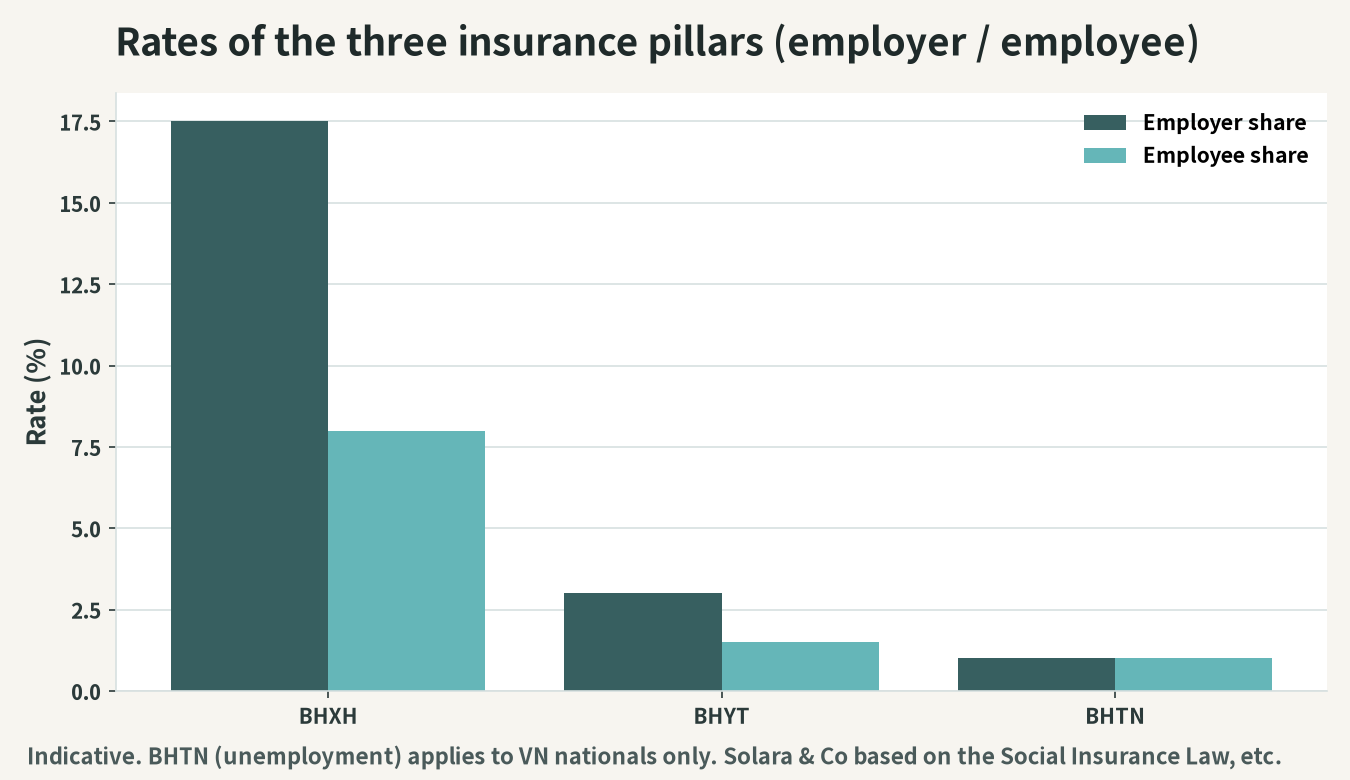
The employer side bears roughly BHXH about 17.5% + BHYT 3% + BHTN 1% = about 21.5% in total, and the employee side bears BHXH 8% + BHYT 1.5% + BHTN 1% = 10.5% in total. Unemployment insurance (BHTN) applies only to Vietnamese employees and not to foreigners. In addition, the employer separately contributes a trade-union fee (KPCĐ), in principle 2%.
The Employer's Share and the Employee's Share
The table below organizes the rates of the three pillars, split into the employer's share and the employee's share. The total burden (over 30% of salary) is a level that must always be factored in when estimating labor costs.
Insurance type | Employer's share | Employee's share | Coverage |
|---|---|---|---|
Social insurance (BHXH) | About 17.5% | 8% | Vietnamese; certain foreigners |
Health insurance (BHYT) | 3% | 1.5% | Vietnamese; certain foreigners |
Unemployment insurance (BHTN) | 1% | 1% | Vietnamese only |
Subtotal (3 social-insurance pillars) | About 21.5% | 10.5% | — |
Trade-union fee (KPCĐ) | 2% | — | Employer contribution |
The Calculation Base and Caps for Contributions
Allowances Included In and Excluded From the Calculation Base
Social insurance contributions take as their calculation base not "gross pay" but the contractual base salary plus certain fixed, continuing allowances such as job allowances and position allowances. By contrast, performance-linked bonuses; subsidies for meals, transport, communications, and housing; and temporary or welfare-type payments such as for marriage or condolences can be excluded from the calculation base if the requirements are met. Because what is included in the calculation base changes the contributions for both the company and the individual, a key practical point is to organize the classification of allowances at the salary-table design stage.
The Caps for BHXH and BHYT and the Cap for BHTN
The calculation base has caps. For BHXH and BHYT, the cap on the monthly calculation base is 20 times the "base salary (lương cơ sở)." For unemployment insurance (BHTN), by contrast, the cap is 20 times the regional minimum wage—note that the two are based on different standards. For high earners the calculation base is capped, so multiplying the face salary directly would overstate the contributions. Because these base amounts change with legal revisions, at the time of a revision you must remember to reflect not only the rates but also the updated cap amounts.
Social Insurance for Foreigners (Expatriates)
Mandatory Enrollment Since Decree 143/2018
Foreigners were once outside the scope of social insurance, but under Decree 143/2018/ND-CP, foreign workers who meet certain requirements also became subject to mandatory enrollment. Those covered are foreigners who have obtained a work permit (or a practice certificate/license) in Vietnam and have concluded an employment contract of one year or more with a local company. Foreigners enroll in BHXH (a prescribed scope centered on the retirement and death portions) and BHYT, and are not subject to unemployment insurance (BHTN). Work-permit and visa procedures are covered in detail in The Practice of Work Visas and Work Permits in Vietnam.
The Treatment of Intra-Corporate Transferees (ICT)
Among foreigners, expatriates dispatched from a parent company to the Vietnamese entity as an intra-corporate transfer (ICT) may have a different social-insurance treatment from ordinary locally hired foreigners. Because whether an enrollment obligation exists varies with the contract form, the basis of the dispatch, whether retirement age has been reached, and so on, you must confirm the working arrangement of each expatriate before determining whether enrollment is required. Consistency with cases where the person continues to be enrolled in social security in their home country is also an issue.
The Withholding of Personal Income Tax (PIT)
The Resident/Non-Resident Determination and Tax Rates
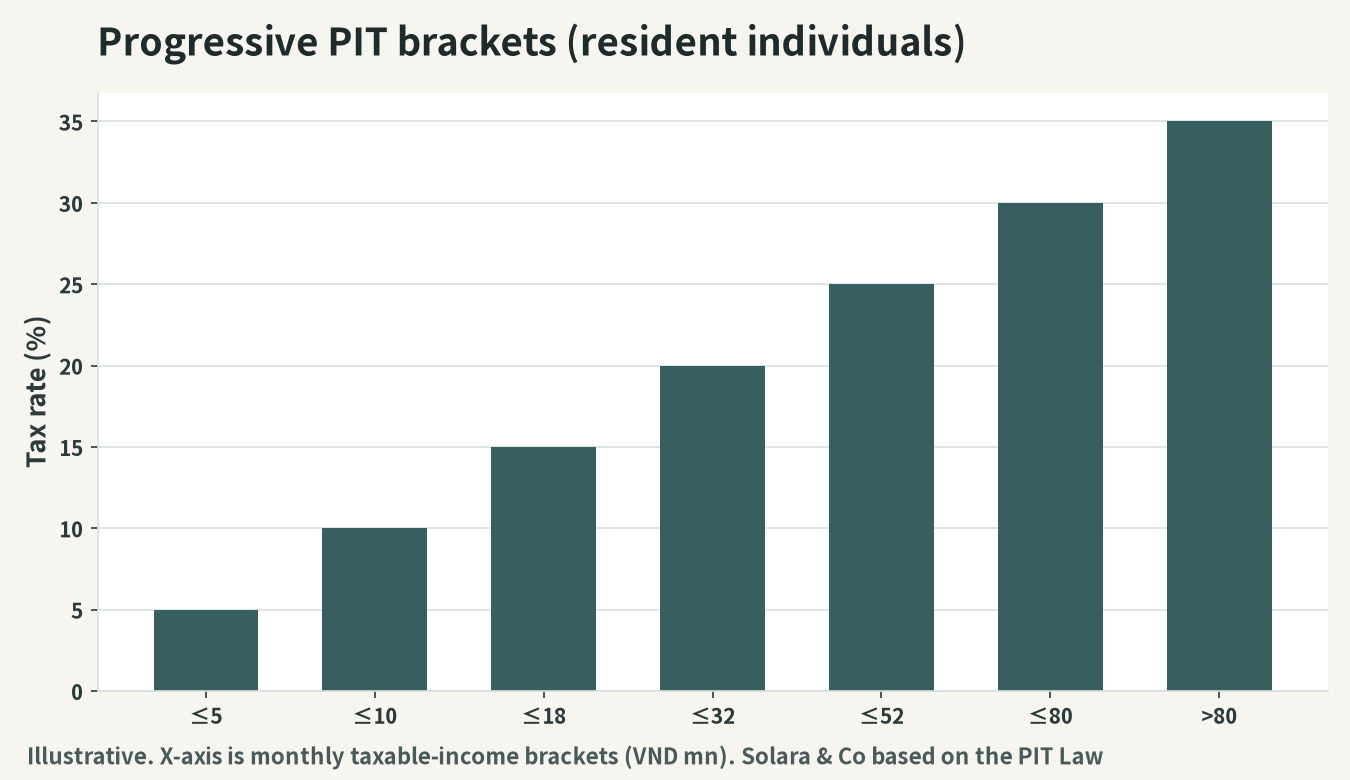
Personal income tax differs greatly in its method of taxation depending on whether someone is a resident or a non-resident. The core of the determination is the "183-day test": one becomes a resident if requirements such as being present in Vietnam for 183 days or more within a calendar year, or within 12 consecutive months from entry, are met. A resident's employment income is taxed at progressive rates from 5% to 35%, while a non-resident is subject to a flat 20% tax on Vietnam-source employment income. Because an expatriate is treated as a non-resident in the first year of assignment and becomes a resident from the following year, such switching makes year-by-year determination management essential.
Deductions and Monthly Withholding / Annual Finalization
A resident is allowed a personal deduction of VND 11 million per month and a dependent deduction of VND 4.4 million per month per dependent (the dependent deduction is premised on a registration procedure). The company withholds and remits personal income tax at each monthly salary payment, and at year-end or the following year performs an annual finalization (corresponding to the final tax return / year-end adjustment) to settle any excess or shortfall. Because the taxable/non-taxable classification of bonuses and various allowances, and omissions in registering dependent deductions, directly lead to back-assessment or refund at the annual finalization, it is important to manage accurately from the monthly stage. Issues specific to expatriates are explored in depth in The Practice of Personal Income Tax for Expatriates.
The Regional Minimum Wage and the Business Custom of the Tet Bonus
The Minimum Wage of the Four Regions
Vietnam's minimum wage is not uniform nationwide but is set in four classifications, from Region I to Region IV, according to the level of economic development. The central areas of Ho Chi Minh City and Hanoi are in the highest Region I and rural areas are in Region IV, so even for the same role the floor changes by location. The minimum wage also serves as the standard for the cap on the unemployment-insurance calculation base, and it is reviewed every year, so you need to grasp the region where your base is located and the revision schedule.
The Tet Bonus and the 13th-Month Salary
In Vietnam, a bonus paid before the Lunar New Year (Tet), while not a legal obligation, has taken firm root as a strong business custom. Generally many companies pay around one month's salary as a "13th-month salary," and the level of the Tet bonus is directly linked to recruitment and retention. Because being stingy with payment invites turnover and lower morale, the standard approach is to factor it into annual labor costs in advance. On designing the retention rate, please also see The Practice of Recruitment and Retention in Vietnam.
Practical Issues: Digitization, Double Taxation, and Compliance
The Digitization of Filing and Payment
For both social insurance and personal income tax, the digitization of filing and payment is advancing. Social insurance handles the registration and change of enrollees and the filing of contributions through an electronic-filing mechanism, and for tax, electronic filing and electronic payment are the norm. Unless you systematize the preparation of electronic certificates and authority accounts and the management of monthly deadlines, a merely formal delay can give rise to surcharges and penalties.
Expatriates' Double Taxation and Social-Security Agreements
Expatriates face tax and social-insurance issues in both the home country (Japan) and Vietnam. For income tax, double taxation can be adjusted under the Japan-Vietnam tax treaty, but for social security, note that no social-security agreement has entered into force between Japan and Vietnam. Because there is no agreement, the reality is that an expatriate who meets the requirements enrolls in social insurance in Vietnam as well, and a double burden with the home-country system can arise, so how to handle the burden should be agreed in advance when designing the assignment terms.
Compliance Risk
Payroll, social insurance, and tax arise every month, and errors pile up every month too. Misclassifying the calculation base, failing to reflect the caps, omitting a foreigner's enrollment, deficiencies in registering dependent deductions, and missing filing deadlines are all subject to back-assessment or penalties in a later tax or social-insurance inspection. Payroll is an area where building a mechanism to "run it correctly and reliably every month" takes priority even over tax saving. The overall picture of a local entity's governance is organized in The Governance of a Vietnamese Subsidiary.
Solara & Co's Integrated Support — Running Payroll, Social Insurance, and Tax Correctly Every Month
Payroll and social insurance in Vietnam are practical work in which the issues—designing the gross/net contract, the rates of the three pillars together with the calculation base and caps, determining the enrollment of foreign expatriates, the resident determination and the withholding and annual finalization of personal income tax, and the regional minimum wage and Tet bonus—all move simultaneously within the monthly cycle. Precisely because a single design error piles up month after month, the initial institutional design and the systematization of monthly operations become decisively important.
Drawing on knowledge from both the Japanese and Vietnamese sides, Solara & Co provides integrated support—from designing the employment contract and salary table, the social-insurance enrollment procedures and the organization of the calculation base, the determination of expatriates' social insurance and personal income tax, and the monthly payroll, withholding, and electronic filing and payment, through to the annual finalization. With compliance as the foundation, we work alongside you to design labor costs with an eye to recruitment and retention, accompanying you from the early stage of entry through to local operations.