
Vietnamese Customs Clearance Is Won or Lost on "HS Codes and FTAs"
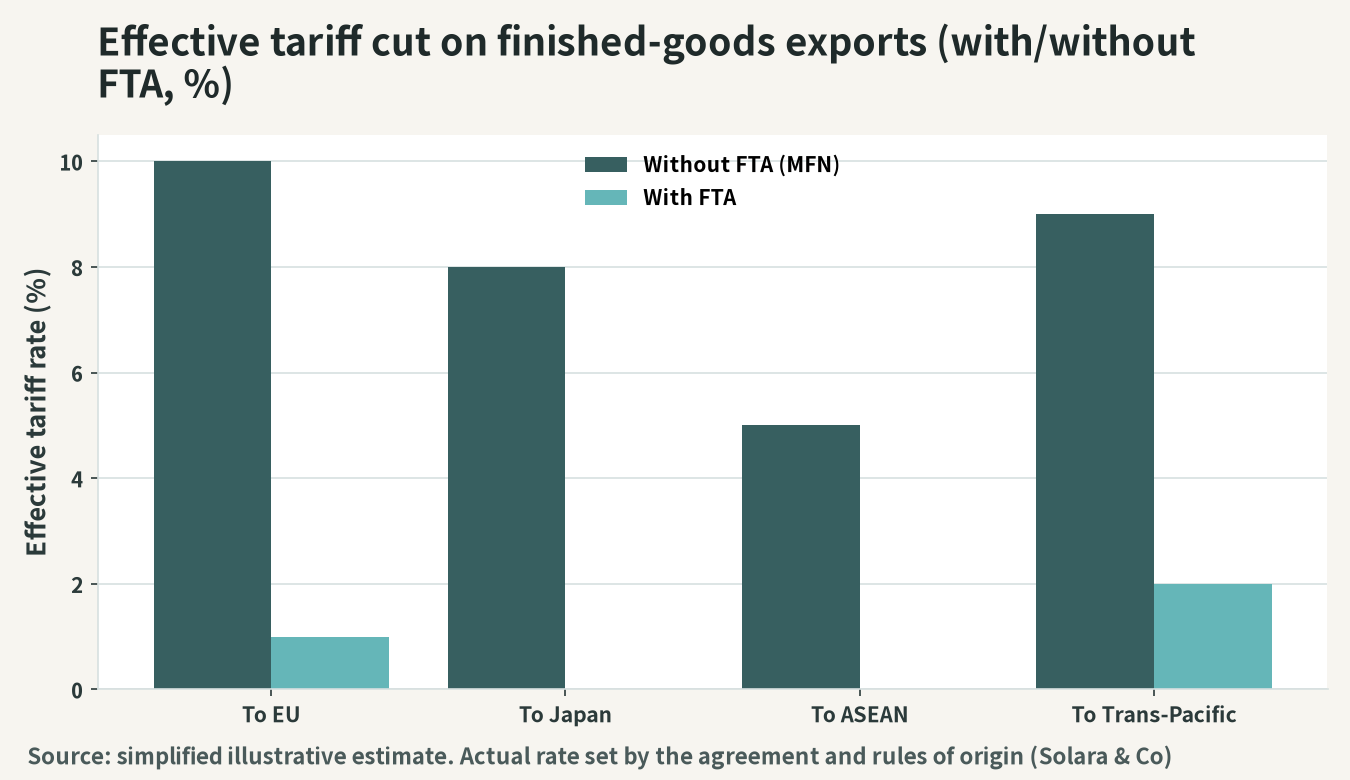
For Japanese companies that use Vietnam as a manufacturing and export base, the practice of customs clearance and tariffs ties directly to cost competitiveness. In a supply chain that imports raw materials and parts and exports finished goods to the world, the burden of tariffs and the speed of clearance govern both profit and lead time. Vietnam is an "FTA powerhouse" bound by numerous FTAs (free trade agreements), and whether or not you can wield them skillfully makes the effective tariff burden on the very same product vary dramatically.
This article organizes the basics of Vietnam's customs system, HS code classification and customs valuation, FTA preferential tariffs and proof of origin, the practice of the electronic clearance system, and the export-processing and bonded mechanisms that are vital to manufacturing.
The Basics of Vietnam's Customs System
Customs clearance in Vietnam is operated on the basis of the Customs Law 2014 (Law No. 54/2014/QH13). Imports and exports involve three elements—classification of goods (HS code), dutiable value (customs valuation), and origin (whether an FTA applies)—and only when these three are correctly aligned is proper and fastest clearance achieved. Conversely, an error in any single one of them invites one of the following: back assessment, clearance delay, or denial of preference.
The Main Tax Items on Imports and Exports
Imports are subject to import duty and import-stage value-added tax (VAT). Some items (resources, environmentally burdensome goods, and the like) also bear export duty or special consumption tax. In manufacturing, the import duty on raw materials and parts, and the treatment at the time of finished-goods export (export processing and bonding, discussed below), form the linchpin of the cost structure.
The Flow and Key Points of Customs Practice
Customs clearance is the work of correctly stacking several elements together. Each of the key points below must be made consistent at every import.
HS Code Classification
Every consignment is identified by an HS code (commodity classification number). Vietnam adopts the ASEAN-common AHTN (ASEAN Harmonized Tariff Nomenclature) and classifies to 8 digits. Because a single difference in how the code is applied to the very same product changes the tax rate, whether an FTA applies, and whether a permit is required, fixing the HS code is the starting point of clearance design. For items where the judgment is in doubt, using an advance ruling can lower the risk of later denial.
Customs Valuation (Dutiable Value)
Duty is, as a rule, calculated using the "transaction value" based on the WTO Valuation Agreement as the dutiable value. In transactions between related parties, the question is whether the price is consistent with the arm's-length price, and this intersects with the topic of transfer pricing. Because misjudging the composition of the dutiable value—such as whether royalties or freight must be added—makes you a target for back assessment, consistency between the invoice and the contract terms is important.
FTA Preferential Tariffs and Proof of Origin
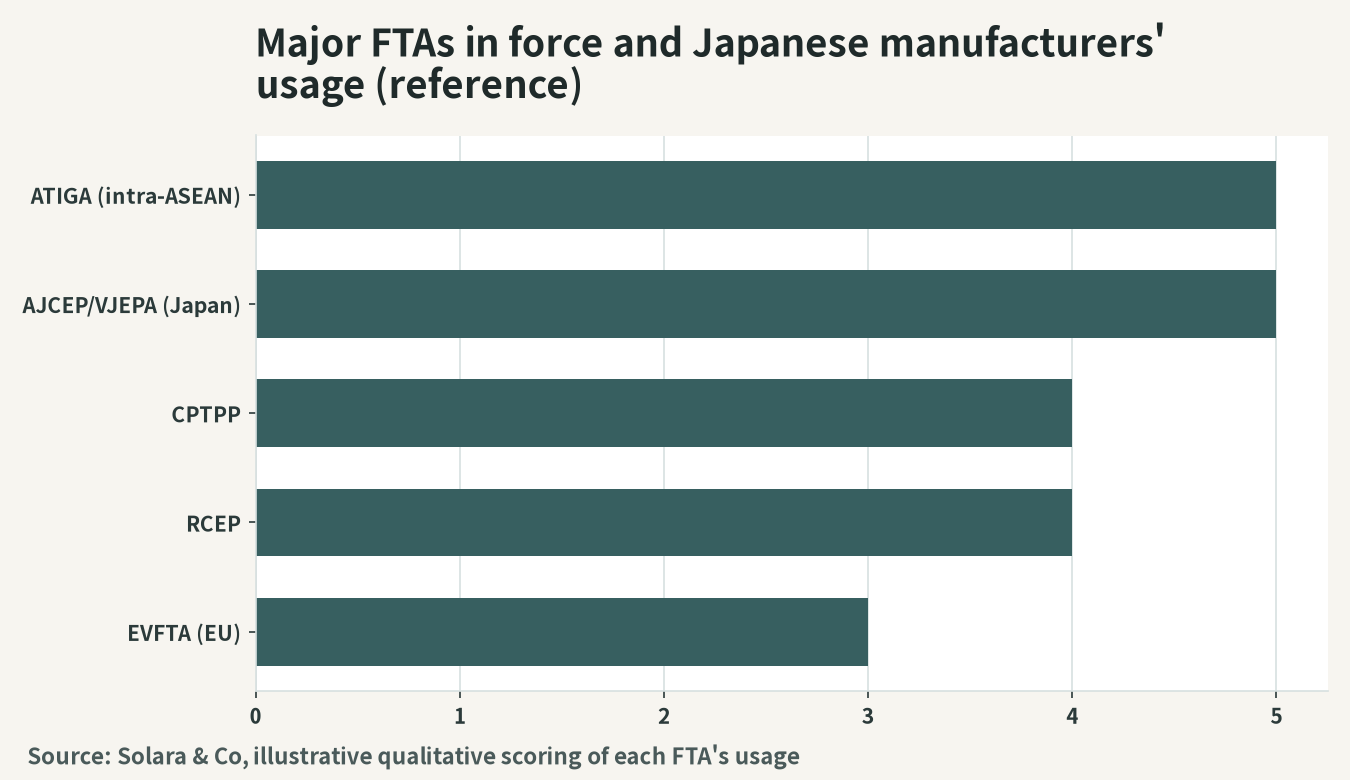
Vietnam is a party to numerous FTAs, including the CPTPP, the EVFTA (FTA with the EU), the RCEP, the ATIGA (within ASEAN), and the VJEPA and AJCEP (EPAs with Japan). Using these can lower the tariff on eligible items substantially—in some cases all the way to zero. The key is satisfying the rules of origin and proving it with a Certificate of Origin (C/O: Form D, EUR.1, self-certification, and others specific to each agreement). If you declare preference without having satisfied the rules of origin, you will face denial and back assessment in a post-clearance audit. Making use of FTAs should be considered as one with the design of the entire supply chain, and it is closely tied to the realignment of supply networks under "China Plus One."
Electronic Clearance (VNACCS/VCIS)
Customs clearance in Vietnam is declared through the electronic clearance system VNACCS/VCIS. Depending on the content of the declaration, the need for document review or physical inspection is sorted into "clearance lanes" (green = immediate clearance, yellow = document review, red = physical inspection). The accuracy and consistency of the declared data and the past compliance record govern inspection frequency and lead time.
Inspection, Permits, and Specialized Management
Depending on the item, in addition to clearance you may need specialized management (quality inspection, conformity to standards, plant quarantine, import permits of the various ministries, and so on). Unless these are advanced in parallel with clearance, the cargo stagnates at the port and demurrage (storage charges) accrues. Checking conditional items also relates to understanding Vietnam's conditional business license system.
The Export-Processing and Bonded Mechanisms Vital to Manufacturing
For manufacturers that use Vietnam as an export base, understanding the systems that structurally lighten the tariff burden is indispensable.
Export Processing Enterprise (EPE)
An Export Processing Enterprise (EPE) is a company that manufactures for the purpose of export, and the import duty and VAT on the raw materials and equipment it imports are, in principle, exempted. It is a special status under which transactions with the Vietnamese domestic market are treated as "imports and exports," suited to manufacturing with a high export ratio. There are also many cases of setting up a dedicated EPE zone within an industrial park, so it is considered as one with site selection.
Bonded Warehouses and Processing Trade
If you use a bonded warehouse, you can store imported cargo while withholding the duty, then route it to re-export or processing. In addition, the scheme of consignment processing (processing trade)—importing raw materials duty-free and re-exporting them after processing—is also effective for the cost optimization of an export-type business. Because these involve both the design of inventory and logistics and tax matters, they are designed from both the supply-chain and tax sides.
Combining Local Procurement (On-Spot) with Bonding
Vietnam has a mechanism of "deemed import-export (on-spot import-export)" that, while being a transaction between domestic companies, is treated as an import and export. For example, when an EPE or a bonded enterprise procures parts from a counterpart within Vietnam, processing this as an import and export can optimize the treatment of duty and VAT. In an export-type manufacturing network, by combining one's own EPE status, bonded warehouses, and deemed import-export, you can structurally hold down the tariff burden from raw-material procurement through to finished-goods export. However, because the procedures and document management become cumbersome, it is important to design by weighing the merits of the system against the operational load. In deemed import-export, having both companies correctly file the corresponding import and export declarations and leave behind reconcilable documents is the premise for avoiding later denial in a post-clearance audit.
Points That Are Easy to Stumble On, and the Post-Clearance Audit
Customs clearance does not end even if it passes at the time of declaration. Customs has the authority to verify the content of the declaration afterward, and a denial here can lead to a large back assessment later.
Preparing for the Post-Clearance Audit (PCA)
Vietnam Customs conducts a post-clearance audit that retroactively verifies the documents and the actual substance of transactions after clearance. The likely targets are HS code classification, the appropriateness of the customs valuation (dutiable value), the satisfaction of the origin requirements for FTA preference, and the grounds for applying tax reductions and exemptions. Several years' worth of imports may be examined together, and if denied, in addition to the differential duty you may also be charged VAT and late-payment interest. Keeping invoices, contracts, remittances, certificates of origin, and inventory records consistently, and maintaining a state in which you can explain the grounds for the declaration at any time, is the greatest defense.
The Pitfalls of the Rules of Origin
The most common reason for the denial of FTA preference is an insufficient understanding of the rules of origin. The rules of origin include the change-in-tariff-classification criterion (CTC), the value-added criterion (regional value content), and specific-processing-operation criteria, and they differ by agreement and by item. Cases of jumping to the conclusion that "because it was assembled in Vietnam it is of Vietnamese origin," when in fact the criterion is not met and the preference is denied in a post-clearance audit, are endless. With agreements where cumulative origin can be utilized, such as the RCEP, the room to secure origin through the design of intra-regional procurement widens, so it is important to be conscious of the rules of origin from the very stage of selecting the supply chain's procurement sources.
Reconciling Related-Party Transactions with Transfer Pricing
For Japanese companies that move raw materials and parts within the group, the customs value at the time of import and the arm's-length price under transfer pricing must be consistent. Because duty increases as the price rises while, for corporate-tax transfer pricing, local profit decreases as the price rises—pressures working in opposite directions—trying to optimize the two separately produces a contradiction. Designing clearance and transfer pricing as one, and holding an explainable basis for the price, is the key to lowering the audit risk on both sides. For details, please refer to Vietnam's transfer pricing taxation.
Comparing the Use of FTAs: An Overview
Organized from the perspectives of the target market and the situations in which Japanese companies make use of them, the features of the main FTAs are as follows. Actual tax rates and rules of origin must be checked precisely for each agreement and item.
FTA | Main target market | Situations of use by Japanese companies |
|---|---|---|
ATIGA | Within ASEAN | Mutual supply of parts and finished goods within the region |
CPTPP | Japan, Canada, Australia, Mexico, etc. | Tariff reduction for exports to the Pacific Rim |
EVFTA | EU | Phased move to zero tariffs for exports to Europe |
RCEP | Japan-China-Korea, ASEAN, etc. | Use of cumulative origin across the wider Asia region |
VJEPA/AJCEP | Japan | Tariff preference between Japan-Vietnam and Japan-ASEAN |
The Practical Points Japanese Companies Should Grasp
First, fixing the HS code is the origin of all clearance design. Because misclassifying the code throws off the tax rate, FTA application, and permits in a chain, you should nail down the main items using an advance ruling as well. Second, an FTA is something that "produces value only once it is put into a usable state." Unless you have a supply-chain design that satisfies the rules of origin and document management including the C/O, you cannot receive preference even with an agreement in place. Third, export-type manufacturing can radically lower its tariff burden by making use of structural systems such as the EPE, bonding, and processing trade. Fourth, because the sorting into clearance lanes is influenced by the compliance record, accumulating accuracy in declarations leads to shortening lead times over the long term.
What is decisive in Vietnam's customs and import-export practice is whether you can optimize the three elements of HS code, customs valuation, and FTAs as one with the design of the entire supply chain. Solara & Co supports everything from the design of commodity classification and the use of FTAs, to the examination of EPE and bonded schemes, to the arrangement of specialized management and permits, with a team well-versed in the trade practice of both the Japanese and Vietnamese sides. From a supply-chain perspective, we propose an optimal clearance and tariff design that raises your company's cost competitiveness by a notch.