
Why "Procurement and Supplier Management" Has Become a Management Issue Right Now
For Japanese companies choosing Vietnam as a base for manufacturing and procurement in the China+1 context, one of the biggest themes is the local sourcing of materials and components—that is, raising local content (the localization ratio). Continuing to rely on imports means perpetually carrying foreign-exchange, logistics, and tariff risks, which dilutes the very point of having gone to the trouble of entering Vietnam. On the other hand, the moment you step into local sourcing, you face the issues peculiar to Vietnam's small and medium-sized suppliers.
Specifically, these are quality variation by lot and by period, opacity of financial information, credit risk as a counterparty, and a lack of traceability for raw materials and processes. Because you cannot presuppose "years of accumulated trust" as in Japan's keiretsu transactions, you need to redesign the entire chain of processes—selection, credit assessment, quality assurance, contracting, and ongoing management—as your own in-house system. This article organizes, from a practical standpoint, everything from procurement strategy to credit management, quality assurance, contracting, and continuous evaluation in Vietnam. For the overall design philosophy of China+1, see also Vietnam's Supply Chain and the China+1 Strategy; for the prerequisites of starting up a factory, see The Practice of Manufacturing and Factory Establishment in Vietnam.
The Reality That Raising the Localization Ratio Confronts You With
Localization looks like the trump card for cutting costs and stabilizing supply, but if the quality, delivery, and creditworthiness of local suppliers do not keep up, it instead invites cost increases in the form of defects, shortages, and bad debts. Rather than chasing the localization ratio as a "target figure" alone, the realistic approach is to raise it in stages according to the actual capability of each supplier.
Procurement Strategy: Avoid Single Sourcing, Discern Make or Buy
Supplier management begins not with selecting individual companies, but with a procurement strategy—the question of "how to buy." If you pile up individual orders while the strategy remains vague, dependence on a particular supplier, or overpriced purchasing, becomes locked in.
Avoiding Single Sourcing and Going Multi-Source
Single sourcing from one company not only forfeits price-negotiating power but also carries the grave risk that if that one company stops, the entire supply stops. For critical materials, the basic measure against supply disruption is, as a rule, to secure multiple suppliers (multi-sourcing) and, even in normal times, to evaluate and cultivate a second and third source.
The Make-or-Buy Decision
What you make in-house and what you buy from outside is decided from the standpoints of core competence, return on investment, and the difficulty of quality control. The basic division is to keep processes directly tied to quality or intellectual property in-house, while procuring general-purpose materials externally to lower procurement costs. In Vietnam, the threshold for in-house production should be reviewed periodically in light of labor-cost and capital-investment levels.
Balancing VA/VE Against Localization Targets
Cost reduction that involves design changes (VA/VE), and local substitution of imported materials, are effective means of cutting costs. However, rushing the localization target figure too fast can mean entrusting critical materials to suppliers that lack the capability. The standard approach is to balance cost against quality and supply stability, and to advance the transfer in stages, starting from prototyping and small lots.
Supplier Selection Criteria: Add Business Stability and Compliance to QCD
In developing new suppliers, it is important to put the evaluation criteria in writing and not rely on person-dependent judgment. If the criteria are vague, you end up selecting on price alone, only for quality, delivery, and credit problems to erupt later.
QCD (Quality, Cost, Delivery) as the Foundation
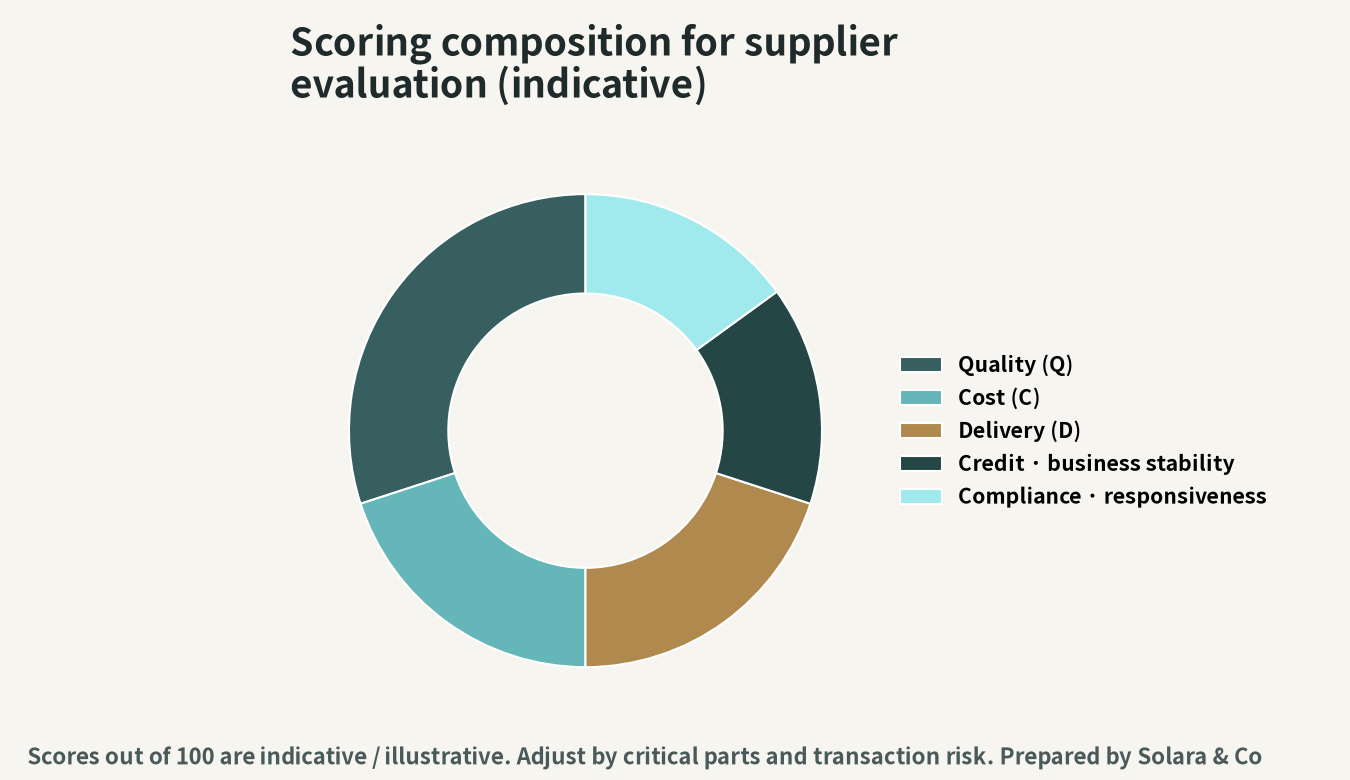
The foundation of evaluation is QCD: Quality, Cost, and Delivery. Quality is viewed through defect rates and process capability; cost is not just price but total procurement cost (including logistics, inventory, and defect handling); delivery is measured by the compliance rate and the stability of lead time. The perspective of comparing on the "total cost" you pay continuously, rather than on a one-off quoted price, is indispensable.
Business Stability, Compliance, and Responsiveness
In addition to QCD, add to the evaluation axes business stability (finances and credit), compliance (risks around labor, the environment, safety, and bribery), and responsiveness (technical support and communication when trouble arises). In particular, legal violations of environmental or labor law spill over to your own company through operational suspensions and reputational risk. On the angle of internal control, Internal Control and Fraud Prevention in Vietnam is also a useful reference.
Credit Assessment and Credit Investigation: Measure a Supplier's "Stamina" Before Trading
In transactions with Vietnam's small and medium-sized suppliers, credit management is as important as quality. There are many situations where prepayment is demanded, so if you misjudge a counterparty's financial stamina, the loss materializes as an irrecoverable prepayment or a supply disruption.
Checking the Enterprise Registration Certificate (ERC) and Financial Statements
First, check the legal personality, business scope, charter capital, and legal representative on the Enterprise Registration Certificate (ERC). Reconciling actual existence with the registered business scope is a basic check. Next come the financial statements, but at Vietnamese SMEs these are often hard to obtain, and even when obtained their accuracy is frequently an issue. The realistic approach is to read the trends in revenue and profit, equity, and the borrowing situation, and to supplement the numbers with on-site verification.
Using Credit Investigation Firms and Designing Trading Terms
When you cannot fully grasp the actual state on your own, use reports from local credit investigation firms to supplement registration information, finances, litigation, the presence of payment delays, and the like. On that basis, design the trading terms (prepayment ratio, credit line, collateral, payment terms) according to the counterparty's risk, and set a credit limit for each supplier. Anticipating risks such as bankruptcy, a midnight flit, and resale (diversion of received materials or prepayments), measures such as paying prepayments in small increments tied to output or delivery are effective. For the practice of settlement and remittance, please also refer to Bank Accounts and Overseas Remittance in Vietnam.
Levels of Credit Risk and the Response to Each
Credit risk is not uniform; if you classify it into levels by the counterparty's financial stamina and the importance of the transaction, and set a response policy for each, your judgments will not waver.
Credit risk level | Supplier's condition | Guideline trading terms | Monitoring |
|---|---|---|---|
Low risk | Financial disclosure available, consistently profitable, sufficient track record | Grant normal payment terms and credit line | Annual periodic review |
Medium risk | Finances partly opaque, shallow track record | Restrict credit line, consider partial prepayment / collateral | Semiannual; monitor delivery compliance |
High risk | Finances opaque, signs of losses or delays | Raise prepayment ratio, secure an alternative source | Quarterly; enforce payment on output |
Trading on hold | Doubts about actual existence or registration information | Decline to trade, reassess after remediation | Halt orders until re-investigation |
Quality Assurance: From Incoming Inspection to Process Audits and Corrective Action
Quality variation is the problem most likely to surface in local sourcing. You build multi-layered quality assurance on the idea of not only "screening out defects through inspection" but also stabilizing the supplier's process itself.
Incoming Inspection (IQC) and Initial-Flow Control
Delivered materials are judged pass/fail by incoming inspection (IQC). Right after a transaction begins or right after a specification change is a start-up period prone to defects, so reinforce initial-flow control and catch problems early with full inspection or a raised sampling rate. Sharing the inspection criteria (limit samples, tolerance values) with the supplier in advance prevents discrepancies in understanding.
Process Audits, On-Site Audits, and Corrective Action (CAPA)
Incoming inspection alone does not reveal why defects occur. Go out to the supplier's site and audit the state of 5S, process capability, the management of equipment and jigs, and the presence of work standards. If a problem is found, demand corrective action (CAPA) that includes root-cause analysis and recurrence prevention, and follow up on its implementation. For critical materials, also consider using an independent third-party inspection body and securing traceability back to the lot and origin of the raw materials.
Contracting: Lock Down Quality, Inspection, Delivery, and IP in Writing
Trading on the basis of verbal agreement or a purchase order alone leads to a "he-said, she-said" when trouble arises, weakening your position. The more important the transaction, the more clarifying the locus of quality and responsibility in a contract ultimately protects both parties.
Quality Clauses, Inspection Standards, and Penalties
In the contract, set out concretely the quality standards and inspection method, pass/fail determination, returns/replacement/compensation for defects, and delivery dates and delay penalties. Drilling down even to tolerance values and the concept of the inspection lot, rather than a vague "must be a good product," prevents later disputes.
Intellectual Property, Confidentiality, and Cautions on Vietnamese Contract Practice
When you entrust drawings, molds, or know-how, clearly specify the ownership of intellectual property, confidentiality (NDA), and a prohibition on manufacturing competing products. In Vietnam, the contract needs to be built in line with local contract practice regarding the contract language (the authoritative Vietnamese-language version), the governing law and means of dispute resolution, the handling of seals, and so on. On the design of dispute resolution, Contracts, Dispute Resolution, and Arbitration in Vietnam is also a useful reference.
Ongoing Management: Nurture the Relationship with Evaluation, Rating, and BCP
Supplier management does not end at the conclusion of a contract. It is precisely the continuous evaluation and improvement after a transaction begins that brings stability of quality and supply.
Supplier Evaluation, Rating, and Periodic Audits
Periodically tally the scores for QCD, credit, and compliance, and rank (rate) your suppliers. By placing heavier orders with the top tier and issuing improvement requests or considering alternatives for the bottom tier, you lift the overall level of your supplier base. A risk-based operation that varies audit frequency according to the rating is efficient.
Price Negotiation and BCP (Measures Against Supply Disruption)
Prices should be reviewed periodically in light of market rates, foreign exchange, and the raw-material market. At the same time, as a business continuity plan (BCP) prepared for disasters, bankruptcies, and logistics disruptions, set out alternative suppliers, safety stock, and the criteria for building up inventory of critical materials. Avoiding single sourcing and cultivating a second source even in peacetime is the greatest BCP of all. The overall picture of localization and building in quality is explained in detail in Localization and Quality Control in Vietnam.
Solara & Co's Integrated Support — From Procurement Strategy to Building Credit and Quality Systems
Procurement and supplier management in Vietnam is a process that links multiple fields of expertise: strategy (what to buy and how), selection (QCD and business stability), credit (credit investigation and trading terms), quality assurance (IQC and process audits), contracting, and continuous evaluation. If even one of these is missing, the consequence bounces back as cost in the form of quality defects, bad debts, and supply disruption.
Leveraging bases and networks on both the Japanese and Vietnamese sides, Solara & Co provides integrated support—from designing the procurement strategy, developing local suppliers and building evaluation criteria, conducting credit investigations based on the ERC and finances and setting trading terms, building the systems for incoming inspection and process audits, reviewing contracts including quality and IP clauses, through to operating continuous supplier evaluation and the BCP. From the stage of "we want to increase local sourcing, but we're anxious about quality and credit," we help you stand up your procurement as a system and grow it.