
Understand Vietnam's Distribution Through Its "Dual Structure"
Vietnam's consumer market, against the backdrop of a population of about 100 million and an expanding middle class, is an attractive market for Japanese companies. However, if you enter with the notion that "if you bring in a good product, it will sell," you will be blocked by the wall of distribution. The essence of conquering the Vietnamese market lies, before product strength, in distribution design—through which channel, via whom, and how to sell.
The key to understanding Vietnam's distribution is its dual structure. On one side, modern retail (modern trade: supermarkets, convenience stores, shopping malls, e-commerce) is growing rapidly and increasing its presence in urban areas. On the other side, what still accounts for a large portion of retail sales is traditional retail (traditional trade: mom-and-pop shops, markets, street stalls). These two differ completely in the commercial flow, logistics, transaction terms, and sales promotion required.
This article, after organizing the structure of Vietnam's distribution channels, explains the practice of conquering retail—from selecting a distributor, how to attack modern trade and traditional trade, to the design of pricing and promotion. For the overall market picture, please also refer to The growth of Vietnam's consumer market and Vietnam's retail market 2026.
Modern Trade and Traditional Trade
The Growth of Modern Retail (Modern Trade)
Supermarkets, convenience stores, minimarts, shopping malls, and e-commerce are growing rapidly, centered on urban areas. Modern trade has standardized merchandise management, display, and payment, and on one hand makes it easy for manufacturers to convey their brand and acquire data; on the other, it poses challenges such as the burden of listing fees, shelf fees, and promotion costs, and the negotiation of transaction terms with major chains.
The Depth of Traditional Retail (Traditional Trade)
Countless mom-and-pop shops (small, family-run stores), traditional markets, and street stalls support consumers' daily purchasing across Vietnam, especially in rural and suburban areas. To conquer traditional trade, "broad-area deployment" is needed—riding the multi-tiered distribution network of wholesalers and distributors and getting products to the enormous number of micro-stores. This is a world of commerce entirely different from modern retail.
The Rise of E-Commerce and Live Commerce
Against the backdrop of smartphone penetration, e-commerce, along with social media and live commerce, is growing rapidly. Especially among the young, purchasing originating from social media and selling through live streaming is reaching a scale that cannot be ignored. In channel design, a perspective that does not sever offline and online but grasps them across the board is important. Listing on e-commerce malls, leveraging live commerce, and building a brand on social media have operating know-how and a cost structure different from in-store distribution, so a dedicated operating system or partner becomes necessary. On the other hand, counterfeits and parallel-imported goods tend to circulate online, and managing authenticity and dealing with inter-channel price conflict become challenges.
Regulation of Distribution and Retail Business by Foreign Capital
When a foreign company itself imports, wholesales, or retails in Vietnam, distribution rights and the permits and conditions for opening retail outlets come into play. In particular, the economic needs test (ENT) may apply to opening retail stores, and the choice of business scheme (in-house distribution or via a distributor) is closely tied to regulation as well. For the overall picture of foreign-investment regulation, please refer to Vietnam's foreign-investment regulation and conditional investment fields.
Selecting a Distributor
Because it is not realistic for a foreign manufacturer to build its own nationwide distribution network from scratch in Vietnam, in most cases a distributor is engaged. Choosing a distributor is one of the most important decisions in conquering the Vietnamese market.
Designing for Exclusive or Multiple Distributors
An exclusive contract entrusting the whole country to a single company launches quickly and makes it easy to draw out the partner's seriousness, but on the other hand, success or failure is bound to that single company's ability. The method of using multiple distributors by region and channel is advantageous for dispersing risk and expanding coverage, but management becomes complex and price disruption (price collapse between channels) tends to occur.
Capabilities to Require of a Distributor
Evaluate logistics and warehouse capability, existing access to the target channel, the size of the sales force, financial strength, and the willingness to act in line with the manufacturer's policy. "A major company, so it's safe" is not necessarily true; what matters is whether it is a distributor strong in your product's category. For searching out and assessing distributor candidates, a local network and business matching are effective, and that method is dealt with in A guide to leveraging business matching in Vietnam.
Key Points of the Distributor Contract
Clearly stipulate the territory (region, channel), exclusivity, minimum purchase quantity (minimum), price and margin, the sharing of promotion costs, inventory and returns, the contract term and termination conditions, and restrictions on handling competing products. A vague contract becomes the spark of a dispute after sales grow or when the relationship sours.
Designing How to Attack Each Channel
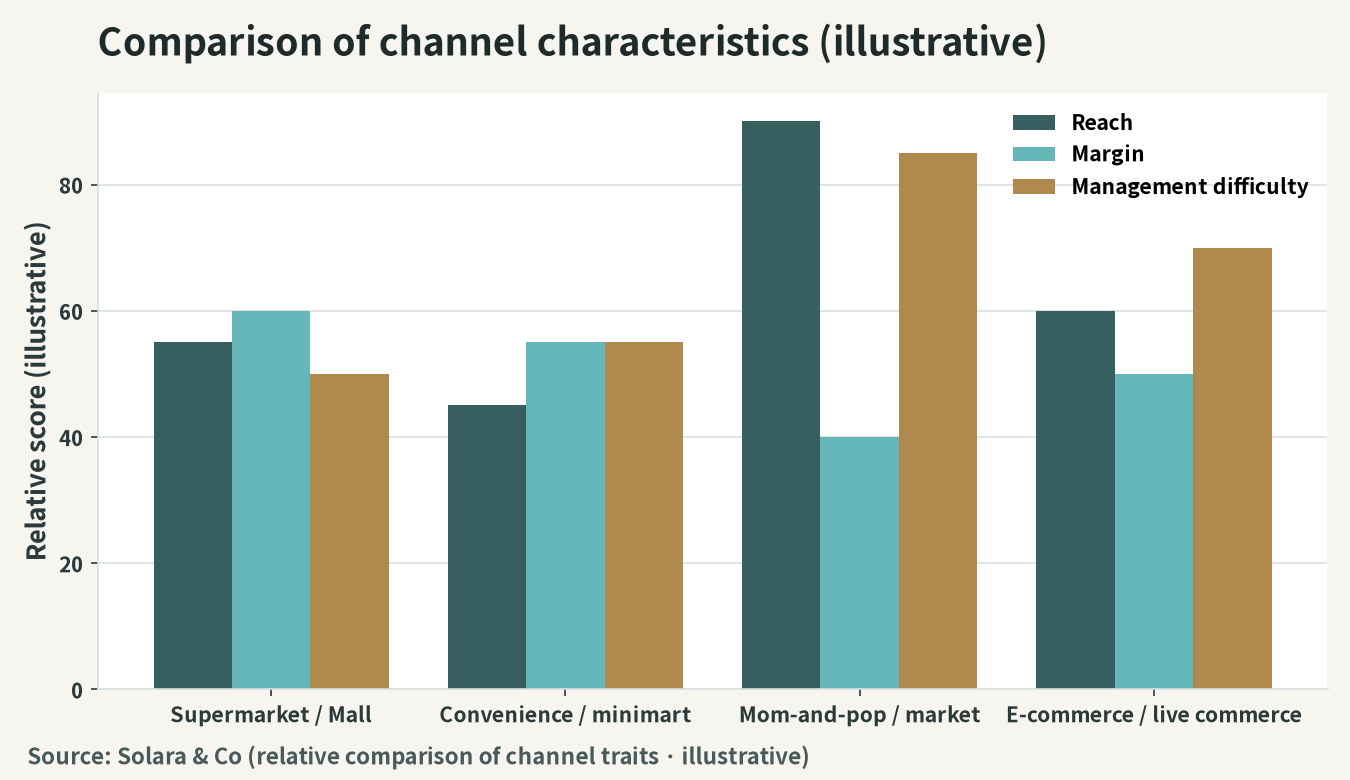
Because channels differ in characteristics, a uniform strategy will not strike home. Tailor the commercial flow, pricing, and promotion separately for each channel.
Channel | Reach | Main challenge | Suitable products and measures |
|---|---|---|---|
Supermarket / mall | Urban, middle class | Shelf fees, transaction terms | Branded goods, experience appeal |
CVS / minimart | Urban, youth | Turnover, downsizing | Ready-to-eat, small packs |
Mom-and-pop / market | Nationwide, rural | Multi-tier distribution, broad-area coverage | Daily necessities, low unit price |
E-commerce / live commerce | Urban, youth | Logistics, authenticity, price | Review appeal, limited editions |
In Modern Trade, "Negotiating Terms" Is the Battle
Transactions with major retail chains are decided by negotiating transaction terms such as listing fees, shelf position, promotion cooperation, and payment terms. Accept too many terms and profitability deteriorates; be too stingy and you cannot secure shelf space. Because major chains have strong bargaining power and tend to present harsh terms to newly entering brands, it is important to prepare data backing up your product's customer-drawing power and differentiation before entering negotiations. Because the length of payment terms is directly tied to working capital, the perspective of viewing profitability across the entire cash flow, not just price, is indispensable.
In Traditional Trade, "Coverage" Is the Battle
The distribution rate to micro-stores (how many stores it is placed in) and visibility at the storefront are the battle. Here, the distributor's sales strength and steady storefront activity are what count. Visiting the enormous number of micro-stores one by one, getting them to place the product, replenishing it, and building relationships with shop owners—the quality and quantity of this steady sales activity (route sales) directly governs traditional-trade sales. Because covering the whole country yourself is unrealistic, riding the sales network of a distributor strong in the region becomes the realistic solution.
Deployment Order Based on Regional Differences
Vietnam differs between north and south in consumption tendencies, income, and distribution structure. Generally, the standard play is a phased deployment: first establish the brand in the modern trade of urban areas with high purchasing power (Ho Chi Minh City, Hanoi), and using awareness as a foothold, broaden coverage to rural areas and traditional trade. Aiming for the whole country and all channels from the start tends to disperse resources and end up half-baked.
Pricing, Promotion, and Brand Building
Pricing and Consistency Between Channels
You need to make the price and margin structures, which differ by channel, consistent as a whole. Inter-channel price conflicts, such as e-commerce discounting inviting price collapse in physical stores, damage the relationship with distributors.
Products and Promotion Adapted to the Local Market
Adjust the package size, price range, taste and specifications, and promotional message to match the income, preferences, and purchase units of Vietnamese consumers. It is not unusual for a hit product in Japan to fail to strike home as is. For example, small-volume, low-unit-price packs matched to a consumption style of frequent single purchases rather than bulk buying, or specification changes adapted to local tastes, greatly govern sales. "Japanese quality" becomes a source of trust, but it does not sell on that alone; the premise is that the price and usability match local life. Confirm the local reality through market research. For how to conduct market research, please refer to How to conduct market research in Vietnam.
Build the Brand Over Time
In Vietnam, trust in a brand is formed through word of mouth, reputation, and actual experience. Relying on a short-term discounting battle damages brand value and risks turning the product into one chosen only on price. A perspective of nurturing the brand over time—through providing trial opportunities, storefront experiences, and reputation-building on social media—leads to sustainable sales.
Where Does Retail Entry Stumble?
The causes of retail entry into Vietnam underperforming concentrate on specific issues.
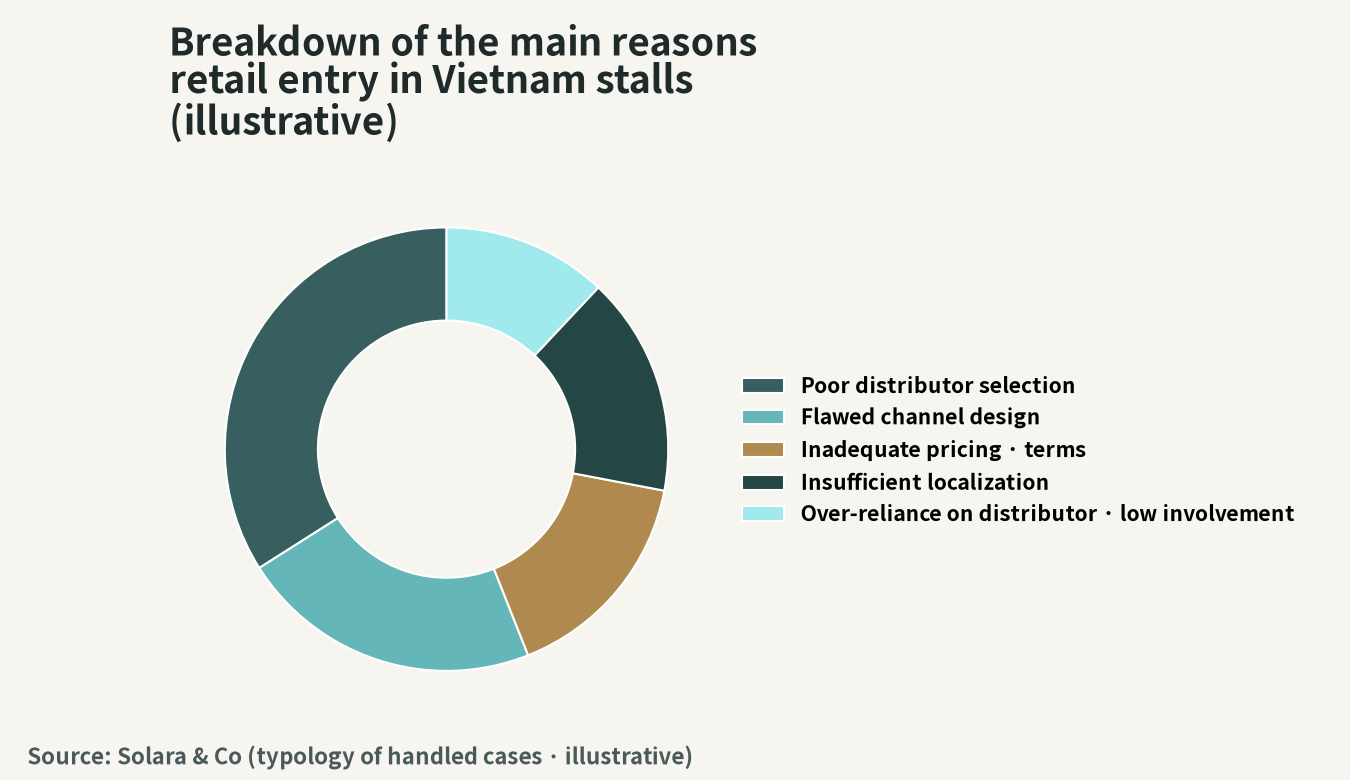
The biggest factor is failure in distributor selection (lack of ability, policy mismatch), followed by errors in channel design, deficiencies in pricing and transaction terms, and lack of local adaptation. All can be greatly reduced through understanding the distribution structure and assessing distributors.
Do Not Leave It All to the Distributor
When you engage a distributor, you tend to leave distribution entirely to them, but this is the typical pattern of underperformance. Periodically grasping data on sales results, inventory, and distribution status, jointly planning promotions, and confirming the storefront reality yourself—a system in which the manufacturer side keeps engaging with the market—draws out the distributor's performance. Not just choosing a good distributor, but how you collaborate after choosing, determines the long-term results.
Solara & Co's Distribution and Retail Conquest Support
Conquering retail in Vietnam is determined, before product strength, by distribution design—"through which channel, via whom, and how to sell." Understanding the dual structure of modern trade and traditional trade, choosing a distributor suited to the objective, tailoring pricing and promotion for each channel, and grasping online and offline across the board—connecting this series of designs in a single line is the condition for conquering the market.
Solara & Co, leveraging its networks on both the Japanese and Vietnamese sides, provides end-to-end support, from designing the channel strategy, searching out distributor candidates, credit investigation, and contract design, to local adaptation of pricing and promotion and verification through market research. To avoid the situation of "a good product that won't sell," we first support you from understanding the channel structure and assessing distributors.