
Don't Proceed on a "Just Set Up a Local Entity" Basis — the Entry Form Binds the Business
The first thing a Japanese company faces once it has decided to enter Vietnam is the choice of "which form to enter with." A representative office, a branch, a local entity (100% foreign-owned), a joint venture (JV), and contract-based partnerships — there are multiple options, and each differs greatly in what it can and cannot legally do, the time and cost of establishment, and the ease of withdrawal. Get this wrong, and you face problems that are hard to reverse: "I want to do business but cannot," "I cannot seize the initiative because of the ownership ratio," or "establishment took far longer than expected."
The choice of entry form is not merely a procedural matter but business strategy itself. The optimal answer changes depending on whether the purpose is market research and information-gathering or a full-fledged business that generates revenue locally, and it is also constrained by how the target industry is treated under foreign-investment regulation (the Law on Investment 2020, the negative list). It must be judged comprehensively, including speed, cost, ease of withdrawal, and the risk of being deemed a permanent establishment (PE) for tax purposes.
This article compares the major entry forms in Vietnam along the axis of what they can and cannot do, then organizes how to choose one suited to your purpose, and a practical strategy for transitioning step by step from a representative office to a local entity.
Representative Office (RO) — the Gateway to Information-Gathering and Relationship-Building
A representative office (RO) is a base placed in Vietnam as a "window" for the parent company back home. Its greatest characteristic is that it has no legal personality and is not an independent business entity, and it is widely used as the lightest first step of entry.
Permitted Activities and Prohibited Acts
What an RO can do is limited to "auxiliary, preparatory" activities such as market research, liaison and coordination between headquarters and Vietnamese business partners, promotion of headquarters' products and services, and supervision of contract performance. Conversely, direct sales and revenue-generating activities — such as concluding sales contracts in its own name, issuing invoices, and receiving consideration — are prohibited. The RO itself cannot carry out profit-generating transactions, and all of its expenses are borne by headquarters. This "prohibition on profit-generating activity" is the essence of the RO, and if you carry out business activities locally while misunderstanding this point, you may be deemed a permanent establishment (PE) for tax purposes, inviting the risk of taxation and corrective measures.
Establishment License and the Chief Representative
To establish an RO, you obtain an establishment License from the competent Department of Industry and Trade. In general, the procedure is lighter than the new establishment of a foreign-invested entity, and the required documents are also limited. The license is valid for five years in principle and can be renewed before expiry. Each RO must have a Chief Representative, who manages the office on behalf of headquarters but does not hold authority to independently conclude transactions beyond the delegation from headquarters. It is a form suited to the stage of "first placing a person to observe the market."
Branch — Practically Difficult to Use for General Business
By Japanese intuition, one tends to think "a branch is easier than a local entity," but in Vietnam the situation differs.
Industries Are Extremely Limited
The branch of a foreign company in Vietnam is severely limited as to the industries in which establishment is permitted — to a few such as banking, insurance, and legal services. For manufacturing or general trading, wholesale, and service businesses to enter in branch form is, in practice, almost never an option. A branch has the appeal of being able to carry out revenue activities as part of the parent company and of having no legal personality, but because the fields that are licensed are narrow in the first place, for many Japanese companies it falls outside the scope of consideration. As a result, the majority of companies aiming for full-fledged, revenue-generating entry will choose the local entity described next.
Local Entity (100% Foreign-Owned / Limited Liability Company) — the Most Common Choice
If you are to conduct full-fledged business and generate revenue locally, establishing a local entity is the basic form. Establishing a wholly foreign-owned enterprise (WFOE) in the form of a limited liability company (LLC, the Limited Liability Company under the Law on Enterprises) is the most common pattern among Japanese companies.
The Two-Step Acquisition of IRC and ERC
The core of establishing a foreign-invested local entity is the procedure of obtaining two documents: the Investment Registration Certificate (IRC) and the Enterprise Registration Certificate (ERC). The IRC is the investment permit meaning "this investment project is approved," and the ERC corresponds to the establishment of the corporation, meaning "this company is registered"; as a rule, you obtain the IRC and then proceed to the ERC. Depending on the industry, it may fall under individual conditional sectors and require additional licenses (sub-licenses).
Freedom of Contribution, Charter Capital, and Business Scope
An LLC is limited-liability up to the amount contributed, confining the parent company's risk to the scope of its contribution. A statutory minimum capital is not set uniformly for many industries, but you must set charter capital commensurate with the business scope applied for and the business plan, and pay it in within the deadline after registration. With 100% foreign ownership, you can fully seize the initiative in decision-making, and the greatest advantage is being able to design profit distribution and governance at your own discretion. The business lines can also be registered in line with your own strategy, so long as they do not conflict with foreign-investment regulation. Establishment takes a certain amount of time and cost, but in terms of stability as a long-term business foundation, it surpasses the other forms.
Joint Venture (JV) — When Local Sales Channels and Licenses Are Needed
A joint venture (JV) is a form in which you establish and operate a local entity jointly with a partner on the Vietnamese side. Amid the principle of 100% foreign ownership, there are clear reasons to deliberately choose a joint venture.
Conditional Sectors with Ownership Caps and the Strength of the Local Side
Depending on the industry, foreign-investment regulation (commitments such as the WTO and CPTPP, and the negative list) imposes a cap on the foreign ownership ratio, and there are fields that cannot be entered except through a joint venture with local capital. Moreover, even where 100% foreign ownership is possible under the regulations, a joint venture is chosen when you wish to take in the sales network, licenses, relationships with the administration, and human resources that a local partner possesses. It can be called a choice of obtaining speed of market entry and local adaptability in exchange for part of the equity.
Risks of Governance, Deadlock, and Exit
On the other hand, a joint venture structurally carries the risk of a clash of interests with the partner. If you misdesign the voting rights corresponding to the ownership ratio, you fall into deadlock in which decision-making stalls on important matters. Conflicts over dividend policy, additional contributions, and management personnel are not rare. Furthermore, unless you arrange in the joint-venture agreement and charter at the time of establishment how to dispose of the equity and withdraw (the exit) when the relationship breaks down, the invested capital becomes effectively frozen. If you choose a joint venture, it is essential to design the voting rights, veto rights, buyout clauses, and deadlock-resolution clauses in detail in advance.
Contract-Based Entry — Distributor, Franchise, BCC
There are also ways to engage with the market without setting up a base. These are a distributorship agreement with a local distributor or agent, a franchise that grants a brand and operating know-how, and a Business Cooperation Contract (BCC) that jointly carries out a business by contract between the parties without newly establishing a corporation.
Lightweight, but the Flip Side Is Initiative and Risk
These access the market without bearing the burden of establishing a base, and withdrawal is also relatively easy. On the other hand, because you depend on the partner for the local business, it is hard to seize the initiative, hard to control the brand and customer information, and your share of the profit is limited — constraints that are the flip side. It is a choice suited to the run-up to full-fledged entry, or to involvement limited to a specific project.
How to Choose an Entry Form — Five Axes of Judgment and a Step-Up Strategy
Organizing the forms above by whether revenue activity is possible, legal personality and liability, the estimated establishment period, and the cases they suit brings the contours of the choice into view.
Entry form | Revenue activity | Legal personality / liability | Estimated establishment period | Suitable cases |
|---|---|---|---|---|
Representative Office (RO) | Not possible (auxiliary/preparatory only) | No legal personality / borne by headquarters | Approx. 4–8 weeks | Market research, information-gathering, relationship-building |
Branch | Possible (industries extremely limited) | No legal personality / parent-company liability | Varies greatly by industry | Only specific industries such as banking and legal |
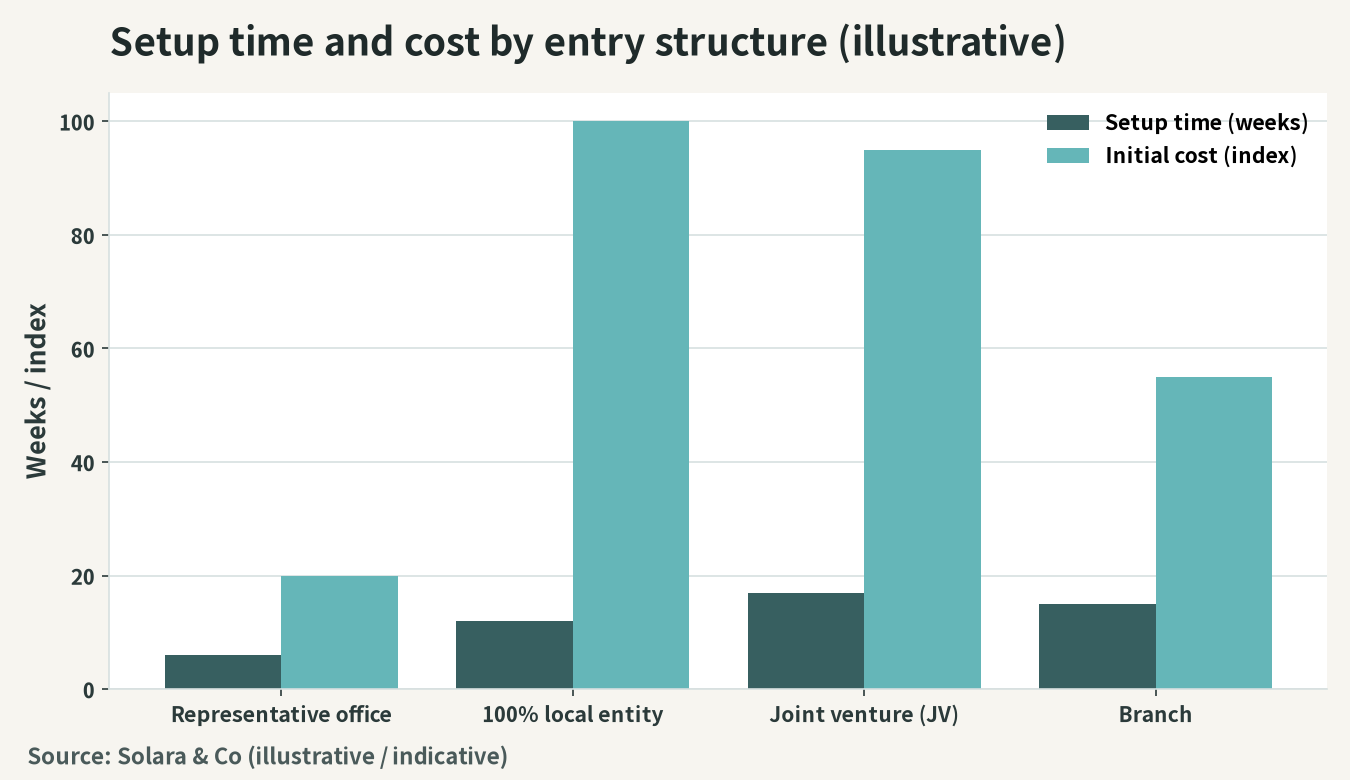
Local entity (100% foreign-owned, LLC) | Possible (high degree of freedom) | Legal personality / limited liability | Approx. 8–16 weeks | The majority of revenue-generating, full-fledged businesses |
Joint Venture (JV) | Possible (according to ownership ratio) | Legal personality / limited liability | Approx. 12–20 weeks + negotiation | Ownership-restricted fields, leveraging local sales channels |
Five Axes of Judgment
The choice is judged comprehensively along the following axes. First, the business purpose — if information-gathering is the main purpose, an RO; if a revenue business, a local entity or JV. Second, foreign-investment regulation — whether the target industry falls under the negative list or an ownership cap. Third, speed and cost — a lightweight RO or contract-based form is fast and cheap, but what it can do is limited. Fourth, ease of withdrawal — an RO or contract-based form is easy to wind down, while a joint venture has a heavy exit design. Fifth, the tax PE risk — note that carrying out substantive business through an RO may be regarded as revenue activity and become subject to taxation.
Stepping Up from RO to Local Entity
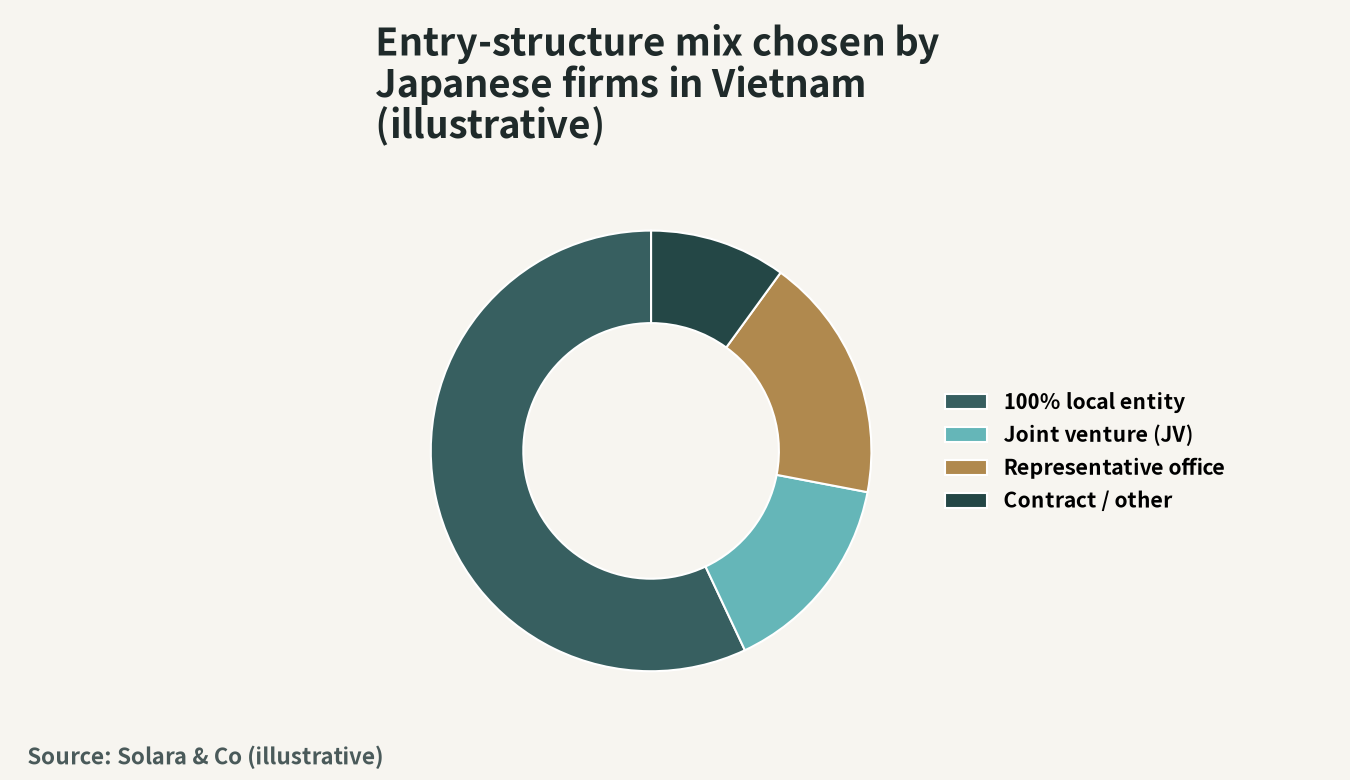
What is effective in practice is a phased entry strategy. First observe the market with an RO, build relationships with business partners, and confirm the prospect of monetization. Once you have a solid feel, establish a local entity and carry over the knowledge and connections accumulated at the RO directly into the business — this step-up raises the certainty of full-fledged entry while keeping initial risk in check. The illustration below shows the sense of the composition of the forms that Japanese companies ultimately choose, reflecting the reality that, as long as the purpose is a revenue business, the 100% local entity makes up the majority.
Solara & Co's Seamless Support — Designing the Form by Working Backward from the Purpose
Choosing a Vietnam entry form is the work of finding the single point that simultaneously satisfies multiple axes — business purpose, foreign-investment regulation, speed, ease of withdrawal, and tax — while "what can and cannot be done" is fixed by law for each form. If you proceed with a Japanese-style sense of a branch or a "just set up a local entity" mindset, you will later be bound by irreversible constraints.
Solara & Co, with bases in both Japan and Vietnam, provides seamless support — from hearing out the entry purpose, checking the foreign-investment regulation of the target industry (the Law on Investment 2020, the negative list), and designing the optimal form, to obtaining the RO establishment license, the IRC/ERC, negotiating the joint-venture agreement, and stepping up from RO to local entity. "Designing the form by working backward from the purpose," rather than moving only after deciding the form, is what divides success and failure in entering Vietnam. We are with you from the very first step.