
Vietnam's environmental regulations have become a precondition for factory operation
For Japanese manufacturers operating factories in Vietnam, environmental regulation is no longer a "nice to have" — it has become a precondition that governs the very question of whether operation is permitted at all. The Law on Environmental Protection 2020 (Law No. 72/2020/QH14, effective 1 January 2022) and its implementing regulation, Decree 08/2022/ND-CP, have restructured the system of environmental impact assessment (EIA) and environmental permits. As a result, unpermitted operation or emissions that exceed the standards now translate directly into the risk of operational shutdown or severe administrative penalties.
This article organizes the overall picture of Vietnam's environmental regulations, the environmental classification of projects, the procedures for environmental impact assessment (EIA) and the environmental permit (GPMT), emission standards and EPR (Extended Producer Responsibility), and the environmental risks that accompany factory operation along with practical responses to them.
The overall picture of Vietnam's environmental regulations
The Law on Environmental Protection 2020 consolidated and integrated the previously fragmented environment-related approvals, redesigning them into a tiered regime calibrated to each project's environmental risk. At its core are the up-front "environmental impact assessment (EIA)" and the pre-operation "environmental permit (GPMT)." The two are linked, requiring companies to manage the environment consistently from the planning stage through to operation.
Environmental classification of projects (Groups I–IV)
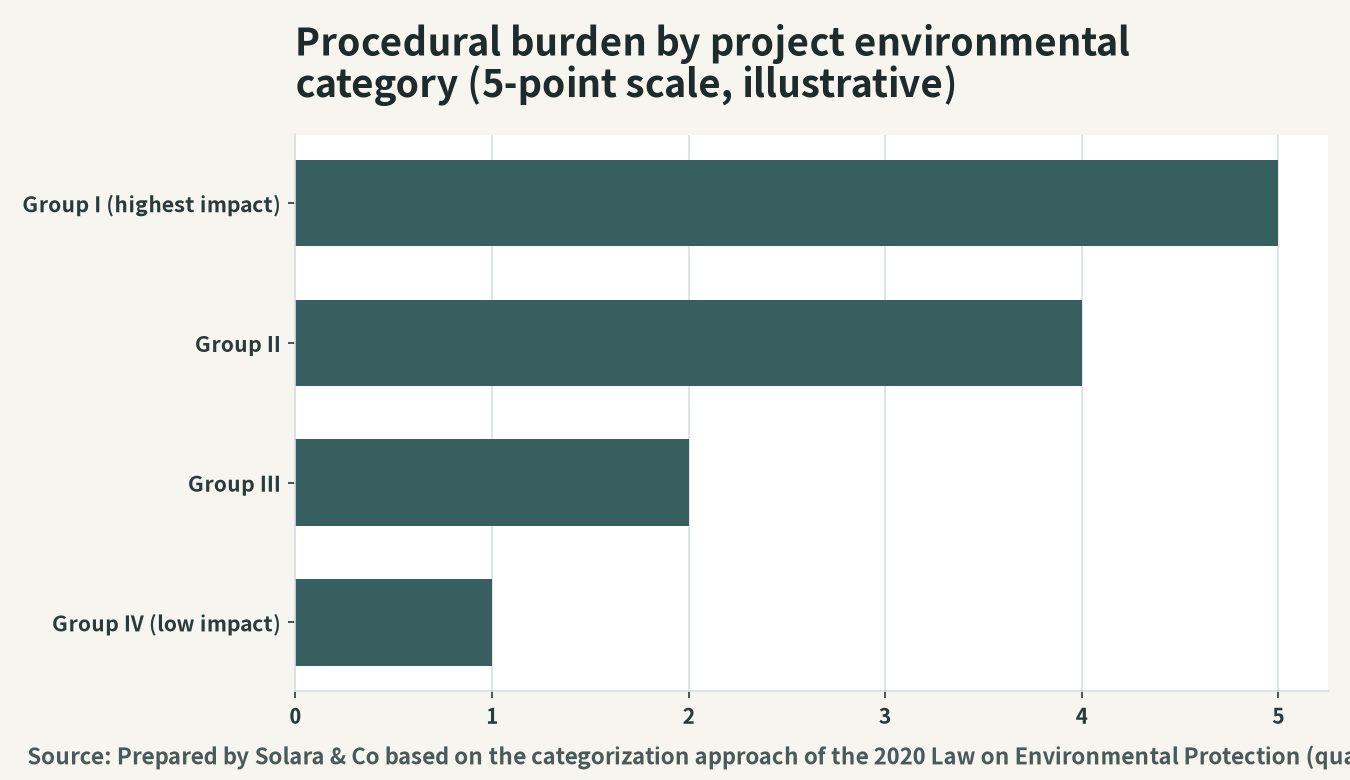
Under the new regime, investment projects are classified into Groups I–IV according to their degree of environmental impact. The higher-impact categories (large-scale manufacturing accompanied by hazardous emissions, etc.) carry heavier EIA and environmental-permit requirements, while lower-impact categories may need only a simple registration. Determining which category a company's project falls into is the starting point that decides the required procedures and the schedule.
The environmental impact assessment (EIA) procedure
The environmental impact assessment (EIA, "ĐTM" in Vietnamese) is a system under which, for projects of a certain scale and nature, the impact of operation on the environment is assessed in advance and the countermeasures are submitted for review and approval by the authorities.
Projects that require an EIA
Manufacturing operations that involve substantial wastewater, exhaust gas, or waste, and large projects involving land preparation, are subject to an EIA. In the EIA, the company sets out estimates of emission sources and volumes, environmental protection measures (wastewater treatment, exhaust-gas countermeasures, waste management), and a monitoring plan, and obtains approval after review by the authorities. If construction or operation begins without approval, the subsequent environmental permit and construction permit both stall, and the entire project grinds to a halt.
Aligning the EIA with the business plan
The content of the EIA is closely tied to the factory's production capacity, equipment, and layout. If production capacity or processes are significantly changed after approval, a re-assessment of the EIA may become necessary. If future expansion or increased output is anticipated, building room for expansion into the EIA stage prevents rework later. The construction-stage procedures should be designed as a single piece with the practice of construction permits and factory construction in Vietnam.
Obtaining the environmental permit (GPMT)
The centerpiece of the Law on Environmental Protection 2020 is the "environmental permit (GPMT: Giấy phép môi trường)," which unified the several previously separate environment-related approvals into one.
The unified environmental permit
Previously, the wastewater discharge permit, waste-treatment confirmation, exhaust-gas confirmation, and others were separate systems, but these have been integrated into the environmental permit. By obtaining this single permit before commencing operation, the company settles the permitted conditions for wastewater, exhaust gas, and waste all together. The permit comes with emission standards, monitoring obligations, and reporting obligations as conditions, and operation that fails to meet these constitutes a violation.
The linkage between the permit and the EIA
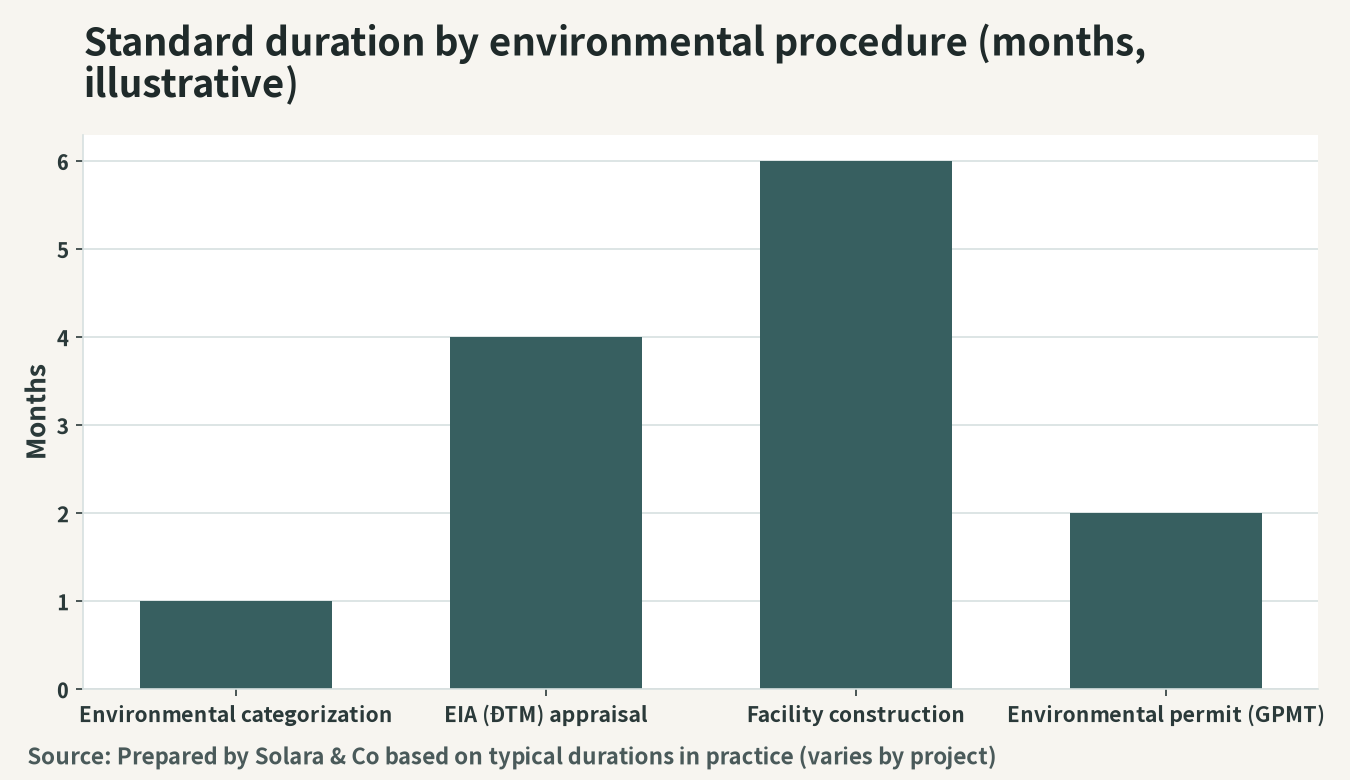
The environmental permit is issued on the premise that the environmental protection measures set out in the EIA have actually been put in place. In other words, the sequence of EIA (planning) → facility installation → environmental permit (pre-operation) → operation (compliance with standards) must be correctly built into the schedule. Because a delay at any single point pushes back the start of operation, this should be managed as the critical path of the approval process.
Emission standards, monitoring, and EPR
Even after operation begins, continuous environmental compliance is required.
Emission standards (QCVN) and monitoring
Wastewater, exhaust gas, noise, and the like are subject to the emission standards set out in Vietnam's National Technical Regulations (QCVN). Companies carry out periodic self-monitoring and reporting to the authorities, and must take corrective action if a standard is exceeded. Exceeding a standard is subject to administrative penalties, and serious or repeated violations can lead to operational shutdown or revocation of the permit. Some facilities are required to install continuous monitoring equipment.
Extended Producer Responsibility (EPR)
The Law on Environmental Protection 2020 introduced Extended Producer Responsibility (EPR). Businesses that manufacture or import certain products and packaging bear responsibility for recycling and waste treatment of those products and packaging after use, and must either carry out recycling themselves or pay a prescribed fee. Makers of consumer goods, food, and electronics that use large amounts of packaging materials need to design their EPR response on both the cost and operational fronts.
Environmental risks of factory operation and practical responses
Environmental regulation is, at one and the same time, both a matter of compliance and a matter of managing business-continuity risk.
The risk of operational shutdown and administrative penalties
Unpermitted operation, emissions that exceed standards, and improper handling of waste can lead not only to administrative fines but also to an order to suspend operations — a sanction that shakes the very foundation of the business. Environmental enforcement in particular has been strengthened in recent years, so one can no longer rely on practices that "have been tacitly tolerated." When acquiring an existing factory through M&A, whether the target company holds an environmental permit, its compliance status with the standards, and any disputes are key items in due diligence. For details, please refer to real estate and factory due diligence in Vietnam.
Demands from ESG and the supply chain
Environmental response, going beyond regulatory compliance, is also tied to ESG demands from global customers and the supply chain. Management systems for emissions, waste, and energy are growing in importance for meeting business partners' procurement standards as well, and have become a management issue that should be grasped as a single piece with Vietnam's green transition and ESG trend.
Relations with the neighborhood and the local community
Environmental risk is tied not only to relations with the authorities but also directly to relations with residents and the local community around the factory. Resident complaints about wastewater, exhaust gas, noise, and odor easily become the trigger for on-site inspections or administrative guidance by the authorities, and once a factory is regarded as one that "causes environmental problems," it becomes difficult to continue operating or to obtain consent for future expansion. Maintaining good relations with the local community through day-to-day monitoring and disclosure of information, and prompt response to complaints, is a foundation of business continuity on a par with regulatory compliance. Investment in the environment should be seen not as a cost but as an up-front investment to maintain the license to operate.
The practice of waste and wastewater management
What is tested day to day at the front line of environmental compliance is the management of waste and wastewater. If operation here is lax, it leads not only to administrative penalties but also directly to a deterioration of relations with the local community.
Waste classification and outsourced treatment
Waste generated by a factory is classified into ordinary waste, industrial waste, and hazardous waste, and hazardous waste in particular is subject to strict management. Companies are required to record generated volumes, comply with storage standards, properly outsource to a licensed treatment contractor, and track the treatment (manifest). It is not uncommon for a company to outsource cheaply to an unlicensed contractor, only for illegal dumping to come to light and the generating company itself to be held responsible. Verifying the license and actual operations of the contractor and keeping records of the treatment are the basics of practice for fulfilling the generator's responsibility.
Wastewater treatment and monitoring
Wastewater discharged from the manufacturing process must be treated to meet the emission standards of the National Technical Regulations (QCVN) before being released. If located within an industrial park, the factory may in some cases be able to connect to the park's central wastewater treatment facility, but there are also many cases where in-house pre-treatment is necessary, so it is important to align the design of treatment capacity with the production plan. Facilities above a certain scale may be required to install continuous wastewater monitoring equipment and to transmit data to the authorities; neglecting this means being unable to objectively prove compliance with the standards, which works against the company at the time of an investigation. The wastewater and exhaust-gas monitoring system is an item that should be reliably stood up before operation begins.
The overall picture of environmental procedures: a comparison table
Organizing the main environmental procedures from the perspectives of purpose, timing, scope, and violation risk gives the following.
Procedure | Purpose | Timing | Main scope |
|---|---|---|---|
Environmental classification | Determines the weight of the procedures | Early planning | All projects |
EIA (ĐTM) | Impact assessment and approval of measures | Before construction | High-impact projects |
Environmental permit (GPMT) | Settles emission conditions all together | Before operation | Facilities with emissions |
QCVN monitoring | Ongoing confirmation of compliance | During operation | Emitting facilities |
EPR | Responsibility for product and packaging recovery | At manufacture/import | Producers of covered products |
Practical points Japanese companies should keep in mind
First, environmental procedures are the "critical path of operation." Unless the flow of environmental classification → EIA → facility installation → environmental permit is built into the investment, construction, and operation schedule from the very start, the start of operation will be delayed. Second, the EIA should be designed with future output increases and expansion in view, because a major change later invites the rework of re-assessment. Third, post-operation compliance with the standards and monitoring and reporting are the lifeline for avoiding administrative penalties and operational shutdown, and one cannot rely on lax past practices. Fourth, in M&A it is essential to thoroughly scrutinize the target company's environmental compliance in due diligence so as not to inherit off-balance-sheet environmental liabilities.
Vietnam's environmental regulations are a precondition for factory operation and, at the same time, a theme positioned at the core of management from the standpoints of business continuity and ESG. Solara & Co supports companies — with a team versed in the practice of both Japan and Vietnam — from determining the environmental classification, to assisting with obtaining the EIA and environmental permit, to building systems to meet emission standards and EPR, all the way to environmental due diligence in M&A. From the planning stage, we help build a foundation on which your factory can operate with confidence on both the licensing and compliance fronts.