
"Not written in the schedule = free" is wrong — the starting point for reading foreign-investment regulation
One of the most frequent questions from Japanese companies considering entry into Vietnam is: "Can this business be done with 100% foreign capital?" Yet the situations in which this question can be answered immediately are surprisingly few. There are fields that are in principle liberalized, such as manufacturing; fields where a cap on the equity ratio, a joint-venture (JV) obligation, or an additional license is imposed, such as retail, logistics, and advertising; and fields not open to foreign investors at all in the first place—because the intensity of regulation differs greatly by industry.
What makes the judgment even harder is that the underlying rules are not a single monolith. Vietnam's foreign-investment regulation builds on a domestic law, the Law on Investment 2020, and layers on top of it the schedule of service commitments at WTO accession (GATS) and the free trade agreements (FTAs) such as the CPTPP, EVFTA, and RCEP. A misunderstanding easily falls here: the reading that "a field not written in the WTO schedule = no restriction = free." The schedule merely indicates "the minimum level of openness Vietnam has committed externally," and a field not written there is rather a domain of "not committed = subject to restriction at the discretion of domestic law"—a point requiring caution.
This article, starting from the framework of the negative-list method of the Law on Investment, systematically explains, from the practitioner's perspective: the procedure for judging foreign capital's market access, the four types of fields, the actual picture of representative restricted industries, the relationship between equity-ratio caps and M&A approval, and the actual way to read the WTO schedule.
The legal framework of Vietnam's foreign-investment regulation — the Law on Investment 2020 and the negative-list method
The first step in understanding Vietnam's foreign-investment regulation is to grasp the "negative-list method (market-access negative list)" adopted by the current Law on Investment (Law on Investment 2020, in force from January 2021). The idea is that, in principle, foreign investors may invest on the same conditions as domestic investors, and only the exceptionally restricted fields are listed and made explicit.
The list structure of prohibited fields and conditional fields
From the standpoint of market access, the Law on Investment manages fields largely through two lists. One is the "prohibited fields (roughly 25 fields in scale)" in which foreign investors are not permitted to participate, including matters related to narcotics, certain hazardous chemicals, endangered species, and trade in human tissue. The other is the "fields with conditional market access (roughly 59 fields in scale)," and falling under these imposes conditions such as a cap on the equity ratio, the form of investment (a JV obligation, etc.), the scope of investment, and the obtaining of a license. These lists are given concrete form by Decree, and because amendments may add or remove fields, it is indispensable to confirm the latest version as of the time of review.
How foreign-investment regulation takes effect in IRC review
When a foreign investor establishes a new business entity, obtaining an Investment Registration Certificate (IRC) is the starting point. In IRC review, where the planned business field is positioned on the negative list is squarely questioned, and if it is a conditional field, whether the requirements for equity ratio, form of investment, and additional licenses can be met is confirmed. In other words, foreign-investment regulation does not stay at the level of abstract rules but operates as a concrete go/no-go judgment at the gateway of IRC review. Misreading this point forces a reconsideration of the plan itself at the very gateway of the establishment procedure.
The procedure for judging foreign capital's market access — the WTO schedule and the FTA top-up
To judge "how far foreign capital can enter this industry," one must overlay multiple sources of law in the correct order. In practice, the standard is to read in three tiers: placing the WTO services schedule as the baseline (floor), factoring in the additional openness from FTAs, and finally making the last confirmation under domestic law.
The WTO services schedule (GATS) is the baseline
At its WTO accession in 2007, Vietnam submitted its level of openness by service field as a Schedule of Specific Commitments. This is the minimum level of openness Vietnam guarantees externally, and it is the starting point when considering whether foreign capital may enter. The schedule records, by field, the cap on the foreign equity ratio, JV obligations, and transitional measures (such as removal of the cap after a certain number of years).
The top-up by the CPTPP, EVFTA, and RCEP and the relationship with domestic law
The WTO schedule reflects the level as of 2007, and the FTAs that came into force thereafter—the CPTPP (Trans-Pacific), EVFTA (EU–Vietnam), RCEP (Regional Comprehensive)—may in certain fields commit openness exceeding the WTO (a top-up). It is important that the applicable level of openness can change depending on which agreement the investor's home country is a party to. However, the final go/no-go is fixed by domestic law (the Law on Investment and its decrees, and the specialized laws by field) reflecting these international commitments. Even where an international commitment promises openness, the procedural and license requirements of domestic law must be met separately; conversely, fields not specified in the schedule are left to the discretion of domestic law.
The four types of fields — liberalized, conditional, restricted, prohibited
In practice, Vietnam's investment fields are easier to see when organized into four types according to the treatment of foreign capital. The table below summarizes the treatment of foreign capital, representative examples, and points to note for each type.
Field type | Treatment of foreign capital | Representative examples | Points to note |
|---|---|---|---|
① Liberalized | Same as domestic; in principle 100% allowed | General manufacturing, software development, many consulting services | Confirm under domestic law even if not in the schedule |
② Conditional | Equity cap, JV obligation, additional license | Distribution/retail (ENT), logistics, advertising, education, real estate | Read alongside specialized laws and license requirements |
③ Restricted / requires review | Case-by-case review; wide authority discretion | Finance such as banking and insurance, transport, some media | Individual approval of the supervisory authority is a prerequisite |
④ Prohibited | Entry not allowed | Narcotics/hazardous chemicals, trade in endangered species, etc. | No exception. Substitute schemes also not allowed |
Conceptual image of the four types
The market-access negative list has a structure that makes prohibited fields and conditional fields explicit and treats everything else as free in principle. To give a rough image of the number of fields, only a limited number are individually enumerated as objects of regulation, while the majority of business activities are in principle open on a par with domestic capital.
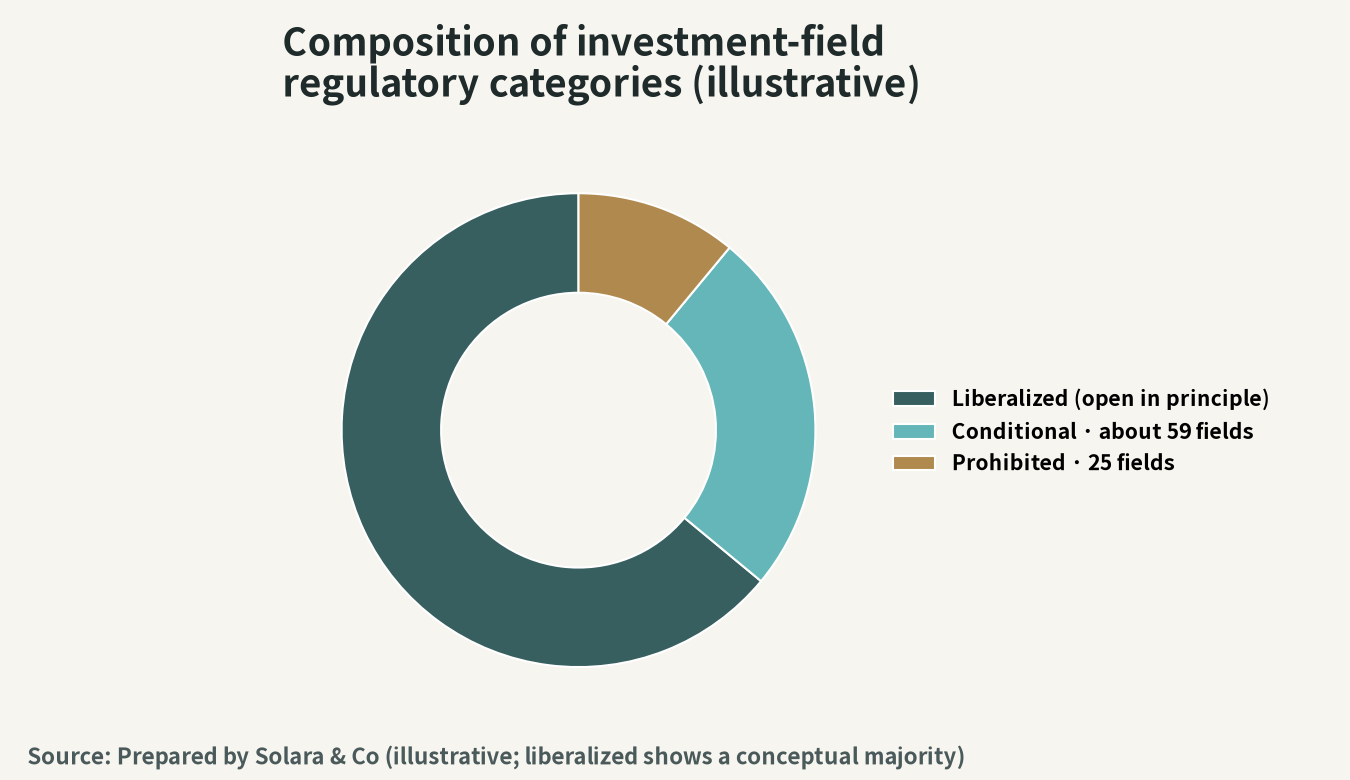
That said, even in a "free in principle" field, the general rules of domestic law—licensing, capital requirements, regional restrictions, and the like—naturally still apply. The point that "liberalized ≠ unconditional" must be grasped together with the points to note discussed below.
The actual picture of representative restricted fields — retail, logistics, advertising, education, real estate, finance, transport
In conditional and restricted fields, each industry has its own issues. Here we take up the representative fields of high interest to Japanese companies.
Distribution/retail and the ENT (Economic Needs Test)
Distribution/retail has become possible at 100% foreign capital in principle, but the opening of outlets from the second one onward may be subject to an "Economic Needs Test (ENT)." The ENT is an individual review by the authorities of population, the density of existing outlets, the stability of the market, and so on, and it becomes a source of uncertainty for outlet-opening plans. For businesses premised on multi-outlet expansion, such as convenience stores and supermarkets, the presence and operation of this ENT governs the business plan.
Logistics, advertising, education, real estate, finance, transport
Logistics has a different level of openness for each subdivided service—warehousing, maritime auxiliary services, and so on—and an equity cap remains in some areas. Advertising is a representative field that in principle requires a joint venture (JV) with a local company. Education (especially pre-school and compulsory-education stages) is subject to strict regulation of curriculum and the ratio of students, and in real estate the scope of foreign capital's business is limited in relation to the land-use-rights system. Finance (banking, insurance, securities) is premised on individual approval by the supervisory authority and strict equity caps, and transport (especially passenger and domestic transport) also retains equity restrictions. These are fields that cannot be lumped together as "conditional" and where reading the specialized laws by industry is indispensable.
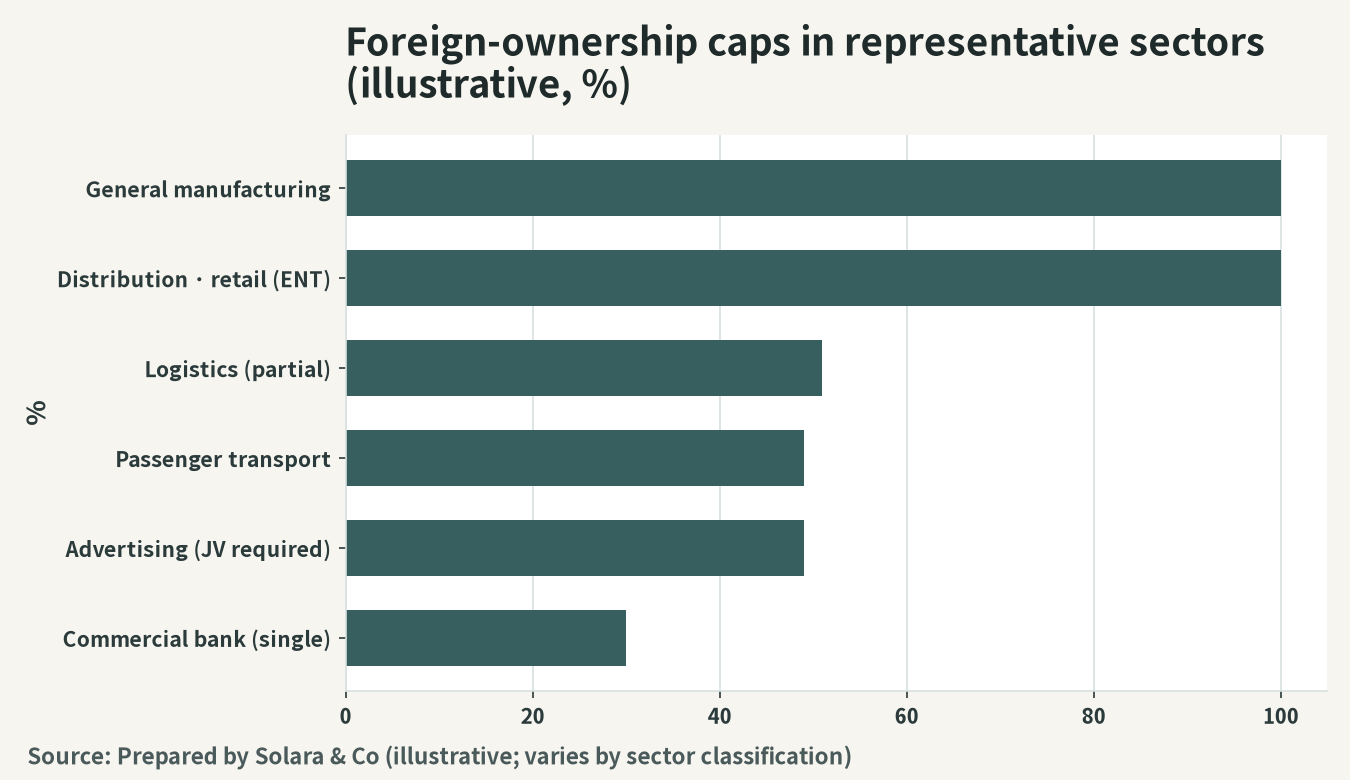
As the image above shows, even within the same "open to foreign capital," the structures one can adopt differ fundamentally between fields where 100% is taken for granted, such as manufacturing, and fields where a strict cap is imposed, such as banking.
The relationship between equity-ratio caps, JV obligations, and M&A approval
Foreign-investment regulation operates by the same logic not only on new establishment (greenfield) but also on the acquisition (M&A) of existing Vietnamese companies. Indeed, in M&A, "up to what percentage of the local company's shares can be acquired" is squarely questioned as a matter of the foreign equity cap.
Confirming the equity cap and JV requirements
In conditional fields, a cap (e.g., 49%, 51%) may be set on the foreign equity ratio, or a JV with a local partner may be obligatory. If an acquisition would cause the foreign ratio to exceed the cap, that transaction either cannot be carried out or requires ingenuity in structure (use of a holding company, staged acquisition, and so on). When the target company holds multiple business licenses together, one must also note that the regulation of the strictest field binds the cap for the whole.
M&A approval (registration/approval of capital contribution and share acquisition)
When a foreign investor makes a capital contribution to or acquires shares in a Vietnamese company, the procedure of "registration of capital contribution and share acquisition (M&A approval)" under the Law on Investment may be required in some cases. In particular, for transactions falling under conditional fields or where the foreign ratio exceeds a certain threshold, registration/approval with the Department of Planning and Investment (DPI) and the like is a prerequisite, and lacking this impairs the validity of the equity transfer and the subsequent registration. The feasibility and schedule of an M&A must be designed with this approval requirement factored in. As for the options for acquisition structure in general, it is effective to consider them together with a comparison of modes of entry.
The actual way to read the WTO schedule — modes 1 to 4 and the limitations columns
Finally, let us organize the essentials for correctly reading, in practice, the WTO services schedule—the baseline of the judgment. The schedule has a distinctive format, and without familiarity one misreads the level of openness.
The division into modes 1 to 4
The GATS divides the form of supplying a service into four modes and sets the committed level for each. Mode 1 (cross-border supply: supply from abroad), Mode 2 (consumption abroad: a consumer receives the service abroad), Mode 3 (commercial presence: supply through the establishment of a local legal entity), and Mode 4 (movement of natural persons: supply accompanied by the movement of people). The most important for foreign capital's entry is Mode 3, where the equity cap and JV obligation are written in. Because the level of openness differs by mode even within the same industry, one must first identify which mode one's own form of supply falls under.
The limitations columns and the interpretation of "Unbound"
The schedule is divided into "market access" and "national treatment" columns, each recording limitations. What frequently appears here is "Unbound (no commitment)" and "None (no restriction)." "None" means a commitment to impose no restriction for that mode, while "Unbound" means "openness is not committed," that is, restriction is possible at the discretion of domestic law. The misreading noted at the outset—"not written in the schedule / Unbound = free"—arises right here. It is safer to read Unbound rather as "may be restricted," and the final confirmation must always return to domestic law.
Solara & Co's end-to-end support — from regulatory judgment to establishment and M&A
Vietnam's foreign-investment regulation is a multilayered structure in which the negative list of the Law on Investment, the WTO schedule, multiple FTAs, and the specialized laws by field overlap. To answer the seemingly simple question "can it be done at 100%," what is required is the reading ability to overlay these in the correct order and translate them into actual procedures such as IRC review and M&A approval. The misreading "not in the schedule = free," or overlooking the regulation of the strictest field, invites a breakdown at the very gateway of the entry plan.
Solara & Co, with bases in both Japan and Vietnam, provides end-to-end support—from confirming the target business's position on the negative list, to identifying the applicable FTA level, designing the equity structure and additional licenses, and executing the procedures for obtaining the IRC and ERC and for M&A approval. Turning a regulatory go/no-go judgment into concrete progress in the form of establishment or acquisition—we will be alongside you from that very first step of verifying "how far this business can actually go with foreign capital."