
Preventing "someone already registered our trademark" when entering Vietnam
A situation Japanese companies entering Vietnam tend to face once they begin operating in earnest on the ground is discovering that "our own brand name or trademark has already been registered by an unrelated third party." Because Vietnam's intellectual property (IP) system applies the "first-to-file principle (whoever files first acquires the right)" to both trademarks and patents, even a brand that is famous in Japan, if left unregistered in Vietnam, runs the risk of having its trademark grabbed by a local third party — leaving the company unable to use it, or pressured to buy it back.
Intellectual property is an intangible asset that carries the core of corporate value — manufacturing technology, consumer-goods brands, software works, and more. Vietnam amended its 2005 Law on Intellectual Property successively in 2009, 2019 and 2022, and the latest amendment that took effect in 2023 advanced its alignment with international standards. This article organizes — from the perspective of Japanese companies — the practicalities of filing and registration, and the methods of actually exercising (enforcing) rights, for each of the four types of rights: trademarks, patents, industrial designs, and copyright.
The overall picture of Vietnam's intellectual property system
Intellectual property in Vietnam is governed by the Law on Intellectual Property (No. 50/2005, with the latest amendment being the 2022 law that took effect in 2023). Industrial property rights (trademarks, patents, designs, etc.) fall under the Intellectual Property Office of Vietnam (IP Vietnam, formerly NOIP), while copyright is administered by the Copyright Office.
Accession to international treaties
Vietnam has acceded to the major international treaties, including the Madrid Protocol on the international registration of trademarks, the Patent Cooperation Treaty (PCT) on international patent applications, and the Hague Agreement on the international registration of designs. This makes it possible, based on an application filed in Japan, to efficiently extend rights to multiple countries including Vietnam via the Madrid or PCT routes.
The four types of rights
Intellectual property rights are divided into several types that differ in their subject matter of protection and method of acquisition. The representative ones are trademarks (brand identifiers), patents (technical inventions), industrial designs (product designs), and copyright (creative expressions), each differing in term of protection, whether registration is required, and whether examination applies. Designing which of your assets to protect, with which right, and to what extent, is the starting point of IP strategy. For example, even a single product is best protected by layering multiple rights: the brand name with a trademark, the internal technology with a patent, the exterior with a design, and the accompanying software with copyright. Conversely, if you neglect to take stock of the assets that need protecting, you will only realize "we hadn't registered any of these rights" after being copied.
Trademarks: the first-to-file principle and brand defense
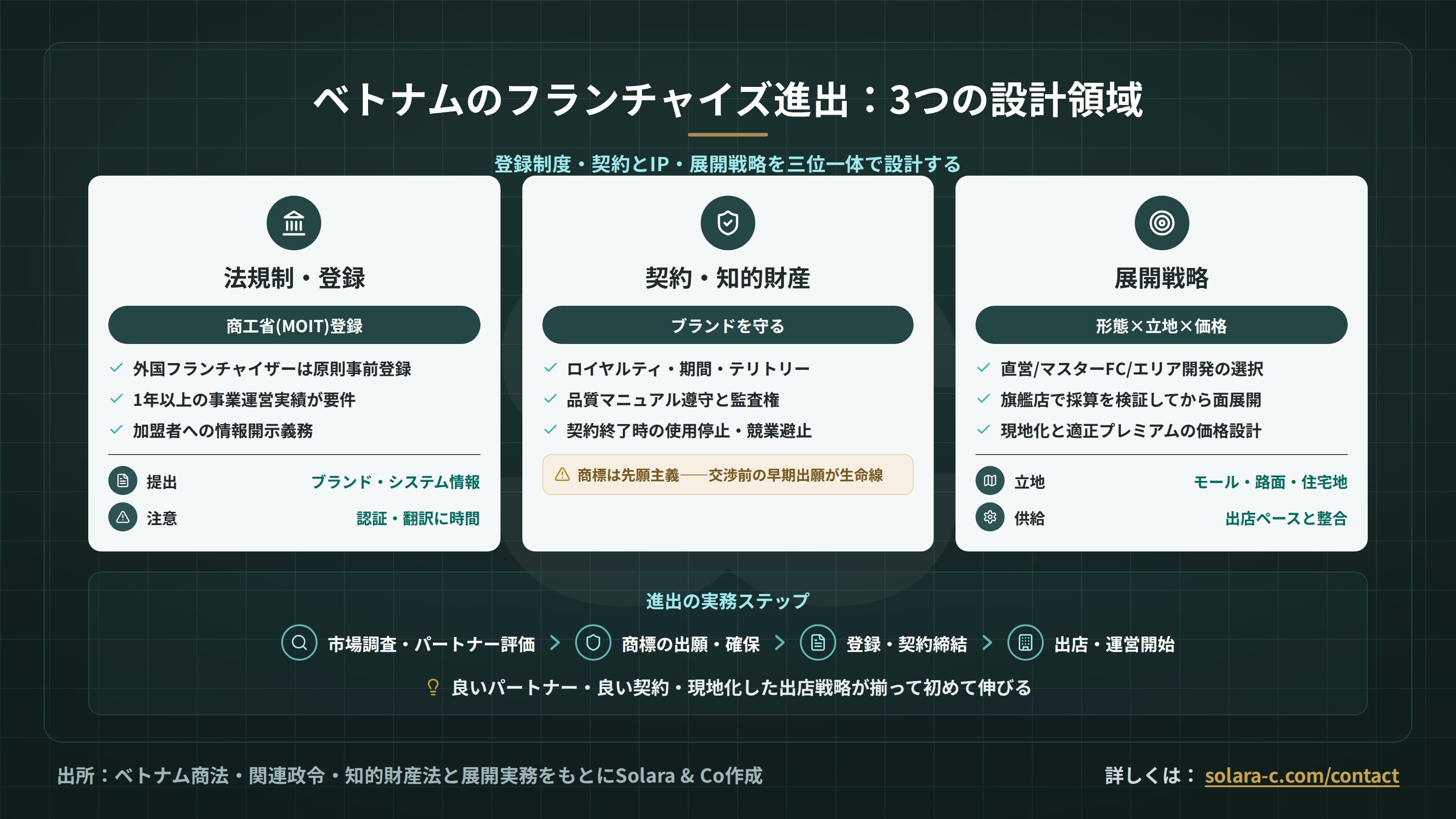
Trademarks are the right that Japanese companies entering Vietnam should secure as the top priority. Because Vietnam follows the first-to-file principle, the rights holder is determined by "who filed first," not "who is using it."
Early filing is the greatest defensive measure
Even if you have established a brand in Japan, if it is unregistered in Vietnam there is a risk of "trademark squatting," where a local third party files for and registers the same trademark. Once registered by someone else, reclaiming it requires opposition, invalidation proceedings, or negotiation, which take enormous time and cost. The greatest defensive measure is to file the trademark in the relevant classes the moment you decide to enter the market — and ideally before putting the product or service on the market.
The path to registration and the term of protection
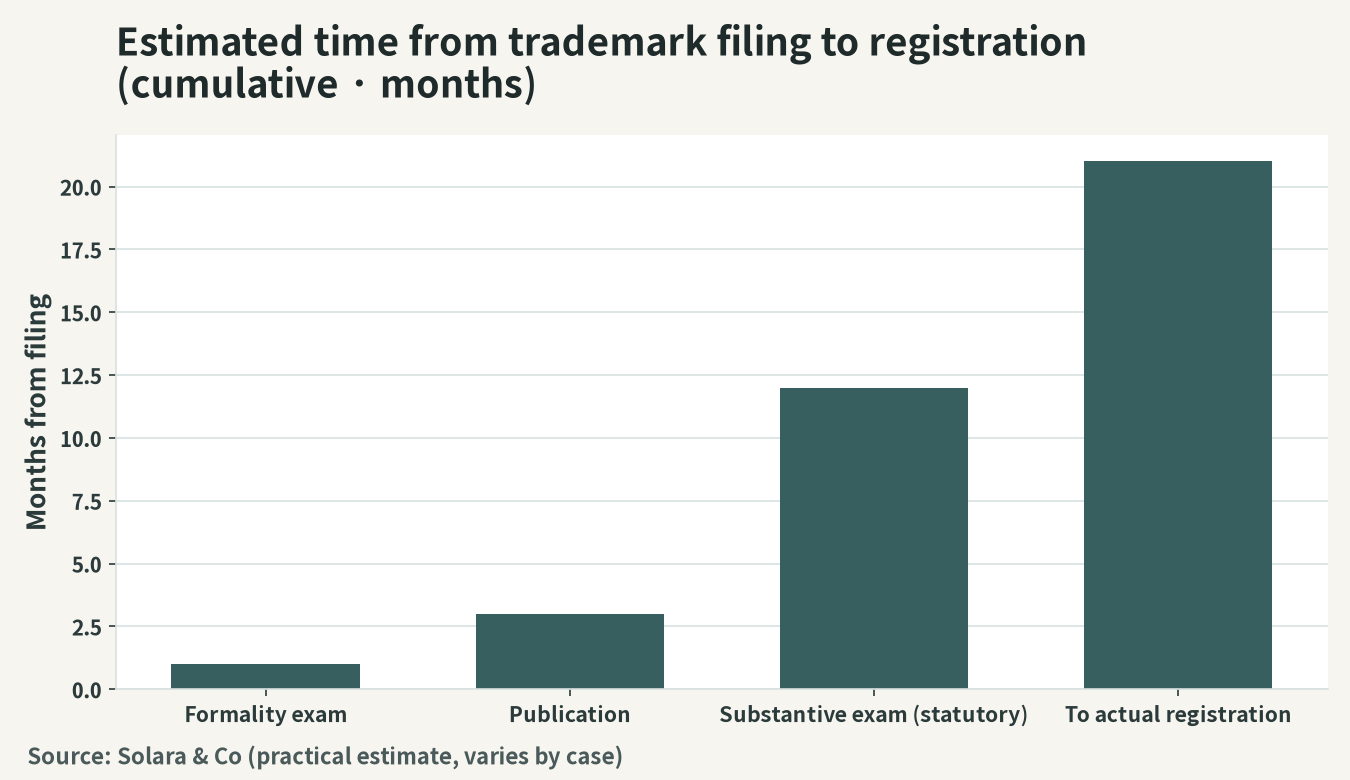
A trademark application undergoes formality examination (about 1 month) followed by substantive examination, and in practice it commonly takes around 18 to 24 months until registration. The term of protection after registration is 10 years from the filing date, renewable every 10 years, and with proper renewal it can be maintained almost indefinitely. Because the way you choose the classes of designated goods and services (the Nice Classification) determines the scope of protection, designing the classes with an eye to future business development is important.
Patents and designs: protecting technology and design
For manufacturers, patents protecting technical inventions and industrial designs protecting a product's exterior are important. Both follow the first-to-file principle, and exclusive rights arise upon registration.
Patents (invention patents and utility solutions)
An invention patent protecting a technical invention has a term of 20 years from the filing date. With requirements of novelty, inventive step, and industrial applicability, it is registered after substantive examination. As a simpler form of protection there is the "utility solution (solution patent)," which has a more relaxed inventive-step requirement and is protected for 10 years. They are used selectively according to the importance and life cycle of the technology. Because disclosing the content before filing causes loss of novelty, managing the timing of filing is essential. An invention filed first in Japan can be extended to Vietnam using the Paris Convention priority right (12 months from the filing date) or the PCT national phase (in principle 30–31 months from the priority date), so managing the deadline for the Vietnam transfer within the overall global filing schedule is important. Note that substantive examination of patents often takes several years, so how to secure protection during the interval until registration also becomes a matter for consideration.
Industrial designs
The exterior design of a product — its shape, pattern, color, and so on — is protected as an industrial design. The term of protection is 5 years from the filing date, renewable twice for a maximum of 15 years. For consumer goods and products with high design value, design rights are a powerful weapon against counterfeits.
Copyright: registration is optional but has real benefits
Creative expressions such as software, manuals, design drawings, and advertising expressions are protected by copyright. Unlike trademarks and patents, copyright arises automatically at the moment of creation, and registration is not a requirement for the right to come into being.
The merits of voluntary registration
That said, Vietnam has a voluntary copyright registration system, and registering provides strong evidence in a dispute of "who created the work and when." Especially for assets whose ownership tends to be contested, such as software and designs, a copyright registration certificate greatly lightens the burden of proof. The term of protection is, in principle, the lifetime of the author plus 50 years after death.
Exercising rights (enforcement)
Even if you register a right, it is meaningless if you cannot actually exercise it against infringement. In Vietnam, infringement can be addressed through four routes: administrative, civil, criminal, and customs.
A system centered on administrative measures
The greatest feature of enforcement in Vietnam is that administrative measures play the central role. Because the Market Surveillance Authority and specialized inspection agencies can carry out administrative actions such as the detection, seizure, and fining of counterfeit goods relatively quickly, it differs from the Japanese sense (which centers on civil litigation). Criminal penalties are provided for serious or repeated infringement, and at the import-export border, customs suspension (border measures) can also be utilized. Civil litigation for damages is possible as well, but considering the burden of proof and time, the practical approach is to combine it with administrative measures. In recent years, the circulation of counterfeit goods through online sales has been increasing, so takedown requests to e-commerce platform operators have also become an important practical tool. Designing operations that flexibly use administrative, customs, civil, and online measures according to the form of infringement enhances the effectiveness of brand defense.
Registration of licenses and technology transfer
When you let a local subsidiary or business partner use your intellectual property in Vietnam, you conclude a license agreement (grant of use) or a technology transfer agreement. For trademark licenses and technology transfer agreements, registration with the Intellectual Property Office is recommended as a condition for enforceability against third parties, and for technology transfer, certain registration or notification under the Law on Technology Transfer may be required in some cases.
The linkage of royalties with transfer pricing and tax
A structure in which the parent company licenses a brand or technology to a local subsidiary and receives royalties is common, but the rate is subject to transfer pricing review. If you cannot explain in documents the actual existence of the benefit and the reasonableness of the royalty rate, there is a risk of disallowed deductions or back taxes. IP strategy must be designed in unison with Vietnam's transfer pricing (TP) regime and taxation at the corporate level.
Practical responses to counterfeits and infringement
In Vietnam, counterfeits still circulate, so for consumer-goods companies that own brands, responding to infringement is a continuing challenge. In practice, you combine grasping infringement through market research, gathering evidence (such as notarized purchases), and filing complaints with administrative authorities or applying for border suspension through customs.
Rights registration is the prerequisite for response
Both administrative measures and customs border measures presuppose, as a condition for response, that you are registered as the rights holder. Even if you discover infringement while unregistered, it is difficult to demand swift administrative action, so firming up your own rights registration in advance determines your responsiveness when the time comes. Looking ahead to infringement response, trademark and design registration should be positioned not as a "cost" but as "insurance."
Comparison of the four types of rights (summary table)
Organizing the main intellectual property rights by subject matter of protection, term of protection, and whether registration is required gives the following.
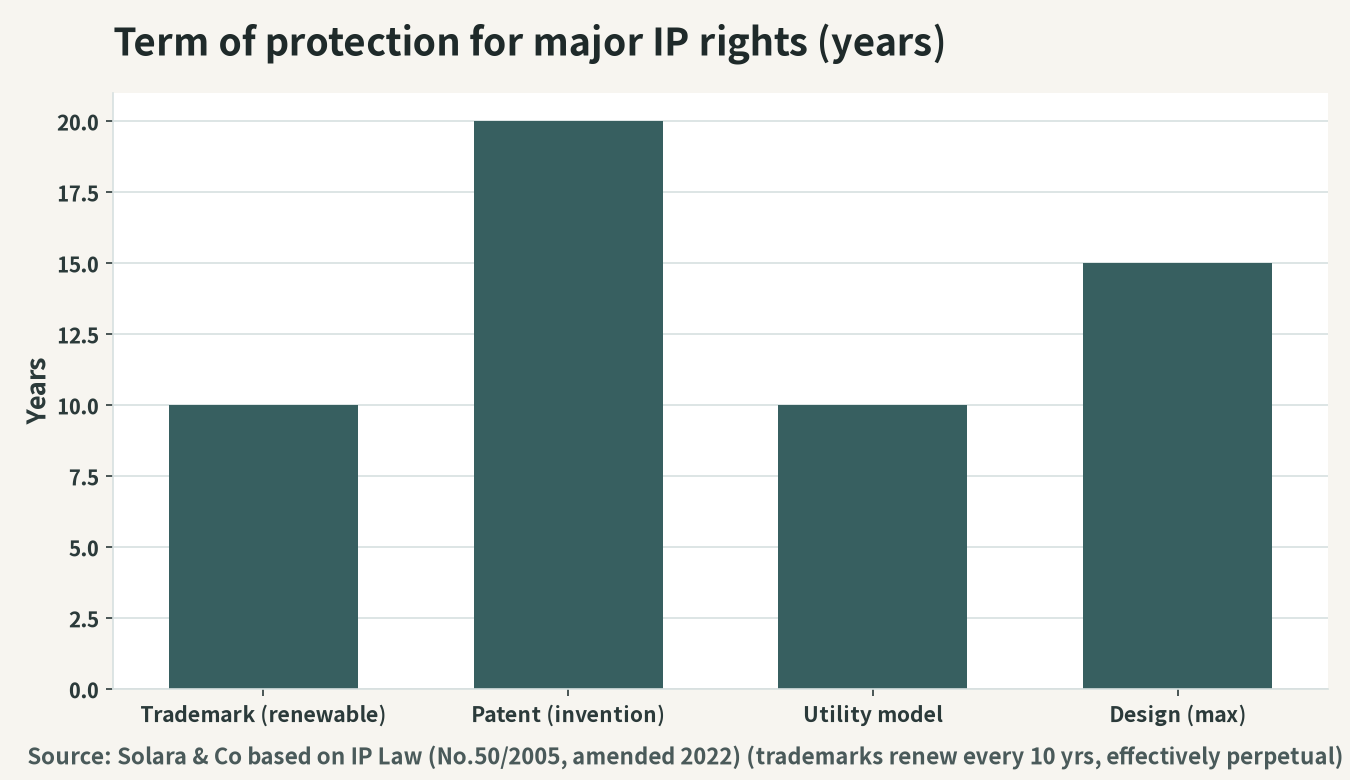
Right | Subject of protection | Term of protection | Registration |
|---|---|---|---|
Trademark | Brand identifier | 10 years (renewable, near-permanent) | Required, first-to-file |
Patent (invention) | Technical invention | 20 years | Required, substantive examination |
Utility solution | Simple technical solution | 10 years | Required |
Industrial design | Product exterior design | 5 years (up to 15 years) | Required, first-to-file |
Copyright | Creative expression | 50 years after the author's death | Optional (enhances evidentiary value) |
The essence of intellectual property protection in Vietnam is to grasp two points: "because of the first-to-file principle, early filing is decisive," and "enforcement centered on administrative measures is effective." File trademarks before entering the market, secure technology with patents and utility solutions, designs with industrial designs, software with copyright registration, and respond swiftly to infringement via the administrative and customs routes — this whole design protects intangible assets in Vietnam. Solara & Co supports, from the perspective of both the Japanese and Vietnamese sides, everything from taking stock of IP at the stage of examining the entry structure, to designing the filing strategy, responding to infringement, and intellectual property due diligence in M&A. Before "panicking after your brand is taken," please consult with us starting from drawing the map of your rights. In any of the manufacturing, consumer-goods, or software sectors, securing rights to trademarks and key technology at the early stage of market entry connects directly to subsequent business expansion and the preservation of brand value.