
"China+1" Is Not Completed by Relocating to Vietnam
The prolongation of US–China confrontation, tariff risk, geopolitical fragmentation, and the fragility of supply chains exposed by the COVID pandemic—against the backdrop of such factors, "China+1," the dispersal of part of production and procurement from China to a third country, has taken root among Japanese companies. Foremost among the destinations is Vietnam. However, the understanding that "if you build a factory in Vietnam, +1 is complete" overlooks a pitfall in practice.
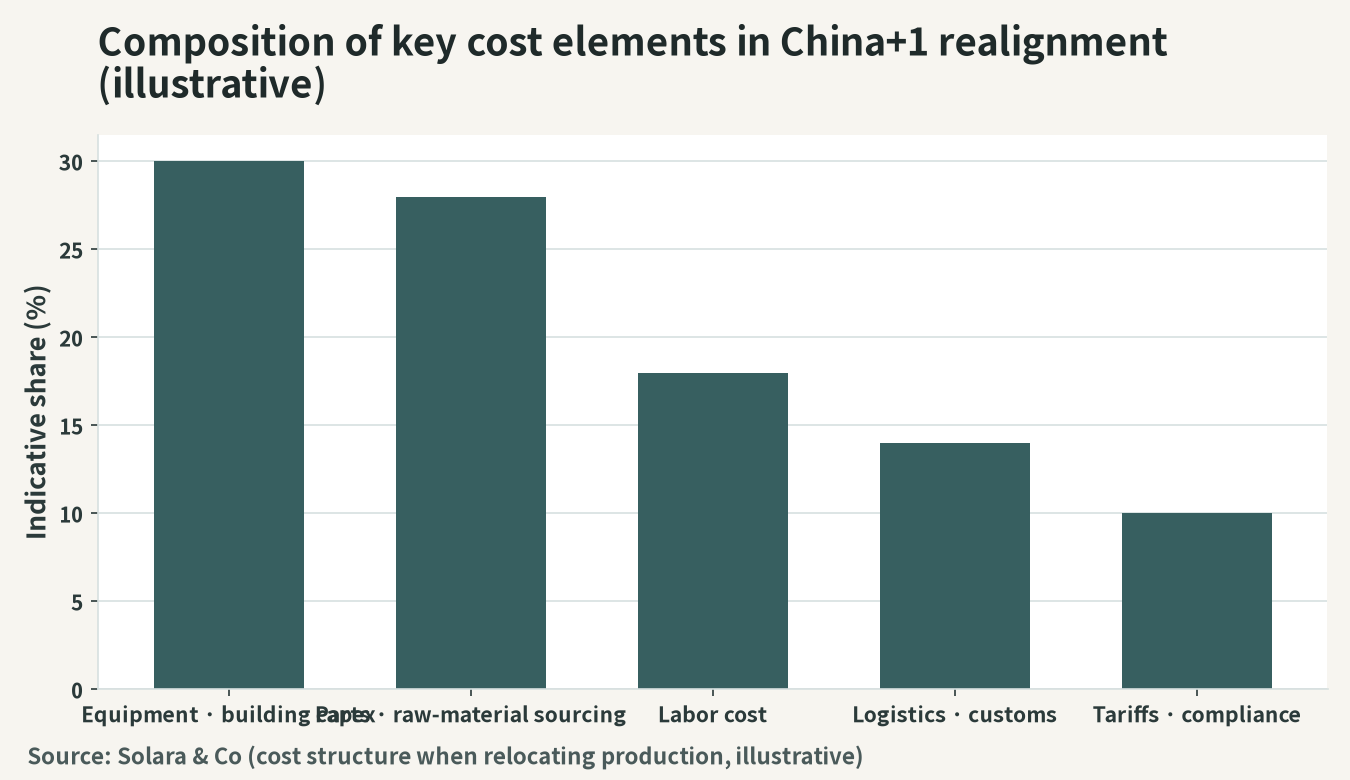
The essence of supply-chain restructuring lies not in relocating final assembly, but in redesigning the entire supply network, including the procurement structure of components and raw materials. Even if final assembly is carried out in Vietnam, if much of the key components and raw materials continues to be imported from China, then tariff, logistics, and geopolitical risks are not sufficiently dispersed. This is the so-called "residual dependence on China," and it is the crux that divides the success or failure of relocation to Vietnam.
This article organizes the practical work when Japanese companies advance supply-chain restructuring in Vietnam—location, supplier base, rules of origin, logistics, and risk dispersal—from the perspective of not letting China+1 end up "in form only."
Why Vietnam Is the Protagonist of "+1"
The Triad of Geography, Cost, and Trade Environment
The reasons Vietnam is chosen lie in a triad: (1) its proximity to South China, making connection with existing supply chains easy; (2) relatively low labor costs and a young workforce; and (3) broad tariff benefits from CPTPP, EVFTA, RCEP, and other FTAs. The network of trade agreements in particular makes Vietnam not merely a low-cost base but a "node of tariff optimization."
The Thickness and Limits of Manufacturing Clustering
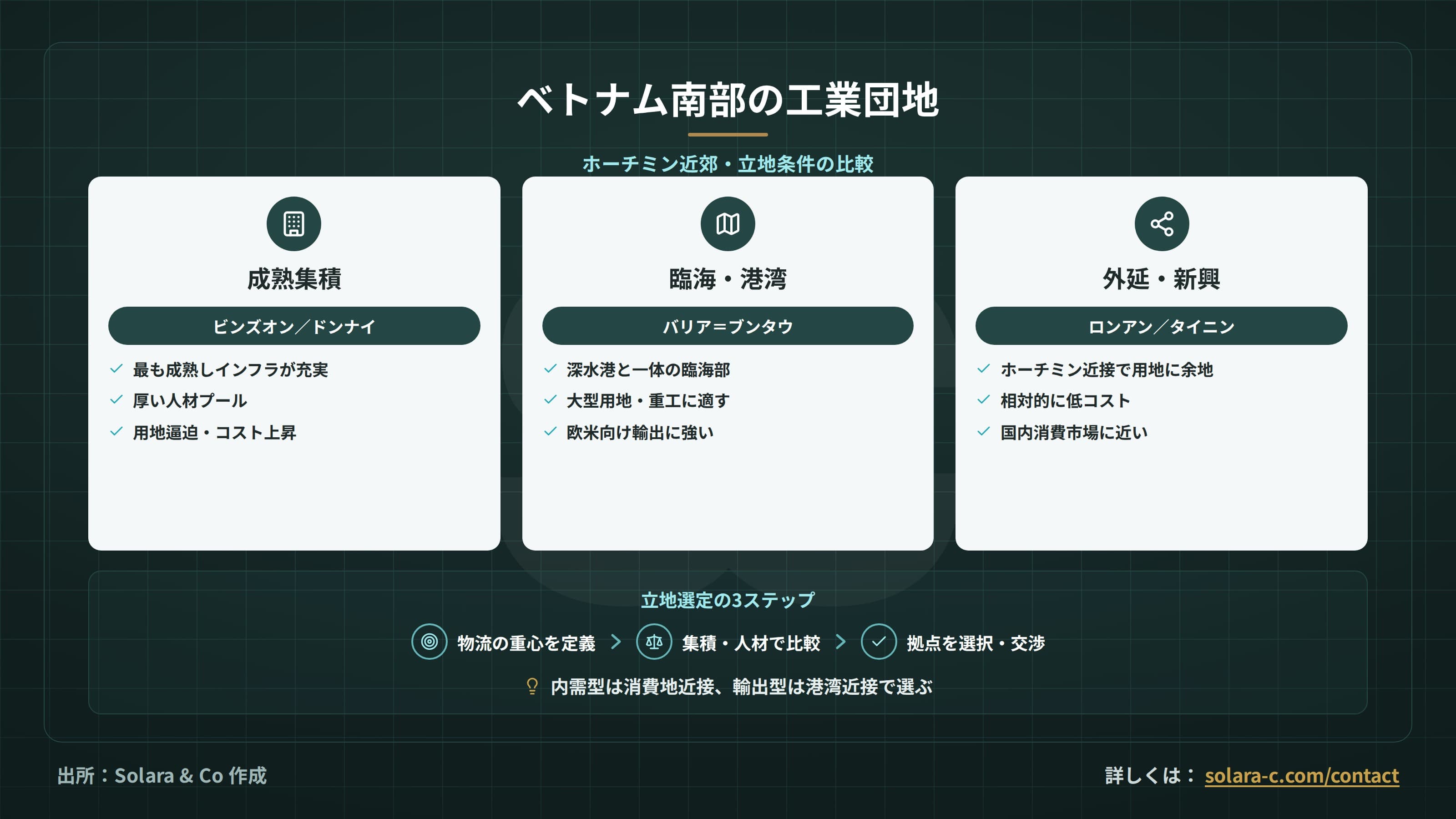
The North (around Hanoi, Hai Phong, and Bac Ninh) has a cluster of electronics, while the South (around Ho Chi Minh City, Binh Duong, and Dong Nai) has a cluster of diverse light industry and consumer goods. On the other hand, the local procurement of upstream materials and key components (the local supplier base) is still developing, and this becomes the biggest bottleneck of the +1 strategy. The current state of manufacturing clustering is also covered in detail in Vietnam's Manufacturing and Supply Chain.
The Network of Trade Agreements as a Structural Advantage
Vietnam possesses a multi-layered network of agreements: CPTPP (trans-Pacific), EVFTA (EU), RCEP (Asia-Pacific), and various bilateral FTAs. This opens up the possibility of exporting at low tariffs to European, North American, and Asian markets with Vietnam as the starting point. However, whether one can actually receive this benefit hinges on whether one can satisfy the rules of origin described later, and the mere existence of an agreement does not automatically make tariffs zero. One should understand the agreement network as a structural advantage that "takes on meaning only when used skillfully."
Five Key Points to Examine in Supply-Chain Restructuring
Restructuring in Vietnam is not a single decision but the simultaneous design of multiple, intertwined key points.
Point 1: Selecting Location and Industrial Park
Location is determined by the distance to suppliers, access to ports and airports, the stability of the power supply, and the ease of securing a workforce. The North has strengths in proximity to electronics suppliers and South China, while the South has strengths in the consumer market and port access. In selecting an industrial park, compare infrastructure capacity, rent, incentives, and room for expansion. In manufacturing in particular, given the tightness of power supply and demand in recent years, it is necessary to factor into the location decision the power-supply capacity and blackout risk of the industrial park, as well as the feasibility of in-house generation and renewable-energy procurement. For labor-intensive types, regions with a thick labor supply; for electronics, existing supplier clusters—such industry characteristics also become the deciding factor in location.
Point 2: Localizing the Supplier Base
The most difficult is raising the local-procurement ratio (local content) of components and raw materials. The quality, delivery times, and mass-production capacity of local suppliers still vary, and at the outset one must rely on imports from China, South Korea, and Japan. Localization is a medium-term theme requiring the supplier discovery, audit, and development to be planned along a time axis.
Point 3: Rules of Origin and Utilizing FTAs
To actually enjoy the tariff benefits of an FTA, one must satisfy the rules of origin. EVFTA and CPTPP have criteria such as the regional value-added ratio and a change in tariff classification (CTC), and if the ratio of Chinese-made components is high, the product is not recognized as "of Vietnamese origin" and loses the tariff benefit. The system for obtaining certificates of origin and the design of procurement that satisfies the rules of origin determine the economic rationality of +1. Because the rules of origin applied differ by product, the practical essence is to examine in advance which criteria of which agreement the main products satisfy, and to build component procurement to match.
Point 4: Logistics and Lead Time
Factor into the design the land and sea transport from South China to northern Vietnam, the domestic transport infrastructure within Vietnam, and the handling capacity and lead time of ports. When importing raw materials from China, the time required for border clearance is directly linked to inventory strategy. While Vietnam's trunk roads and ports are being developed, peak-time congestion and variability in lead time remain, so the design of safety stock and the selection of a customs broker (forwarder) become the key in practice. The higher the dependence on imported components, the greater the impact of clearance delays on production planning.
Point 5: Risk Dispersal and BCP
The original purpose of +1 is risk dispersal. Avoid excessive concentration in a single country or single base, and design the supply network as a business continuity plan (BCP) that withstands demand fluctuations, disasters, and abrupt changes in the trade environment. Not only "China + Vietnam," but depending on the product, also consider multi-tracking that includes India, the ASEAN region, and Mexico, thereby raising resilience to shocks in a specific region. For key components, systematically build a structure that can procure from multiple suppliers and multiple regions (multi-sourcing).
Making "Residual Dependence on China" Visible
Whether relocation to Vietnam has become "in form only" is judged not by the place of final assembly but by the composition of the origin of components and raw materials. Even if the finished product is made in Vietnam, if the bulk of the value added depends on Chinese-made components, then tariff and geopolitical risks are not dispersed.
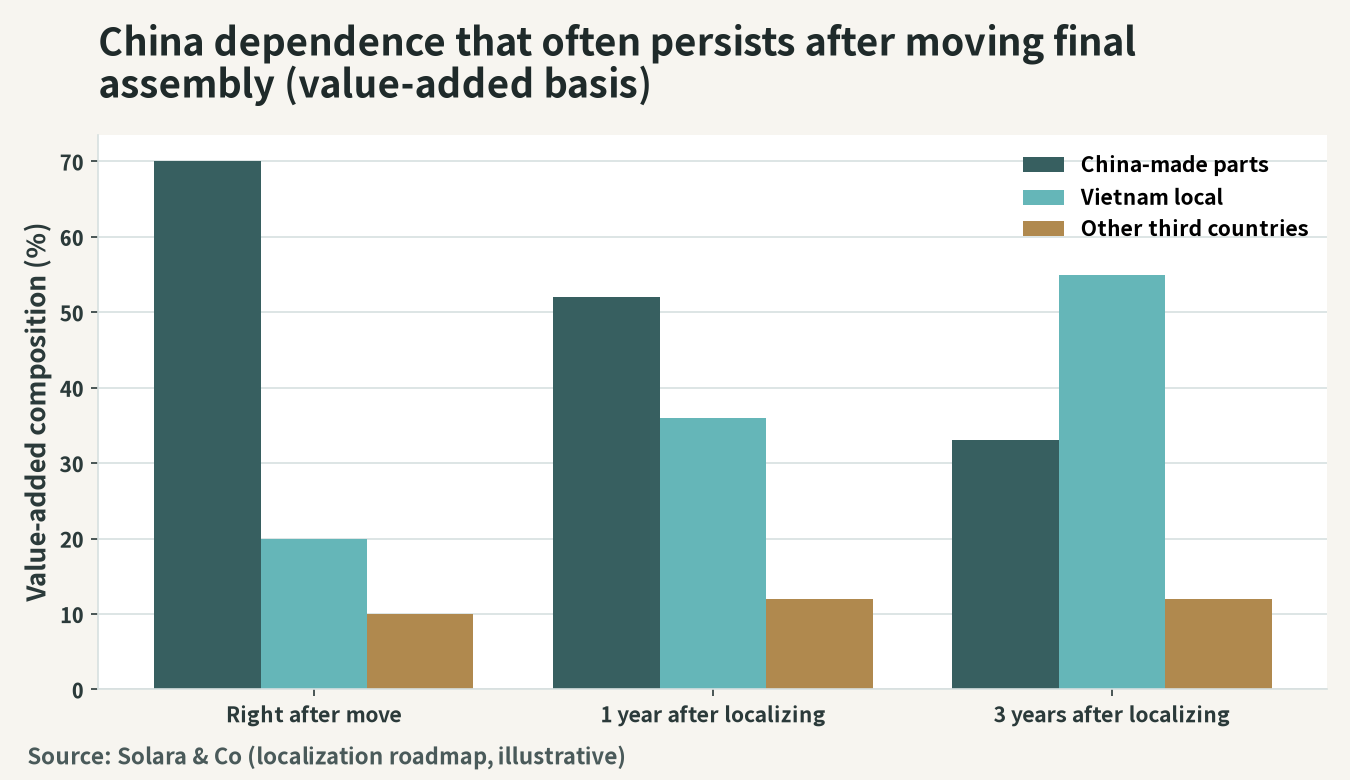
The roadmap of localization is precisely the stepwise reduction of this "residual dependence." Because 100% localization at once is unrealistic, set priorities by product, and advance in parallel the development of local suppliers and the securing of alternative procurement sources (South Korea, Taiwan, India, the ASEAN region).
Furthermore, in recent years, surveillance by various countries over circumvention exports through the falsification of origin (the act of sending Chinese-made goods to a third country via Vietnam) has been intensifying, and "Vietnamese-made in label only" without accompanying substance becomes a trade risk. Localization that generates legitimate value added within Vietnam itself is the very foundation of a sustainable +1 strategy in both respects: tariff benefits and the avoidance of trade risk. Advancing localization with substance, rather than formal relocation, leads to long-term competitiveness.
The Relationship Between Entry Mode and the Supply Chain
Supply-chain restructuring is closely related to the choice of entry mode (own factory, contract manufacturing, joint venture).
Mode | Start-up speed | Freedom of management | Initial investment | Supply control |
|---|---|---|---|---|
Wholly owned own factory | Slow | High | Large | High |
Joint venture (JV) | Moderate | Moderate | Moderate | Depends on partner |
Contract manufacturing (EMS/OEM) | Fast | Low | Small | Low |
Acquisition of an existing factory (M&A) | Fast | High | Medium–large | High (DD required) |
Prioritizing Speed or Prioritizing Control
If you are in a hurry to avoid tariffs, start up quickly with contract manufacturing; if you prioritize quality, intellectual property, and supply control, choose an own factory or M&A—this is the axis of judgment. The differences among entry modes are detailed in Comparison of Entry Modes into Vietnam. When buying an existing factory to start up in one stroke, DD that includes land-use rights and the environment is a prerequisite.
Establishing or Acquiring
When starting up from scratch, please refer to The Practice of Establishing a Local Subsidiary in Vietnam; for a sense of the overall cost of entry, please refer to A Complete Explanation of the Cost of Entering Vietnam.
Practical Steps to Make Restructuring Succeed
Phase 1: Mapping the Current Degree of Dependence
First, take stock of the current procurement structure by product and by origin, and make visible where dependence on China is concentrated. This is the starting point of restructuring.
Phase 2: Deciding the Targets and Methods of Relocation
Select the processes and products to relocate, and decide whether to do so via an own factory, contract manufacturing, or acquisition. Simultaneously consider the constraints of location, FTAs, and logistics.
Phase 3: Stepwise Execution of Localization
Advance the discovery, audit, and development of suppliers, and raise local content step by step. Raising local procurement to a level that satisfies the rules of origin leads to the realization of FTA benefits. In discovering local suppliers, utilize industry networks, chambers of commerce, and business matching to gather candidates, audit their quality, finances, and mass-production capacity, and only then begin transactions. Methods for cultivating local partners are also covered in A Guide to Utilizing Business Matching in Vietnam.
Phase 4: Settling In and Optimizing Cost
After start-up, the challenges become the stabilization of yield and defect rates, the development of local human resources, and the continuous optimization of procurement costs. Labor cost cannot be discussed by "cheap" alone; it is important to evaluate it by the real cost, including retention rate and productivity. This point is explained in detail in The Reality of Labor Costs in Vietnam.
Solara & Co's Support for Supply-Chain Restructuring
"China+1" is not completed by merely relocating final assembly to Vietnam. Only when the supply network is redesigned to include the procurement structure of components and raw materials, and localization that satisfies the rules of origin is realized along a time axis, is the original purpose—the dispersal of tariff and geopolitical risk—achieved. Location selection, supplier discovery, origin and FTA design, and the choice of entry mode are all, in truth, connected by a single line.
Solara & Co, leveraging its networks on both the Japanese and Vietnamese sides, supports the entire process—from mapping the current degree of dependence, to selecting location and industrial park, discovering and auditing local suppliers, designing the entry mode (establishment, contract manufacturing, M&A), and procurement planning based on the rules of origin. So as not to end up with a +1 in form only—"we built a factory in Vietnam, but in the end we still buy components from China"—we support restructuring that looks at the entire supply network.