
Vietnam's energy M&A market in 2025: The big picture and a shifting tide
Energy-sector M&A in Vietnam reached a clear inflection point in 2025, in both volume and quality. From 2017 to 2020, the feed-in tariff (FIT) regime spurred a surge in solar and onshore wind power plants. Many local developers, however, built projects but lacked the equity and operational know-how to run them. As a result, "secondary transactions"—in which these operating or near-operating generation assets are sold to foreign investors—have become the market's leading act. In other words, the defining feature of 2025 is that acquiring stakes in existing projects (brownfield) has grown overwhelmingly more common than primary greenfield development built from scratch.
The cast of buyers has also changed. The market had long been led by Thai power conglomerates such as Gulf, B.Grimm, EGCO, and Banpu. Now Japanese trading houses and utilities (Sumitomo Corporation, Marubeni, JERA, J-POWER, and others), together with funds from South Korea, the Middle East, and Europe, have entered in earnest, intensifying competition for premium assets. On the seller side, developers face concerns over retroactive reviews of FIT prices, output curtailment on the transmission grid, and a deteriorating cash position driven by rising interest rates—all of which have strengthened their incentive to divest assets.
As "selling pressure" and "buying demand" rose at the same time, 2025 saw more frequent moments in which valuations tilted in buyers' favor. Even so, premium operating solar and wind assets that face few transmission constraints and have stable grid connections still trade at high prices, sharpening the divide between the good and the mediocre. For Japanese companies, it has become a year that demands, more than ever, a keen sense of market pricing and a discerning eye for selecting deals.
The investment map drawn by Power Development Plan 8 (PDP8)
The starting point for understanding Vietnam's energy M&A is the eighth National Power Development Plan (Power Development Plan 8, commonly known as PDP8). PDP8 is a national plan that sets the policy for the power-generation mix and transmission-infrastructure development through 2030. After its approval in 2023, a revised version was issued in 2025 that clarified investment priorities further. The standard approach is to judge which sectors and which regions Japanese companies should target first by aligning with the direction of this plan.
The heart of PDP8 lies in effectively freezing new coal-fired development and pivoting decisively toward gas-fired power (domestic gas and LNG) and renewable energy. LNG-fired power in particular is positioned as a core source toward 2030, with several large-scale projects planned. For renewables, the plan explicitly calls for raising the share of onshore and offshore wind, with offshore wind promoted at the national level as a growth driver from 2030 onward. For solar, the key issues are integrating the rapidly expanded stock of existing projects into the grid and shifting toward self-consumption models (rooftop and self-consumption solar).
One more point that cannot be overlooked is investment in the transmission grid. Generation capacity raced ahead while transmission and substation infrastructure failed to keep pace, which led to output curtailment. Reflecting on that lesson, PDP8 prioritizes investment in the transmission grid and in system stabilization (storage batteries and pumped hydro). The fact that not just generation assets themselves but also transmission-, storage-, and smart-grid-related fields have emerged as new targets for M&A and investment is an important perspective for looking ahead to 2026 and beyond.
Renewables: Secondary transactions in solar and wind become the mainstream
The core of 2025's deal flow is the acquisition of stakes in operating or near-operating solar and onshore wind power plants. Among the projects that sprang up in profusion during the FIT boom, plants held by developers that hit a financial wall, or by early investors hurrying toward an exit, are coming to market one after another. For buyers, the appeal is being able to acquire cash-generating operating assets without bearing the risks of obtaining development permits or of construction.
That said, the points of evaluation differ between solar and wind. Solar is relatively easy to build and projects are numerous, so quality varies widely in practice. Land-rights relationships, EPC (engineering, procurement, and construction) workmanship, panel degradation rates, and—above all—the stability of the grid connection determine the price. Onshore wind, by contrast, has fewer projects and thus higher scarcity value, but the reliability of wind-resource data, the turbines' operating track record, and the terms of the O&M (operation and maintenance) contract become the focus of scrutiny.
The difficulty unique to secondary transactions is the risk that the preconditions for FIT eligibility are overturned after the fact. For example, some projects are in dispute with the authorities over certification of the commercial operation date (COD), and others do not fully satisfy the requirements for applying the FIT price. Acquiring such projects can mean failing to earn the assumed FIT revenue, with the post-acquisition profit model collapsing from its foundation. Accordingly, verifying the bankability of the PPA (power purchase agreement) and the certainty of FIT eligibility from both legal and technical angles is the lifeblood of renewable-energy M&A.
The end of FIT and DPPA: M&A opportunities and risks born of regulatory change
The single biggest key to reading Vietnam's energy M&A from 2025 into 2026 is the transformation of the pricing regime. The generous FIT has already ended for new projects, giving way to a transitional pricing mechanism and an auction system. With the disappearance of the "predictable high returns" that FIT provided, a project's profitability now hinges on negotiations with the system operator EVN (Vietnam Electricity) and on market prices, raising the difficulty of risk assessment.
Amid this transition, the mechanism rapidly drawing attention is the DPPA (Direct Power Purchase Agreement). A DPPA is a scheme that lets a power producer and a large consumer (such as a manufacturer's factory) trade electricity directly without going through EVN, or by leasing the transmission grid. Against the backdrop of demand from global manufacturers seeking 100% renewable energy (RE100)—epitomized by the supply chains of Apple, Samsung, and Nike—generation assets that can accommodate a DPPA are beginning to carry new value. For Japanese companies on the demand side, investing in or partnering on generation projects premised on a DPPA is becoming a realistic option as a means of decarbonizing their own factories and stabilizing costs.
On the other hand, the regulatory transition also breeds uncertainty. The detailed rules for the DPPA have only just begun to be applied, and practical issues remain—such as the level of the grid-usage fee (wheeling charge) and the allocation of responsibility for supply-demand balancing and system operation. From an M&A standpoint, it is essential to quantify across multiple scenarios questions such as "Which revenue source does this project rest on—FIT, transitional price, DPPA, or the wholesale power market?" and "If the regime changes further, how will earnings swing?" How regulatory risk is built into the acquisition price and contract terms (representations and warranties, price adjustments, conditions precedent) is what separates a skillful deal from a clumsy one.
LNG-fired power, offshore wind, and the transmission grid: Growth frontiers of 2026
The destinations toward which investment money is heading for 2026 can be broadly organized into three. First is LNG-fired power. Positioned by PDP8 as the core of baseload-to-mid-merit generation, several large LNG-to-power projects are in the development stage. LNG requires enormous upfront investment and must be structured as an integrated package spanning the gas-supply contract, PPA, terminal, and pipeline; the focus is therefore on large deals in which trading houses, utilities, and engineering firms form a consortium. This is an area where Japanese companies can hold an edge thanks to their command of the entire LNG value chain.
Second is offshore wind. Vietnam has a long coastline and favorable wind conditions, and its offshore-wind potential is regarded as among the highest in Southeast Asia. Looking ahead to a full-scale launch from 2026 onward, the field is at the stage of sea-area surveys, building the permitting framework, and constructing a local supply chain, and European developers and Japanese companies are moving early to stake out positions. That said, much remains undeveloped on the institutional side—such as sea-area use permits, foreign-ownership ratios, and the grid-connection framework—making it a frontier that calls for a long-term outlook and a high tolerance for risk.
Third is transmission, system stabilization, and energy storage (BESS). Reflecting on how output curtailment became chronic as renewables expanded, investment in reinforcing the transmission grid and in storage batteries and pumped hydro is being supported by policy. Transmission long carried a strong flavor of state monopoly, which limited private participation; but as the debate over socialization (introducing private capital) advances, transmission, storage, smart grids, and energy management have emerged as new arenas for M&A and investment from 2026 onward. The fact that investment themes once fixated on generation alone are now spreading across the entire system is a major change.
Due-diligence issues unique to energy M&A
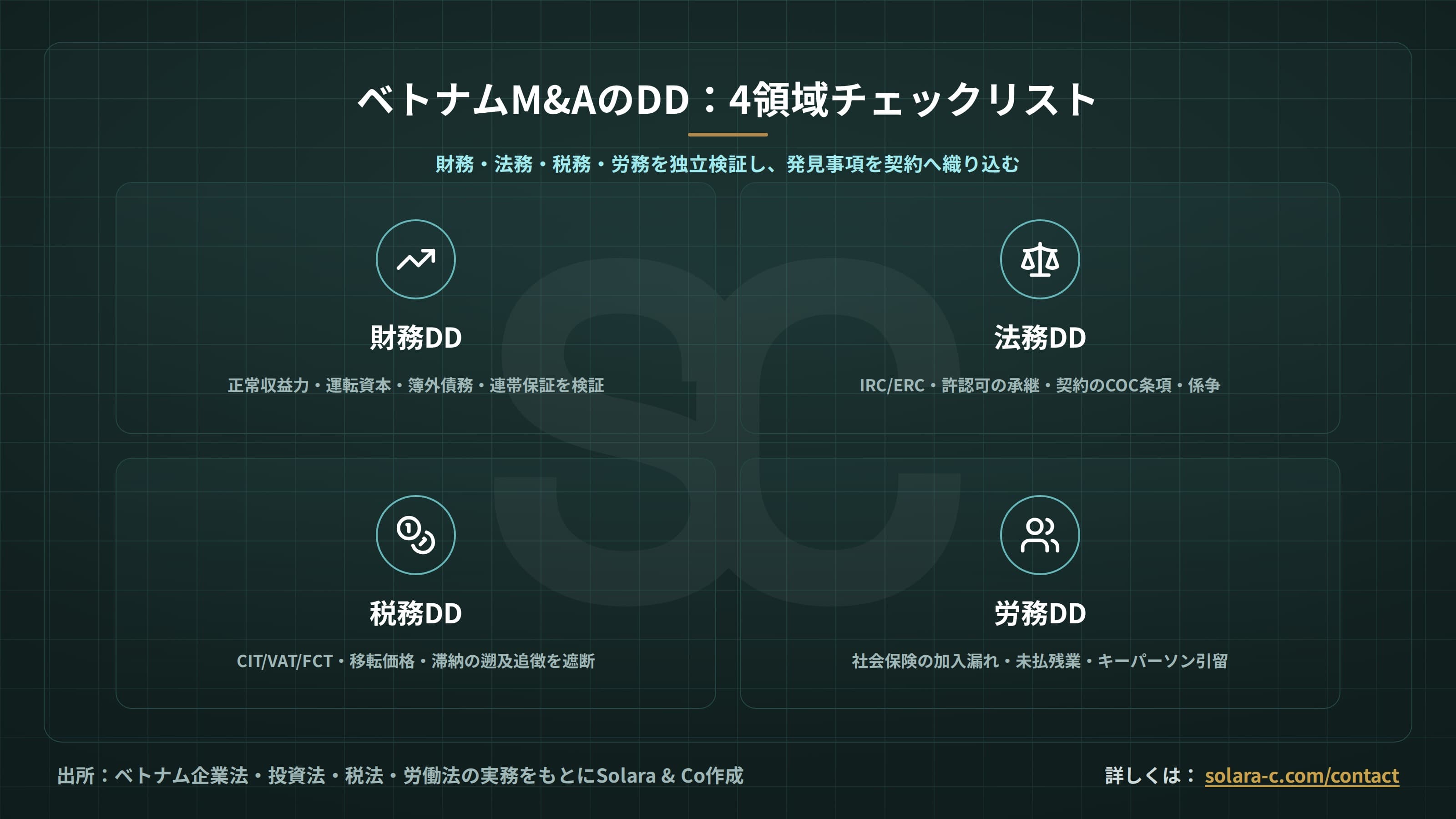
Due diligence (DD) on an energy project differs greatly in emphasis from M&A on an ordinary operating company. First is land (the site). Because power plants use vast tracts of land or sea, one scrutinizes the validity of the land-use right (LURC), the remaining term of the lease, the completion status of resident resettlement and land acquisition, and the securing of easements. In Vietnam, land-rights relationships are complex, and discrepancies between documents and reality are not unusual, so land DD forms the very foundation of a deal.
Next are permits and the PPA. Power generation involves a host of licenses—the investment registration certificate (IRC), enterprise registration certificate (ERC), construction permit, environmental impact assessment (EIA/ESIA), operating license, fire-safety approval, and more. One confirms whether these have been validly obtained and maintained, whether the permits carry over upon a transfer (share transfer), and whether regulatory approval is required. For the PPA, one verifies—from both legal and finance angles—the price (FIT, transitional price, DPPA), the contract term, take-or-pay clauses, the treatment of force majeure and system constraints, and bankability.
Technical DD is also indispensable. Together with experts, one evaluates the consistency between generation output and resource (irradiance, wind) data, the condition of the equipment and the O&M history, the reasonableness of the assumed capacity factor, and the risk allocation in the EPC and O&M contracts. In addition, off-balance-sheet liabilities often lurk—unresolved claims with the EPC contractor, land- and tax-related penalties, and disputes with the authorities over grid connection—so one must dig into even the existence of the dual contracts or verbal agreements peculiar to Vietnam. It is an area that demands the design capability to integrate financial, legal, technical, tax, and environmental DD and translate the risks into the acquisition price and contract terms.
Entry strategies for Japanese companies and common pitfalls
When a Japanese company takes on energy M&A in Vietnam, the first thing to decide is "from which position to enter." The options broadly divide into: (1) minority or majority investment in operating renewables, (2) consortium participation in large developments such as LNG and offshore wind, (3) generation investment originating from the company's own demand by leveraging a DPPA, and (4) entry into peripheral areas such as transmission, storage, O&M, and EPC. The starting point is to determine the entry route by weighing it against one's own power-business expertise, risk tolerance, and decarbonization needs in Vietnam.
The first common pitfall is taking FIT revenue at face value. As noted above, there is uncertainty surrounding COD certification and FIT-eligibility requirements; unless the risk that assumed revenue fails to materialize is factored in, valuations collapse after the acquisition. The second is underestimating output curtailment. In regions where the grid is strained, there are time slots when power can be generated but not sold, so the utilization rate falls short of plan. Quantifying the grid conditions of the location through technical DD is indispensable.
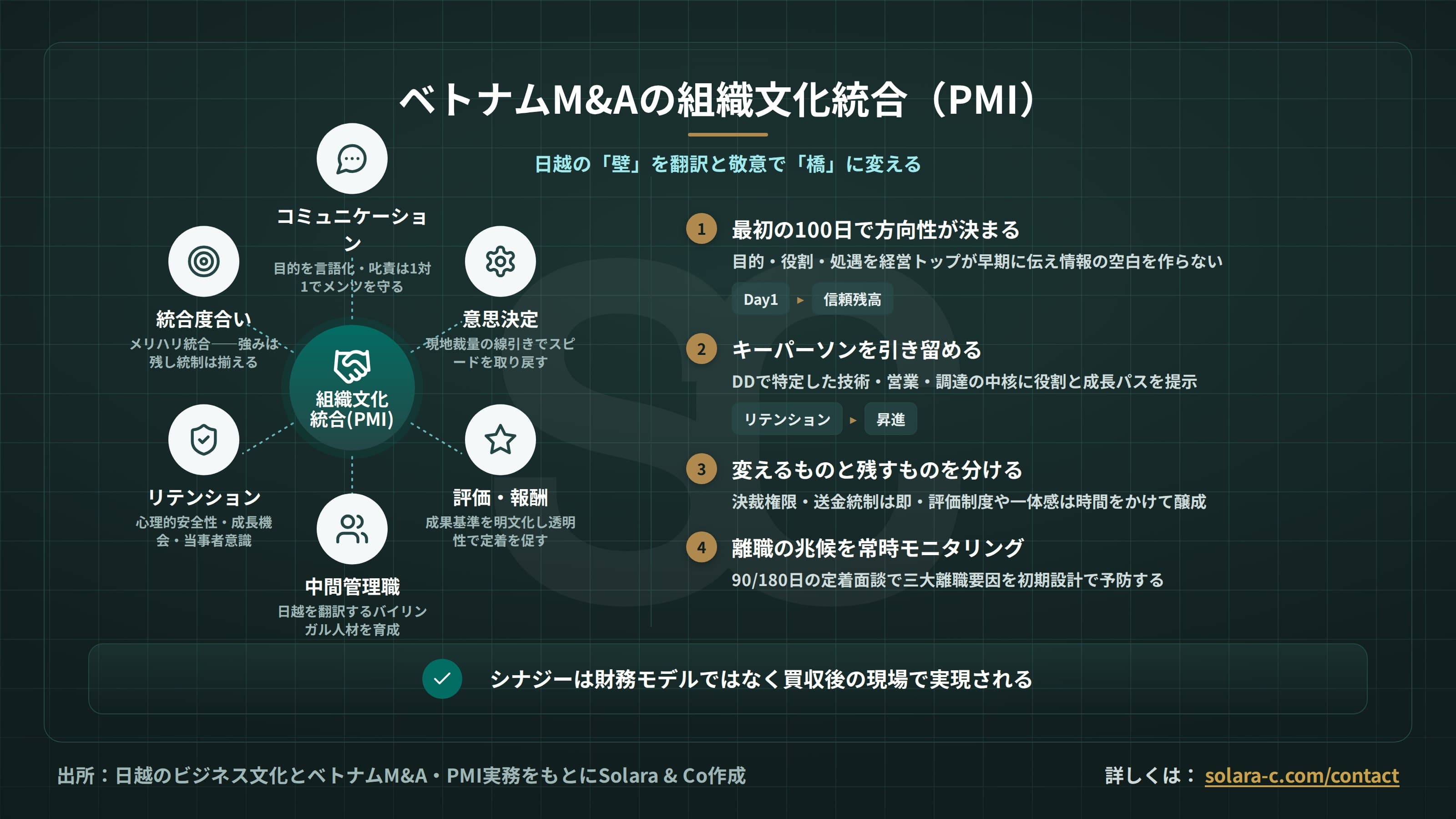
The third is treating foreign-investment regulation and the approval process lightly. Energy is a nation's core infrastructure, so the procedures are multilayered—foreign-ownership ratios, regulatory approval, and antitrust (economic-concentration) filings. The period to closing is hard to read, exposing the deal for a long time to risks from exchange rates, interest rates, and regulatory change. The fourth is a failure to build a relationship of trust with local partners. Negotiating with local developers and EVN, dealing with the administration, and coordinating land and residents cannot proceed without bridge personnel and advisors who understand local business customs. Putting in place from the earliest stage a structure that can "translate" the contexts of both Japan and Vietnam is a precondition for success.
Outlook for 2026 and a practical action plan
Vietnam's energy M&A in 2026 is expected to be a year in which "the continuation of secondary transactions in renewables" and "the full-scale arrival of new frontiers in LNG, offshore wind, and the transmission grid" run in parallel. The three structural tailwinds—decarbonization (the 2050 net-zero target), energy security, and the RE100 demand of manufacturers—will not waver, and over the medium to long term it will remain a market with substantial investment appeal. At the same time, because uncertainties remain in the form of regulatory transition (the end of FIT, DPPA, and auctions) and system constraints, a discerning eye for each deal and the pricing-in of regulatory risk will separate success from failure more than ever.
As a practical action plan: first, define the investment theme and entry position early, and build a long list of target projects. Second, for the target projects, design an integrated DD covering land, permits, PPA, the grid, technology, finance, and tax, with local experts involved. Third, quantify earnings across multiple scenarios for each revenue-supporting regime (FIT, transitional price, DPPA, market price), and reflect the downside in the contract terms (price adjustment, representations and warranties, special indemnities, conditions precedent, and escrow).
Finally, energy projects have a long lead time from decision to realization, so a trinity of coordination across regulation, partners, and finance is essential. The best path to harvesting the fruits of a growth market while containing risk is to partner from an early stage with advisors well-versed in the regulations and business customs of both Japan and Vietnam, and to design the whole sequence end to end—from deal structuring, DD, and permitting through to PMI. Vietnam's energy transition is a core theme of the "golden decade," and 2026 can be called a prime opportunity to establish a solid position right at its threshold.