
What is a carve-out acquisition — and why is it rising in Vietnam now
A carve-out acquisition refers to a transaction in which the buyer does not acquire an entire company, but instead separates out and acquires only a part of its business (a business division, a plant, or a product line). In Japanese it is also called "carving out a business"; for the seller it is a way to tidy up unneeded divisions, while for the buyer it is a method to take precise aim at and acquire only the part it wants. Compared with an ordinary share transfer (share deal) — where the whole company is taken over — the distinctive feature of a carve-out is that the very work of "drawing the line" around the acquisition target becomes the core of the deal.
There is a clear structural background to the rise of carve-out deals in Vietnam. First, amid China+1 and supply-chain realignment, multinationals are increasingly carving out part of a Vietnamese subsidiary's production lines or business divisions to sell or transfer them. Second, Vietnamese conglomerates are actively divesting non-core businesses in order to return to their core operations. Third, cases also stand out where, as part of a parent company's management restructuring and "selection and concentration," only the profitable divisions are separated off and monetized. In every case, the unit of sale and purchase is the "business," not the "company."
The difficulty of "carving out a business to buy it" rather than "buying a company"
The reason carve-outs become structurally heavy in Vietnam is that the business being carved out was not originally an independent legal entity, but had been operated as a part of the parent company. Permits and licenses, land use rights, employees, IT infrastructure, and shared services such as accounting and HR are all tied to the parent company's name and contracts. The additional step of reassembling these into a state where they can operate independently as a "business" — that is, standing the business alone (separation into a standalone) — comes on top in full as a burden that does not exist in a share deal. From the moment of purchase, the buyer must design transfer and separation simultaneously so that the business does not grind to a halt.
Choosing the structure: share transfer, business transfer, company demerger
The structures for executing a carve-out fall broadly into three. Because the choice substantially changes whether permits can be succeeded, the tax burden, the weight of procedures, and the risk of off-balance-sheet liabilities, this is the first branching point in deal design.
Share transfer (share deal) and business transfer (asset deal)
When the business already exists as an independent subsidiary, or when the seller carves it out into a new company in advance, buying that company's shares — a share transfer — is the simplest. Because permits and contracts continue together with the company, the transfer procedures are relatively light. By contrast, when the target business is embedded inside the parent company, the rule is to transfer assets, contracts, and employees individually — a business transfer (asset deal) — and this is the typical form of a carve-out. An asset deal lets you select only the assets you want and makes it easier to block off-balance-sheet liabilities, but in return — as discussed below — the re-acquisition of permits and the individual transfer procedures weigh heavily.
The third path: company demerger
Under Vietnam's Law on Enterprises, the buyer can also choose a two-step scheme: separate the target business into a newly established company by means of a company division (chia/tách doanh nghiệp), then transfer the shares of that new company. By having the seller first build the "box" and then sell it in the form of shares, the buyer can to some extent avoid the cumbersome individual transfer of assets. However, the division itself requires time and procedures with the authorities, and whether permits and land use rights will reliably pass to the new company at the time of division must be verified separately. In practice, the choice between an asset deal and a company division plus share transfer is weighed by looking at the weight of the target business's permits and the degree of the seller's cooperation. A comparison of each point is as follows.
Point | Share transfer (acquiring the whole company) | Business transfer (carve-out) |
|---|---|---|
Succession of permits | In principle continue as-is, per the IRC/ERC | Not succeeded automatically; in principle must be re-acquired |
Transfer of workers | Employment remains with the company and continues | Transfer requires the individual consent of each worker |
Off-balance-sheet liabilities | In principle all succeeded (hard to block) | Selective acquisition makes it easier to block risk |
Land use rights | Title remains as-is (verify remaining years) | Re-registration / change of title on the LURC required |
Weight of procedures | Relatively light | Heavy (transfer per asset and contract) |
Tax | Mainly capital gains tax | Asset transfer may incur VAT, etc. |
Defining the carve-out perimeter
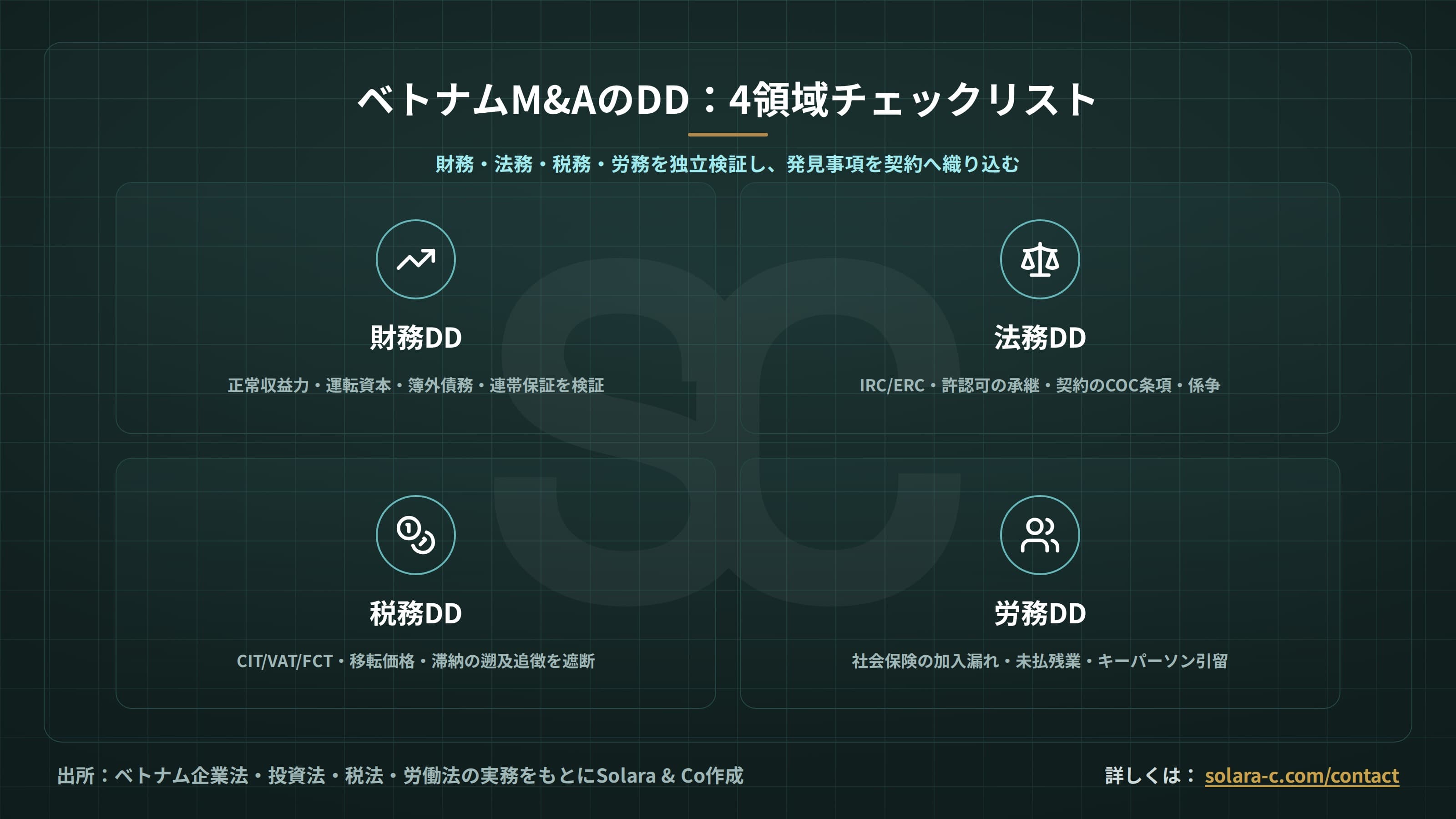
The first thing to do in a carve-out is to define the carve-out perimeter rigorously. Unless you draw the line at the asset level over what is transferred and what is left with the parent company, you cannot build the contract or the price. From the legal due diligence stage onward, the identification of transfer targets and their transferability must be verified as a set (for details, see the explanation of legal due diligence in Vietnam M&A).
What to transfer — assets, contracts, IP, employees, permits
Transfer targets include tangible assets such as machinery and equipment, inventory, and accounts receivable; plus customer contracts, supply contracts, and lease contracts; intellectual property (IP) such as trademarks and know-how; the employees engaged in the target business; and the permits necessary for the business. The problem is that many of these are concluded under the parent company's name. Customer contracts and supply contracts often contain clauses that do not allow rights and obligations to be transferred without the counterparty's consent (assignment-restriction and change-of-control clauses), so the work of obtaining transfer consent from each and every major business partner arises. As for IP, too, it is necessary to decide early whether to keep using the shared brand held by the parent company or to switch to a new brand. The key points of separating the financial side are detailed in financial due diligence in Vietnam M&A.
How to divide what is being shared
For assets that the target business has shared with the parent company — shared plant zones, a common core system, group-shared permits, and so on — you judge one by one whether they can be divided physically and contractually. For things that cannot be divided, there are two choices: either continue to receive supply from the parent company for a set period after the acquisition (the TSA, discussed below), or have the buyer rebuild them in-house. Defining the perimeter is, in the end, the work of sorting "what can be cut cleanly" from "what cannot be cut and is dragged along."
Re-acquiring permits and licenses
In Vietnamese carve-outs, the most easily misunderstood aspect is the treatment of permits. In an asset deal, permits do not transfer automatically together with the business.
IRC/ERC and conditional business licenses
When a foreign investor acquires a business, the buyer must put in place an Investment Registration Certificate (IRC) and an Enterprise Registration Certificate (ERC), and must reflect the business lines of the transferred target business in these. Furthermore, if the business falls under conditional business lines such as manufacturing, distribution, logistics, food, or healthcare, the individual licenses for those (e.g. the economic needs test for retail, various operating permits) are not naturally inherited as an attachment to the business; in principle the buyer must newly re-acquire them as its own business entity. Re-acquiring permits requires a review period, and if the closing date is set without factoring this in, a blank period arises in which, immediately after purchase, the business cannot be operated legally. The practice of permits for conditional businesses is covered in the explanation of conditional business licenses in Vietnam.
Re-registration of land use rights (LURC)
When the target business involves a plant or warehouse, the treatment of the Land Use Rights Certificate (LURC, the "red book") becomes a major issue. In Vietnam, land is owned by the entire people, and what a company holds is no more than a time-limited "use right." To transfer land and buildings in an asset deal, a change of title and re-registration of the LURC is required, and the remaining years of use, the permitted use, transfer restrictions, and the existence of any mortgage must be verified in advance. For a lot within an industrial park, the consent of the park management company is also needed regarding succession of the sublease contract. Re-registration is a procedure dealing with local land authorities and takes time, and this tends to become a bottleneck in the schedule. For the overall picture of the land system, please refer to the explanation of Vietnam's 2024 Land Law.
Transfer of workers — the wall of individual consent
What divides the success or failure of a carve-out is the transfer of employees. It is also the point where Japanese companies are most apt to miscalculate.
Vietnamese labor law has no TUPE
A system like Europe's TUPE — under which employment is automatically succeeded along with a business transfer — does not exist in Vietnamese labor law. In an asset deal, to move the target employees from the seller to the buyer's business entity, the procedure is in principle to obtain the individual consent of each and every employee, terminate the old employment contract, and conclude a new employment contract. Employees who do not consent are not transferred and either remain with the seller or become subject to severance procedures. It can even happen that, if a key person does not consent to the transfer, the acquired business cannot operate.
Transfer practice and social insurance and severance
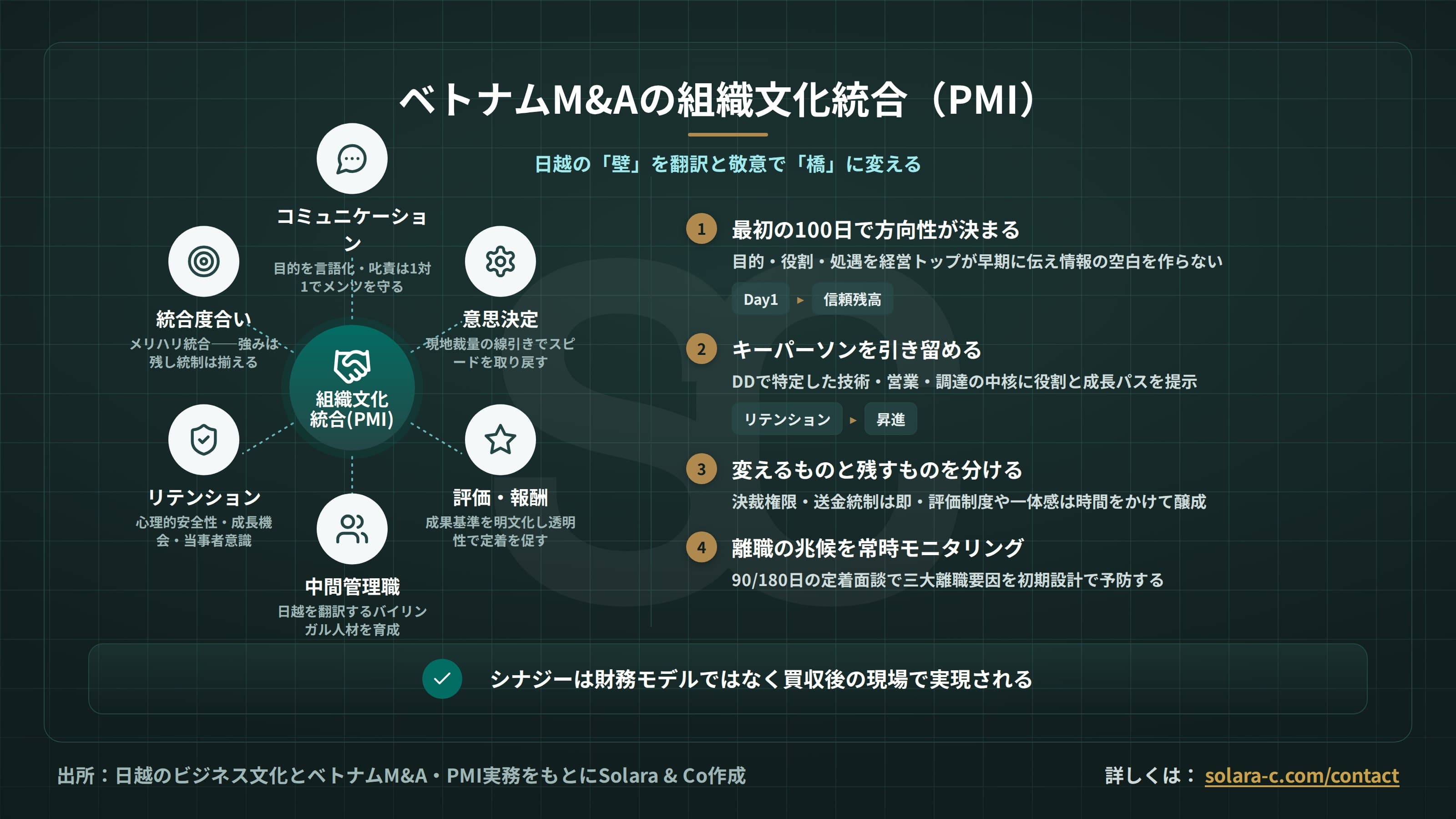
When transferring, it is necessary to settle, one matter at a time, the treatment under labor law — such as the aggregate counting of years of service, untaken annual leave, succession of social insurance (SI), and settlement of severance allowance for the years of service before unemployment insurance. In Vietnam, where worker protection is thorough, leaving these ambiguous becomes a risk of disputes later. The points to note under labor law are covered in the explanation of Vietnamese labor law, and personnel risk in general after an acquisition is dealt with in detail in the explanation of PMI and personnel risk after Vietnam M&A.
Standalone and the TSA (Transitional Service Agreement)
To run the carved-out business on its own, standing it alone — replacing the functions it has depended on the parent company for with its own — is unavoidable. Because this takes time, a bridging mechanism is needed.
Separation of shared services, IT, and finance
Identify the functions the target business has depended on the parent company for — from shared services such as accounting, HR, procurement, and IT, to the core system (ERP), bank accounts, the company seal, and the legal representative structure — and draw up a plan for transfer and reconstruction. In particular, separating IT systems entails data migration and switching access rights, and tends to become heavier than expected.
Designing the TSA (Transitional Service Agreement)
Because completely separating all functions on the closing date is unrealistic, the parties conclude a Transitional Service Agreement (TSA) under which they continue to receive services from the seller (parent company) for a set period. In the TSA, the scope of the covered services, the quality level, the fees, the term (usually around 6–12 months), and the termination conditions are clearly defined. If the term is left ambiguous, dependence on the parent company is prolonged and the buyer's independence is delayed. Conversely, if it is too short, the standalone build does not finish in time. In addition, which side bears the stranded cost remaining at the parent company is also sorted out within the price negotiations and the TSA.
Tax and the standard schedule
VAT, transfer pricing, and tax points to note
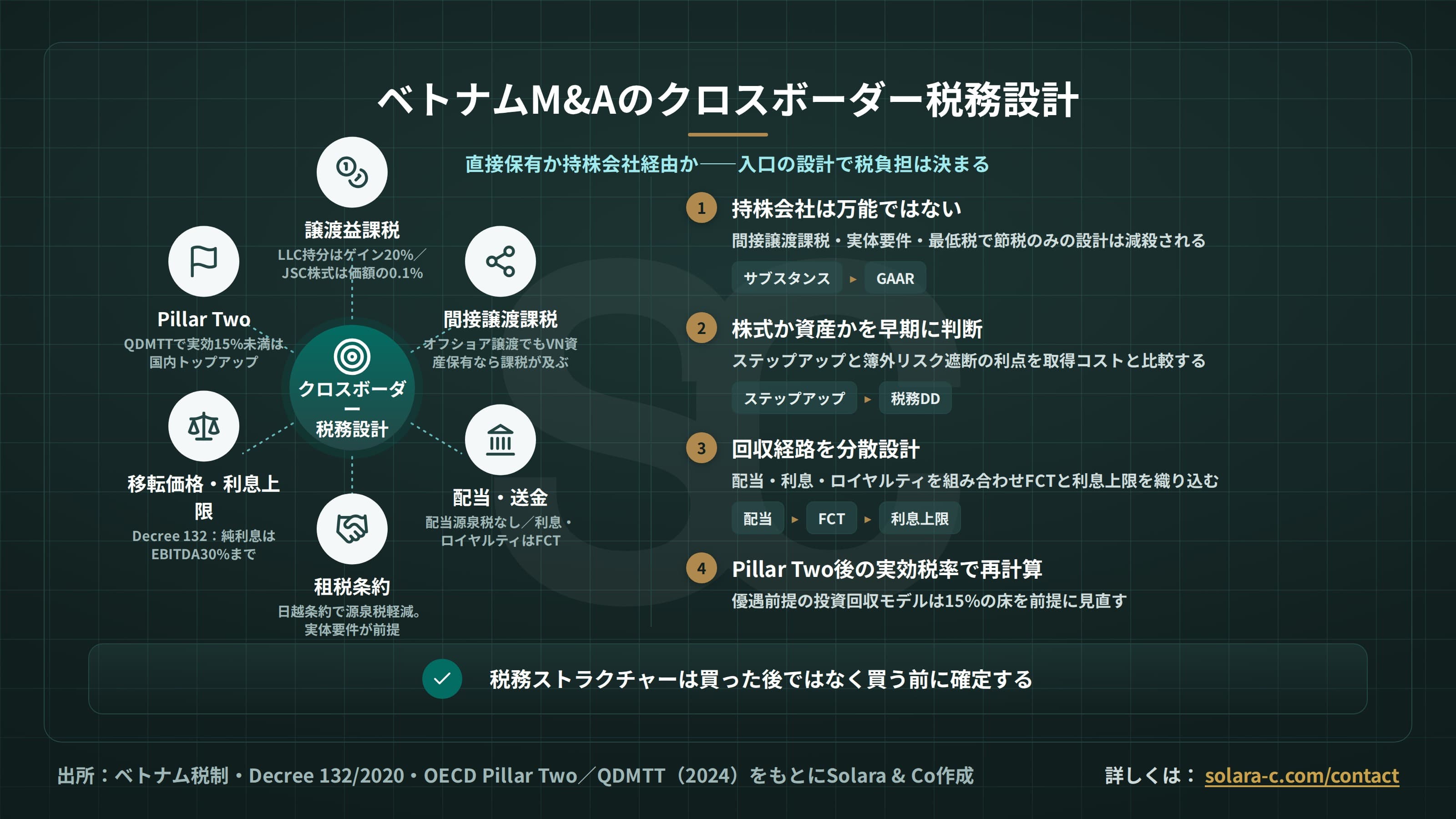
In an asset deal, value-added tax (VAT) may be levied on the transfer of assets, so the structure of the tax burden differs from a share transfer (mainly capital gains tax). Also, because service transactions arise between the parent company and the buyer through the TSA, the consideration set for them must be reasonable from the standpoint of transfer pricing (arm's-length price). When cross-border intra-group transactions are involved, designing the entire tax structure early is important.
The standard schedule for a carve-out
A carve-out has more steps than a share deal, and because re-acquiring permits, re-registering the LURC, transferring employees, and standalone all run in parallel, the overall lead time grows longer. A guide to the standard time required by phase is as follows.
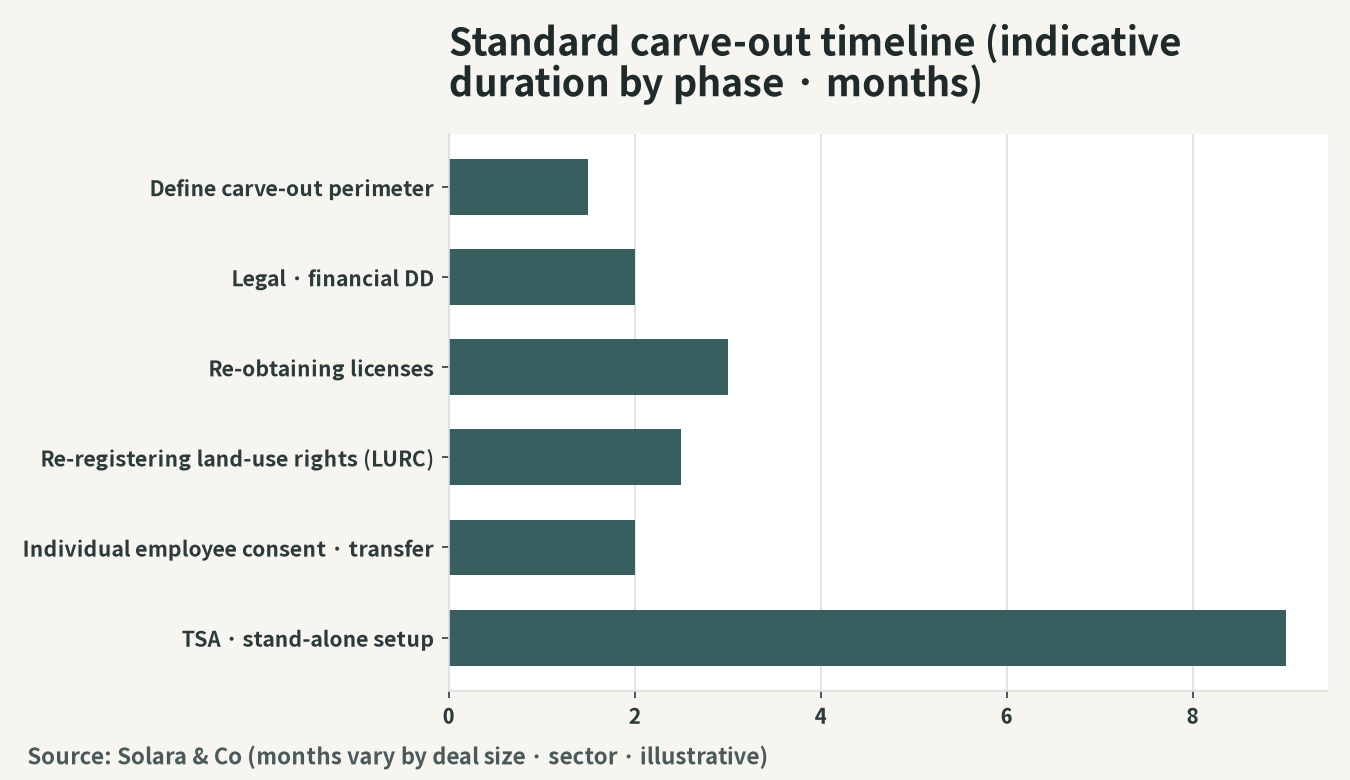
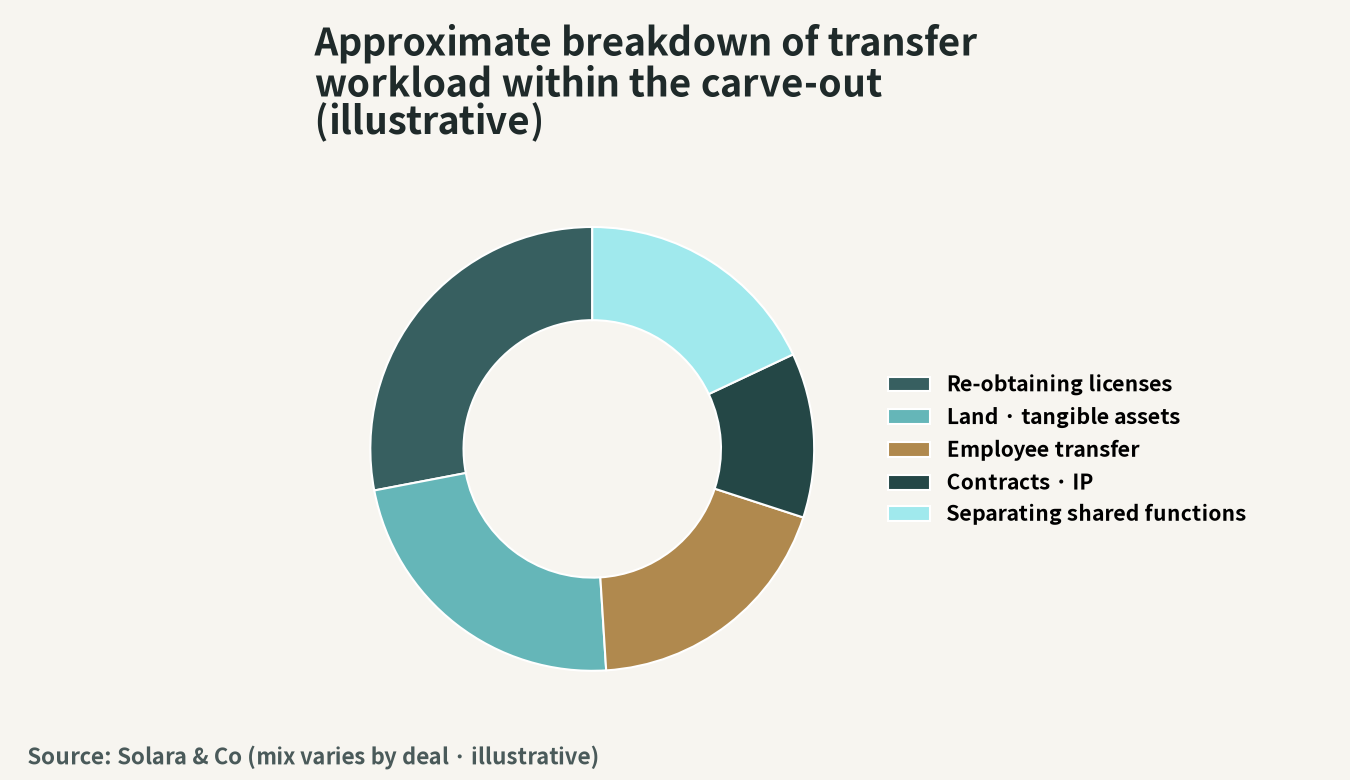
The composition of the carve-out target differs by deal, but the weight of the transfer work is broadly allocated among "permits," "land and tangible assets," "employees," "contracts and IP," and "separation of shared functions."
Solara & Co's carve-out support — seamless from carve-out to independence
A Vietnamese carve-out is a structurally heavy deal in which multiple hard spots run simultaneously in parallel: choosing the structure, defining the perimeter, re-acquiring permits, re-registering the LURC, transferring employees by individual consent, designing the TSA, and standing the business alone. Overlooking any single one of these creates a blank in which the business stops the moment it is bought. On how to run the deal as a whole, please also see the explanation of the overall process of Vietnam M&A.
Solara & Co has bases in both Japan and Vietnam, and supports you along a single continuous line — from defining the carve-out perimeter, through legal and financial due diligence, the transfer design for permits, land, and labor, the TSA and standalone plan, all the way to the business standing on its own after closing. Precisely because a carve-out means buying a "business" rather than a "company," the key to success is not to err in designing the carve-out at the entrance. We will support you starting from the very first step: drawing the line together over "what to carve out and what to leave behind."