
Why Due Diligence Is the "Make-or-Break Line" in Vietnam M&A
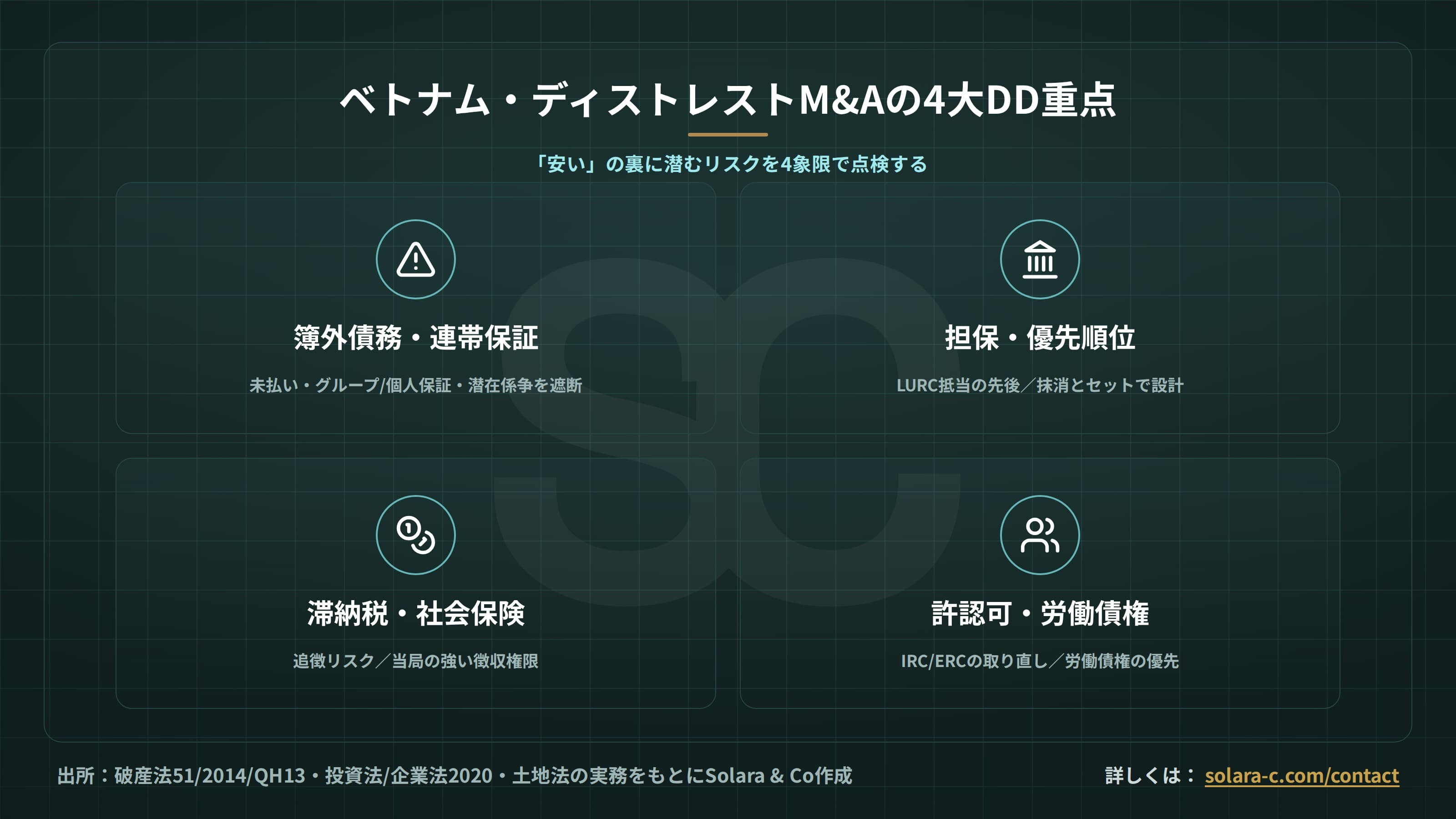
In M&A involving Vietnamese companies, profit and loss are swung far more by "risks that were never visible" surfacing after the acquisition than by the negotiation of the purchase price. The reasons: financial statements are not as well-organized as in Japan, licenses are not automatically inherited, and taxes and social insurance carry a structure that allows retroactive assessment going back several years. In other words, no matter how promising a target company is, if you cannot surface the issues through due diligence (DD) and build them into the deal terms, you may find yourself shouldering off-balance-sheet liabilities the moment you buy.
This article is a comprehensive checklist that organizes the issues that must always be examined in Vietnam M&A practice into four areas: finance, legal, tax, and labor. For each area, we explain "where to look," "what the Vietnam-specific pitfalls are," and "how to reflect the results in the deal," from the perspective of a Japanese buyer. For the overall picture of M&A, please refer to The Complete Vietnam M&A Process; for credit checks at the pre-acquisition stage, see Credit Investigation Before Acquiring a Counterparty.
Financial Due Diligence: Reading Behind the Numbers
The purpose of financial DD is to verify whether the financial statements presented "represent reality," and from there to determine normalized earnings power (a normalized EBITDA) and net interest-bearing debt. In Vietnam, statements prepared on a VAS (Vietnamese Accounting Standards) basis are common, so they must be read on the premise that there are differences from IFRS and that accounting manipulations for tax optimization may be mixed in.
Verifying the Quality of Earnings
The first thing to confirm is whether the recorded revenue is real and recurring. You should surface revenue pushed in toward the period-end, profits inflated through related-party transactions, and expenses where the owner's personal costs have been shifted onto the company, then deduct one-off and non-operating items to restate normalized earnings power. In Vietnam, some industries have a high proportion of cash transactions, so reconciling bank deposit records against invoices (valid VAT invoices) is essential. Differences in accounting standards are organized in Differences Between Vietnamese Accounting Standards (VAS) and IFRS.
Working Capital, Net Interest-Bearing Debt, and Off-Balance-Sheet Liabilities
You should determine the level of normalized working capital and set the basis for the price adjustment at acquisition (locked box or closing adjustment). The key issues are the collectibility of receivables, slow-moving inventory, omissions in accruing payables, and the treatment of owner loans and intercompany receivables/payables. Particularly in Vietnam, liabilities that do not appear on the books—joint guarantees on bank borrowings, off-balance-sheet leases, damages claims in dispute—tend to lurk, so verify them against original contracts and bank balance certificates. For details, please refer to Financial Due Diligence in Vietnam M&A.
Reliability of Cash Flow and Accounting Records
At mid-sized and owner-run companies in Vietnam, it is not uncommon for management accounting and tax accounting to diverge, operated in a manner close to double bookkeeping. Rather than relying on the presented P&L alone, reconcile it with bank transaction statements, the cash ledger, and physical inventory counts to grasp the gap between reported profit and actual cash-generating power. Deferring capital expenditure, under-provisioning (bad debt, warranty, repairs), and the handling of foreign exchange are also factors that distort normalized earnings power; tracking outliers across monthly trends leads to the discovery of window-dressing and one-off factors.
Legal Due Diligence: Inheriting Licenses and Contracts
The heart of legal DD is "can this company's business be continued legally and without interruption after the acquisition?" In Vietnam, even if you acquire a company through a share transfer, licenses, incentives, and contractual standing are not necessarily maintained as a matter of course, so the inheritability itself must be verified.
IRC, ERC, and Business Licenses
For a foreign-invested enterprise, confirm the contents recorded on the Investment Registration Certificate (IRC) and the Enterprise Registration Certificate (ERC), the cap on ownership ratio (in conditional sectors), and the scope of business codes. Distribution, retail, logistics, education and similar fields involve foreign-investment restrictions and sub-licenses (e.g., the economic needs test for retail), so the buyer becoming foreign may trigger the need to obtain new licenses. Regulations for conditional sectors are detailed in Conditional Investment Sectors and Licenses.
Shareholders, Capital, Disputes, and Compliance
Confirm the consistency of the charter, the shareholder register, and the capital-contribution history; the legality of past capital increases/decreases; and whether any collateral has been provided or shares pledged. In addition, compliance aspects such as ongoing or potential litigation/arbitration, history of administrative penalties, and bribery/sanctions risk are also within the scope of review. On the contractual side, the presence of a change-of-control clause (a clause allowing the counterparty to terminate when control is transferred) in key customer contracts, leases, and loan agreements can be fatal. Legal matters in general are covered in Legal Due Diligence in Vietnam M&A.
Tax Due Diligence: Blocking the Risk of Back Assessments
Tax audits in Vietnam, as a rule, go back five to ten years and carry surcharges and late-payment interest. If there are defects in the seller's past filings, the buyer will bear those back assessments after the acquisition, so tax DD is the work of finding "bombs from the past."
Corporate Income Tax, VAT, and Foreign Contractor Tax (FCT)
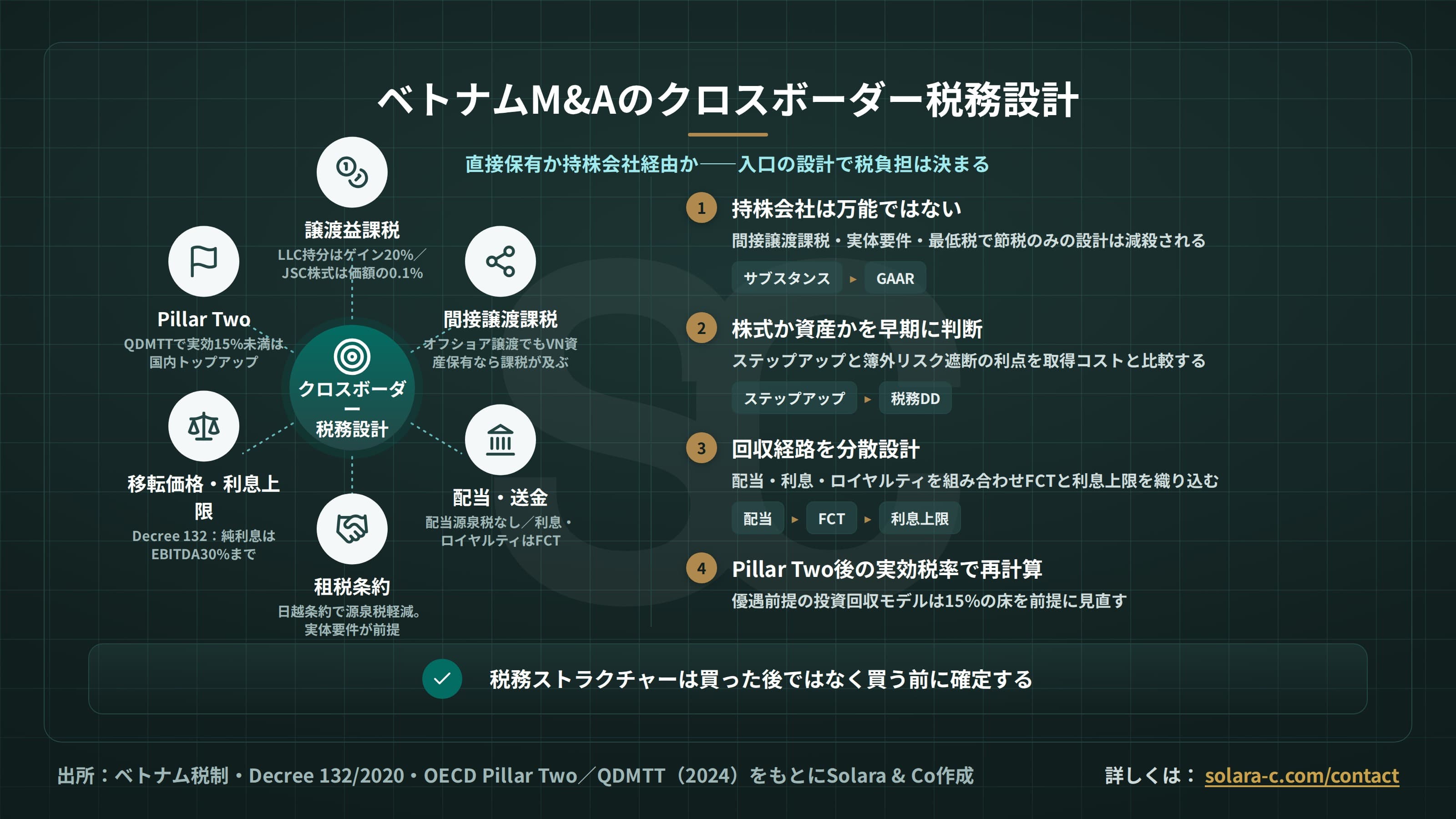
For corporate income tax (CIT), verify expenses with a high risk of being non-deductible (expenditures without invoices, cash settlements over VND 20 million, excessive interest) and the validity of the basis for any tax incentives applied. Because incentives operate on a "self-application plus ex-post verification" basis as described in Corporate Income Tax and Tax Incentives in Vietnam, they can be denied if segregated accounting is insufficient. For VAT, check whether the requirements for input-tax credit are met and the validity of refund applications; for FCT, examine omissions in withholding on interest, royalties, and service fees paid abroad.
Transfer Pricing and Tax Arrears
Where related-party transactions exist, the state of transfer pricing (TP) documentation and the validity of the pricing are the most critical issues. Deficient documentation or deviation from arm's-length prices leads directly to enormous back assessments (see Vietnam's Transfer Pricing Regime). At the same time, confirm any unpaid taxes, unpaid social insurance, and whether there are correction notices from the tax authorities; risks identified are addressed through representations and warranties and indemnity, or through a price reduction.
Labor Due Diligence: People and Social Insurance
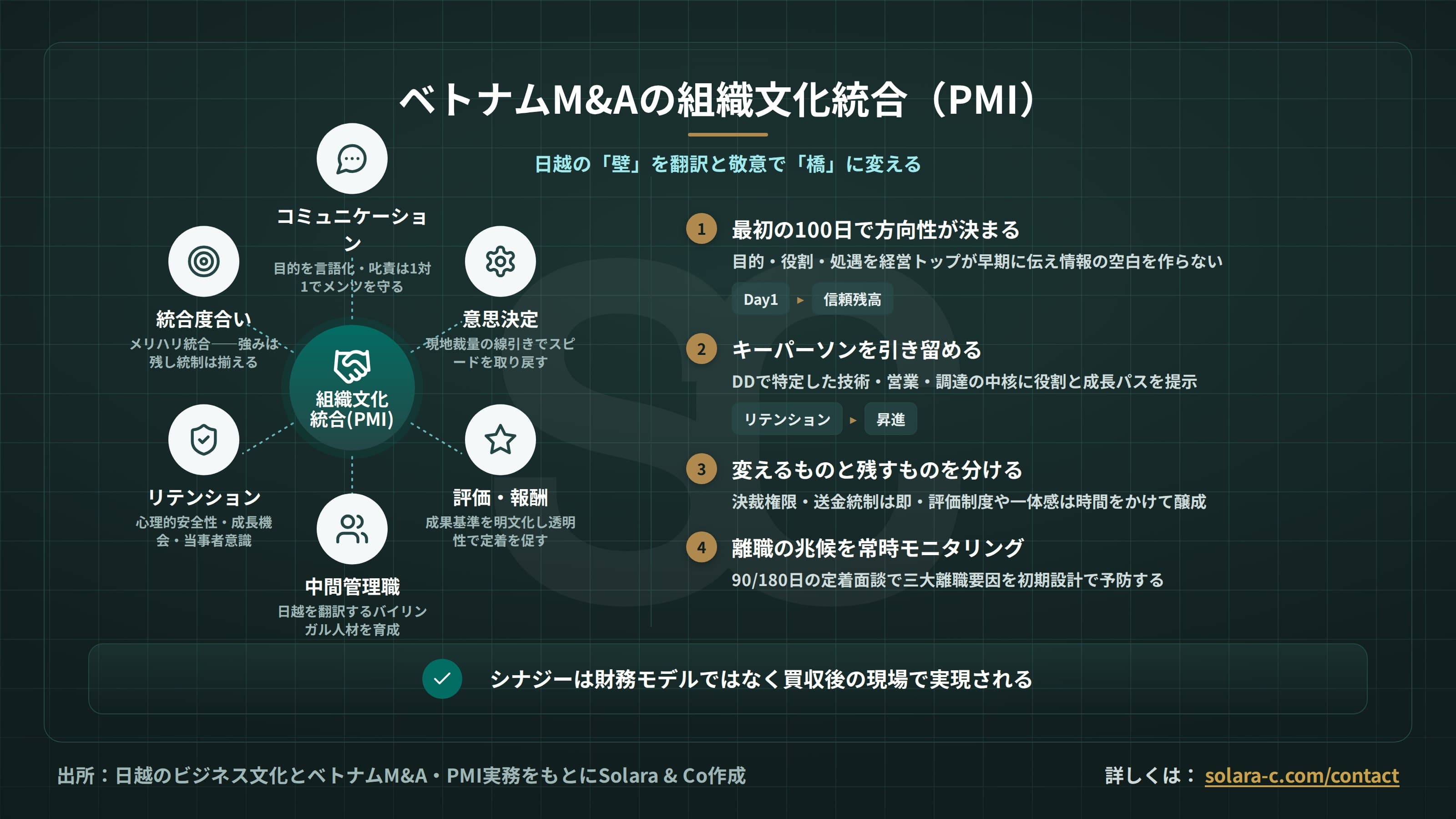
"People" are the most easily overlooked element in Vietnam M&A, and at the same time they determine post-merger integration (PMI). Labor DD simultaneously looks at hidden personnel-cost liabilities and the retention of key persons.
Social Insurance, Unpaid Overtime, and Severance Pay
Omissions in enrolling employees in social insurance (SI), health insurance, and unemployment insurance, or filing on a basis below the minimum wage, are subject to retroactive collection and penalties. Surface off-the-books personnel-cost liabilities such as unpaid overtime, provisions for unused annual leave, and the unpaid balance of severance allowance for service before 2009. For the social insurance mechanism, please refer to Payroll and Social Insurance in Vietnam; for the legal framework, see Vietnam's Labor Law.
Key Persons, Labor Unions, and Transfers
Because business value is impaired if key engineers or salespeople leave, confirm the non-compete and retention terms in employment contracts. Where a carve-out (spinning off a business) is involved, transferring workers requires individual consent and is not automatically inherited. The relationship with the labor union (or the umbrella organization) and whether there have been past labor disputes are also indicators of how difficult integration will be. HR risk after acquisition is detailed in HR Risk in M&A PMI.
Real Estate, Assets, and Environment as Cross-Cutting Issues
In addition to the four areas, for manufacturers, real estate and the environment become independent issues. The holder name, remaining term, intended use, and presence of a mortgage on the Land Use Right Certificate (LURC); the consistency of the factory's construction, fire-safety, and environmental (EIA) permits; and latent liabilities such as soil contamination and industrial waste all bear directly on the risk of a shutdown after acquisition. For details, please refer to Real Estate and Factory Due Diligence in Vietnam.
Building DD Results into the Deal
DD is not "find it and be done." Findings are sorted by the severity of the risk and assigned to one of: (1) a price reduction, (2) representations and warranties and indemnity, (3) a demand for remediation as a closing condition precedent (CP), or (4) escrow or retention of part of the consideration, and are then reflected in the SPA (share purchase agreement). Risks that cannot be blocked ultimately also serve as grounds for the decision "not to buy" (a deal breaker).
A point to note that is specific to Vietnam is that a design relying solely on representations and warranties is dangerous. This is because the market for warranty-and-indemnity (W&I) insurance is not as mature as in Japan, and where the seller lacks financial means, the indemnity clause tends to become a "pie in the sky." Therefore, you build multi-layered defenses: quantifiable risks are reflected, to the extent possible, in the price itself; what can be remediated is required to be executed as a closing condition precedent; and remaining risk is secured through escrow (retaining part of the consideration). Creating a "findings-to-terms matrix" that lists the correspondence between findings and deal terms, and sharing it with the seller as supporting material for negotiation, is a practical device to keep price negotiations from descending into emotion.
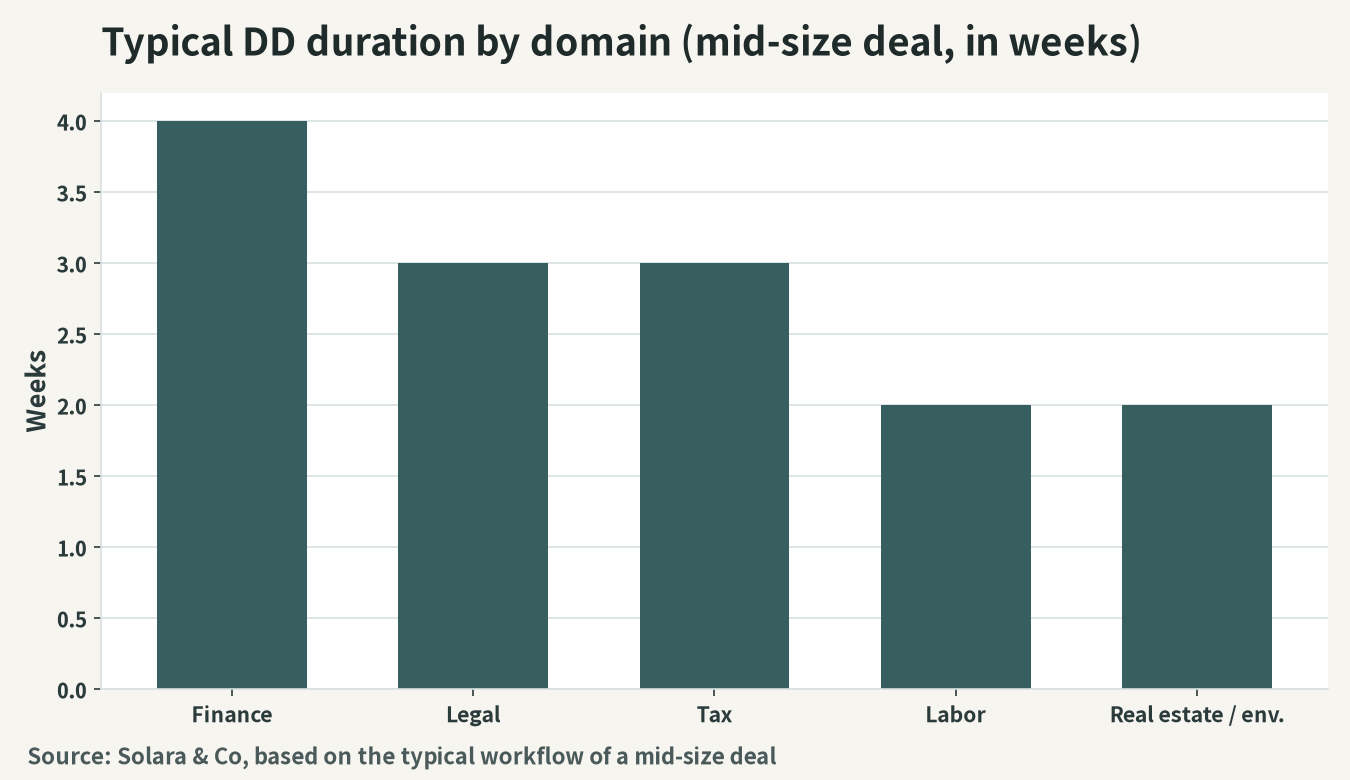
Summary Table of the Four-Area Checklist
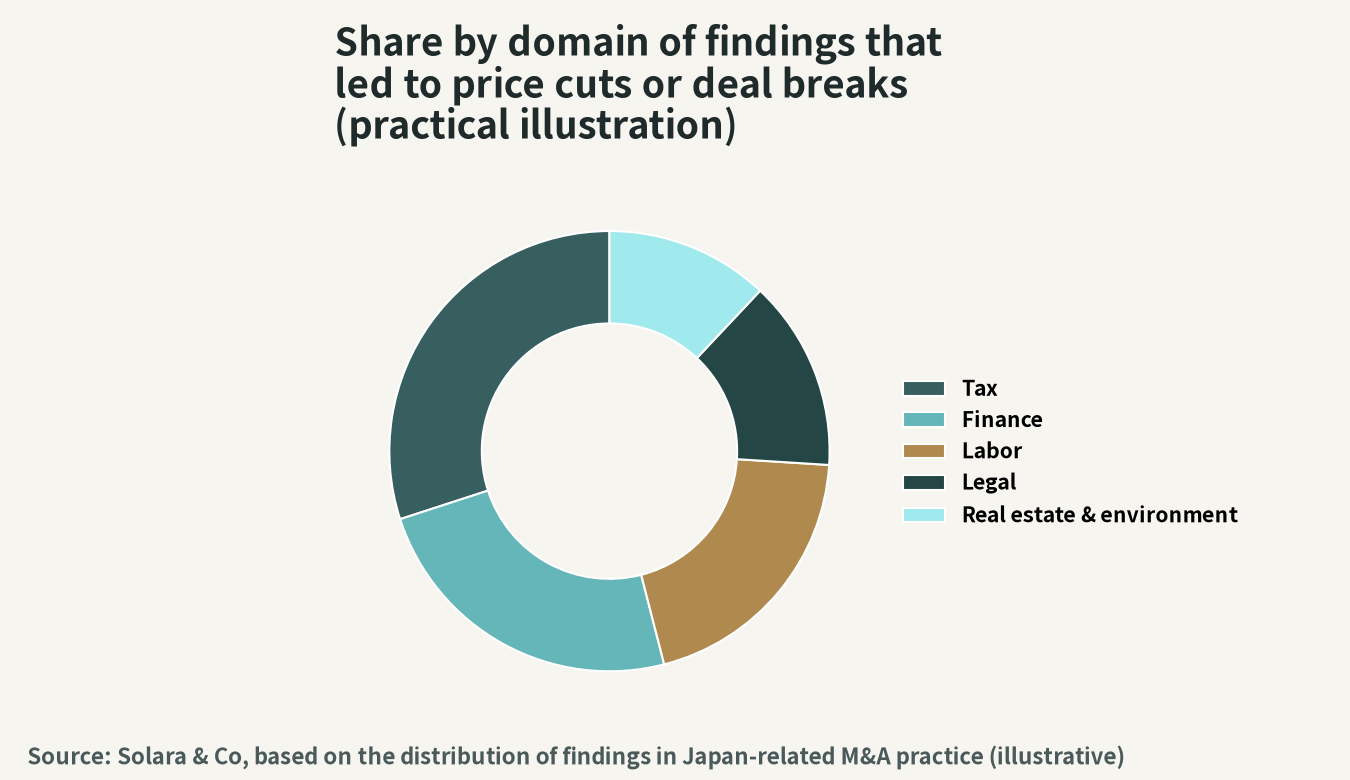
When the main check items of each area are listed together with the principal Vietnam-specific pitfalls and the typical ways of reflecting them in the deal, the result is as follows. The actual weighting is adjusted by industry, scale, and scheme.
Area | Main Check Items | Vietnam-Specific Pitfalls | Principal Deal Reflection |
|---|---|---|---|
Finance | Normalized earnings power, working capital, net debt | Pushed-in revenue, off-balance-sheet guarantees, owner expenses | Price adjustment, QofE deduction |
Legal | IRC/ERC, licenses, disputes, contracts | Non-inheritance of licenses, COC clauses | CP, representations and warranties |
Tax | CIT/VAT/FCT, TP, arrears | Denial of incentives, TP back assessment, retroactive audit | Indemnity, escrow |
Labor | Social insurance, overtime, severance, key persons | Enrollment omissions, transfer consent, resignation chain | Indemnity, retention design |
Real estate, environment | LURC, construction/fire-safety/EIA | Holder name, use non-conformity, contamination liability | CP, price reduction |
Conclusion: DD Is Not "Work to Decide the Price" but "Work to Design the Risk"
The success or failure of Vietnam M&A is determined not by whether you bought cheaply, but by whether you correctly priced the risk you took on and allocated it through the contract. Having independent specialists cross-verify the four areas of finance, legal, tax, and labor, and systematically translating findings into price, representations and warranties, and CPs, is the only way to prevent the "unexpected" after acquisition. With teams of specialists on both the Japanese and Vietnamese sides, Solara & Co accompanies you in the DD of Vietnamese companies from the design stage, providing consistent support all the way from reflecting findings in the SPA through post-merger integration (PMI).