
Tax structure is decided "before you buy," not "after you buy"
One of the most common misconceptions among Japanese companies considering the acquisition of a Vietnamese business is the belief that "tax can be left to the accountants and optimized after closing." Yet the tax burden in cross-border M&A is largely determined right at the entrance of a deal — in the design of who (which entity) acquires, through which country the deal is routed, and whether shares or assets are acquired. Reworking the acquisition structure after the fact requires another transfer or capital reorganization, each of which triggers taxable events in both Vietnam and Japan, so a design mistake made at the entrance is far from easy to recover later.
This article takes the comparison between direct holding by the Japanese parent and holding via an intermediate holding company (holding/SPV, e.g. in Singapore) as its central axis, and organizes — from a practitioner's perspective — the issues specific to Vietnam: capital gains tax on capital contributions and shares, the reach of indirect transfer (offshore transfer) taxation, withholding tax on remittances of dividends, interest, and royalties, relief under the Japan–Vietnam tax treaty (DTA), the interest deductibility cap under the transfer pricing regime (Decree 132), and the impact of Pillar Two (the 15% global minimum tax) and QDMTT. These are issues that should be considered together with the design of valuation and financing, and they are closely linked to the discussions in Valuation in Vietnam M&A and Financing structures in Vietnam M&A.
Capital gains tax in Vietnam: different rates for capital contributions and shares
The starting point for understanding tax in Vietnam M&A is that "the method of taxing transfer gains differs fundamentally depending on the legal form of the target company." If you apply the Japanese instinct and treat it uniformly as "transfer gain × tax rate," you will be far off from the actual tax amount.
Transfer of an LLC's (limited liability company) capital contribution: 20% on net profit
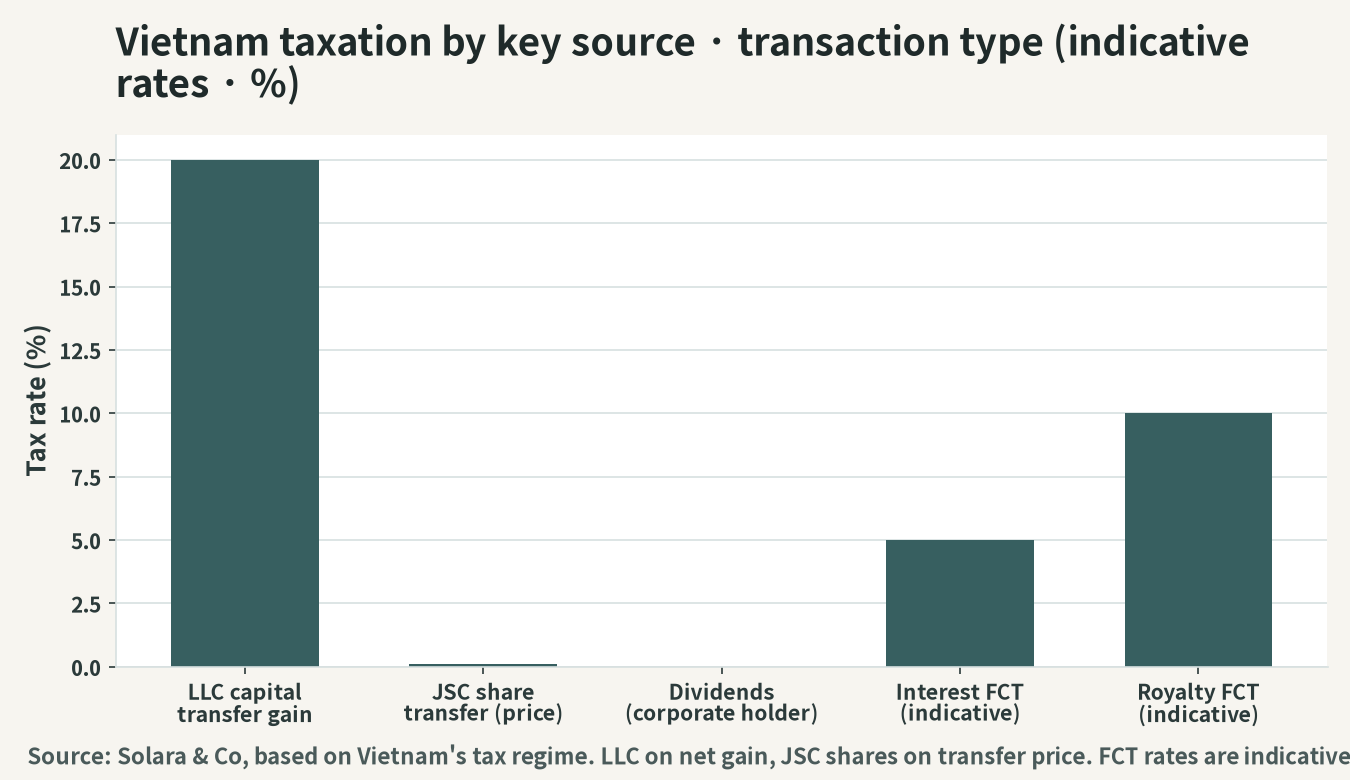
When the target is a limited liability company (LLC, the most common legal form for foreign capital in Vietnam), the gain on transferring its "capital contribution" is taxed at 20% on the net profit (gain) — the transfer price less the acquisition cost and related expenses. For a corporate seller, this is effectively a capital gains tax, and wherever there is a gain a tax burden will certainly arise. If the evidence substantiating the acquisition cost (the original capital contribution vouchers, records of past changes in the contribution) is insufficient, there is a risk that the tax authorities will assess the cost basis as close to zero, treating nearly the entire transfer price as gain; for this reason, tracing the cost basis at the due diligence (DD) stage is important.
Transfer of a JSC's (joint-stock company) shares: 0.1% of the transfer price
By contrast, when the target is a joint-stock company (JSC) and its "shares" are transferred, 0.1% of the transfer price (total transaction value) is withheld as a "deemed tax" regardless of whether there is a gain. This treatment is akin to a securities transfer, and its distinctive feature is that tax applies even on a transfer with no profit or below book value. As a result, even when buying the same business, the seller's tax cost (which ultimately feeds back into price negotiations) changes significantly depending on whether the target is an LLC or a JSC, and on whether it is a transfer of capital contribution or a transfer of shares. There are cases where converting an LLC to a JSC before the acquisition — or vice versa — is considered, and this is an important branch point in structure selection.
The reach of indirect transfer (offshore transfer) taxation
"As long as you buy and sell the shares outside Vietnam, Vietnamese tax won't reach you" — this is the most dangerous misconception. Even if the Japanese parent places an intermediate holding company in Singapore or elsewhere and transfers the shares of that holding company offshore, if that holding company substantively holds Vietnamese assets (a Vietnamese subsidiary), the Vietnamese tax authorities take the position that they may tax the profit arising from that transfer. This is what is known as indirect transfer (offshore transfer) taxation.
In practice, an operating practice has developed under which the Vietnamese subsidiary bears an obligation to report changes of shareholder occurring offshore to the authorities and, where necessary, to declare and pay an amount equivalent to the capital gains tax. Building a structure on the premise that "merely inserting an intermediate holding company will automatically avoid Vietnam's capital gains tax" is therefore dangerous. An intermediate holding company is effective for purposes such as applying tax treaties, providing flexibility for future reorganizations, or consolidating multiple investors; but it must be understood that it is not a magic device that makes Vietnamese-source capital gains tax itself disappear.
Remittance of dividends, interest, and royalties, and Foreign Contractor Tax (FCT)
Recovering cash (returns) after the acquisition is also at the core of tax design. Each remittance route differs in whether tax applies and at what rate.
Repatriation of dividends
Under Vietnam's current regime, dividends paid to a corporate shareholder are not subject to dividend withholding tax. This is a major advantage of Vietnam. However, "a zero rate" and "being able to actually remit" are separate matters: the source of dividends is limited to audited retained earnings, and distribution is only possible after covering prior-year losses and setting aside statutory reserves. Furthermore, remittance to a foreign investor must be carried out through a Direct Investment Capital Account (DICA), on the premise that the tax obligation has been completed. When dividends cannot be relied upon, the interest, royalties, and management fees discussed below become alternative cash-recovery routes, but these come with other forms of taxation.
Interest, royalties, and Foreign Contractor Tax (FCT)
Interest, royalties, and service fees paid by the Vietnamese subsidiary to overseas affiliated companies are subject to Foreign Contractor Tax (FCT). FCT consists of a corporate-income-tax-equivalent portion and a value-added-tax-equivalent portion, and the effective rate differs by transaction type (interest and royalties incur withholding at a certain rate). A design that injects acquisition funds via parent-subsidiary loans and recovers them through interest — even though it appears to avoid dividend taxation and save tax through deductible expenses — is constrained by both FCT and the transfer pricing and interest-cap rules discussed below. Rather than relying on a single remittance route, it is essential to take an overall-optimization view, combining dividends, interest, royalties, and fees.
Relief under the Japan–Vietnam tax treaty and the substance requirement
Japan and Vietnam have concluded a treaty for the avoidance of double taxation (DTA), and for FCT (withholding tax) on interest, royalties, and the like, a reduced treaty rate may be applicable in certain cases. One motive for using an intermediate holding company routed through Singapore and similar jurisdictions also lies in reducing withholding tax through the treaty network each country has concluded.
However, to enjoy treaty benefits, the beneficial owner requirement and the substance requirement must be met. If an intermediate holding company that is conduit-like (a paper-company type) lacks economic substance such as employees, an office, and decision-making functions, there is a risk that treaty benefits will be denied or that the general anti-avoidance rule (GAAR) will be applied. Amid the recent trend of responding to BEPS (base erosion and profit shifting), the Vietnamese authorities are also sharpening their scrutiny of tax-saving structures that lack substance, and we have entered an era in which a "shell-only holding company" cannot stably enjoy treaty benefits. For consistency with investment regulations, please also refer to Foreign investment regulation in Vietnam.
The transfer pricing regime and Decree 132's cap on deductible interest
Related-party transactions (interest on parent-subsidiary loans, royalties, service fees, and the transaction prices of products and raw materials) are subject to the transfer pricing regime. Under Decree 132/2020, Vietnam requires documentation showing that related-party transactions are at arm's length, and covered enterprises bear an obligation to prepare a Local File, a Master File, and Country-by-Country Reporting (CbCR).
Particularly important in relation to the acquisition structure is the cap on deductible net interest expense that Decree 132 sets. The deductible net interest expense of an enterprise that has related parties is, in principle, capped at 30% of EBITDA (earnings before interest, taxes, depreciation, and amortization), and any excess cannot be deducted in the current period (with certain carry-forward provisions). In other words, a "thin capitalization" type design — injecting excessive parent-subsidiary loans to compress taxable income through interest — will not achieve the intended tax-saving effect because of this cap. The ratio of equity (capital contribution) to debt (loans) must be designed with this cap built in; the details are explained in Transfer pricing in Vietnam.
The impact of Pillar Two (the 15% global minimum tax) and QDMTT
A factor that cannot be ignored in recent structure design is Pillar Two of OECD/BEPS 2.0 — the 15% global minimum tax on multinational enterprise groups. Vietnam has introduced QDMTT (Qualified Domestic Minimum Top-up Tax) from 2024, under which, for multinational enterprise groups of a certain scale or above (consolidated revenue at or above the threshold), if the effective tax rate in Vietnam falls below 15%, the difference is subject to top-up taxation within Vietnam itself.
This means that the economic benefits of the corporate income tax incentives (rate reductions/exemptions, tax holidays) Vietnam has granted to attract businesses are, in effect, neutralized up to the 15% effective-rate floor. For deals that have built their investment-recovery models on the premise of incentives, recalculation based on the post-Pillar-Two effective tax rate is necessary. The interaction between incentive design and the minimum tax is detailed in Corporate tax incentives in Vietnam, but it is important to build into the pre-acquisition model the impact that the post-acquisition target will have on the entire group's global minimum tax calculation. A design that compresses the tax burden by routing through a low-tax intermediate holding company will, under Pillar Two, also be absorbed by the minimum tax, working in the direction of eroding the tax-saving benefit.
Tax comparison by structure
Up to this point, we compare these issues across three representative acquisition structures — direct holding by the Japanese parent, routing via an intermediate holding company (e.g. Singapore), and asset acquisition.
Comparison axis | Japanese parent → direct holding | Via intermediate holding company (e.g. Singapore) | Asset acquisition (acquiring the business/assets) |
|---|---|---|---|
Capital gains tax (exit) | LLC contribution: 20% on the gain / JSC shares: 0.1% of the transfer price. Income tax also arises on the Japan side | Vietnamese tax reaches it in principle (indirect transfer). Taxation at the holding-company level depends on the transit country | The seller (Vietnamese entity) bears asset transfer gains tax. The buyer can step up to the acquisition cost |
Dividends / remittance | No dividend withholding tax. The Japan–Vietnam treaty's FCT relief on interest/royalties applies directly | Withholding tax may be reduced via the transit country's treaty network, but on the premise of meeting the substance requirement | Not dividends but settlement of consideration for assets. FCT and the like are determined per transaction type |
Reach of indirect transfer taxation | Unlikely to apply (ordinary transfer taxation due to direct holding) | Even an offshore transfer may be reached by tax because of the holding of Vietnamese assets | In principle out of scope (the transfer of the assets themselves) |
Tax treaty | The Japan–Vietnam treaty applies directly with ease | Uses the transit-country = Vietnam treaty. Meeting the beneficial-owner and substance requirements is mandatory | Determined individually according to the nature of the transaction |
Points to note | Simple, with small substance risk. Reorganization flexibility is relatively low | Flexible, but the tax-saving effect may be eroded by GAAR, Pillar Two, and the substance requirement | Heavy procedural costs such as re-obtaining licenses, asset-by-asset transfer, and VAT |
Direct holding is simple and carries small substance risk, but in return it lacks flexibility for accepting additional investors or for reorganizations in the future. The intermediate holding company is superior in flexibility and treaty utilization, but because of indirect transfer taxation, the substance requirement, and Pillar Two, it is becoming hard to justify on a "tax-saving" purpose alone. Asset acquisition accompanied by carving out the business has the advantage of cutting off off-balance-sheet liabilities and obtaining a step-up, while the weight of licenses and transfer procedures stands as an obstacle.
Tax differences and step-up between share deals and asset deals
Finally, let us grasp the essential tax difference between a share (capital contribution) deal and an asset deal.
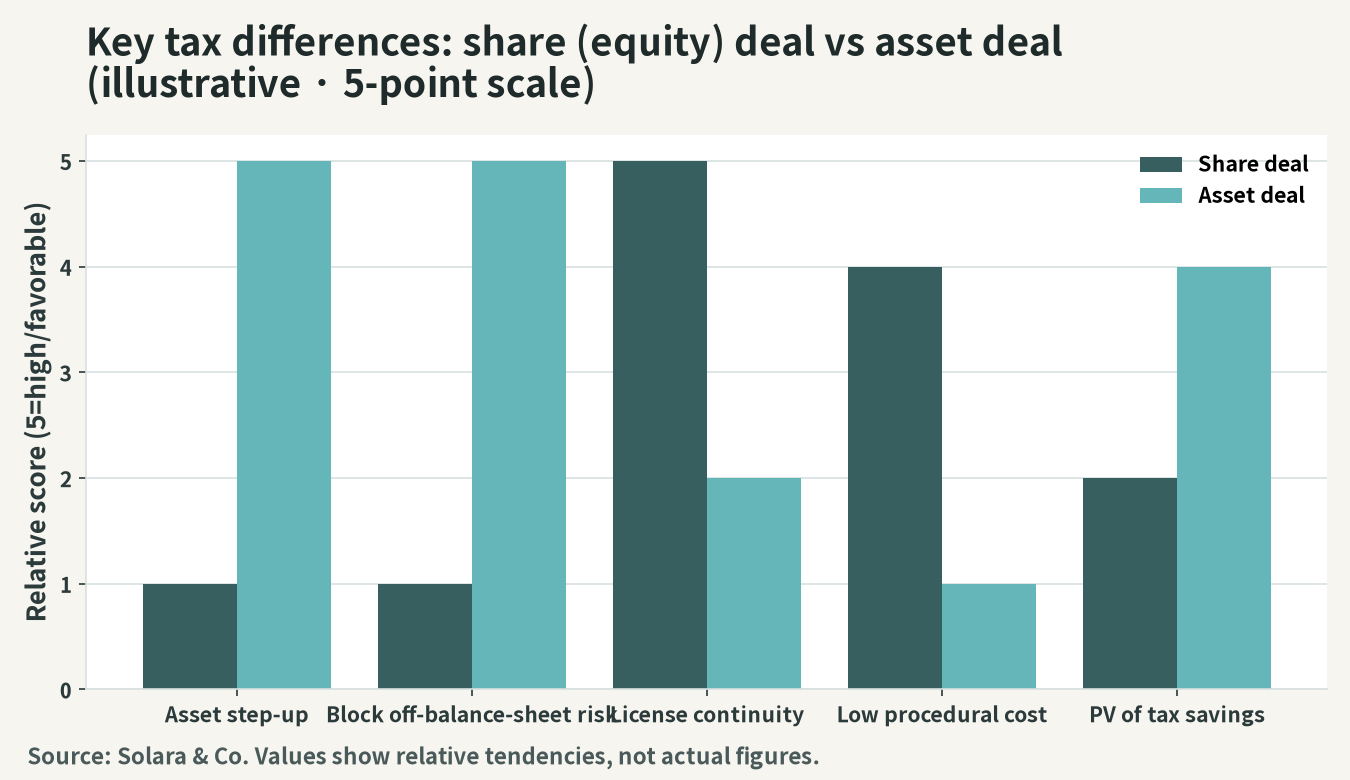
A share (capital contribution) deal takes over the corporate vessel whole, so the target company's tax book value (the acquisition cost of its assets) is carried over, and the difference between the purchase price and the book value cannot be stepped up (an increase in the recorded value of assets). Because the goodwill-equivalent portion cannot be amortized for tax purposes, it is a structure that hardly contributes to compressing the buyer's future taxable income. On the other hand, since off-balance-sheet tax risks (filing errors in prior years, denial of transfer pricing, unpaid FCT) are also in principle all inherited, it is necessary to scrutinize past tax positions through tax DD and to delineate risk with representations, warranties, and indemnity clauses. The contractual handling is explained in SPA in Vietnam M&A (share transfer agreement).
An asset deal allows the buyer to record the acquired assets at their acquisition cost, so a step-up is possible, and future taxable income can be compressed through depreciation of the target assets. The advantage of being able to cut off off-balance-sheet liabilities is also large, while in return, transaction costs such as re-obtaining licenses/contracts, asset-by-asset transfer registration, VAT, stamp duty, and registration fees arise, and asset transfer gains tax also arises on the seller's side. Which is more advantageous is decided by comparing the magnitude of the target company's tax risk, the transferability of licenses, and the present value of the tax savings obtained through the step-up; it is an issue that should be judged early within the overall design of the deal (The full Vietnam M&A process).
Solara & Co's tax structuring support
In Vietnam M&A, tax — with its multiple issues of capital gains tax, indirect transfer, remittance tax, treaties, transfer pricing, and the global minimum tax — is largely settled at the design of the deal's entrance. Direct holding or via an intermediate holding company, a share deal or an asset deal — that choice simultaneously governs not only the tax burden but also the difficulty of regulatory approval, reorganization flexibility, and the ease of cash recovery after the acquisition.
Solara & Co leverages a network of tax and legal experts on both the Japanese and Vietnamese sides to design the acquisition structure in unity with valuation, financing, and regulatory compliance. From substance design under which a "shell-only holding company" no longer works in the Pillar Two era, to risk assessment that looks ahead to indirect transfer taxation, to a capital-and-debt composition that factors in transfer pricing and the interest cap — we provide consistent support as a move to make before you buy. Please start with a single step: taking inventory of the tax risks of the structure you have in mind.