
The value of M&A is decided by "integration," not "signing the contract"
Acquiring a Vietnamese company is not finished the moment you sign the SPA (share purchase agreement) — that is the starting line, not the goal. Even after you have scrutinized the numbers in due diligence, negotiated the price, and completed closing, if you fail to blend organizational cultures during post-merger integration (PMI), the synergies you projected will remain pie in the sky. Importing the parent company's Japanese logic wholesale causes key people to leave one after another, saps frontline morale, and lets the very competitiveness of the company you bought dissolve away — this is the most frequent failure pattern in Vietnam M&A.
This article decodes the true nature of the "Japan–Vietnam wall" that Japanese firms face when integrating a Vietnamese company, and organizes from a practitioner's perspective how to design organizational-culture integration (culture PMI) so you can get over that wall. For the acquisition process as a whole, please also see The complete Vietnam M&A process; for the execution plan immediately after acquisition, see The PMI 100-day plan; and for HR-side risks, see HR risk in M&A PMI.
Where is the "Japan–Vietnam wall"?
Failures in cultural integration are not a matter of individual ability or goodwill; they arise from structural differences between the two countries' business cultures. Understanding the true nature of the wall at the level of concrete behavior — not abstract theory — is the starting point for addressing it.
Communication style and face (thể diện)
The Japanese workplace is accustomed to high-context communication in which "you grasp the meaning without it being said," but vague instructions do not get through to Vietnamese staff, who will not act unless even the reason — "why are we doing this?" — is made explicit. At the same time, in Vietnamese society scolding someone in public is taken extremely seriously as an act that "destroys their face (thể diện)," and the kind of "grilling in front of everyone" that is taken for granted in Japan can trigger an outstanding employee's resignation the very same day. The iron rule is that feedback be one-on-one, conveying points to improve together with points to commend. Conversely, praise in public is a powerful motivator. Scold in private, recognize in public — just this one distinction in how you operate can dramatically change the mood on the floor. Understanding the structure whereby the guidance the Japanese side gives in the belief that "strictness is affection" is received locally as "a lack of respect" will prevent stumbles right at the outset.
The tempo of decision-making and delegation of authority
The Japanese head office's decision-making by ringi (circulated approval) and consensus does not mesh with the speed of a young, fast-growing Vietnamese market. The recurring picture is one in which a local competitor decides a discount or a hire on the spot, while the Japanese subsidiary waits for head-office approval and misses the opportunity. If you do not delegate authority to Vietnamese managers but instead make them seek the head office's say-so on every single matter, they feel they are "not trusted" and lose their sense of ownership. Where to draw the line on how far local discretion extends is something that gets tested early in integration.
The sense of time and the workplace as "family"
In the Vietnamese workplace, relationships between superiors and subordinates and among colleagues are "familial," and the depth of human relationships that extends into private life underpins the sense of belonging. The dry, transactional detachment of the Japanese style, and an attitude that evaluates people by numbers alone, severs this emotional bond and invites unexpected backlash. On the other hand, simply respecting the local rhythm — such as the long holidays around Tet (the Lunar New Year) and consideration for weddings and funerals — greatly raises trust. Cultural integration is, at the same time as the work of aligning systems, also the accumulation of attentiveness to these everyday subtleties.
What to design in the early stage of integration (the first 100 days)
Cultural integration is not something that "will naturally settle in someday"; its direction is decided in the 100 days right after the acquisition. The anxiety and speculation left unattended during this period become the single biggest cause of attrition and declining performance.
Sharing vision and respect
The first step is to convey to all employees — as early as possible and in the words of top management themselves — the purpose of the acquisition, their roles under the new structure, and the continuity of employment and treatment. What matters is the equal stance of "let's grow together," not "we did you a favor by buying you." By clearly showing respect for what the Vietnamese founders and management team have built up to now, you let them receive the acquisition as an "opportunity for growth" rather than a "takeover." Because speculation and anxiety spread across the floor from the very day after the acquisition is announced, leaving no information vacuum, and reliably doing what you promised so as to build up an early "trust balance," will shape every subsequent stage.
Identifying and retaining key people
For the key people in engineering, sales, and procurement identified during the DD stage, offer retention bonuses, promotion paths, and clear roles in the new organization. Because whether they stay greatly changes the business's value, what is indispensable is a design that gives them not only good treatment but also the genuine sense that "I am needed for this company's future."
Friction in management style, and its adjustment
Transplanting Japanese management methods wholesale breeds resistance and confusion on the floor. Deliberately separating "the parts to change" from "the parts to respect" is the crux of the adjustment.
Transparency in evaluation, compensation, and promotion
Vietnam's labor market has high mobility, and young people strongly demand a clear career path and fair evaluation. If they feel that treatment is decided by seniority or personal favoritism, they will change jobs without hesitation. Putting evaluation criteria based on duties and results in writing, and making the conditions for promotion and raises visible, is the precondition for retention. The full picture of securing talent is also explained in The practice of recruiting and retaining talent in Vietnam.
Developing middle managers (Vietnamese managers)
Middle managers, who serve as interpreters and coordinators in the gap between Japan and Vietnam, are the lifeline of cultural integration. Giving them authority and backing (a voice in budget and personnel) and developing them into "bilingual managers" who can translate the Japanese side's intentions and the Vietnamese side's frontline sense leads to breaking free from dependence on expatriates. "Bilingual" here does not refer to language alone. It means people who understand both the values the Japanese head office prizes — quality, compliance, hou-ren-sou (report-contact-consult) — and the values the Vietnamese floor prizes — speed, human relationships, fairness — and who can explain each side's logic to the other. The reality is that such people are better found among the acquired company's existing employees and developed through investment than hired in from outside; that way they stay longer and find it easier to earn the floor's trust. For points to note under labor law, please refer to Vietnam's labor law.
Retention design to prevent attrition
Vietnam's voluntary turnover rate is structurally higher than Japan's, and it has its own rhythms, such as job changes concentrating right after bonuses are received following Tet (the Lunar New Year). The success or failure of cultural integration is, in the end, measured by "whether people leave."
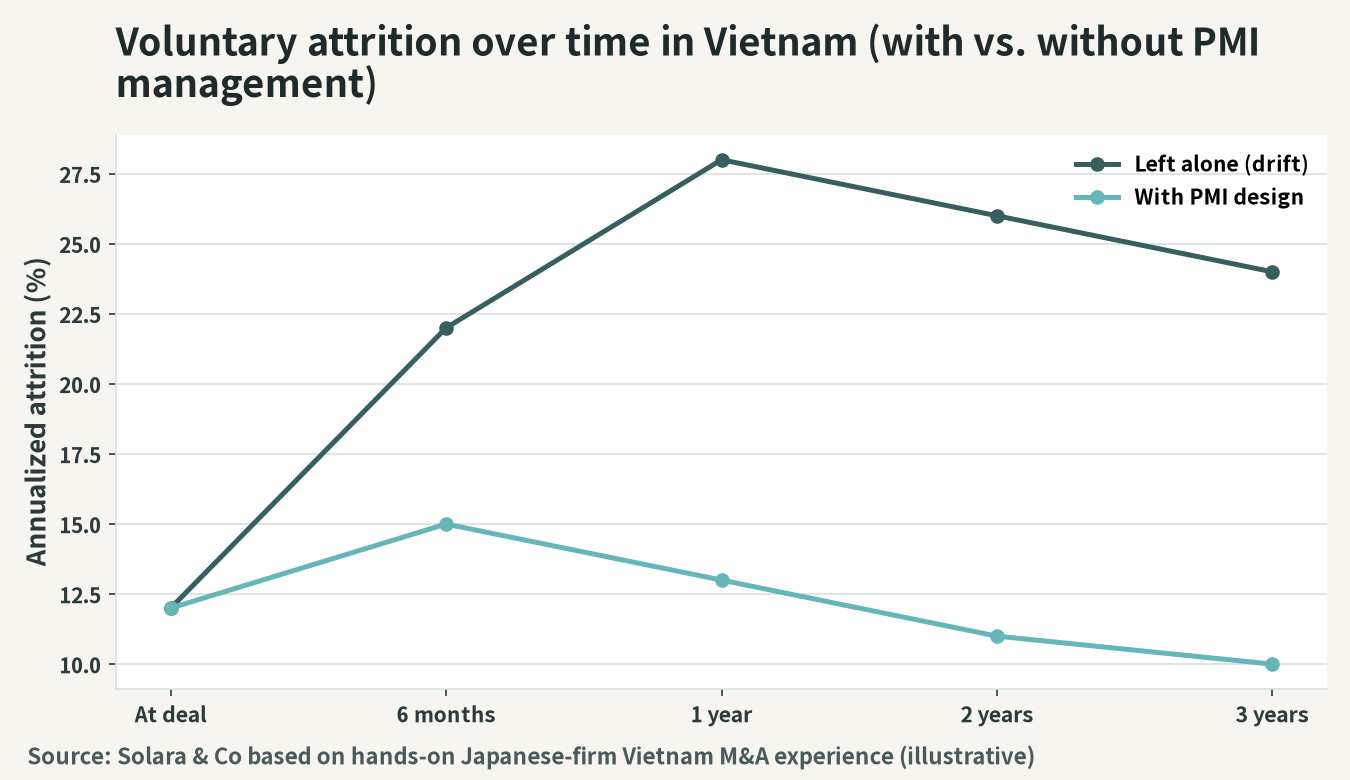
Retention cannot be completed by monetary treatment alone. Only when three things are in place — psychological safety (operations that protect face), growth opportunity (training, promotion), and a sense of ownership (delegation of authority) — do top performers stay for the long term. For an expatriate to wholly negate the floor's way of doing things right after the acquisition is the worst move; the standard play is to first respect the current ways and then standardize little by little through data and dialogue.
In practice, you set up mechanisms to catch signs of attrition early at milestones such as 90 days, 180 days, and one year after the acquisition (retention interviews, engagement surveys, and structured analysis of reasons for leaving). In particular, "the relationship with one's superior," "a lack of a felt sense of growth," and "conviction about one's evaluation" are the three biggest drivers of attrition, and all three are far lower in cost to prevent through early management design than to fill in reactively with money. To prevent the "domino" in which one outstanding person's departure triggers a chain of resignations among those around them, the satisfaction of key people should be a constant object of monitoring.
Designing the degree of integration — full integration or preserved autonomy
"Full integration" that repaints everything in the Japanese style is not always the right answer. When the acquisition target possesses unique strengths (brand, customer base, speed), excessive integration destroys those very strengths. If "making it the same as the Japanese parent's way" becomes an end in itself, you risk relinquishing with your own hands the greatest asset — the local adaptability you were supposed to have gained through the acquisition.
The degree of integration is decided by where the source of synergy lies. Because the back office (accounting, HR, IT governance) has large benefits from standardization, push integration there; in domains where local agility is the source of competitiveness — such as customer touchpoints and product development — deliberately leave autonomy in place. This kind of "integration with priorities" is especially effective in Vietnam.
The speed of integration also needs to be designed. For domains where risk accumulates if left unattended — such as governance, internal controls, and compliance — intervene early; meanwhile, changing corporate culture or brand too hastily invites psychological backlash on the floor. The key to minimizing confusion is to clearly distinguish "things that must absolutely change on Day 1 (approval authority, remittance controls, contract-approval flows)" from "things that take time to cultivate (evaluation systems, codes of conduct, a sense of unity)," and then plan the order of changes together with communication. The design of subsidiary governance is also organized in Governance and internal controls for Vietnamese subsidiaries.
Japan–Vietnam management practices: differences and integration policy
Regarding the main areas of friction, organizing the Japanese-side tendency, the Vietnamese-side tendency, and the integration policy gives the following. The actual design is adjusted according to the target company's size, industry, and staffing composition.
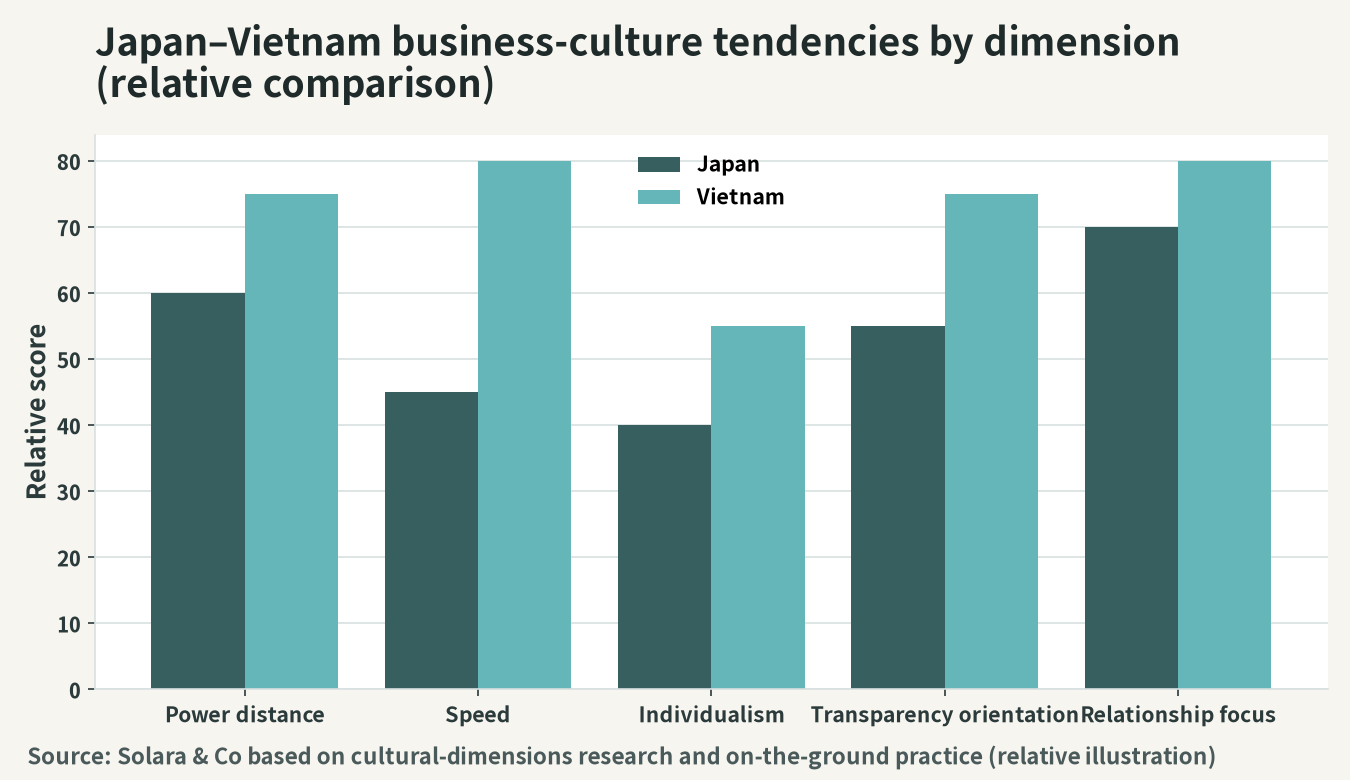
Area | Japanese-side tendency | Vietnamese-side tendency | Integration policy |
|---|---|---|---|
Instructions | High-context, read between the lines | Explicit, demand reasons | Verbalize purpose and background |
Reprimand | Guidance in front of the group | Face-conscious, done privately | Feedback one-on-one |
Decision-making | Consensus, ringi | Speed-focused | Draw the line on local discretion |
Evaluation | Seniority, personal | Results, transparency | Put criteria in writing |
Sense of belonging | Long tenure assumed | High mobility | Retention design |
Conclusion: cultural integration is the design of "translation" and "respect"
The synergy of Vietnam M&A is realized not inside the financial model but on the ground after the acquisition. And what moves that ground is a management that translates the cultural distance between Japan and Vietnam and pays respect to the strengths of both sides. Communication that protects face, speed through delegation of authority, retention through transparent evaluation — whether you can design these three points in the early stage of integration is the fork that decides whether you can turn the "wall" into a "bridge." With a team that knows the ground on both the Japanese and Vietnamese sides, Solara & Co provides seamless support from pre-acquisition DD through the formulation of the 100-day plan to walking alongside you in cultural integration.