
The Vietnam-specific risks behind "you can buy it cheap"
In the shadow of Vietnam's high-growth economy, companies burdened by excessive debt and owner-run businesses squeezed for cash are quietly increasing in number. Stagnant inventory in real estate development, a credit crunch in the corporate bond market, overinvestment in manufacturing equipment, and failed succession by founding owners — from these factors, "distressed deals (business turnaround / underperforming companies)" steeply discounted against their true operating value appear before buyers. For Japanese companies, this looks like an attractive entry opportunity. It offers the possibility of acquiring quality factories, land-use rights, licenses, and customer bases at prices unthinkable in normal times.
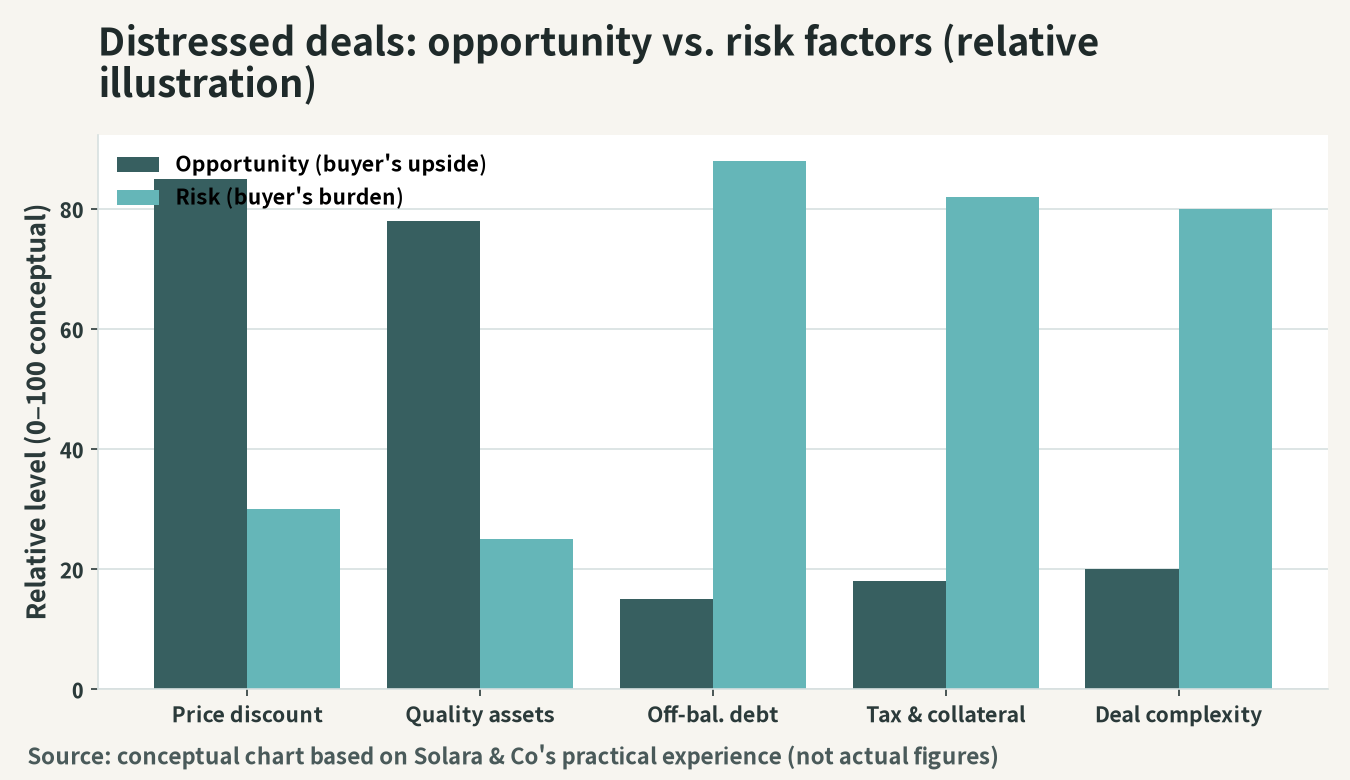
However, a distressed deal is not "cheap" but rather "cheap for a reason." Undisclosed off-balance-sheet debt, joint and several guarantees, overdue taxes and social insurance, the priority ranking of collateral, employee claims, unresolved negotiations with suppliers and banks — if all of these are structured to fall on the buyer, the cheapness of the acquisition price evaporates in an instant. Furthermore, Vietnam has a unique circumstance in that effective, court-led reorganization procedures like those in Japan barely function in practice, making the very way a deal is assembled fundamentally different from developed economies.
This article explains, from a practical perspective and grounded in issues specific to Vietnam, the sources of opportunity and the structure of risk in business-turnaround / distressed M&A in Vietnam, the practical reality surrounding the 2014 Law on Bankruptcy, and why a business / asset acquisition (carve-out) structure rather than a share acquisition is, as a rule, the safer choice.
Where do distressed deals come from
Behind the emergence of distressed deals in Vietnam lie several typical patterns. Understanding their sources is the first step to anticipating the kinds of risk lurking in a deal.
Over-leveraged real estate and manufacturing
The most common are real estate developers and manufacturers that took on excessive leverage through bank loans or bonds during boom times. In real estate, due to delays in project licensing or sluggish sales, inventory (unsold or under-construction properties) cannot be converted to cash, and interest payments fall into arrears. In manufacturing, after overinvestment in equipment, orders come in below expectations and the company can no longer bear its fixed-cost burden. In both cases, the core is "financial distress" — the business itself has value, but the capital structure (balance sheet) has collapsed.
The credit crunch in the corporate bond market
In Vietnam in recent years, a credit crunch has spread, centered on the real estate and construction sectors, triggered by tighter discipline in the corporate bond market and redemption difficulties at some issuers. Issuers unable to refinance selling off held assets or stakes in group companies to raise cash has become a supply source of distressed deals. Because bondholders, banks, and related parties are intricately entangled, grasping the creditor composition becomes the starting point for considering an acquisition.
Failed succession and internal disputes among founding owners
Vietnamese companies have a strong owner-control character, and it is not uncommon for management to fall into dysfunction due to the aging or sudden death of a founder, or internal disputes among family members and co-founders. This is distress originating in "governance" rather than "finance," and off-balance-sheet personal guarantees and the commingling of the owner's personal assets and liabilities with those of the company are often severe, raising the difficulty of due diligence (DD).
Why the price is attractive yet the risk is high
The price of a distressed deal is cheap because the seller is cornered in terms of time and money. But that very state of "being cornered" is also the source of risk for the buyer. Behind a rushed sale there is a high probability of hidden undisclosed debt, litigation, and tax risk, requiring deeper investigation than even a normal-times deal.
What to be especially wary of in Vietnam is off-balance-sheet debt and joint and several guarantees. Unpaid amounts to suppliers not recorded on the company's books, the company's joint and several guarantee of the debts of group companies or the founder personally, ongoing or potential litigation — these become the buyer's burden the moment the shares are acquired. In addition, overdue corporate income tax / value-added tax (VAT) and unpaid social insurance premiums will, because Vietnam's tax and social insurance authorities hold strong collection powers, surface in the form of back-tax assessments after the acquisition.
For these reasons, in distressed deals the sequence of "credit investigation first, then deep DD" is decisively important. If you grasp the target company's background, creditor composition, and the presence of any disputes at the gateway, you can pass on deals you should not pursue early. As detailed in Vietnam M&A: Why You Should Conduct a Credit Check First, the importance of this gateway credit investigation carries even greater weight in a distressed situation. For how to assess the credit risk of the acquisition target itself, please also refer to Credit Risk in Acquiring Vietnamese Companies.
The practical reality of Vietnam's bankruptcy law — why court procedures cannot be relied upon
In designing distressed M&A, what Japanese companies must understand most is the "gap between the text of the law and practice" in Vietnam's bankruptcy law regime.
The framework of the 2014 Law on Bankruptcy (Law on Bankruptcy 51/2014/QH13)
Vietnam has the 2014 Law on Bankruptcy (Law on Bankruptcy 51/2014/QH13, effective 2015), which institutionally provides a framework for "reorganization procedures" equivalent to Japan's civil rehabilitation / corporate reorganization, and "declaration of bankruptcy" equivalent to liquidation. The procedure is presided over by the competent People's Court and broadly stipulates the elements of a modern bankruptcy law, such as resolution of a recovery plan at a creditors' meeting and the appointment of an administrator (the entity responsible for asset management and liquidation).
The text exists but does not function in practice
The problem is the reality that this court-led reorganization procedure is barely used in practice. Because the procedure takes too long from commencement to conclusion, the courts' and administrators' accumulated experience in bankruptcy practice is limited, and the mechanism for coordinating interests among creditors is immature, there is a marked tendency for both companies and creditors to avoid formal court procedures. As a result, the majority of business turnarounds in Vietnam are handled as consensual out-of-court private workouts — that is, debt reduction through individual negotiations with creditors, banks, and sellers, or the sale of the business / assets.
This practical reality determines the shape of distressed M&A in Vietnam. The scheme of "taking over the entire company (as a going concern) under reorganization procedures," as in Japan, cannot be relied upon, and the buyer cannot presuppose a court's endorsement (such as approval of a reorganization plan guaranteeing a clean succession). It is precisely for this reason that the buyer must protect itself through the structure.
Share acquisition, or business / asset acquisition — protecting yourself through structure
The biggest issue in a distressed deal is the structural choice of "buying the entire company (shares)" versus "carving out and buying only the desired business / assets." To state the conclusion up front, in a distressed situation in Vietnam, a business / asset acquisition (carve-out) structure that selectively picks out only clean assets is, as a rule, the safer choice.
The pitfall of share acquisition (share deal)
A share acquisition has the advantage that, because it inherits the "vessel" of the company intact, licenses, contracts, and employees in principle continue. But in a distressed deal, this very nature of "inheriting intact" becomes fatal. This is because the buyer in principle comprehensively succeeds to all the negative legacy tied to the company — off-balance-sheet debt, joint and several guarantees, overdue taxes and social insurance, and litigation. Even if you try to address this with representations and warranties or indemnity clauses, since the seller has lost its financial means (which is precisely why it is selling), an indemnity claim tends to become pie in the sky.
The advantage of business / asset acquisition (asset deal / carve-out)
By contrast, a business / asset acquisition allows the buyer to select which assets, contracts, and employees it inherits. Acquiring only valuable factory equipment, inventory, intellectual property, and key customer contracts, while leaving the corporate entity to which off-balance-sheet debt and litigation are tied on the seller's side — through this "cherry-picking," the succession of negative legacy can be cut off. In a distressed deal, this ring-fencing effect holds value more important than the cheapness of the price.
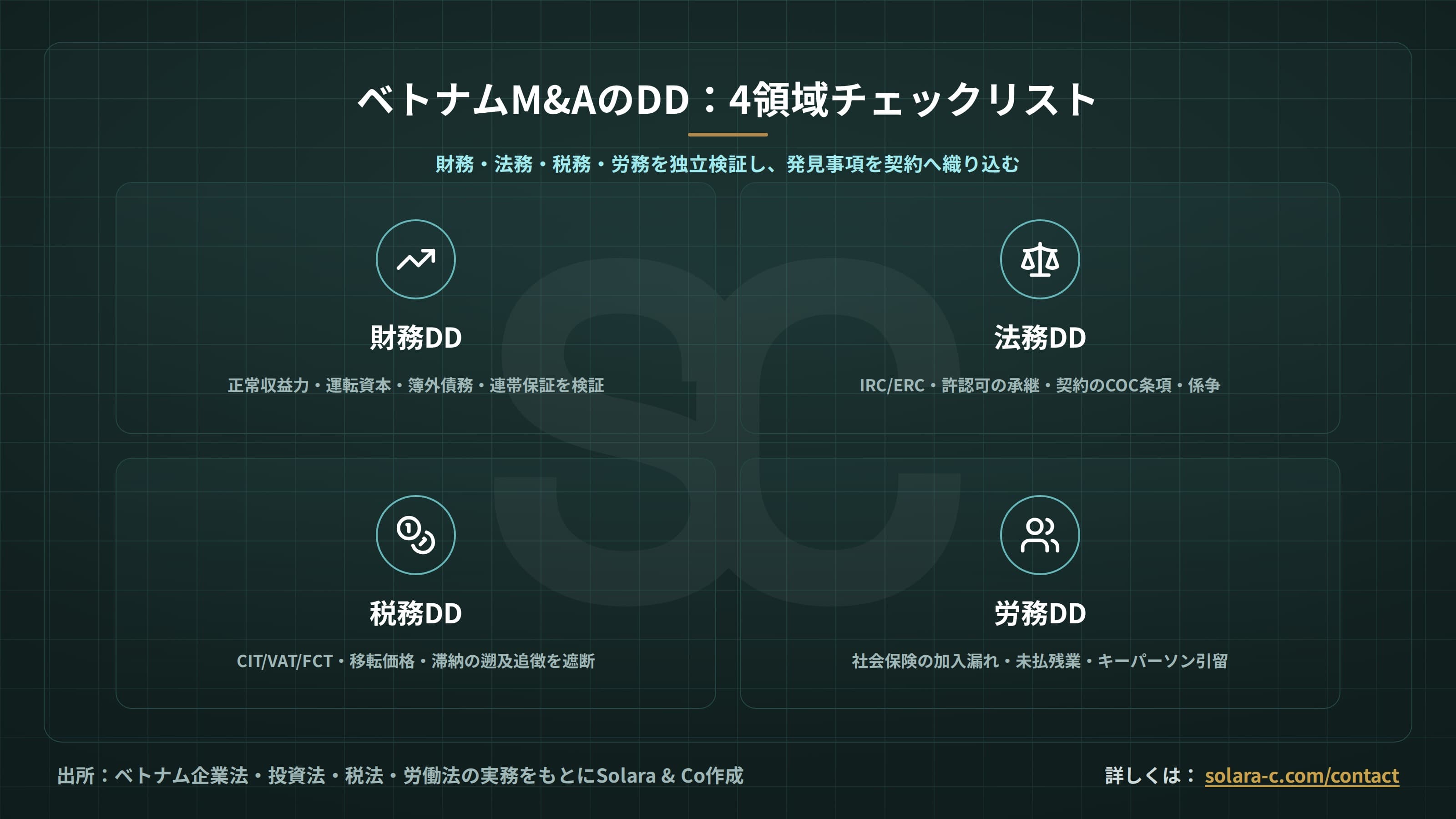
That said, an asset deal also has drawbacks. First, in Vietnam licenses (IRC/ERC and various business licenses) are tied to the corporate entity, so carving out the business gives rise to the need to re-obtain licenses, which takes time and cost. Second, the transfer of land-use rights (LURC) and individual assets requires asset-by-asset procedures such as discharge of mortgages and title transfer, which becomes burdensome. Third, attention must be paid to the risk, discussed later, of future rescission as a fraudulent transfer. For an overview of legal investigation, please refer to Legal Due Diligence in Vietnam M&A.
Comparison axis | Share acquisition | Business / asset acquisition (carve-out) | Via court procedure |
|---|---|---|---|
Cutting off off-balance-sheet debt | Weak (comprehensive succession) | Strong (cut off via selective acquisition) | Medium (can be sorted out via plan approval, but practice is immature) |
Speed | Fast (acquire the whole vessel) | Medium (heavy due to asset-by-asset transfer) | Slow (prolonged procedure) |
Price | Cheap but effectively high due to hidden debt | Reflects a peace-of-mind premium for the cut-off | Uncertain (depends on creditor coordination) |
Licenses | In principle easy to continue | Re-obtaining required | Depends on the plan, uncertain |
Suitable situation | Deals where debt is clear and limited | Deals with high off-balance-sheet debt / litigation risk | Exceptions where many creditors make a private workout difficult |
The priority ranking of collateral and employee claims — reading the structure of the scramble
In a distressed deal, multiple rights-holders swarm around the target assets. Unless you can read who holds rights to which assets and in what order, the assets you thought you bought may later be taken away by other creditors.
LURC mortgages and the priority ranking of collateral
In Vietnam, bank mortgages are set on most Land-Use Right Certificates (LURC, the Red Book) and key equipment. The priority ranking of security interests is in principle determined by the order of registration. Even if the buyer acquires the assets, if a prior-ranking mortgage has not been discharged, the risk of the mortgagee (bank) enforcing remains. Therefore, in an asset deal, it is essential to design the transaction so that part of the consideration is used as a repayment source bundled with the discharge of collateral, and to build the "substitution of collateral" or the simultaneous performance of mortgage discharge into the closing conditions.
The priority of employee claims
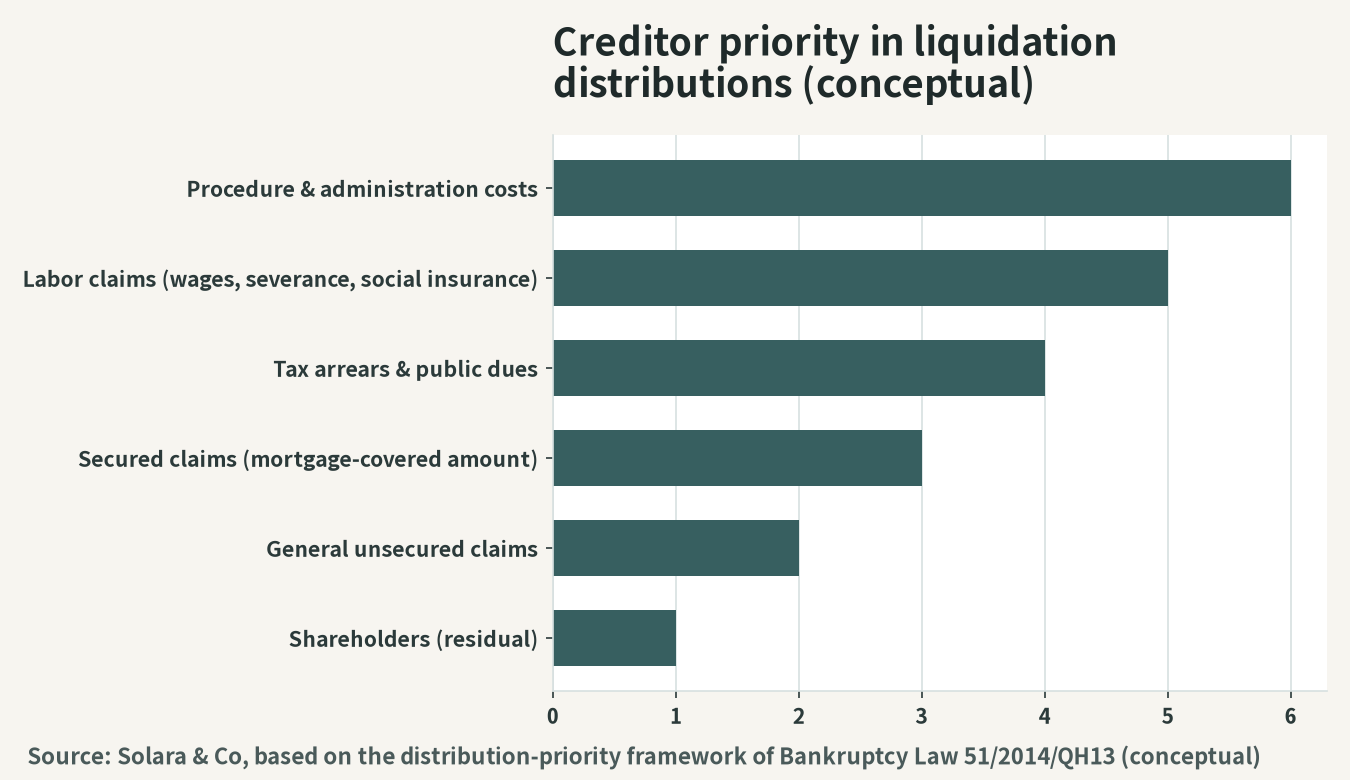
Under Vietnam's bankruptcy law regime, employee claims such as unpaid wages, severance allowances, and social insurance are placed at a high priority ranking in liquidation distributions. This is an expression of employee protection, but for the buyer it means that if a large amount of unpaid wages and social insurance has accumulated at the target company, it stands as a de facto priority claim against the assets. Alongside overdue taxes and social insurance, employee claims are one of the highest-priority items in distressed DD.
Fraudulent transfer / avoidance (clawback) risk
If a seller, while insolvent, transfers a specific asset to the buyer at an unjustifiably low price, that transaction may later become subject to avoidance or rescission by creditors or (if it transitions to bankruptcy proceedings) the administrator as a fraudulent transfer. This is clawback (unwinding) risk. In a distressed asset deal, substantiating the reasonableness of the consideration (that it is an acquisition at fair value) with an objective valuation, and clarifying the creditors' consent or the application of proceeds to repayment, is the lifeline protecting the stability of the transaction.
DIP-style new money and the practice of turnaround
A distressed deal does not end with "buying it"; it is only established when you design even how and by whom new money for the turnaround is supplied.
The concept of DIP-style financing
In turnarounds in developed economies, the company under reorganization (DIP: Debtor in Possession) is given a priority position and operations are run while the business recovers through new financing (DIP financing). Because Vietnam does not have an equivalent institutional framework, when the buyer injects new money, the realistic approach is to secure it in the form of setting collateral or as consideration for asset acquisition, so that the new money is not eroded by being subordinated to existing unsecured claims. Here too, the strength of the security changes greatly depending on whether the new money is injected into the company (shares) or into the carved-out business entity.
Negotiations with suppliers and banks determine success or failure
Since court procedures cannot be relied upon, a distressed turnaround in Vietnam hinges on the skill of individual negotiations with key creditors (especially banks) and major suppliers. Whether you can get the bank to accept discharge of collateral and debt forgiveness (a haircut), and whether you can get major suppliers to agree to continued supply and deferral of claims — this negotiation design carries the same weight as the acquisition structure. As for the means of resolution if negotiations break down and develop into a dispute, the framework of arbitration / mediation covered in Commercial Dispute Resolution in Vietnam serves as preparation.
Maintaining licenses and designing the exit
Finally, what tends to be overlooked is maintaining licenses after acquisition and the exit in case the turnaround does not go well.
How to inherit licenses
In Vietnam, the licenses that form the core of a business (Investment Registration Certificate IRC, Enterprise Registration Certificate ERC, and industry-specific licenses) are tied to the corporate entity. Even when carving out clean assets in an asset deal, to lawfully operate that business often requires newly obtaining licenses or procedures for conditional business lines, and unless you factor this required period into the acquisition plan, you fall into the situation where you have obtained the assets but cannot run the business. Confirming whether it is a conditional business line is a precondition for the choice of structure.
The exit when things do not go well
Distressed investment is inherently high-risk, so you should design even the exit of withdrawal / liquidation on the premise that the turnaround may not succeed. Because the practice of company liquidation / withdrawal in Vietnam takes time and cost, the entry structure (especially a design in an asset deal that does not bring in debt) directly governs the ease of the exit. The specific procedures for withdrawal / liquidation are detailed in Vietnam M&A Exit Strategy: Liquidation and Withdrawal. Note that the overall choice of structure in a distressed situation is positioned as an application that builds on The Full Process of Vietnam M&A, which discusses the full process in normal times, but raises the weight of risk cut-off.
Support from Solara & Co — to turn "opportunity" into "fruit"
Vietnam's distressed / business-turnaround M&A, even more than normal-times M&A, is only established when gateway credit investigation, deep DD, structure design, and creditor negotiations are connected as a single line. Lured by the cheapness of the price, leaping into a share acquisition gets you swallowed by off-balance-sheet debt; mistaking the structure gets your legs swept out by the priority ranking of collateral and employee claims; misreading the licenses leaves you with assets but an inoperable business — a distressed deal is a domain where opportunity and risk sit side by side, separated by a hair's breadth.
Solara & Co, with bases and human networks on both the Japan and Vietnam sides, provides integrated support from gateway credit investigation and grasping the creditor composition in a distressed deal, to deep-dive financial, legal, and tax DD, the design of a carve-out structure that cuts off off-balance-sheet debt, negotiations with banks and suppliers, a closing that incorporates discharge of collateral and licensing procedures, and accompaniment through the turnaround phase. Whether you can truly turn the opportunity of "buying it cheap" into "fruit" — we support you starting from determining that dividing line together.