
Minority investment as a strategic option — the "don't take the majority" approach
When it comes to investing in Vietnamese companies, many Japanese firms picture an acquisition in which they take more than 50% of the shares and turn the target into a subsidiary (a majority investment). In practice, however, an investment structure in which the investor deliberately remains a minority shareholder holding less than 50% is, in more than a few situations, the rational choice. The problem lies in the wide gap between, on one hand, the misconception that "a minority investment is a weak position that receives no protection at all under company law," and on the other, the reality that "with properly drafted contracts you can secure influence comparable to that of a majority shareholder."
This article organizes — by investment-ratio band — the following questions: why choose a minority investment in Vietnam, what statutory rights the Law on Enterprises 2020 grants to minority shareholders, and which rights — precisely because the law does "not grant" them — must be separately secured through a shareholders' agreement (SHA). Precisely because you are not taking the majority, the skill of your contractual design is what determines the safety of the investment.
Why choose a minority investment
Regulatory caps on foreign ownership
The biggest reason is Vietnam's distinctive foreign-investment regulation. Under WTO commitments and individual statutes, conditional sectors (market-access-restricted sectors) impose a foreign ownership cap on the equity ratio of foreign investors. In fields such as advertising, logistics, transport, parts of real estate, banking, and telecommunications, a cap of 49% or 51%, or a sector-specific cap, may mean that taking the majority is impossible from the outset, or that sharing the stake with a local joint-venture partner is a precondition. Which sectors carry which caps is a matter to confirm early as the starting point of deal design, as detailed in the discussion of Vietnam's conditional business sectors and licensing.
Partnering with the local owner
Vietnamese companies tend to be strongly owner-controlled, and it is not uncommon for "intangible assets" — licenses, land-use rights, sales networks, and relationships with authorities and business partners — to be tied to the individual founder-owner. Taking the majority and removing the owner risks letting these assets flow out together with them. A minority investment — leaving operational leadership to the owner while injecting capital and management know-how — is a rational structure for preserving such locally dependent assets. How to assess a joint-venture partner is covered in the discussion of joint-venture partner selection in Vietnam.
Staged entry and the call option
Limiting risk to establish a foothold in the market, assessing the substance of the business from the inside, and only then making additional investments to raise the stake above 50% — this staged entry is also a typical motivation for choosing a minority investment. If you enter first as a minority shareholder and set up in the contract a call option to buy additional shares upon meeting certain performance conditions or after a set period, you secure the path to future majority control while limiting initial-stage risk.
Statutory rights the Law on Enterprises 2020 grants to minority shareholders
In a Vietnamese joint-stock company (JSC), the rights a minority shareholder automatically holds under the law grow stronger in stages according to the investment ratio. Especially important is the supermajority threshold required for material resolutions.
Voting thresholds — the 65% / 75% walls
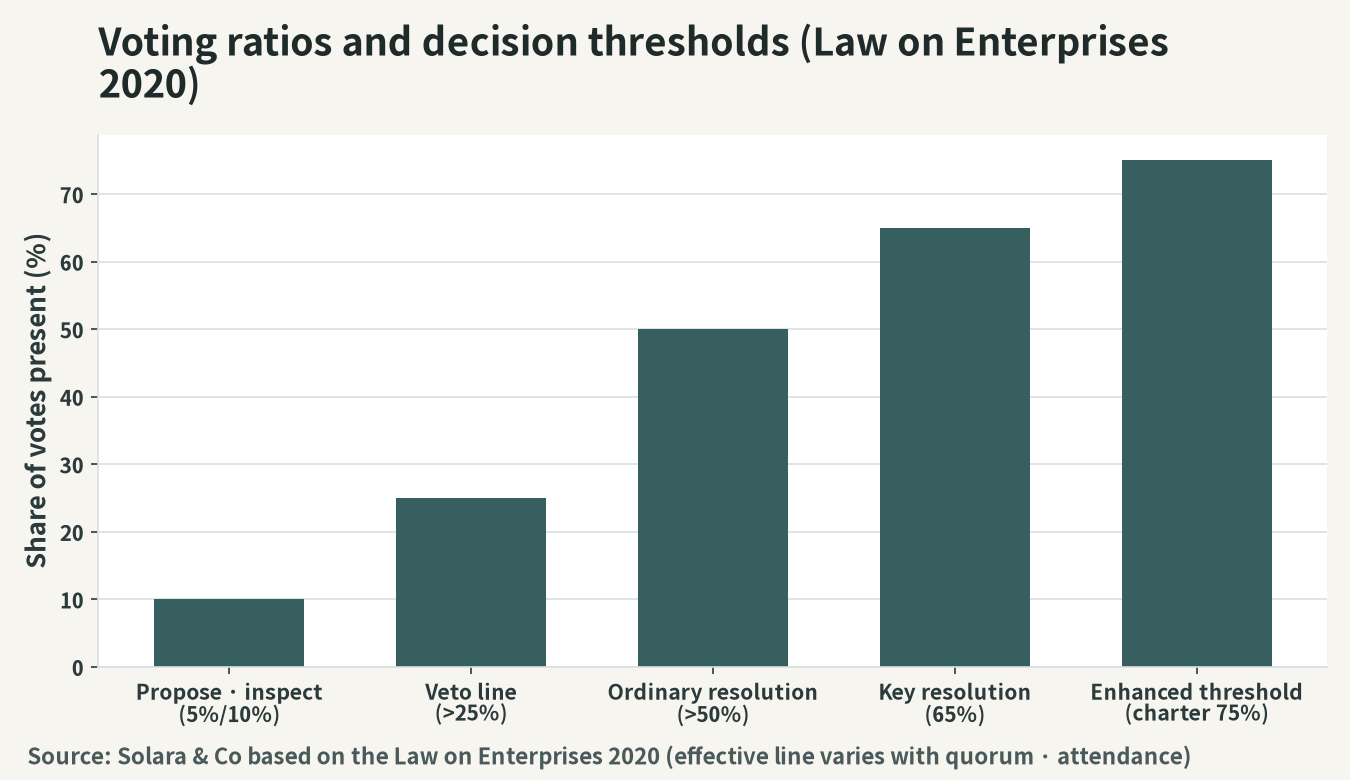
Under the Law on Enterprises 2020, an ordinary resolution of the general meeting of shareholders passes with more than 50% of the votes of attending shareholders, but material matters — such as amending the charter, changing the type of business or field of investment, reorganization (merger or division), dissolution of the company, and disposing of assets worth 35% or more of total assets — require the approval of at least 65% of the votes of attending shareholders. Furthermore, if the charter so provides, a higher threshold (in practice, a 75% level) can be set for certain matters.
The practical implication is clear. Even a minority shareholder, if holding more than 25%, stands at the blocking-minority line and can single-handedly block the passage of a material resolution (65%) on an attendance basis. Depending on assumptions about the meeting's quorum and attendance rate, securing more than 35% yields a more reliable blocking position. It is not that "being unable to take the majority means being powerless"; rather, holding 25–35% is itself a powerful bargaining card — a de facto veto over material resolutions.
Shareholder proposal rights, inspection rights, and derivative actions
Beyond voting rights, the Law on Enterprises 2020 grants minority shareholders a range of governance rights. Notably, shareholders holding at least a certain percentage (in practice, 5% or 10% or more unless lowered by the charter) are granted the right to propose agenda items for the general meeting, the right to inspect and copy books and records such as minutes of the board of management and the supervisory board and finance-related documents, and the right to bring a derivative action against breaches of duty by directors and management. These are statutory footholds that let shareholders without a majority monitor the controlling shareholder and management and check improper management decisions.
That said, these statutory rights have limits. The scope of documents that can be inspected and the handling of proposals ultimately depend on how the meeting and board — controlled by the majority — are run, and a derivative action involves the heavy procedures of proving and enforcing a claim in Vietnamese courts. Statutory rights are a "minimum floor"; they do not satisfy all the protection an investor truly needs.
Rights the law does not grant — so secure them by contract
What divides success and failure in a minority investment is whether you can build, without gaps, the rights the company law does not grant into a shareholders' agreement (SHA). The following are representative items not covered by statutory rights that must be separately secured by contract.
Veto rights (reserved matters)
Beyond the scope protected by the 65% statutory threshold, the minority shareholder lists matters on which "these, at least, must not be decided without my consent" and sets up veto rights (reserved matters). Typical examples include approval of the annual budget and business plan, capital expenditure or borrowing above a certain amount, related-party transactions, capital increases, charter amendments, M&A, dividend policy, and the appointment and removal of key persons. Because the matters on which a statutory block is effective at a 25% or 35% holding are limited, you actively widen the scope of protection through contractual reserved matters.
Board nomination rights
A minority shareholder's right to place its own representative on the board (board nomination right) is not automatically guaranteed by law. By stipulating in the contract a number of nomination seats proportional to the investment ratio and reflecting this in the charter, the investor can stay continuously involved in the management decision-making process. Securing a seat on the board is also indispensable for closing the information asymmetry and exercising veto rights effectively.
Information and reporting rights
Monthly and quarterly financial reports, management metrics, notification of material events — information and reporting rights for continuously grasping the situation at the investee are also contractual matters. Because the statutory inspection right under company law is passive and limited in scope, you need to set up in the SHA a framework for actively receiving periodic reports. Building a continuous governance structure for the investee is also closely related to the design of subsidiary governance in Vietnam.
Rights of first refusal, tag-along, and drag-along
The cluster of clauses governing situations of change in the shareholder structure is also important. The right of first refusal (ROFR) is the right of a minority shareholder to buy out, on the same terms, on a priority basis when another shareholder sells its stake to a third party; the tag-along right is the right of a minority shareholder to sell out together on the same terms when the controlling shareholder sells. Conversely, the drag-along right — which lets the controlling shareholder compel the minority shareholder to sell — is also negotiated as part of the exit design. These prevent the minority shareholder from being "left behind with a counterparty it does not want" or "having its exit blocked."
Dividend policy, anti-dilution, deadlock, and exit
The dividend policy is set in the contract to clarify the balance between retaining profits internally and returning value to shareholders. An anti-dilution clause to prevent the minority shareholder's stake from being diluted in future capital increases, a procedure for resolving stalemates when decision-making among shareholders is deadlocked (the deadlock clause), and a put option securing the ultimate exit (the right to make the counterparty buy out one's stake under certain conditions) are all lifeline clauses for the minority investor. The full range of exit-strategy options is organized in the discussion of exit and liquidation in Vietnamese M&A.
Investment-ratio band | Rights under company law (Law on Enterprises 2020) | Rights to secure separately by contract |
|---|---|---|
~5% | Basic shareholder rights such as receiving dividends and voting at the meeting | Information and reporting rights; consider an exit (put) |
5–25% | Shareholder proposal rights, inspection rights, derivative actions (5%/10% threshold) | Board nomination rights, reserved matters, ROFR/tag |
25–35% | The above + a de facto veto line over material resolutions (65%) | Widen the scope of veto rights, information rights, anti-dilution |
35–50% | A firm blocking position (blocks supermajority) | Expand board nomination seats, dividend policy, deadlock resolution |
Over 50% | Sole passage of ordinary resolutions (substantive control) | (Majority side) Minority consent matters, drag design |
Vietnam-specific issues — the effectiveness of the SHA and protection of minority shareholders
Governing law and arbitration of the shareholders' agreement
However finely you build rights into a contract, it is meaningless if they cannot be effectively enforced in Vietnam. For an SHA covering a Vietnamese company, the design of the governing law and the dispute-resolution venue is decisive. In practice, a widely adopted design makes the governing law of the SHA itself a neutral law such as Singapore law and refers dispute resolution to offshore arbitration such as the Singapore International Arbitration Centre (SIAC), enhancing predictability and neutrality. On the other hand, matters relating to the company's organization — such as board nomination and charter amendment — must ultimately be reflected in Vietnamese law and in the charter and the enterprise registration certificate (ERC) to be enforceable against third parties. The key is not to leave the rights in the SHA as mere "contractual promises," but to translate them into charter provisions to the maximum extent possible and protect them with a two-tier structure.
The risk of minority oppression by the controlling shareholder
In a structure where a dominant owner remains, the risk of minority oppression — extracting profits through executive compensation or related-party transactions rather than paying dividends, withholding information, diluting the stake through capital increases — genuinely exists. Because judicial relief in Vietnam takes time and cost and is not easy to prove, the best defense is not to fight after oppression has occurred but to design preventively: build reserved matters, information rights, dividend policy, and a put option into the contract stage so that oppression itself never arises.
Capital injection via DICA and remittance on exit
The payment of capital by foreign investors, and the future recovery of dividends and consideration for the transfer of the stake, are in principle carried out through a direct investment capital account (DICA). Even for a minority investment, if you do not correctly design this remittance route at both the entry (capital injection) and exit ends, you may end up unable to recover the consideration abroad even after exercising the put option you painstakingly secured. The financing structure of the investment should be examined together with the issues covered in the discussion of financing and funding structures in Vietnamese M&A.
Realistic exit routes
A minority investment has several exit routes: exercising the put option against the majority shareholder or founder-owner, transferring the stake to a third party (under the constraints of ROFR or tag-along), staged accumulation into majority control and full acquisition, or riding along into a future IPO or trade sale. What matters is to agree concretely on the exit route and the price-determination mechanism (valuation method and reference date) at the time the entry investment contract is signed. A minority investment that defers its exit clause is liable to become a stranded holding while still carrying the risk of being unable to recover.
Conclusion — precisely because it is minority, contract design is the lifeline
A minority investment in Vietnam is an option with clear strategic rationality: responding to foreign-investment regulation, collaborating with the local owner, and staged entry. The Law on Enterprises 2020 grants minority shareholders statutory protections such as a veto over material resolutions through holdings above 25–35%, shareholder proposal rights, inspection rights, and derivative actions — but these are no more than a "minimum floor."
The scope of veto rights an investor truly needs, board nomination rights, information and reporting rights, ROFR/tag/drag, dividend policy, anti-dilution, deadlock resolution, and a put-option exit must all be actively built into the shareholders' agreement, reflected in the charter to the maximum extent possible, and have their effectiveness secured through a neutral governing law and offshore arbitration. Precisely because you are not taking the majority, the precision of contract design translates directly into the safety of the investment. Solara & Co provides end-to-end support — from rights design by investment-ratio band, to the governing-law and arbitration clauses of the SHA, to the design of capital injection and exit remittance via DICA, and on to future majority control. For the fundamentals of the joint-stock-company system for Vietnamese companies, please also refer to the explanation of Vietnam's Law on Enterprises 2020.