
Closing Is Not the Goal but the Start of the "100 Days"
"We have succeeded with our M&A of a Vietnamese company"—many buyers feel exactly that at the moment of closing (deal completion). Yet the synergies priced into the acquisition do not materialize by so much as a single yen merely upon signing the contract. Whether synergies turn into real profit is largely decided by the post-merger integration (PMI) that follows—and above all by how you act in the first 100 days.
PMI in Vietnamese M&A has its own inherent pitfalls that differ from domestic Japanese integration or the acquisition of a Western company. The legal representative and the company seal are tied directly to actual managerial control; off-balance-sheet liabilities tend to surface after the acquisition; the departure of key people strikes directly at business continuity; and the burden of aligning accounting and internal control from VAS to group standards is heavy. This article explains, from a practical standpoint, how to build a "100-day plan" that takes all of this into account, together with the focus of each phase.
Why the First 100 Days Are Decisive
The first few months right after the acquisition are a period in which employees, business partners, and banks watch with bated breath to see "how the company will change from here." If you cannot clearly show managerial intent and the direction of integration during this period, key people who cannot bear the uncertainty will leave, business partners will drift away, the front line will adopt a wait-and-see stance, and performance will stall.
Securing Momentum and Trust
The 100-day marker carries the meaning of "not letting the initial momentum slip away." Demonstrating small successes (quick wins) early and cultivating trust in the new management forms the foundation for driving the full-scale integration that follows. Conversely, spending the first 100 days solely on "grasping the current situation" squanders a prime opportunity for change.
Preparing Day 1 Readiness
Ideally, execution of the 100-day plan should be able to begin on the very day of closing (Day 1), so it should be prepared before closing. Who goes to which site on the first day, what they communicate, and which authorities they take over—by fixing this Day 1 readiness (first-day response plan) in advance, you can move to take control from the moment the acquisition is completed, leaving no vacuum. In Vietnam, the delicate steering required is to give due consideration to relations with the former management and to the continuity of licenses, while transferring real control swiftly.
The Most Critical Vietnam-Specific Issue: Taking Control of the Representative and the Seal
What must be secured before anything else in Vietnamese PMI is control over the legal representative and the company seal (con dấu).
Changing the Legal Representative
In Vietnam, the legal representative holds enormous authority, representing the company in contracts, banking transactions, and administrative procedures. After the acquisition, amending the entry on the Enterprise Registration Certificate (ERC) to install the person nominated by the buyer as legal representative is the first step in taking hold of real managerial control. Until this change is completed, the former management can continue to act in the company's name, so it must be advanced as the top priority.
Managing the Seal, Bank Accounts, and Key Documents
In Vietnam, the practical custom that a contract or instruction takes effect only once the seal is affixed is deeply rooted, so physical control of the seal is synonymous with managerial control. Clarifying and taking hold—at the point of Day 1—of who manages the seal, the authorized signatories on bank accounts, and the originals of the key licenses (IRC/ERC) and the Land Use Right Certificate (LURC) is the lifeline for preventing outflows of funds and fraud.
The Three Phases of the 100-Day Plan
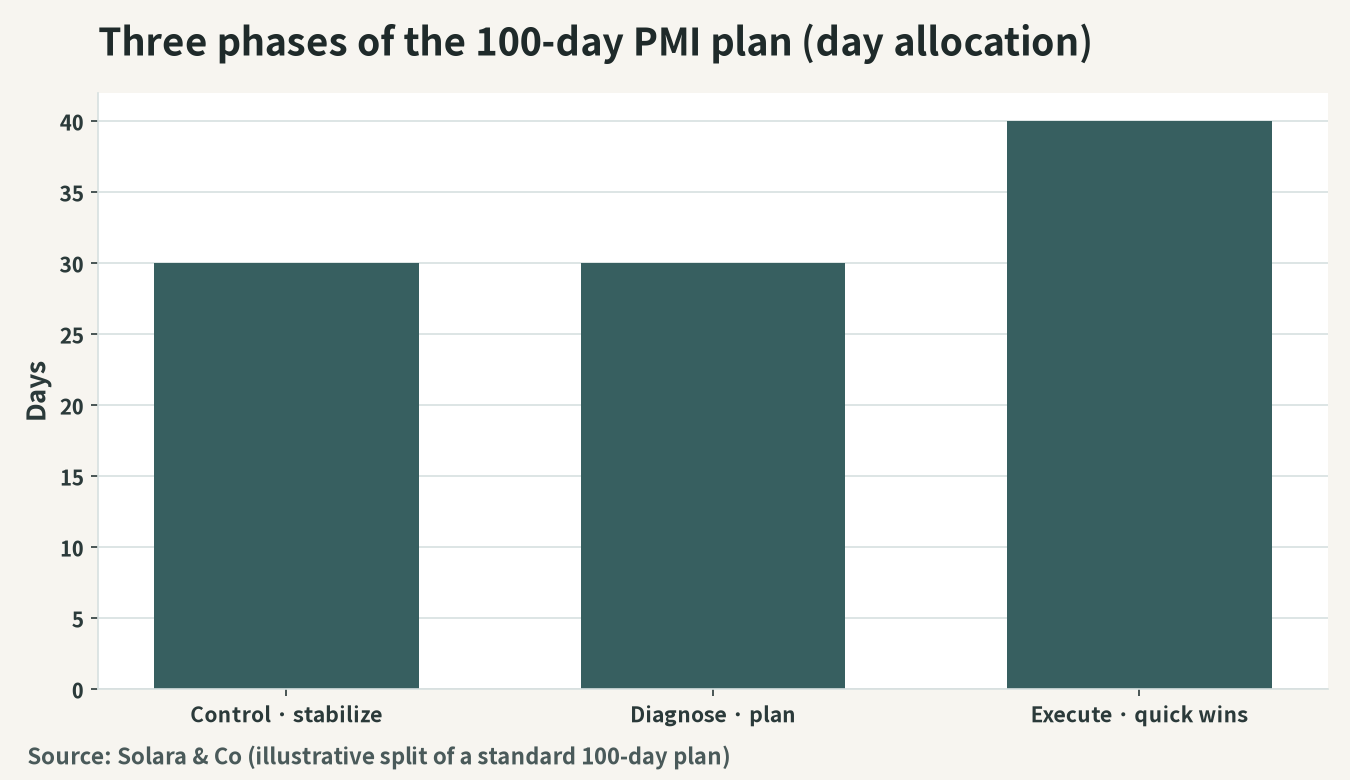
The 100-day plan is designed in roughly three phases. Not confusing the focus of each phase is the key to making effective use of the limited time.
Phase 1 (Days 0–30): Taking Control and Stabilizing
The first 30 days have "taking control" as their theme. You secure control of the legal representative, the seal, and the bank accounts; redesign the board of directors and decision-making authority; hold individual interviews with key people and signal your intent to retain them; and send a unified message to employees, business partners, and banks. At the same time, you launch the Integration Management Office (IMO) as the command center that leads integration.
Phase 2 (Days 30–60): Diagnosis and Planning
The next 30 days are for "diagnosis." You grasp the realities of finance, HR, operations, and IT from the inside, going beyond the information obtained in due diligence, and root out hidden off-balance-sheet liabilities and inefficiencies. On that basis, you translate the priorities for realizing synergies, the optimization of the organization and headcount, and the policy for integrating accounting and internal control into a concrete roadmap for the period beyond 100 days.
Phase 3 (Days 60–100): Execution and Quick Wins
The final 40 days are for "execution." Among the measures defined during diagnosis, you implement those whose effects show early (reviewing procurement terms, rationalizing duplicated functions, strengthening credit and receivables management) and make the quick wins visible. Integrating accounting to group standards and establishing reporting lines should also be put on track during this period. What matters is not to "finish everything" within 100 days, but to position the 100 days as "the period for completing the run-up to full-scale integration and establishing momentum and trust." If, at the end of the 100 days, it is clear who holds what authority and which KPIs are tracked and how, the subsequent integration becomes far easier to advance.
Talent Retention and the Integration of Corporate Culture
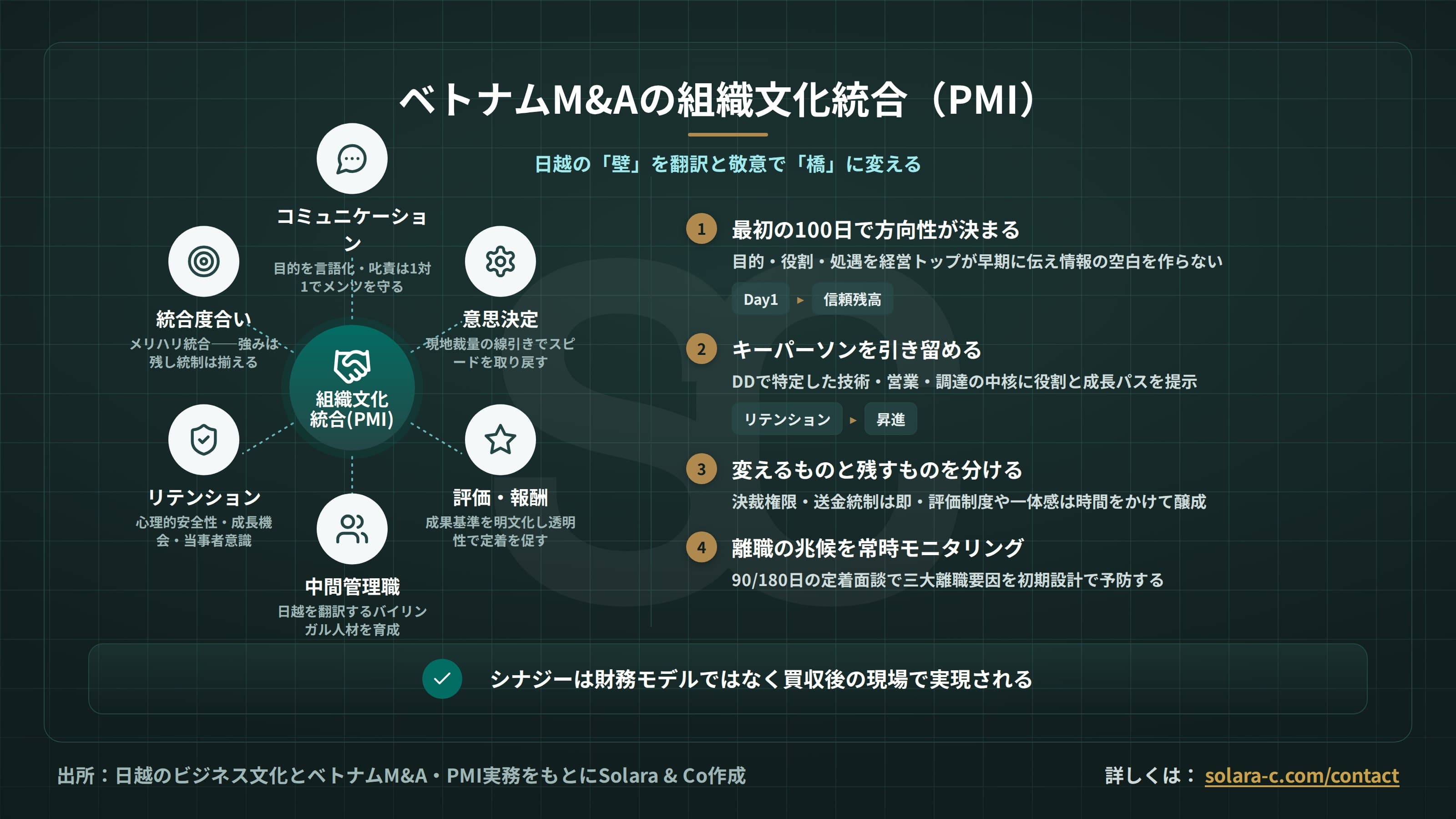
The single greatest variable that determines performance in Vietnamese PMI is people. Especially at companies with a strong owner-controlled character, the sales network, technology, and relationships with business partners are concentrated in the founder or specific key people, and their departure shakes the very foundation of the business.
Retaining Key People
At an early stage after the acquisition, identify who is indispensable to business continuity and retain them through retention bonuses and clarity on roles and treatment. At the same time, to dissolve excessive dependence on specific individuals, advance the visualization and handover of knowledge in a planned manner. The structure of personnel risk and how to address it is also discussed in detail in our explanation of PMI and HR risk after M&A in Vietnam.
Culture and Communication
Unilaterally imposing Japanese-style management invites resistance and resignations among local employees. While respecting local business customs and decision-making styles, clearly state the principles on which you will not compromise (compliance and governance)—continuing to convey this balance through careful communication is the crux of cultural integration. The period right after the acquisition is when employee anxiety peaks, so showing the management policy, the continuity of employment, and the outlook on treatment early and candidly prevents needless resignations and turmoil. You should bear in mind that silence is the worst message of all.
The Role of the Integration Management Office (IMO)
Indispensable to keeping the 100-day plan from becoming a "pie in the sky" is a dedicated command center that drives integration full-time: the Integration Management Office (IMO).
Who, What, and by When
The IMO gathers members from both the buyer and the target company and takes charge of listing integration tasks, prioritizing them, managing progress, and escalating issues. By centrally managing "who, what, and by when" and putting in place a mechanism to report weekly to top management, it eliminates the ambiguity of leaving things to the front line. Because Vietnam has barriers of language and business custom, placing in the IMO people who can bridge both the Japanese and Vietnamese sides greatly influences the speed and precision of integration.
Tracking KPIs and Synergies
The synergies anticipated at the time of acquisition (cost reductions, revenue expansion) are broken down into concrete KPIs that the IMO monitors at fixed intervals. Synergies are not something that "will appear someday"; they materialize only when you track "when, where, and how much." If there is a shortfall, taking action early and revising the plan nimbly is what leads to justifying the acquisition price.
Integrating Accounting, Finance, and IT Systems
A quiet but important area of integration is accounting, finance, and IT. Because the target company keeps its books under VAS (Vietnamese Accounting Standards), loading them into head-office consolidation requires recasting to group standards.
Accelerating the Monthly Close and Internal Control
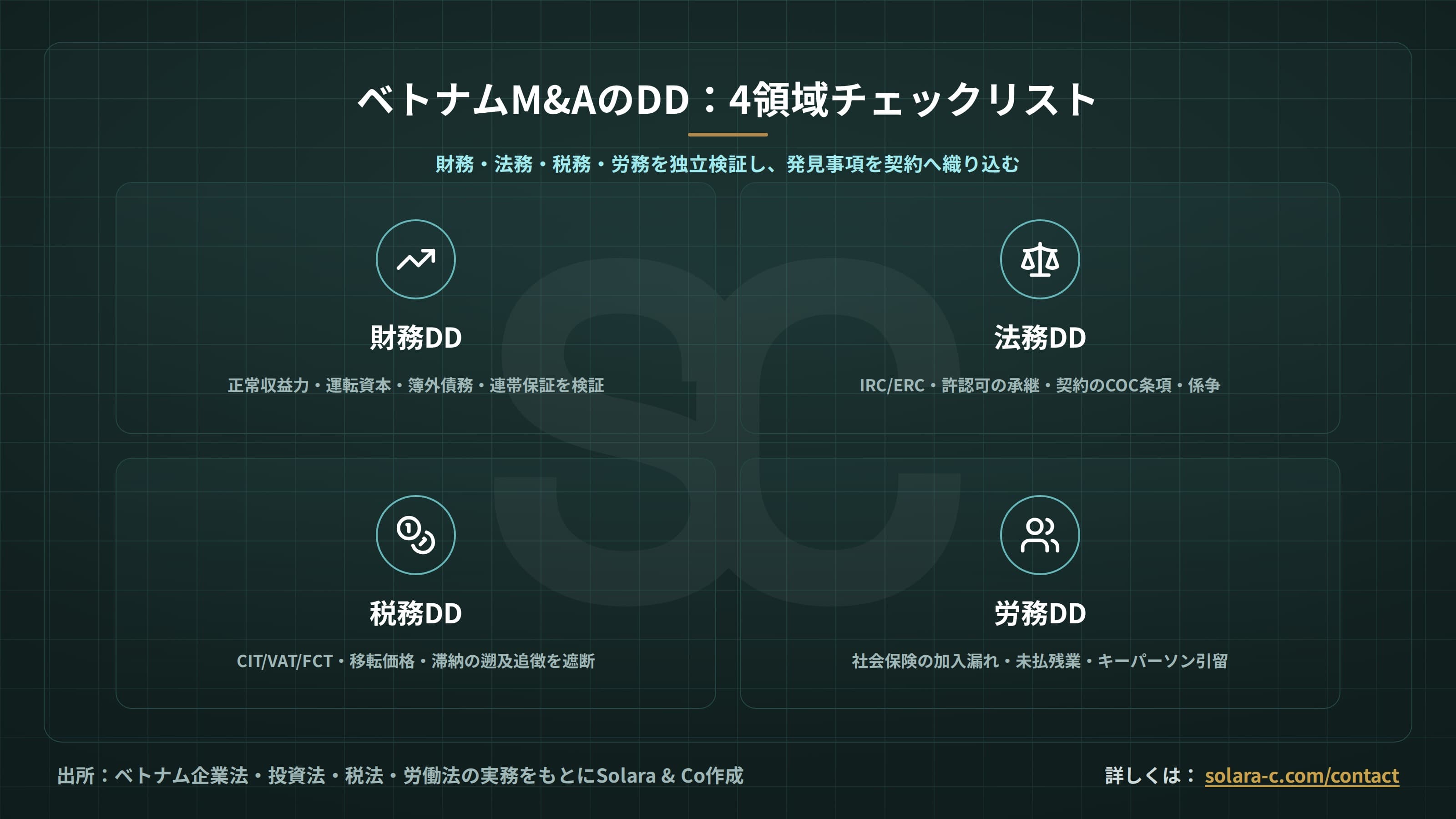
Early in PMI, accelerating the monthly close and aligning it with the group's chart of accounts and reporting format is the prerequisite for managerial visibility. At the same time, develop internal controls such as approval authority, segregation of duties, and cash-and-deposit management to prevent fraud and opaque outflows of cash. A concrete response to the differences between VAS and group standards is effectively designed together with our explanation of Vietnamese Accounting Standards (VAS) and the differences from IFRS.
Why PMI Fails
A failure to achieve M&A synergies correlates strongly with the skill or clumsiness of PMI. Failure has typical patterns.
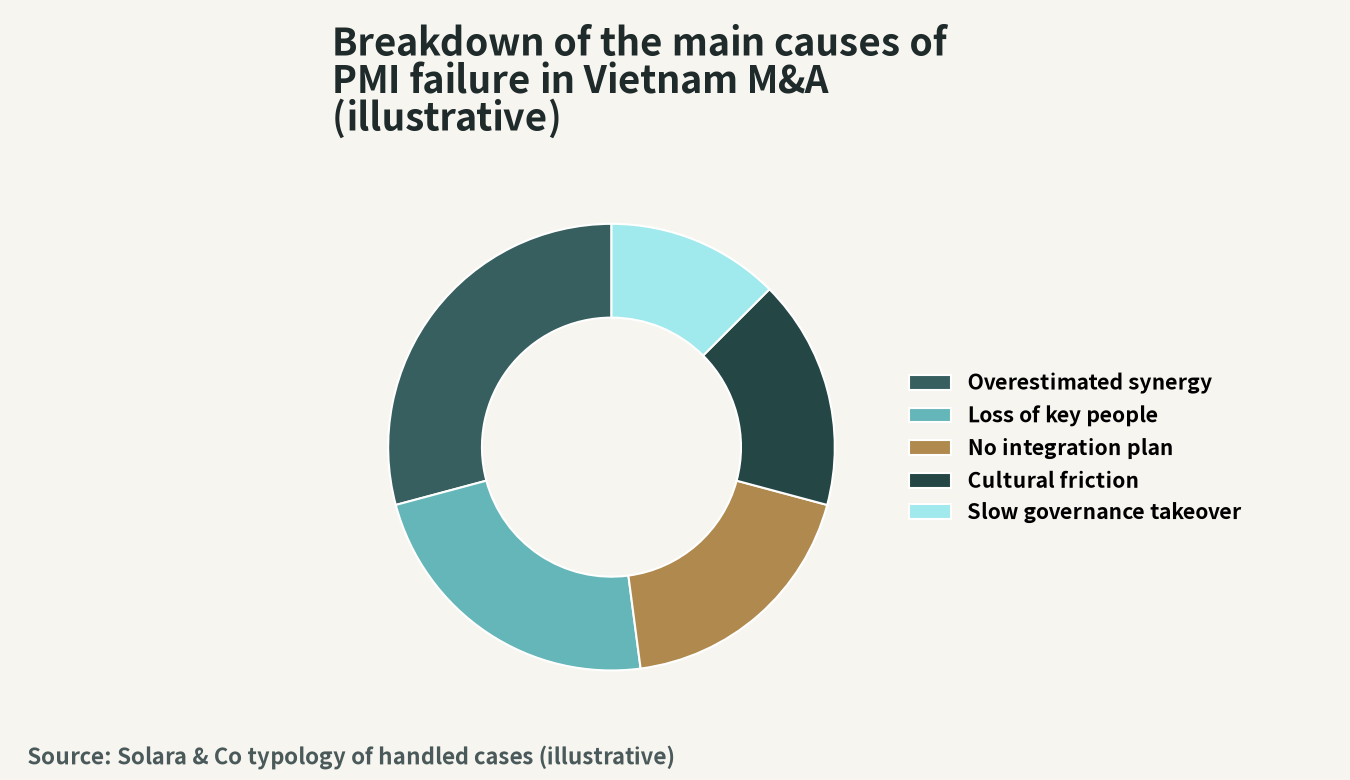
The main causes are overestimating synergies, the outflow of key people, the absence of an integration plan, cultural friction, and delay in taking control of governance (the representative and the seal). Many of these can be mitigated by grasping the target company's background through credit checks and due diligence at the entrance of the deal, and by designing the 100-day plan from before closing.
Key Points of the 100-Day Plan (Summary Table)
Organizing the theme and the principal actions of each phase gives the following.
Phase | Period | Theme | Principal Actions |
|---|---|---|---|
Phase 1 | Days 0–30 | Control · Stabilization | Change of representative · Seal control · Establish IMO |
Phase 2 | Days 30–60 | Diagnosis · Planning | Grasp realities · Integration policy · Roadmap |
Phase 3 | Days 60–100 | Execution | Quick wins · Accounting integration |
Beyond 100 days | Ongoing | Full-scale integration | Realizing synergies · Embedding PMI effects |
The conditions for success in Vietnamese M&A PMI are to "take control of the representative and the seal as the top priority," to "design the 100 days in the three phases of control, diagnosis, and execution," and to "integrate talent and culture with care." Leave things to the front line in the elation of closing, and synergies will evaporate. Solara & Co provides seamless support with knowledge from both the Japanese and Vietnamese sides—from designing the 100-day plan from before closing, to support for launching the IMO, taking control of governance, retaining talent, and integrating accounting and internal control. We will design with you the 100 days that turns an acquisition from a mere "success" into a "result." Especially for Japanese companies acquiring a Vietnamese company for the first time, supplementing the locally specific control points with outside knowledge is an effective way to contain integration risk.