
"How Many Months Until the License Comes Through?" — How to Read the Incorporation Schedule
When establishing a wholly foreign-owned local subsidiary (often a limited liability company, LLC) in Vietnam, the first thing the management of a Japanese company worries about is the schedule of "when can we start the business?" In practice, however, the incorporation period is not determined by the standard number of review days alone. This is because the "pre-application" preparation—consular legalization and notarized translation of documents prepared on the home-country side, confirmation of foreign-investment regulations by industry, and securing an office address—takes more time than imagined.
Company incorporation in Vietnam, based on two laws—the Law on Investment 2020 and the Law on Enterprises 2020—proceeds in three large tiers: "obtaining the IRC (Investment Registration Certificate)" → "obtaining the ERC (Enterprise Registration Certificate)" → "post-licensing procedures." In deals involving foreign capital, a characteristic is that—unlike domestic-capital incorporation—one additional stage of investment licensing, the IRC, is added.
This article organizes these three stages from a practical standpoint—from advance preparation (step 0) to the start of operations—together with the required documents, the competent authority, and the standard number of days required, and explains where bottlenecks tend to occur and roughly how much time to allow overall.
Step 0: Advance Preparation Decides the Success or Failure of Incorporation
The success or failure and the speed of incorporation are almost entirely decided in the preparation stage before the application is filed. If you start running without nailing this down, the authority will request corrections partway through the IRC review, sending it back repeatedly and wasting time.
Fixing the Business Scope and the VSIC Industry Code
In Vietnam, you apply by accurately linking the business you intend to conduct to an industry code in the "Vietnam Standard Industrial Classification (VSIC)." It is important to set codes neither too broadly nor too narrowly, looking ahead to future expansion such as trading-style buying and selling, manufacturing, IT services, and consulting. Since, in principle, you cannot conduct activities outside the registered business scope, too narrow a scope means additional procedures later, while too broad a scope drags in conditional fields and makes the review heavier.
Foreign-Investment Regulation Check and Investment Conditions
Whether foreign capital can enter, the cap on the ownership ratio, and the attached conditions differ by industry. First confirm whether the business falls under a "conditional investment field," where foreign capital is restricted or prohibited by international agreements such as WTO commitments and the CPTPP and by domestic law. Distribution, logistics, education, advertising, and the like often carry conditions; if applicable, consultation with the competent ministry is needed, and this is a factor that extends the IRC review far beyond the standard number of days.
Office Address and Lease Agreement
In Vietnam, that the registered address (place of business) actually exists and can be used for business purposes is a premise of incorporation. Residential-only properties may not be usable for corporate registration, and the lease agreement (or office-use agreement) becomes an attachment to the IRC application. Unless you secure an address first, the application itself does not move forward.
Charter Capital and the Capital Contribution Plan
In Vietnam, for many general industries no statutory minimum capital is set, but you must set a "reasonable charter capital (contribution amount)" consistent with the applied business plan, headcount, and office scale. Because the authority substantively examines whether the capital is reasonable in light of the business plan, too small an amount prompts a request for explanation during the review. Note, too, that in conditional fields and some industries, statutory minimum capital (legal capital) is imposed.
Step 1: Obtaining the IRC (Investment Registration Certificate)
In incorporation involving foreign capital, you first obtain the license for the investment project itself—namely, the IRC. This effectively corresponds to the "foreign-capital entry license."
Where to Apply and the Flow of Review
Where to apply differs by location. To establish in an ordinary urban area, the counter is the Department of Planning and Investment (DPI) of each province or city; to occupy an industrial park, export-processing zone, or high-tech park, it is that zone's management board (Industrial Zone Authority). The authority reviews the content of the submitted investment project, the investor's eligibility, the business scope, and the capital plan.
Required Documents and Consular Legalization / Notarized Translation
When a foreign corporation is the investor, you submit documents such as the home-country corporate registration certificate, the most recent financial statements, and bank-balance certificates demonstrating contribution capacity. These home-country documents must be notarized on the Japanese side, then undergo consular legalization or apostille-equivalent procedures, and further be accompanied by a notarized translation into Vietnamese. This legalization-and-translation process is the step whose timing is hardest to read in practice.
The Standard 15 Working Days and Extension in Conditional Fields
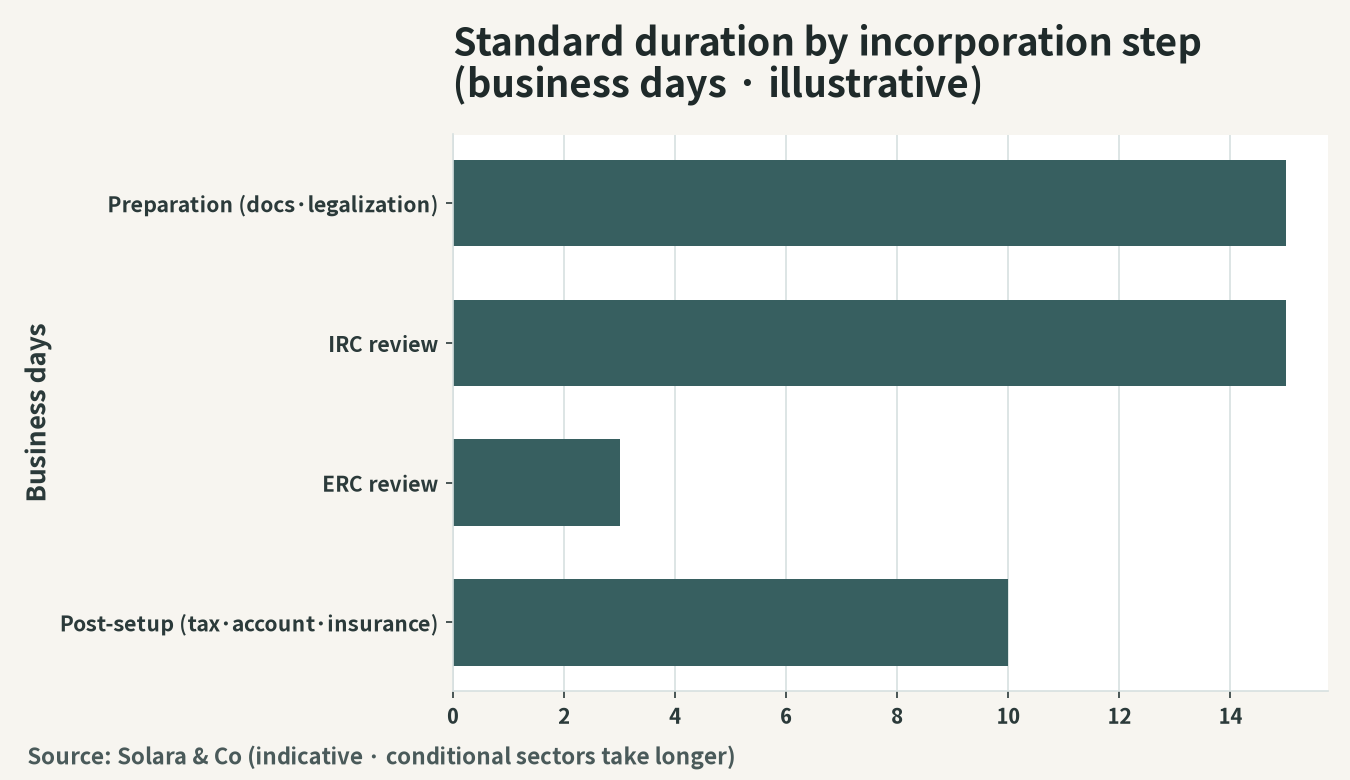
If the documents are in order, the IRC review takes a standard of about 15 working days as one benchmark. However, if the business falls under the aforementioned conditional investment field, because a request for the competent ministry's opinion (authority consultation) is involved, it can extend from several weeks to months. You should also anticipate that if corrections arise, the count restarts from the beginning each time.
Step 2: Obtaining the ERC (Enterprise Registration Certificate)
Once you have obtained the license for the investment project with the IRC, you next register the "legal personality of the company." This is the ERC, positioned close to incorporation registration as in Japan.
Granting of Legal Personality and the Standard 3 Working Days
The ERC is applied for at the DPI's enterprise registration counter. You register the charter, information on the members (contributors), the legal representative, and the capital, and if the documents are in order it is issued in a standard of about 3 working days. The enterprise code stated on the ERC functions directly as the tax code (taxpayer number). It is here that the company is first legally established.
Creating the Company Seal
After obtaining the ERC, you create the company's seal (corporate seal). Under the current system, the form and number of seals can be decided by the company itself, and the former obligation to register with the public security authorities has been relaxed, but it is important in practice to stipulate the management of the seal in the charter or internal regulations. The seal is needed in each contract and application context.
Quick Reference: Main Steps, Competent Authorities, and Days Required
Below is an organized summary of the flow up to this point, together with the competent authority, the standard number of days required, and the main required documents. The number of days is only a benchmark when documents are in order, and extends if legalization, translation, or consultation in conditional fields is involved.
Procedural step | Competent authority | Standard days required (benchmark) | Main required documents |
|---|---|---|---|
Advance preparation | (internal / specialists) | 2–4 weeks | Fix VSIC code, lease agreement, legalization and translation of home-country documents |
Obtaining the IRC | DPI / industrial-park management board | About 15 working days | Investment application, home-country corporate registration, financial statements, bank-balance certificate, address evidence |
Obtaining the ERC | DPI (enterprise registration counter) | About 3 working days | Charter, contributor information, legal representative, IRC |
Post-incorporation registration | Tax office, bank, labor / social-insurance authorities | 1–3 weeks | ERC, seal, account-opening documents, labor and social-insurance registration |
Step 3: Only After Post-Licensing Procedures Can You Operate
With the ERC, the company is established, but to actually move funds, hire people, and issue invoices, a series of post-incorporation registrations is needed. Neglecting this leads to a situation where you have incorporated but cannot start the business.
Tax Code and E-Invoice Registration
Based on the ERC's enterprise code, you carry out initial registration at the tax office, and proceed with use registration and initial setup of the electronic invoice (e-invoice) that is mandatory in Vietnam. Until this is in place, you cannot lawfully invoice or record revenue.
Opening a DICA Capital Account and Making the Contribution
A foreign investor opens a "Direct Investment Capital Account (DICA)" at a bank, and contributions from overseas are paid in through this account. The contribution must, in principle, be paid in by the deadline set in the ERC (or IRC)—generally within 90 days of company establishment. If you cannot pay in within the deadline, a procedure to change the registered content, such as reducing the capital, is needed, and leaving the under-capitalization unaddressed becomes a rectification risk. Unless you accurately arrange the purpose and evidence of the remittance, obstacles will arise later at junctures such as dividend remittance and capital recovery, so keeping the records consistent from the very first contribution is essential.
Signboard, Labor / Social Insurance, Sub-License, and Bank Account
There is an obligation to display the company's signboard at the registered address. When hiring employees, you carry out labor and social-insurance establishment registration and proceed with filings such as the work rules. Furthermore, depending on the industry, operating requires an additional permit (sub-license / license for a conditional business), and there are industries that cannot actually operate until this is obtained. Together with this, you also open an ordinary business account used for daily settlements.
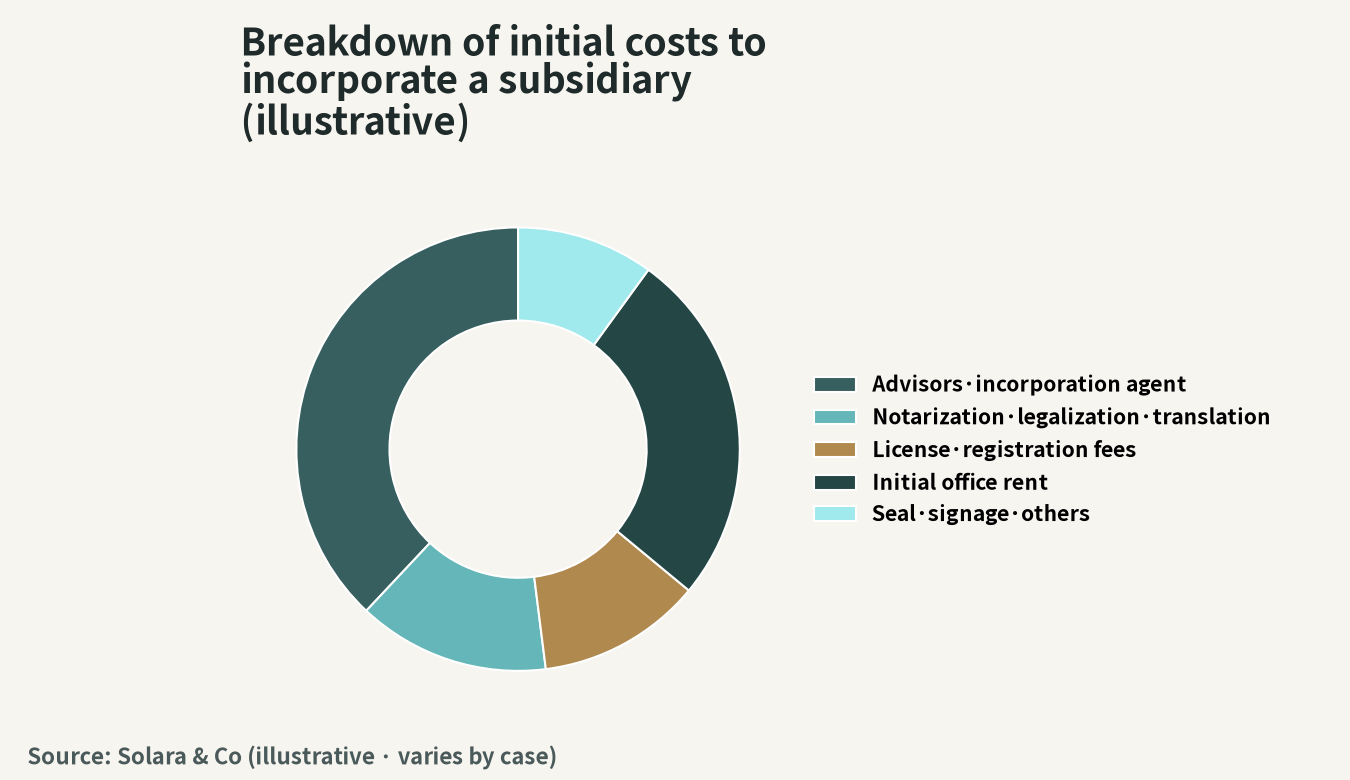
Benchmark for the Overall Period and the Bottlenecks
Finally, below is an organized summary of how much time and cost to allow for incorporation overall, and where time tends to be lost.
The Standard Is 4–8 Weeks; Conditional Fields, 2–3 Months
If the documents are in order and the industry has no particular constraint under foreign-investment regulations, allowing roughly 4–8 weeks for the IRC, the ERC, and the main post-incorporation registrations is one benchmark. On the other hand, if it is a conditional investment field requiring authority consultation, or if legalization and translation of home-country documents get bogged down, you need to allow 2–3 months or more. The practical view is that the schedule is decided by "preparation and legalization" rather than the "number of review days."
The Bottleneck of Consular Legalization and Translation
What generates the most delay in practice is the notarization, consular legalization (apostille-equivalent), and notarized translation of home-country documents. When the procedural schedule on the Japanese side, redoing due to formatting defects in documents, and confirming the accuracy of translations all stack up, this part alone takes several weeks. If you are in a hurry to incorporate, you should begin legalizing home-country documents with the highest priority, in parallel with preparing the application on the Vietnamese side.
The Address Requirement and How to Think About Capital
Securing a business address usable for registration is both a premise of the application and a cause of delay. Moreover, the notion that "since there is no statutory minimum, a small amount is fine" is dangerous; designing a reasonable level—including the business plan, obtaining visas and work permits, and credibility with banks and business partners—is the shortcut to avoiding the trouble of later capital increases or rectification.
Solara & Co's End-to-End Support — Accompanying You from Preparation to the Start of Operations
Establishing a local subsidiary in Vietnam is a process with many steps, in which two stages of licensing—the IRC and ERC—are followed by post-incorporation procedures such as tax, capital contribution, labor, and licensing. Where one tends to stumble is not the review itself, but the "arrangements before and after the application," such as designing the business scope (VSIC code), assessing foreign-investment regulations, legalizing and translating home-country documents, and reconciling the address and capital.
Solara & Co, with bases and human networks on both the Japanese and Vietnamese sides, provides end-to-end support, from advance diagnosis of the business scope and foreign-investment regulations, to preparing the IRC and ERC application documents and handling the authorities, opening the DICA account and making the contribution, and the post-incorporation registrations for tax, e-invoice, labor and social insurance, and sub-licenses. Working backward from "when can the business start," we get ahead of the legalization-and-translation bottleneck and accompany you toward a sure launch in the shortest time.