
Vietnam's Construction Permit Becomes the "Final Gate" of Factory Launch
For Japanese manufacturers building their own factory in Vietnam, the construction permit is the final major gate before the start of operations, waiting beyond the investment, land, and environmental procedures. Stumble here, and you can end up unable to break ground even though the land and licenses are all in place, or unable to use the factory even after it is completed. Construction proceeds, with the Construction Law (enacted in 2014, amended by Law 62/2020/QH14 in 2020) as its foundation, in a chain with the Law on Investment, the Land Law, the Law on Environmental Protection, and the fire-safety law.
This article organizes the overall picture of Vietnam's construction-permit system, the flow of factory-construction procedures, cases in which the construction permit is exempted, the permits needed in parallel, and the key points of schedule management for a factory project.
The Overall Picture of Vietnam's Construction-Permit System
The construction permit (GPXD: Giấy phép xây dựng) is a permit obtained before constructing, renovating, or repairing a structure, through which the authority confirms that the design conforms to the law, urban planning, and construction standards. In factory construction, design review and fire-safety and environmental procedures are chained before and after this construction permit, and stacking these in the correct order determines the schedule for breaking ground and operating.
The Relationship Between the Construction Permit and Upstream Procedures
The construction permit is not self-contained; it presupposes upstream procedures. That the IRC (Investment Registration Certificate) under the Law on Investment, the land use right under the Land Law (securing the site), the detailed plan under urban planning (the 1/500 plan), and the environmental procedures under the Law on Environmental Protection are all in place is the premise for the construction-permit review. If any one of them is delayed, the construction permit is also pushed back.
The Flow of Factory-Construction Procedures
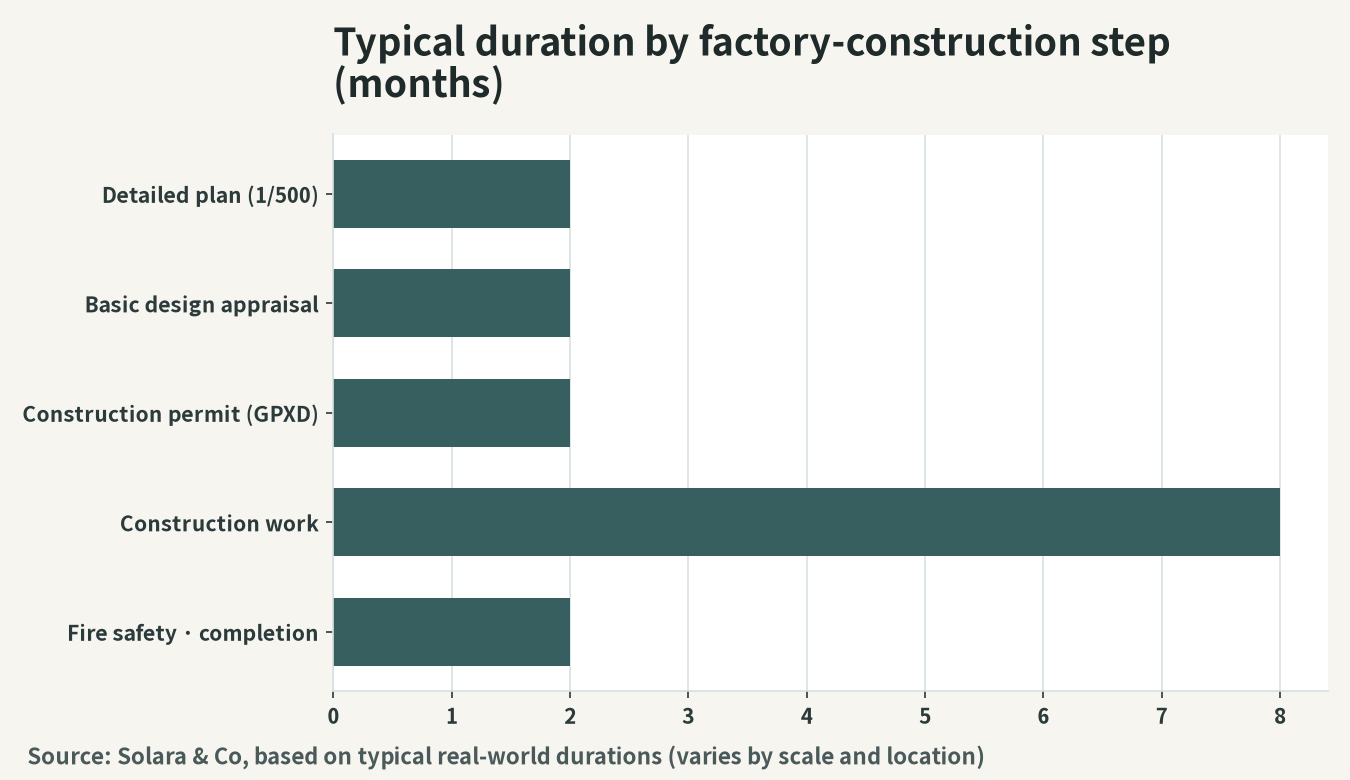
The construction-related procedures of a factory project proceed roughly in the following order.
Confirming the Detailed Plan (the 1/500 Plan)
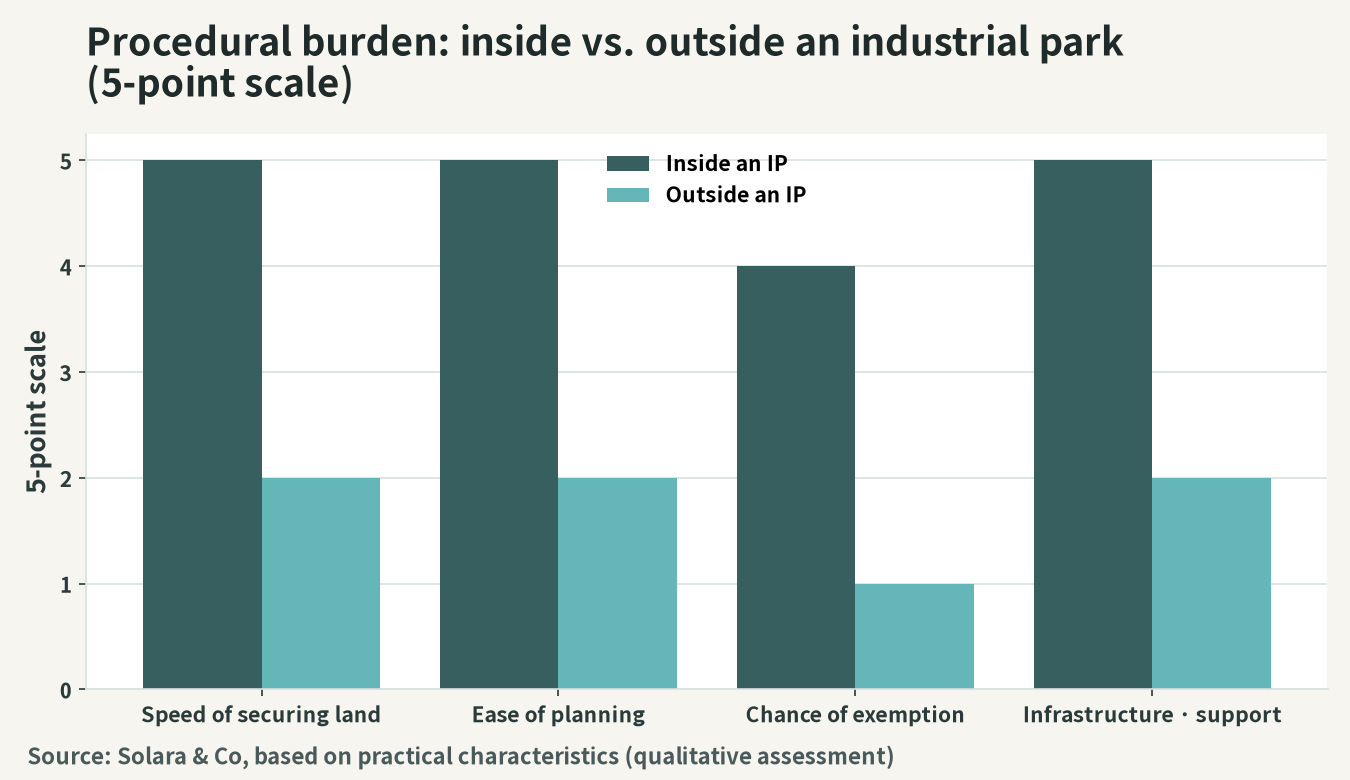
Confirm whether the site where the factory will be built is covered by an approved detailed plan (a construction plan at a scale of 1/500). Plots inside an industrial park often already have the whole park's 1/500 plan approved, and this can lead to the construction-permit exemption described later. On the other hand, for a site outside a park, the very preparation of the detailed plan can take time.
Review of the Basic Design
For a factory of a certain scale and grade, review and approval of the basic design (construction design) is needed before breaking ground. The authority confirms the structural safety of the building, fire safety, the environment, and conformity with relevant laws and regulations. Because the design review is closely tied to the subsequent construction permit, it is important to coordinate early with the design firm and the contractor.
Obtaining the Construction Permit (GPXD)
After passing the design review, you obtain the construction permit. The permit application requires evidence of the rights to the site, the approved design, and evidence of the relevant prior procedures. Because breaking ground without a permit constitutes illegal construction, with risks of rectification, demolition, or penalties, not breaking ground before obtaining the permit is an iron rule.
Breaking Ground, Construction, and Supervision
After obtaining the construction permit, you notify the authority of the start of construction and begin building. During construction, through construction supervision, you manage whether the work is being executed according to the approved design. Work that differs from the design will be ordered to be rectified at the later completion inspection, delaying the start of operations.
Fire Inspection and Completion Inspection (nghiệm thu)
A factory is required to have design approval for fire prevention (PCCC) and to pass the fire inspection after completion. Together with this, after construction is complete, it must undergo the completion inspection (nghiệm thu), and only upon obtaining confirmation that the building has been completed according to the approved design can it be lawfully used and operated. Clearing these inspections, in parallel with the environmental procedures (environmental permit), is the condition for starting operations. The environmental-side flow is detailed in "Vietnam's Environmental Regulation (EIA) and Factory-Operation Risk."
Cases in Which the Construction Permit Is Exempted
Not all factory construction requires an individual construction permit.
Plots in an Industrial Park / with an Approved Detailed Plan
For plots inside an industrial park that have an approved 1/500 detailed plan in which the construction conditions (building coverage ratio, height, use, etc.) are already fixed, the individual construction permit may be exempted. This is because the construction conditions are deemed already fixed at the whole-park planning stage. Even if the exemption applies, procedures such as design review, fire safety, and the environment are still needed separately, so note that "exemption from the permit ≠ exemption from procedures." Whether the location is an industrial park or not should be considered together with securing the site, and it also relates to "Land strategy under Vietnam's Land Law 2024."
Determining the Exemption Must Be Confirmed in Advance
Whether the exemption applies is determined individually according to the planning status of the site and the scale and grade of the factory. If you proceed on the assumption that "it should be exempted," there is a risk that the need for a permit is discovered later and construction is halted. It is important, at the early stage of the project, to confirm the applicability of the exemption with the competent authority or the industrial-park operator.
Permits Needed in Parallel
In factory construction, not only the construction permit but multiple permits must be advanced in parallel. These are mutually prerequisite, and getting the order wrong halts everything.
Environment, Fire Safety, and Occupational Safety
The environmental procedures (EIA, environmental permit) are a premise of breaking ground and operating, and are linked to the construction schedule. Fire prevention (PCCC) is a gate at both design approval and the completion inspection. Furthermore, at the operation stage, the establishment of an occupational safety and health system is also needed, and this is designed together with compliance with Vietnam's Labor Law.
Sub-Licenses and Operational Preparation
Depending on the product manufactured, an industry-specific sub-license (food, chemicals, medical devices, etc.) may be needed before operation. Aligning the timing of the construction completion inspection with these operating licenses, and planning by working backward so that operations can start at the same time as completion, prevents launch delays.
Schedule Management and the Roles of Stakeholders
The success or failure of factory construction is governed, more than by knowledge of permits, by the quality of project management that binds together multiple procedures and stakeholders.
Managing the Critical Path with a Single Schedule
In a factory project, procedures such as investment, land, the detailed plan, design review, the construction permit, construction, fire safety, the environment, and sub-licenses are mutually prerequisite while proceeding in parallel. If these are managed piecemeal by department, the delay of one procedure cascades, and the whole is pushed back. Putting all permits and processes into a single Gantt chart, visualizing which is the critical path (the rate-limiting process that determines the overall completion time), and starting from the procedures that must be tackled first is the key to preventing launch delays. Environmental procedures and design review, in particular, take time at the front end, so an early start is effective.
Coordination with the Design Firm, Contractor, and Authorities
The quality and legality of construction are determined by coordination with the design firm (consultant), the contractor (general contractor), and the authorities. In Vietnam, the qualifications and grades of the operators involved in design and construction are stipulated, so you need to engage qualified parties commensurate with the scale and grade of the deal. Carrying Japanese-style specifications over as is can create conflicts with Vietnamese standards and customs, so choosing a partner versed in local design and construction practice and carefully holding prior consultations with the authorities reduces rework. As the orderer (the owner), it is also important to have a system to confirm, through construction supervision, whether each milestone is progressing according to the approved design.
Preparing for Design Changes and Cost Overruns
In factory construction, situations arise where changes from the original design are unavoidable. These include unexpected ground conditions, changes in the specifications of production equipment, and rectification demands from the authorities. When a design change reaches a scale that overturns the premise of the approved basic design or construction permit, re-review and re-obtaining the permit become necessary, and this rebounds onto the construction period and cost. Stipulating, at the contract stage, the change-management procedure with the contractor (who approves what and how, and how it is reflected in cost and schedule), and allowing for contingency funds, leads to stable operation of the project. Because a delay in completion is directly connected to a delay in starting operations and the loss of revenue opportunities, planning conservatively—including the design of schedule buffers—is wise.
The Main Procedures of Factory Construction: A Comparison Table
Below is an organized summary of the main procedures involved in factory construction from the perspectives of purpose, timing, and the impact of delay.
Procedure | Purpose | Timing | Impact of delay |
|---|---|---|---|
Confirming the detailed plan (1/500) | Fixing the site's construction conditions | Early planning | Preparation for breaking ground does not progress |
Basic design review | Confirming the design's conformity | Before breaking ground | The construction permit stalls |
Construction permit (GPXD) | Legalizing the start of construction | Before breaking ground | Cannot break ground; becomes illegal construction |
Fire prevention (PCCC) | Securing fire safety | At design and completion | Cannot pass the completion inspection |
Completion inspection (nghiệm thu) | Lawful start of use | After completion | Cannot start operations |
Practical Points Japanese Companies Should Grasp
First, the construction permit is "the culmination of upstream procedures." Because you can advance to the review only when investment (IRC), land (land use right), planning (1/500), and the environment are all in place, rushing the construction part alone in isolation will not move things forward. Second, on plots inside an industrial park, the construction permit may be exempted, but "exemption ≠ the total abolition of procedures"; design review, fire safety, and the environment are needed separately. Always confirm the applicability of the exemption in advance. Third, fire prevention (PCCC) and the completion inspection (nghiệm thu) are the final gates that bring a completed factory to a "usable" state, and without passing here, operations are impossible. Fourth, managing construction, the environment, fire safety, and sub-licenses with a single schedule, and designing by working backward from the timing of completion and the start of operations, is the best measure to prevent launch delays.
Vietnam's construction permit and factory construction are the final gate before the start of operations, where the investment, land, and environmental procedures bear fruit. Misjudging the critical path of permits invites a situation where a carefully made investment cannot get moving even after completion. Solara & Co supports—with a team versed in the practice of both the Japanese and Vietnamese sides—everything from obtaining the detailed plan, design review, and construction permit, to the parallel management of fire safety, the environment, and sub-licenses, and backward-scheduling between completion and the start of operations. We will propose, from the early stage, a launch plan so that your company's factory is completed on schedule and starts operations without delay.