
Vietnam's Law on Enterprises Defines the Corporate "Vehicle" and Its Governance
The foundational law for establishing and operating a business entity in Vietnam is the Law on Enterprises 2020 (legal document No. 59/2020/QH14, effective January 1, 2021). Whereas the Law on Investment governs whether foreign capital may enter and the investment registration process, the Law on Enterprises regulates the corporate "vehicle" and corporate governance — namely, "which company form to choose" and "who holds what authority to run the company." When selecting an entry structure, designing a joint venture, or looking ahead to future M&A and listing, an understanding of the Law on Enterprises is indispensable.
This article organizes the characteristics of the major company forms, organizational design (corporate governance), the practical issues surrounding the legal representative, and the principal changes introduced by the 2020 amendment, in a form useful to the decision-making of Japanese companies.
Vietnam's Major Company Forms
The Law on Enterprises defines several categories of business entity, but in practice foreign investors choose almost exclusively between two: the limited liability company (LLC) and the joint-stock company (JSC).
Limited Liability Company (LLC) — Single-Member and Multi-Member
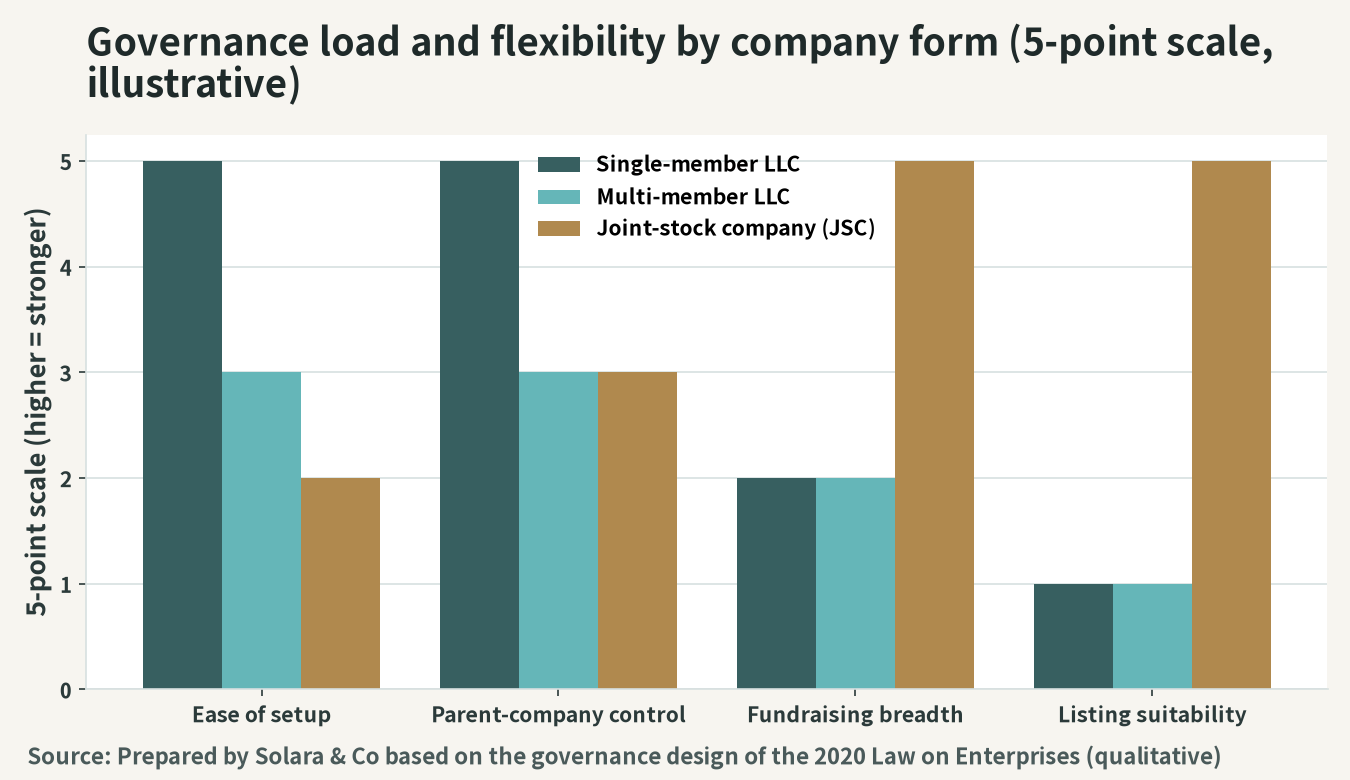
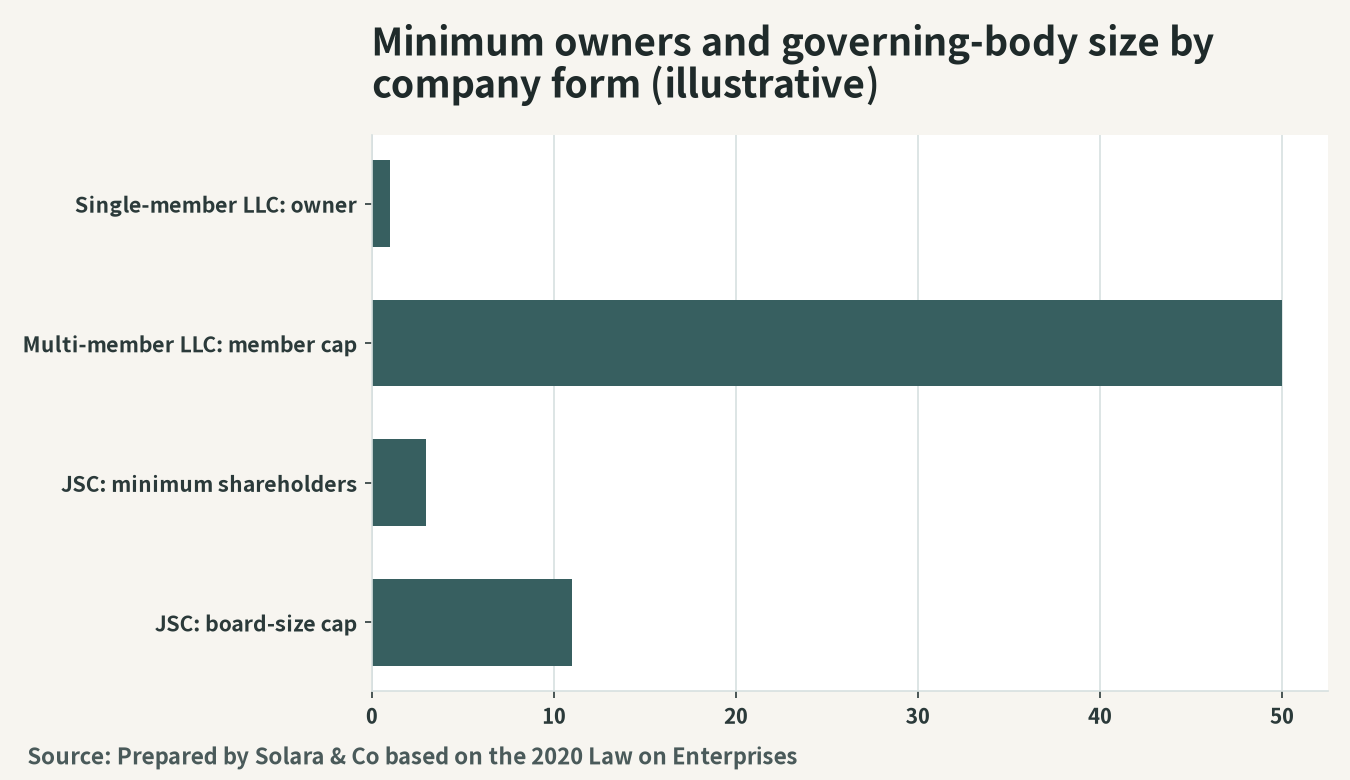
A limited liability company (Công ty TNHH) is the simplest and most manageable form, in which contributors bear liability only up to the amount of their capital contribution. It divides into two types by the number of members (capital contributors). The single-member LLC (sole contribution) is the standard form for Japanese companies establishing a 100% subsidiary. The multi-member LLC, with 2 to 50 members, suits joint ventures (joint contribution with a local partner). Transfers of capital portions are subject to certain constraints, such as a right of first refusal for the other members, and the form is characterized by a high degree of closed ownership.
Joint-Stock Company (JSC)
A joint-stock company (Công ty Cổ phần) is a form that divides capital into shares and is established with three or more shareholders. It allows free transfer of shares, issuance of preferred shares, issuance of bonds, and future listing on a securities exchange, making it suitable when looking toward fundraising from institutional investors and business expansion. On the other hand, its organizational design and the operation of the general meeting of shareholders are heavier than those of an LLC, and it tends to be over-specified for a small subsidiary in the early stage of establishment.
Other Forms
In addition, the partnership and the private enterprise are also provided for, but the situations in which foreign investors use them are limited. How to choose an entry form is also organized in our article Comparison of Vietnam Entry Structures.
Corporate Governance: The Basics of Organizational Design
The organizational design (the mechanism for decision-making and oversight) prescribed by the Law on Enterprises differs for each company form. If this is not designed correctly, risks arise such as the parent company being unable to exercise control, or important resolutions stalling.
The Organs of a Single-Member LLC
In a single-member LLC, the owner (capital contributor) makes decisions through a members' council or a director, and the director (Director/General Director) executes day-to-day operations. The organization is simple, and its advantage is that it readily reflects the will of the parent company. Where the owner is a corporate entity, it is also possible to design a members' council composed of several representatives.
The Organs of a Multi-Member LLC
A multi-member LLC has a Members' Council as its highest decision-making body, its chairperson, and a director. The requirements for passing resolutions of the Members' Council (the proportions for attendance and approval) are set in the charter, but a heightened majority is required for important matters such as capital increases, charter amendments, and mergers. In a joint venture, the design of these resolution requirements and veto rights becomes the core that determines the balance of power between partners.
The Organs of a Joint-Stock Company
A joint-stock company has a General Meeting of Shareholders (GMS), a Board of Management (3–11 members), and a director, and the basic model places an Inspection Committee as the supervisory organ. The Law on Enterprises 2020 also allows the choice of a single-tier structure that places independent directors and an audit committee within the Board of Management in place of the Inspection Committee, making a more modern governance design possible. The quorum and approval requirements for important resolutions are set by law and may be raised in the charter.
Practical Issues Surrounding the Legal Representative
A company in Vietnam must have a "Legal Representative" who performs legal acts on behalf of the company. This is one of the points where Japanese companies most often stumble in practice.
Multiple Legal Representatives and the Allocation of Authority
The Law on Enterprises 2020 permits a company to appoint multiple legal representatives. However, at least one must reside within Vietnam. Where multiple representatives are appointed, unless the scope of each representative's authority is clearly defined in the charter, each representative is deemed externally to hold full representative power, giving rise to the risk of unilateral contracts and remittances. From the standpoint of the parent company's governance, the design of who is granted how much authority is crucial.
The Company Seal and the Control of Authority
In Vietnam, the company seal (the corporate chop) is widely used on contracts and applications. The Law on Enterprises 2020 abolished the previous obligation to register the seal with the police, allowing the company to determine the design and number of its seals itself. While freedom has increased, the flip side is that loose seal management raises the risk of misuse, so clearly defining rules for seal custody and stamping approval in internal regulations is the key to subsidiary governance.
Principal Changes in the Law on Enterprises 2020
The Law on Enterprises 2020 made several amendments to the 2014 law that affect practice.
Procedural Simplification and Protection of Minority Shareholders
In addition to abolishing the seal-registration obligation, the electronic processing and simplification of business registration procedures advanced. At the same time, the protection of minority shareholders was strengthened, with the right to inspect books, the use of cumulative voting in the election of directors, and the framework for shareholder derivative suits all being organized. When standing on the minority side in a joint venture, how to give concrete form to these rights in the charter and the shareholders' agreement becomes the crux of governance design.
Regulation of State-Owned Enterprises and Related-Party Transactions
A review of the definition of state-owned enterprises and a clarification of the approval procedures for transactions between related parties were also carried out. Transactions with the parent company and affiliated companies (loans, supply of raw materials, royalties, etc.) need to be consistent with both the approval process under the Law on Enterprises and the transfer-pricing rules under tax law. For details, please refer to Transfer Pricing Taxation in Vietnam.
Registration and Change of the Legal Representative and Senior Officers
The company's legal representative and the members of its principal organs are reflected in the business registration (ERC) and in notifications to the authorities. In practice, each time an expatriate is replaced or officers are re-elected, the registration information must be updated promptly. If the registered representative and the person who actually executes business are left diverging, the validity of contracts and the relationships of external liability become unclear, causing obstacles in banking procedures and dealings with the authorities. Having an internal operating rule that links personnel changes to registration updates underpins the effectiveness of governance. In particular, when the legal representative departs from Vietnam, unless the appointment and registration of a successor and the transfer of banking and tax authority are carried out seamlessly, there is a risk that day-to-day operations halt for lack of a signing authority; it is therefore essential to link the schedule of the expatriate handover with the registration procedures early on.
Practical Issues of Capital, Contributions, and Organizational Change
Concerning the corporate vehicle, the way of thinking about capital and the flexibility for future organizational change are also points that should be grasped at the establishment stage.
Charter Capital and the Payment of Contributions
There is no general statutory minimum capital amount for companies in Vietnam (except for certain regulated sectors). However, the "charter capital" stated in the charter must, as a rule, be paid in full within 90 days of business registration. Registering excessive capital that does not match the business plan turns the payment obligation directly into a heavy financial burden, while too little capital is disadvantageous in terms of licensing, transactional creditworthiness, and capital-increase procedures. Capital should be designed at a realistic level, taking into account the initial investment, working capital, and room for future capital increases. The actual payment and remittance are carried out through a Direct Investment Capital Account (DICA).
Flexibility of Organizational Change and Exit
The Law on Enterprises provides a path to convert from a single-member LLC to a multi-member LLC, or from an LLC to a joint-stock company, in line with the growth of the business. When bringing in outside investors, forming a joint venture, or looking ahead to a future listing or an exit by M&A, being conscious at the time of establishment of which form is easier to change broadens later options. In particular, the joint-stock company, through the standardized capital portion of shares, makes it easy to accept and transfer contributions and offers a high degree of freedom in capital policy — a strength in the expansion phase. The design of the exit, including withdrawal and liquidation, should be considered as a whole together with the issues in Exit and Liquidation in Vietnam M&A.
Choosing a Company Form: A Comparison Table
Organizing the major forms that foreign investors choose by establishment requirements, governance, fundraising, and suitable situations gives the following.
Item | Single-member LLC | Multi-member LLC | Joint-Stock Company (JSC) |
|---|---|---|---|
Number of contributors | 1 | 2–50 | 3 or more shareholders |
Main use | 100% subsidiary | Joint venture | Expansion / listing-oriented |
Highest organ | Owner / members' council | Members' council | General meeting of shareholders |
Transfer of capital portion | Relatively free | Constraints such as right of first refusal | Free in principle |
Fundraising | Mainly capital increase | Mainly capital increase | Issuance of shares and bonds possible |
Weight of governance | Light | Moderate | Heavy |
Practical Points on Entry Form and Governance Design
First, the choice of form should be considered not only by "the current scale" but by "the shape three to five years from now." A path of initially establishing a single-member LLC, which is easy to manage, and then converting to a joint-stock company at the stage of business expansion or acceptance of outside capital, is a realistic option. Second, in a joint venture, designing the resolution requirements, veto rights, and deadlock-resolution clauses in detail in the charter and the shareholders' agreement prevents later disputes. Third, the authority of the legal representative and the management of the seal are the lifeline by which the parent company controls the local entity, and they need to be firmed up as internal regulations at the same time as establishment.
Vietnam's Law on Enterprises is the foundational law that determines the shape and governance of the corporate vehicle. A mistaken choice of vehicle forces heavy organizational change at every later capital increase, dissolution of a joint venture, M&A, or listing. Solara & Co provides seamless support — from the selection of the entry form, through the design of the charter and shareholders' agreement, to the construction of the organizational design and governance framework — with a team well versed in the practices of both Japan and Vietnam. We design the optimal "vehicle" for your medium-to-long-term business plan together, right from the entrance of establishment.