
Vietnam's Investment Law 2020 Sets the "Entrance" for Foreign Investment
The first law a foreign company entering Vietnam confronts is the Law on Investment 2020 (Law No. 61/2020/QH14, effective January 1, 2021). This is the basic law that determines into which businesses, under what conditions, and through which procedures a foreign investor may enter, and all of local-subsidiary establishment, joint ventures, and equity contributions via M&A proceed within the framework of this law. From the old 2014 Investment Law, the thinking on market-entry regulation・procedures・the incentive regime has been substantially overhauled, so proceeding with a study on the basis of outdated information risks misjudging the premises of licensing.
This article organizes the overall picture of the 2020 Investment Law from the perspectives of foreign-capital entry conditions (market access), the practical procedures of investment registration, investment incentives, and the pitfalls Japanese companies easily fall into in practice. Because the company-establishment procedure itself is handled by the Enterprise Law, understanding both laws as a single whole is important.
The "Market-Access Negative List" That Divides Foreign-Capital Entry
The single largest feature of the 2020 Investment Law is that it organizes a foreign investor's market access by a "negative list" method. In principle, a foreign investor may enter under the same conditions as a domestic investor, and it was revised into a structure that lists only those businesses restricted as exceptions.
Prohibited-Access Businesses and Conditional-Access Businesses
The list divides broadly into two layers. First, "access-prohibited businesses" into which foreign investors are not permitted to enter. Second, "conditional-access businesses" to which conditions attach—such as caps on the equity ratio, the form of investment, whether a Vietnamese partner is required, and prior approval by the authorities. These are specifically enumerated in the annexed lists of Decree 31/2021/ND-CP, and many service businesses such as distribution・logistics・advertising・transport・education・finance are included here.
The Relationship with WTO・FTA Commitments
The equity-ratio caps of conditional businesses are judged on the basis of Vietnam's WTO services commitments and FTA commitments such as the CPTPP・EVFTA. Where a commitment under a treaty is more favorable than domestic law, the treaty may take precedence, so closely examining where one's own industry code (VSIC) falls within the commitment schedules is the starting point for judging whether entry is possible. For details on conditional businesses, please also refer to the explanation of Vietnam's conditional-business licensing system.
The Practical Procedure of Investment Registration: From IRC to ERC
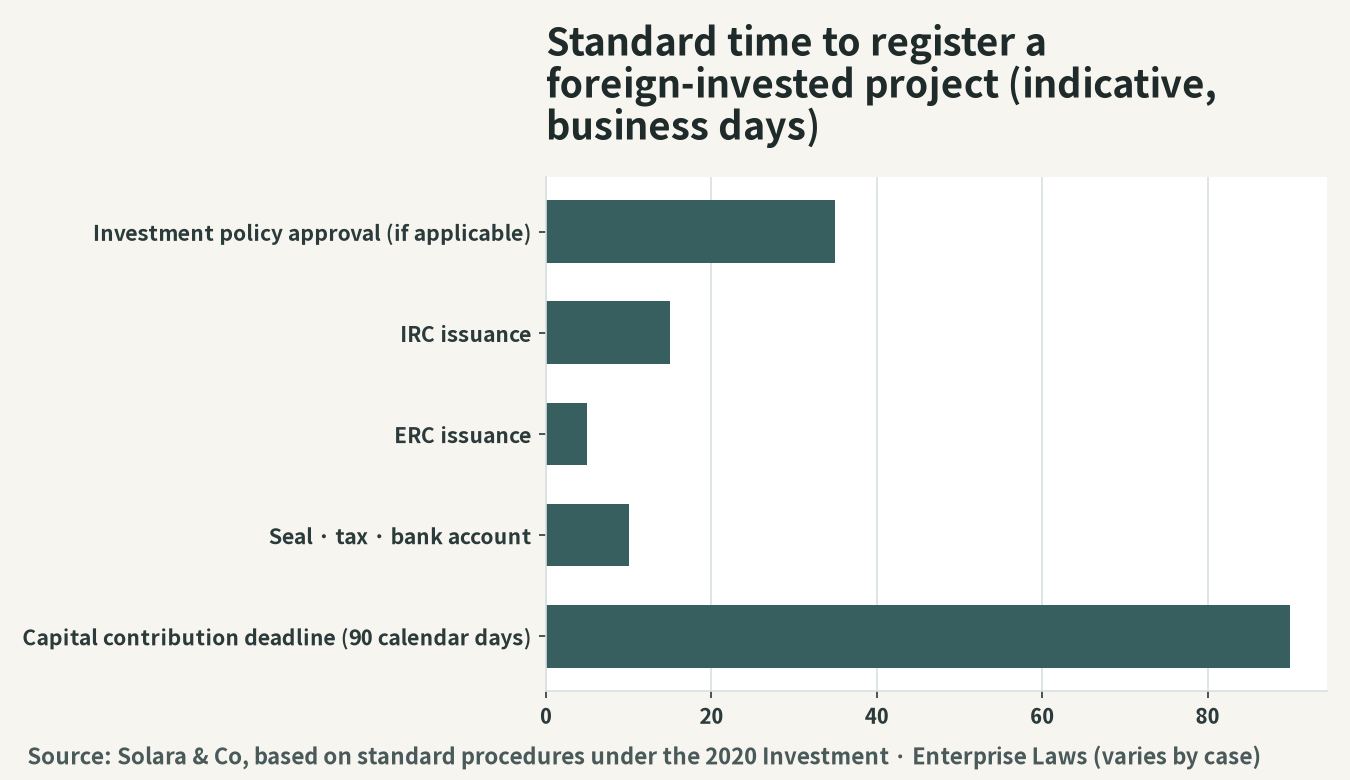
When a foreign investor launches a new project, registration as an "investment project" is required before establishing the company. The procedure generally proceeds in the flow: in-principle investment approval (where required) → obtaining the Investment Registration Certificate (IRC) → obtaining the Enterprise Registration Certificate (ERC) → preparation for the start of business.
In-Principle Investment Approval
Projects of a certain scale・nature require "in-principle investment approval" (chấp thuận chủ trương đầu tư) before the IRC application. Depending on the project's importance, the approving body is the National Assembly・the Prime Minister・or the provincial People's Committee, and it is required for large projects involving land use or for specific industries. For many ordinary manufacturing・service projects this stage is unnecessary, but for projects involving land acquisition outside industrial parks, whether it is required must be determined early.
Investment Registration Certificate (IRC)
The IRC is the "permit" of a foreign-capital project, recording the project's investor・purpose・scale・location・term・incentive content. As a standard it is issued in about 15 working days from acceptance of the application, but for conditional businesses or where the authorities request supplements, it is not unusual for it to extend from several weeks to several months. Because the reasonableness of the investment capital and the way the business scope is described also affect subsequent licenses and capital increases, the design at the application stage is important.
Enterprise Registration Certificate (ERC)
After obtaining the IRC, the ERC (the company's registration certificate) is obtained under the Enterprise Law, by which the legal entity comes into being. Thereafter one proceeds to seal creation, opening a bank account, payment of capital contributions (in principle within 90 days of registration), tax registration, and obtaining the necessary sub-licenses. These establishment procedures are detailed in the practice of establishing a local subsidiary in Vietnam.
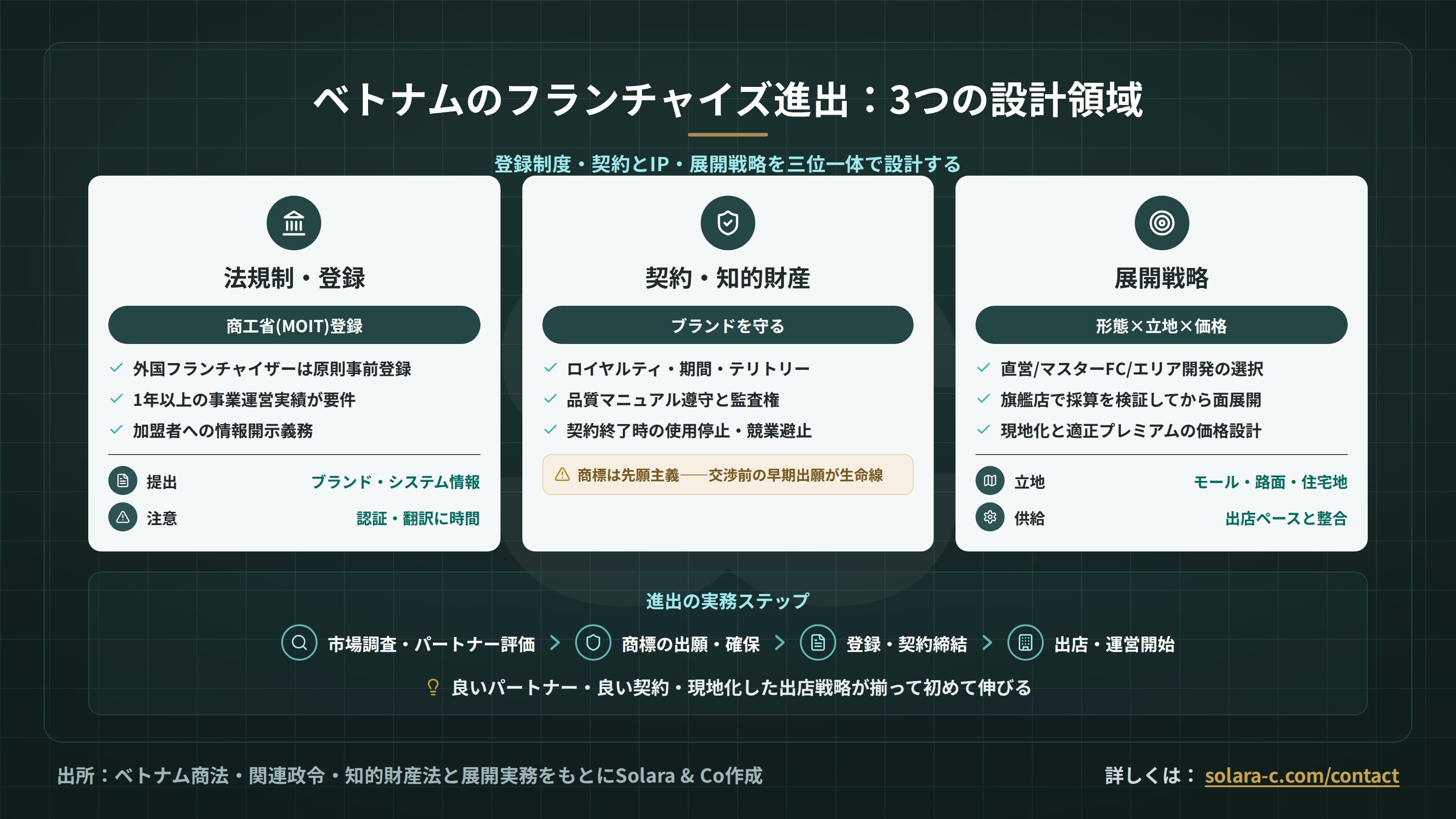
Forms of Investment: New Establishment・Equity Acquisition・BCC・PPP
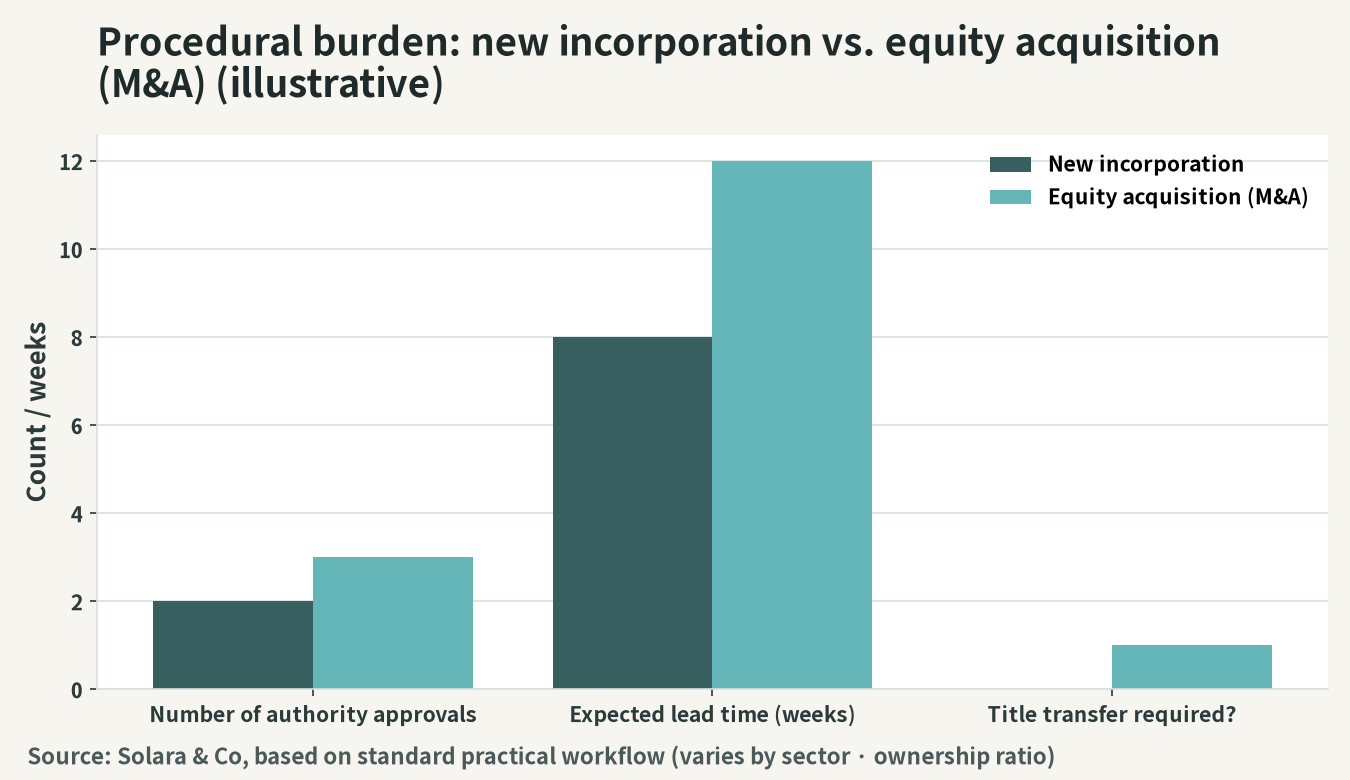
The 2020 Investment Law organizes the forms of investment a foreign investor may take. First, the establishment of a new economic organization (establishing a local subsidiary). Second, equity contribution・share acquisition into an existing enterprise (M&A). Third, project execution via a business cooperation contract (BCC). Fourth, participation in infrastructure projects via PPP (public-private partnership).
Procedures Specific to Equity Contribution・Share Acquisition (M&A)
When making an equity contribution・share acquisition into an existing Vietnamese enterprise, under certain conditions "registration of the equity contribution・share acquisition" (M&A approval) is required in advance. Specifically, the targets are equity contributions into enterprises operating conditional businesses, contributions that take the foreign-capital ratio above a certain level, and contributions into enterprises holding land-related rights. Because closing without going through the approval means the change of registered ownership is not recognized, it needs to be built into the design of the overall M&A process in Vietnam.
Investment Incentives and Their Application
The 2020 Investment Law sets a framework of incentives (preferential corporate income tax rates・tax exemptions and reductions, import-duty exemption, reduction or exemption of land rent) for investment in encouraged industries・encouraged areas. Furthermore, for strategic projects with an extremely large total investment, the law newly establishes "special investment incentives," introducing a regime that permits incentives exceeding the ordinary level under the Prime Minister's approval.
Incentives in Principle Are "Self-Application + Ex-Post Verification"
Much of the incentives is not a system of individual prior approval; rather, the enterprise itself judges that it meets the statutory conditions and applies them, and they are verified ex post during a tax audit. Recording the incentive content in the IRC is one of the grounds, but the practical essence is to prepare materials demonstrating the industry code・location・satisfaction of conditions, and to remain in a state where one can explain to the authorities at any time. The tax details are organized in Vietnam's corporate income tax and tax incentives.
Post-Investment Management Obligations and Practical Points to Note
Even after obtaining the IRC and starting operations, there are continuing obligations under the Investment Law. Treating this area lightly produces unexpected rework in situations of capital increase・withdrawal・M&A.
Investment Reporting and Project Changes
Foreign-capital enterprises bear an obligation to submit quarterly・annual investment-activity reports through the authorities' electronic system. In addition, when changing important matters of the project—such as the investment amount・business scope・location・investor composition—registration of an IRC change is required. Leaving the actual situation diverging from the registration leads to demands for correction in later procedures, greatly delaying the schedule.
Capital Payment・Remittance and the Direct Investment Capital Account (DICA)
Foreign-capital enterprises must conduct the payment of capital contributions and the overseas remittance of dividends・profits through a Direct Investment Capital Account (DICA). If the deadline for capital payment (in principle 90 days) lapses, measures such as registering a reduction of the registered capital become necessary. Because remittance practice is closely tied to the parent company's funding plan and the governance of the Vietnamese subsidiary, it is an area that should be designed in coordination with the bank・accounting from the early stage of establishment.
The Intersection of the Investment Law with Other Laws
The Investment Law is not self-contained; it intersects with the Enterprise Law (company form・institutional design), the Land Law (land acquisition・land-use rights), the Labor Law, the Environmental Protection Law, and the specialist laws of each industry. For example, in building a new factory, in addition to the IRC under the Investment Law, a chain is needed: land lease under the Land Law, an environmental permit under the Environmental Protection Law, and a construction permit under the Construction Law, and if any one of them is delayed, the entire start of operations is pushed back.
Entry Issues Foreign Capital Tends to Face
There are issues that are hard to see merely by reading the articles of the Investment Law but repeatedly become problems in practice. Grasping them at the early stage of study prevents backtracking.
The Procedure for Confirming Equity-Ratio Regulation
The cap on the foreign-capital equity ratio is determined by layers stacking up—industry・treaty・domestic law—so judging "how much % can we ultimately hold" is no simple matter. In practice, first fit your own business into Vietnam's industry classification (VSIC), next confirm how it is treated in the WTO services commitment schedule or the CPTPP・EVFTA commitment schedules, and then overlay the conditional-business list of Decree 31/2021 and the regulation of the specialist laws to make the judgment. Even the same "retail" may, depending on the store format and product category, require an additional economic needs test (ENT), so the entry conditions as a whole must be assessed together with the equity ratio.
The Risk of Nominee Arrangements
The "nominee" scheme—borrowing the name of a Vietnamese person or local company to substantively control the business in order to circumvent the foreign-capital ratio restriction—is sometimes heard of in practice, but it carries an extremely high risk. If the relationship with the nominee deteriorates, one may lose control of the equity or the business, and if the authorities grasp the actual situation it is deemed illegal, with the danger that the investment itself is invalidated. In industries with strict entry conditions, designing lawful alternative structures—such as staged equity contributions, joint ventures, and adjusting the business scope—is the safer course over the long term.
Organizing the Main Issues of the Investment Law (Comparison Table)
Organizing the main issues to grasp at the stage of studying foreign-capital entry, from the perspective of the change from the old law and the practical impact, gives the following.
Issue | Treatment under the 2020 Investment Law | Practical impact |
|---|---|---|
Entry regulation | Negative-list method (prohibited + conditional) | Judging industry-code applicability is the starting point for whether entry is possible |
In-principle investment approval | National Assembly/PM/province approves per scale・nature | Large・land-acquisition projects need early judgment of whether required |
Investment registration | Two stages of IRC → ERC | The design of the IRC description governs subsequent procedures |
M&A | Under certain conditions, registration of equity contribution・share acquisition is required | Design the closing on the premise of approval |
Incentives | Encouraged industries・areas + special investment incentives | Self-application + documentation is the key to preventing denial |
Post-investment management | Investment reporting・IRC change・DICA remittance | Do not leave registration and the actual situation diverging |
Practical Points Japanese Companies Should Grasp
First, the starting point of the study is a close examination of "whether one's own business falls under a conditional business." Getting this wrong means the assumed equity ratio or form of investment cannot be taken, forcing a redesign of the entire structure. Second, because the content recorded in the IRC (business scope・investment amount・incentives) is the premise of all subsequent procedures, designing with foresight from the application stage is important. Third, because the Investment Law chains with laws on land・environment・construction・labor, taking an overview of the critical path of licensing on a single schedule is the best measure to prevent delays in the start of operations.
Vietnam's Investment Law is the basic law that sets the "entrance" for foreign capital, and how it is read and understood greatly governs the speed of entry and the risks. Solara & Co provides end-to-end support—from judging industry applicability to obtaining the IRC・ERC, estimating incentives, and putting in place the post-investment management system—from the perspectives of both the Japanese and Vietnamese sides. From the initial design stage of the entry structure, we help you draw, together, the optimal entry route suited to your business plan.