
Why Vietnam IT offshore development is being chosen right now
In-house software development that can't keep pace; domestic engineer hiring rates that stay stubbornly high — for Japanese companies wrestling with these challenges, Vietnam IT offshore development has taken hold as a realistic option. A growing number of companies use it not as a mere "cheap outsourcer" but as a partner that complements and extends their own development capacity.
There are several structural reasons behind why Vietnam is chosen. First, the depth of its science-and-engineering talent pool. Vietnam is strong in mathematics and information-engineering education, and with a large young population, a large number of software engineers are supplied to the market every year. Second, its cost advantage. Labor costs are reckoned to be a fraction of Japan's level, allowing cost to be optimized while quality is maintained. Third, a certain number of personnel who can handle Japanese and English, with companies oriented toward development for the Japanese market (the lab model) in particular often holding Japanese communicators and bridge SEs.
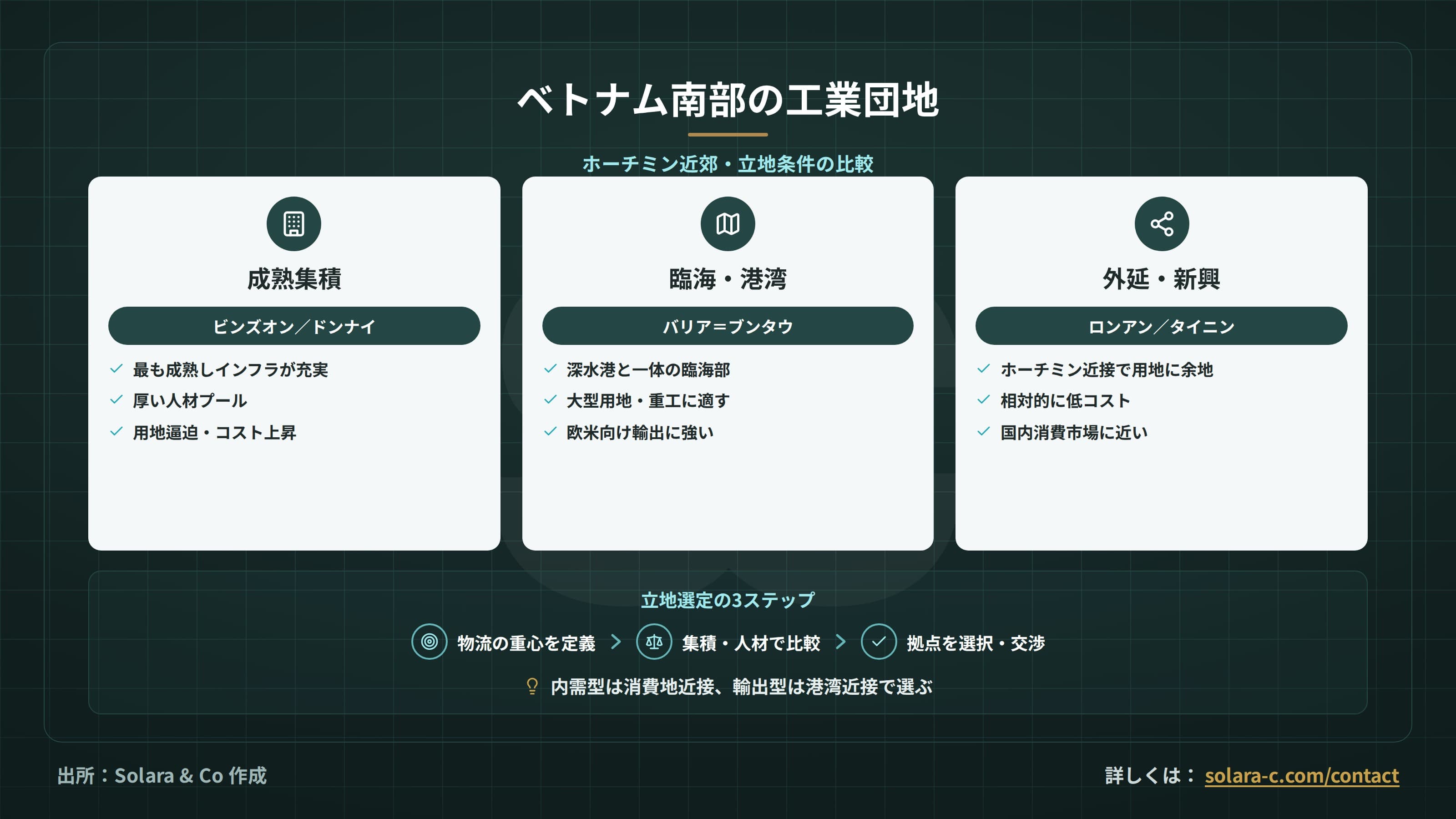
Development bases are concentrated mainly in three cities. Hanoi in the north has many government-affiliated and major IT companies and a deep talent pool; Ho Chi Minh City (HCMC) in the south is where startups and globally oriented companies cluster; Da Nang in the center has low living costs and a relatively containable turnover rate, and in recent years has drawn attention as a BPO and development base. Because wage levels and talent mobility tend to differ by city, the choice of base is the starting point of order design. For the overall picture of the talent market, reading Recruiting and retaining talent in Vietnam together with this will deepen your understanding.
Choosing the right engagement model
The success or failure of offshore development depends heavily on whether you can choose the "shape" of the contract and structure to match the project's characteristics. There are three representative models.
The lab model (ODC / dedicated team)
The lab model secures a dedicated team of engineers for your exclusive use on a monthly basis and proceeds with development continuously. Its strengths are that it can respond flexibly to specification changes and agile development, and that know-how accumulates within the team. It suits medium- to long-term product development and areas where the requirements have not fully solidified. On the other hand, it presupposes filling capacity (securing enough order volume so the team is not left idle) and management involvement on your own side.
The contract model (project basis)
The contract model sets the requirements, deliverables, and deadline and orders the whole as a package. It suits development with clear requirements and a fixed scope, and makes cost and schedule easy to forecast; on the other hand, it is weak against mid-course specification changes, and additional requirements mean re-estimation. The precision of the requirement definition translates directly into quality and cost.
BOT (Build-Operate-Transfer)
BOT is a phased model in which the vendor sets up and operates a development base locally and eventually transfers it to your own subsidiary. While looking ahead to future local incorporation, you can entrust the initial hiring and labor risks to the vendor. It is an option for companies that intend to expand locally in a committed way, and for the overall design of entry costs, The reality of labor costs in Vietnam is also a useful reference.
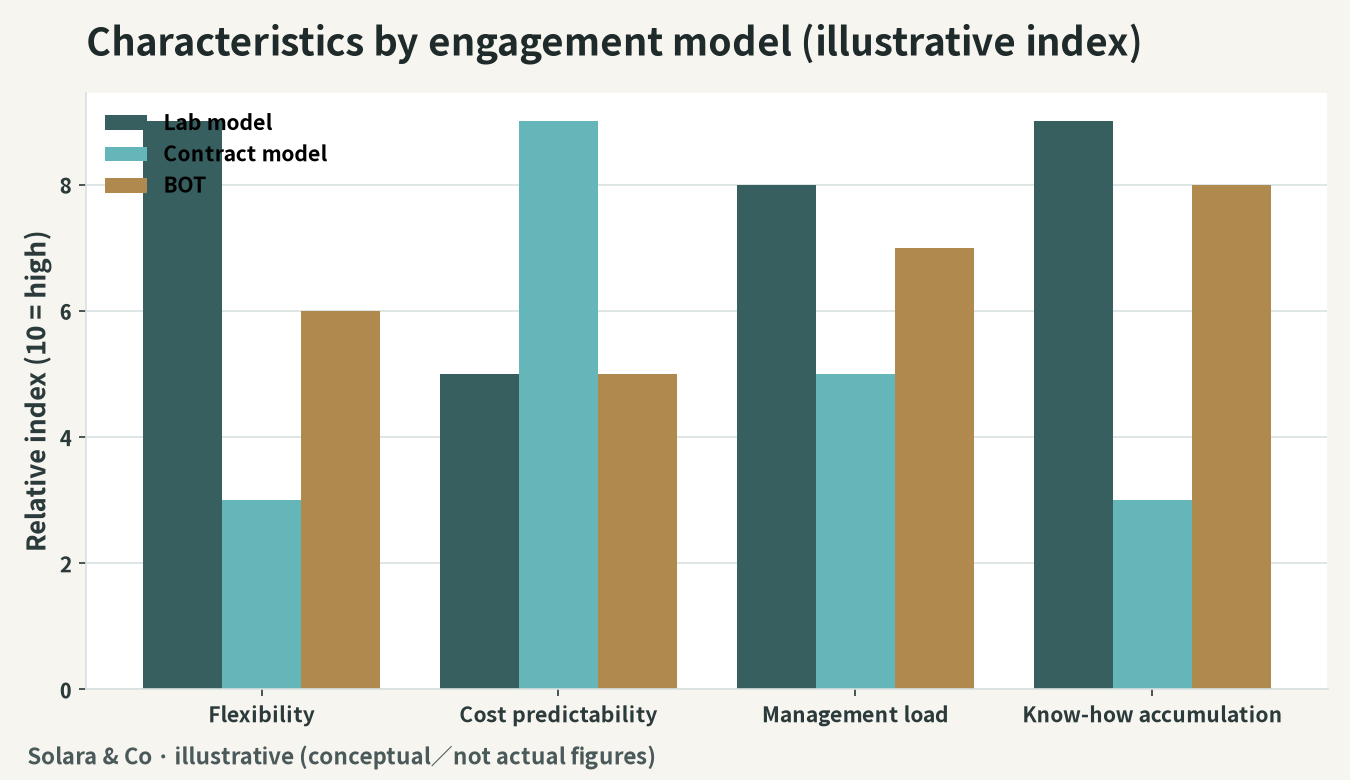
The table below organizes the differences among the three models. Please make your selection against your development phase and in-house management structure.
Aspect | Lab model | Contract model | BOT |
|---|---|---|---|
Suitable projects | Continuous development, fluid specs | Fixed scope, clear requirements | Oriented toward a local base |
Flexibility | High | Low | Medium to high |
Cost predictability | Varies on a monthly basis | Fixed, easy to forecast | Varies by phase |
Your management burden | Large | Moderate | Increases by phase |
Know-how accumulation | Accumulates in the team | Limited | Transferred to your company |
Criteria for selecting a vendor
Selecting a vendor is not a comparison of price lists. What you should check are: the fit of the technology stack (track record in your languages, frameworks, and cloud), experience in development for the Japanese market (understanding of business customs and quality requirements), the quality and number of bridge SEs / communicators, the turnover rate and mechanisms for talent retention, the information-security posture (certifications such as ISO27001, access and device management), and financial stability.
What is especially easy to overlook is the "resolution" of the proposal. A vendor that can articulate the premises, risks, and structure concretely tends to have less drift at the implementation stage than one that issues a vague lump-sum estimate against requirements. The sound approach is to run a small PoC (trial development), assess the reality of communication and the quality of deliverables, and only then proceed to a full order. The trends of local IT companies can also be grasped from Vietnam's startup ecosystem.
Order design — the requirements and structure to avoid "dumping it all on them"
Most offshore failures arise not from technical capability but from insufficient design of communication and requirement definition. What the ordering side must do is clear.
First, putting the requirement definition and specifications into words. "Read between the lines" does not work. Document everything down to screen transitions, input rules, exception handling, and acceptance criteria, to structurally reduce discrepancies in understanding. Second, communication design. Decide at the outset the frequency of regular meetings, the tools to use (ticket management, chat), the report format, and who is responsible for decisions. Third, deploying bridge SEs / communicators. Personnel who can translate both language and technology determine quality and speed.
In terms of structure, it is important to also appoint a product owner on your side and unify the point of contact for priorities and specification judgments. If the ordering side is in a "can't decide" state, then no matter how excellent the team, rework will increase.
Quality management — assured through acceptance criteria and process
Quality is not something to "pray" for but something built in through process. The foundational mechanisms are as follows.
- Code review: make review mandatory at the pull-request level to prevent reliance on individuals.
- CI/CD: continuously run automated tests, static analysis, and builds to make quality visible.
- QA / test design: tie test cases to requirements and manage coverage.
- Acceptance criteria (DoD): put the definition of "done" in writing to objectify pass/fail at delivery.
By building these into the contract and structure, and by having the ordering side actively participate in sprint reviews as well, deviations in quality can be detected early. What matters is agreeing on quality standards at the order-design stage, not "later."
Structure and contract — NDA, IP ownership, SLA
Designing the legal and contractual side is the lifeline for preventing trouble before it arises. At a minimum, clarify the following three points.
In the NDA (non-disclosure agreement), define the scope of information, its duration, and whether subcontracting is permitted. The ownership of intellectual property is the most important: state clearly in the contract that the copyright of deliverables (source code, documents) belongs to your company, to prevent reuse and diversion. Proceeding while this remains vague is the textbook example of later disputes over rights. In the SLA (service-level agreement), define response times, availability, and the level of incident response. The issues of IP and contracts are organized systematically in Intellectual property protection in Vietnam.
For projects that handle data, you also need to confirm in advance the rules for handling personal information and confidential data and for cross-border transfer. For a sense of the regulations when handling the financial and payments domain, Vietnam's fintech market is also a useful reference.
Cost structure and how to think about unit rates
Comparing by unit rate (per person-month) alone is dangerous. Effective cost is determined by "unit rate × required effort × rework rate." Even at a low unit rate, if rework increases due to vague requirements, total cost balloons. Conversely, if you invest appropriately in bridge SEs and quality management, rework decreases and total cost tends to fall.
Unit rates have a range depending on the engineer's skill level (junior / middle / senior), whether Japanese-language support is provided, and the city (Hanoi / HCMC / Da Nang). When evaluating an estimate, always check the team composition (the proportion of seniors) and whether management and QA effort is included.
In addition, "costs that do not appear on the rate sheet" — exchange-rate fluctuations, remittance costs, annual base pay raises, and the hiring lead time when expanding the team — cannot be ignored over the medium to long term. For a continuing engagement, if you design the annual budget to include not just the stacking-up of unit rates but also retention incentives and training investment, you ultimately keep rework and re-hiring costs down. The stance of judging by total cost of ownership (TCO) rather than the short-term lowest price maximizes the cost-effectiveness of offshore utilization.
Common failures and how to avoid them
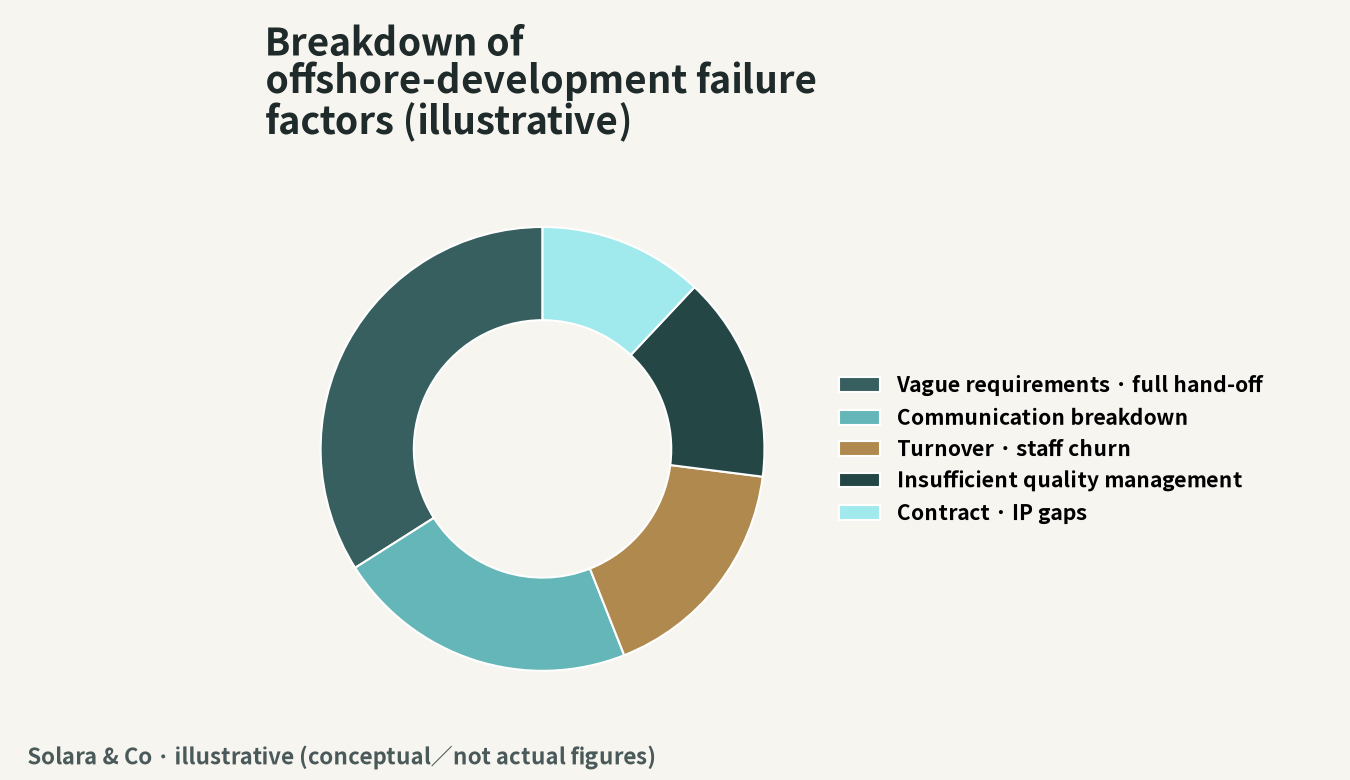
The failures repeated in the field share common patterns.
- Dumping it all on them: leaving requirements and judgments to the other side, so quality and direction drift. Avoid through ownership on the ordering side.
- Vague requirements: insufficient specification resolution generates rework. Avoid by putting everything into words down to the acceptance criteria.
- Turnover and personnel changes: knowledge is lost when key people leave. Mitigate through documentation and retention measures.
- Communication breakdown: insufficient design of reporting and decision-making. Firm up regular meetings, tools, and points of contact at the outset.
All of these are failures that can be prevented by "design" that precedes technology. That is precisely why the quality of order design decides the success or failure of a project.
Solara & Co's support for Vietnam IT offshore utilization
Solara & Co supports Japanese companies' Vietnam IT offshore development consistently, from strategy design through execution. From selecting the engagement model, selecting and conducting due diligence on a reliable vendor, accompanying you through requirement definition and structure-building, designing contracts including the NDA, IP ownership, and SLA, putting quality-management processes in place, to future local incorporation (BOT) — advisors who understand the business customs of both the Japan↔Vietnam sides will run alongside you.
To realize offshore utilization that does not end as "cheap outsourcing" but substantively raises your own development capacity. Even at the stage where you are unsure at the very entrance of order design, please feel free to consult us. Solara & Co will help design the optimal Vietnam development structure for your company.