
Vietnam's Labor Code is grounded in "protection of workers"
Alongside taxation and licensing, one area that Japanese companies establishing a local entity in Vietnam invariably confront is the practice of the Labour Code. As befits a socialist state, Vietnam's labor law has a strong worker-protection character, and it differs greatly from Japanese labor law in points such as "ease of dismissal," "contract renewal rules," and "the obligation to file work rules." If you proceed with the mindset of "hire employees with the same sense as in Japan, and if there is a problem just let them go," you will stumble in the form of compensation for unfair dismissal, administrative penalties, or labor disputes.
The current law is the 2019 Labor Code (No. 45/2019/QH14), which took effect on January 1, 2021. It contains many revisions directly tied to practice, such as simplification of the types of labor contracts, clarification of the maximum probationary period, a phased increase in the retirement age, and the introduction of harassment regulation. This article organizes the practical points Japanese companies should grasp, centering on four pillars: hiring (labor contracts and probation), wages and working hours, dismissal and severance, and work rules.
Basic rules on hiring and labor contracts
Under the 2021 new law, labor contracts in Vietnam were simplified into two types: the "indefinite-term labor contract" and the "fixed-term labor contract (within 36 months)" (the "seasonal labor contract" that existed under the old law was abolished).
Fixed-term contracts "may in principle be renewed only once"
The point requiring the most attention is the renewal rule for fixed-term contracts. A fixed-term labor contract may in principle be renewed only once, and if employment continues after the contract term expires, from the second time onward it is automatically deemed an indefinite-term labor contract. You cannot operate the Japanese-style practice of repeatedly renewing fixed-term contracts to preserve room for employment adjustment. If you want to secure flexibility in employment, you need to consider the design of the contract type from the point of hiring.
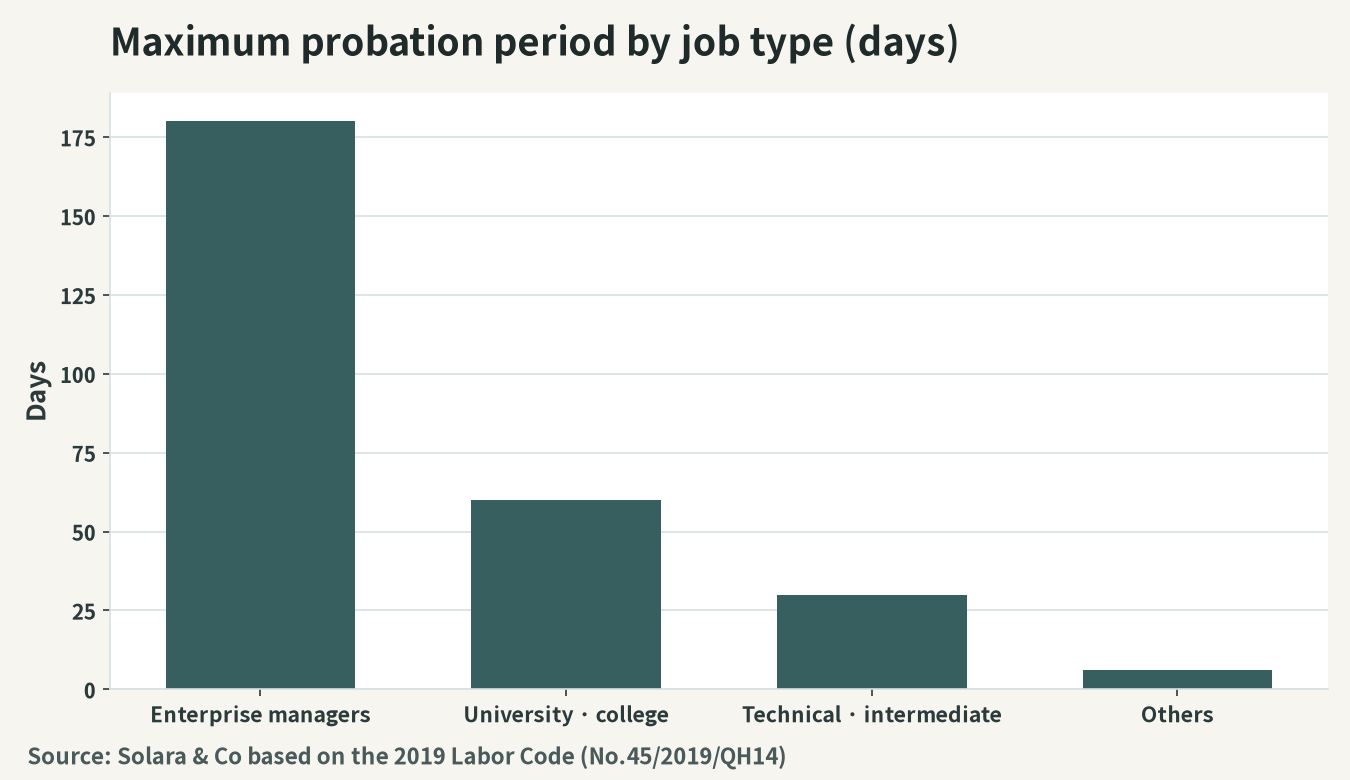
Limits on the probationary period
The probationary period has maximum limits set by job type. Company managers (legal representatives, department heads, etc.) up to 180 days, jobs requiring a university or junior-college qualification 60 days, jobs requiring a specialized or intermediate qualification 30 days, and all others up to 6 days. Wages during probation must be at least 85% of the wage after formal hiring. As a rule, probation is once per job type and cannot be repeated multiple times.
Wages and working hours
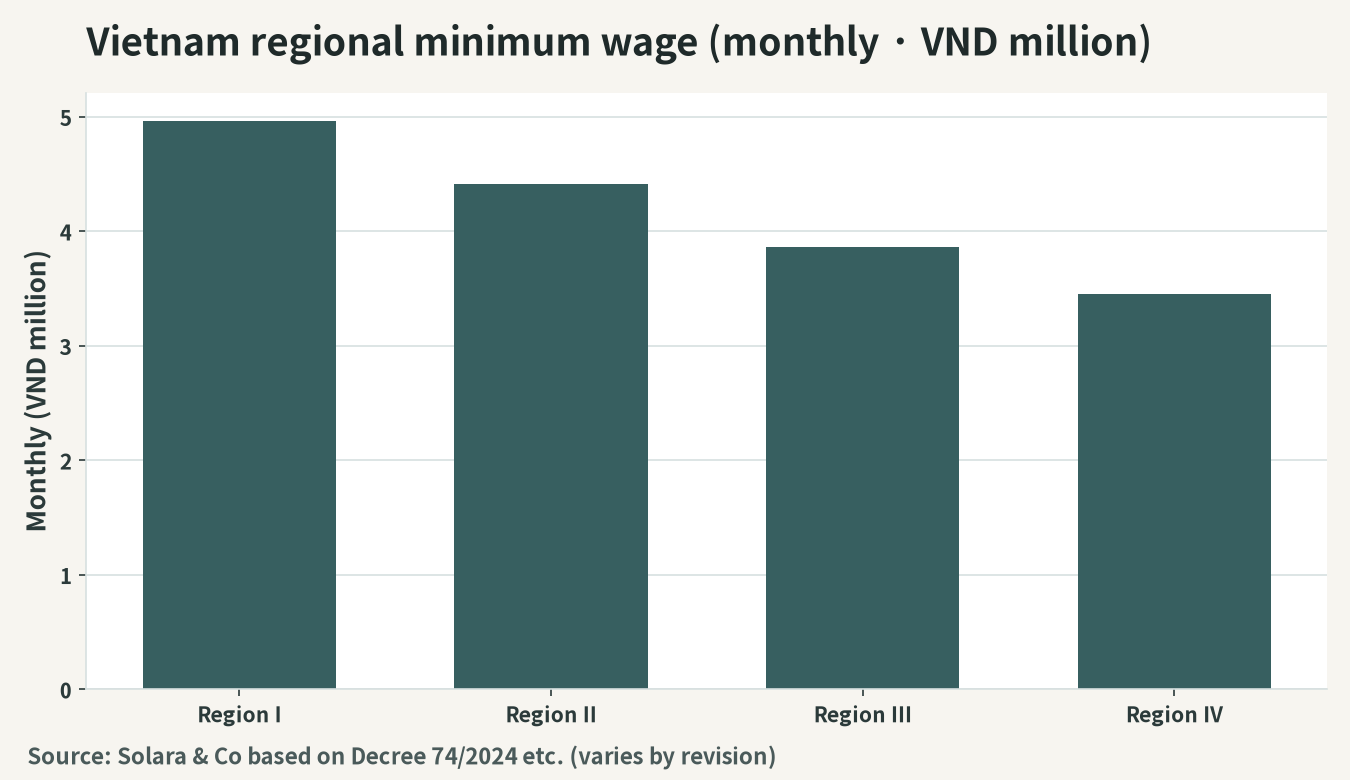
Wages cannot fall below the regional minimum wage. Vietnam divides the whole country into four regions (Region I–IV), with the urban areas of Hanoi and Ho Chi Minh City (Region I) set highest and the provinces (Region IV) set lowest.
Minimum wage and the basis for social insurance calculation
The minimum wage is revised by the government from time to time, and in recent years it has been raised almost every year. Because the minimum wage also affects the basis for calculating social insurance and union dues, total labor cost moves with each revision. In wage design, it is important to estimate by total cost including the employer's social insurance burden (over 20% of wages), not just the face amount.
Working hours and the cap on overtime
Statutory working hours are capped at 48 hours per week. Overtime (work outside hours) has caps: in principle up to 40 hours per month and 200 hours per year, with exceptional allowance up to 300 hours per year in some industries such as textiles and electronics. Overtime premium rates are set high—150% on weekdays, 200% on rest days, and 300% on holidays—so in manufacturing the skill of overtime management greatly affects labor cost. In addition, night work (10 p.m. to 6 a.m. the next day) carries a further premium of 30% or more, so at shift-based factories attention must be paid to the accumulation of premiums. Annual paid leave is a minimum of 12 days after one year of service, increasing with length of service, and Vietnam's public holidays (around 11 days per year, including the Lunar New Year, Tet) are also guaranteed as paid leave. Factory operations drop sharply around Tet, so this must be factored into production planning and staffing.
Dismissal and severance
What Japanese companies most easily misunderstand in Vietnamese labor law is the difficulty of dismissal (termination of the labor contract). An employer may unilaterally terminate a labor contract only on the grounds enumerated by law.
Grounds on which unilateral termination is permitted
Unilateral termination by the employer is permitted only in cases such as repeated breach by the worker of the duty to perform the job, prolonged illness or injury, business contraction due to force majeure, or unauthorized absence beyond the prescribed period. Casual dismissal on grounds of "insufficient ability" or "company convenience" is readily judged to be unfair dismissal, with the risk of being ordered to reinstate, pay unpaid wages, and pay compensation. Termination requires prior notice according to job type and contract (indefinite-term 45 days, fixed-term 30 days, short-term 3 business days, etc.).
Severance pay and unemployment benefit
When a contract ends for personal reasons or company convenience, severance pay (trợ cấp thôi việc) of 0.5 month's pay per year of service in principle arises. However, because service from 2009 onward is covered by unemployment insurance (UI), the target of severance pay is mainly the portion of service before 2009. In the case of contract termination due to business restructuring or workforce reduction, a job-loss allowance of one month's pay per year of service (minimum two months) is required, and the cost of redundancy can be heavier than in Japan. Furthermore, when carrying out a workforce reduction, you must go through procedures such as drawing up a labor-use plan (labor-restructuring plan), consulting with the labor union, and notifying the competent authority; if the prescribed steps are lacking, the reduction itself may be judged invalid. If you misjudge this cost and procedure in the withdrawal or contraction phase, the entire liquidation schedule will be delayed, so it is important to factor it in from the business-planning stage.
Work rules and internal regulations
A company employing 10 or more workers must draw up work rules (nội quy lao động) in writing and register them with the competent labor authority. Registered work rules serve as the basis for disciplinary action.
Disciplinary action is grounded in the work rules
In Vietnam, an employee cannot be disciplined on grounds not expressly stated in the work rules. To carry out a disciplinary dismissal, the applicable grounds must be specifically defined in the work rules, and the prescribed procedures (such as holding a disciplinary meeting) must be followed with the involvement of the labor union. If the work rules are not in place, or are operated while their content remains vague, then even when you try to deal with a problem employee you will lack the basis for the action and be unable to respond.
Labor unions and internal labor regulations
In Vietnam, the establishment of a labor union (officially under the Vietnam General Confederation of Labour) is anticipated, and the union plays a certain role in collective bargaining and disciplinary procedures. Beyond the work rules, putting in place internal regulations such as wage regulations, an evaluation system, and occupational safety and health regulations in a form consistent with local law forms the foundation of dispute prevention and sound labor management. Such a labor foundation also connects directly to the management of personnel risk in PMI after M&A.
Hiring foreign workers and the work permit
To employ foreign expatriates or foreign specialists in Vietnam, obtaining a work permit is in principle required. To be granted one, you must satisfy requirements such as an explanation that the position cannot be filled by Vietnamese, proof of education and work history (three or more years of practical experience or a relevant degree, etc.), a health examination, and a criminal-record clearance.
Integrated management of the hiring plan and residence procedures
The work permit is granted on the premise of an employment relationship and position with a Vietnamese enterprise, and its validity period is up to two years. Only once the permit is obtained do the corresponding residence permit (temporary residence card) and social insurance enrollment based on a labor contract of one year or more fall into place. Because the work permit, residence, social insurance, and personal income tax are interlinked, an expatriate's assignment cannot do without managing the hiring plan and residence procedures together. The specific handling of tax and social insurance is detailed in the explanation of expatriates' personal income tax and social insurance.
Resolving and preventing labor disputes
When a labor dispute arises, Vietnam provides a staged resolution procedure of conciliation by a labor conciliator, the labor arbitration council, and the people's court. Most individual labor disputes are required to go through conciliation first.
Mechanisms to prevent disputes before they arise
Considering the cost and time of disputes, prevention before reaching litigation is more important than anything. Clear, registered work rules, transparency of the wage and evaluation systems, proper observance of disciplinary procedures, and a framework of dialogue with the labor union form the foundation for preventing disputes before they arise. In particular, since a single procedural violation can cause a disciplinary dismissal to be judged unfair, carefully keeping records of fact-finding and procedures will protect the company in later disputes.
Phased increase in the retirement age
The 2021 new law set out a policy of raising the retirement age in stages. Men rise to 62 by 2028 and women to 60 by 2035, increasing by several months each year. This is a system change anticipating an aging population, affecting plans for retirement, pensions, and successor development. Together with this, the definition of and the duty to prevent sexual harassment in the workplace, and protective provisions for female and young workers, were also clarified in the 2019 law, and these should be reflected in the work rules and harassment-prevention regulations.
Practical points Japanese companies should grasp (comparison table)
Organizing the main points from hiring to departure, together with the differences from Japan, gives the following.
Point | Vietnam's characteristic | Practical considerations |
|---|---|---|
Labor contract | Two types: indefinite / fixed-term (within 36 months) | Fixed-term renewal in principle once; second time becomes indefinite |
Probationary period | 6–180 days by job type | Probation wage 85% or more, in principle once |
Working hours | 48 hours/week, overtime 200 (300) hours/year | High premium rates make management important |
Dismissal | Limited to statutory grounds | Insufficient ability / company convenience carry unfair-dismissal risk |
Work rules | Registration mandatory at 10 or more workers | Discipline is grounded in the work rules |
Vietnam's labor law, in that hiring flexibility is low, the hurdle for dismissal is high, and putting work rules in place is the premise for discipline, makes "the design of the entrance and the mechanism" even more important than in Japan. Solara & Co supports everything from putting in place labor contracts, work rules, and wage regulations, to how to conduct dismissals and workforce reductions, and responding to labor disputes, with a team versed in labor practice on both the Japanese and Vietnamese sides. Building labor design into the very stage of considering local-entity establishment and market-entry structure is the best way to contain later dispute costs. Designing the hiring, wage, work-rule, and dismissal points under a consistent policy, and putting them in place as documents consistent with local law, becomes the foundation for stable business operations.