
Vietnam's Land Law 2024 changes the premise of land strategy
For Japanese companies setting up a factory or logistics base in Vietnam, land is the physical foundation of the business and, at the same time, the area where understanding of the legal system is tested most. Vietnam has no private ownership of land as Japan does, and what a company can obtain stops at the "land-use right" (LUR: Land Use Rights). The Land Law 2024 (Land Law 2024, document number 31/2024/QH15) overhauled this land-use-right system for the first time in about a decade and took effect ahead of schedule on August 1, 2024. The rules on land acquisition, valuation, and compensation have changed, and the very premise of land strategy on entry is being updated.
This article organizes the fundamental principles of Vietnam's land system, the forms of acquiring a land-use right, the practice by which foreign-invested enterprises secure land, the checkpoints on the land-use-right certificate (LURC), and the main changes in the Land Law 2024.
Fundamental principles of Vietnam's land system
Vietnam's Constitution and Land Law provide that land "belongs to the ownership of the entire people and is managed uniformly by the State." That is, no one can "own" the land itself; the mechanism is that one uses it after being granted a land-use right by the State. If you proceed without understanding this overarching principle, with the Japanese-style mindset of "buying land," you will misjudge the nature of the right and its term limits.
The nature of the land-use right as a right
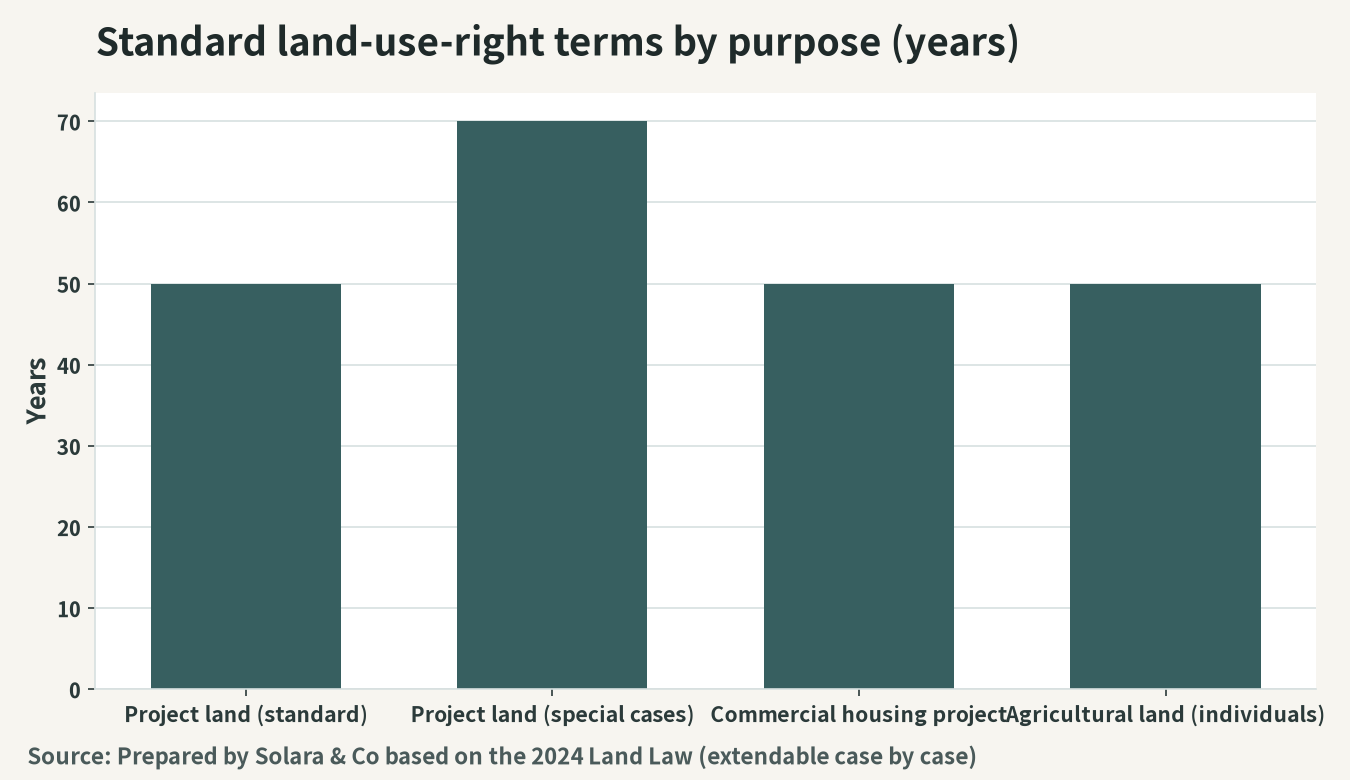
The land-use right is a property right that allows land to be used for a fixed term and a fixed purpose, and, if conditions are met, to be transferred, leased, or mortgaged. Business land (factories, offices) usually has a term of 50 years (up to 70 years for special projects), and on expiry an application for extension is required. Because the remaining years bear directly on asset value and financing, this is the most important check item when securing land.
Forms of acquiring a land-use right
The forms in which the State grants a land-use right to an enterprise are broadly divided into "allocation" and "lease," and the way consideration is paid also differs.
Land allocation (giao đất) and land lease (cho thuê đất)
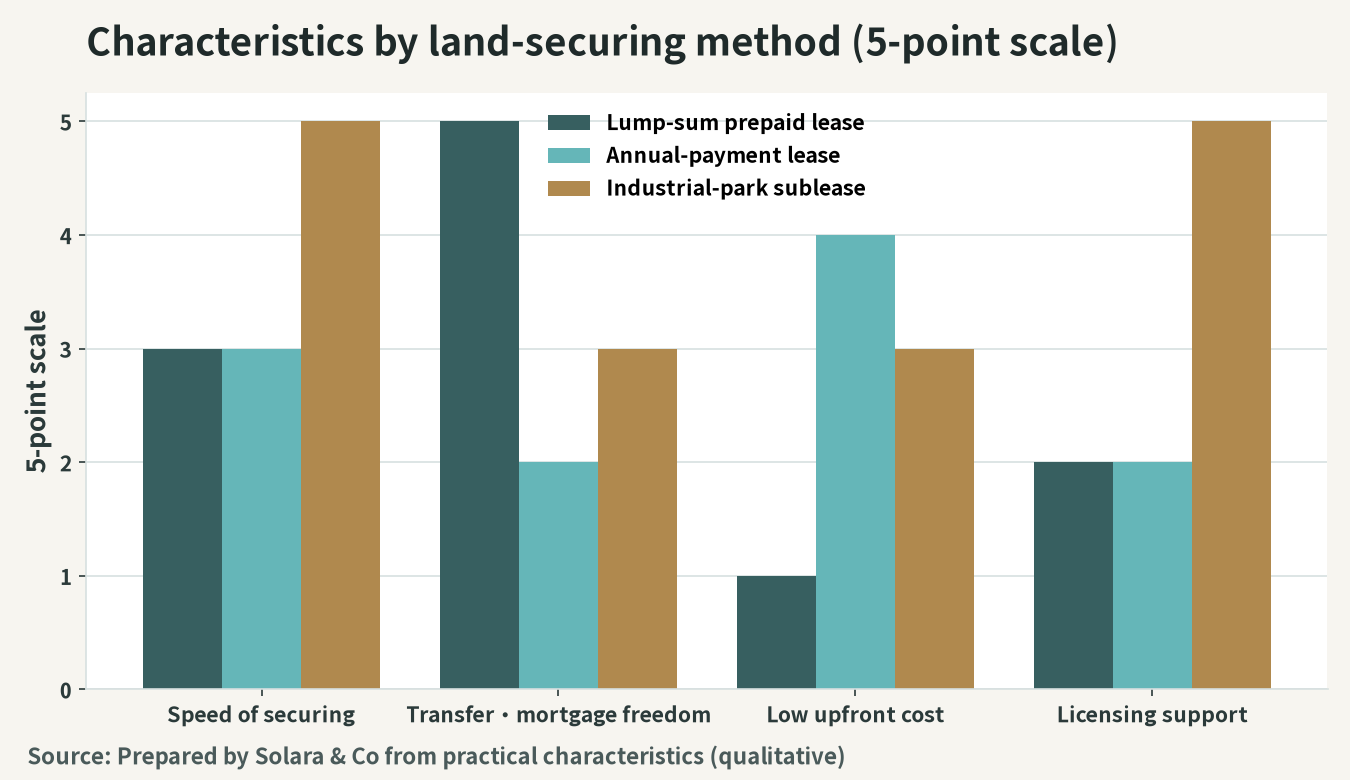
Land allocation is a form of granting a use right for a certain project. By contrast, the standard form by which a foreign-invested enterprise (FDI enterprise) secures business land is a lease from the State. Methods of paying the lease include a one-time upfront payment for the whole lease term and an annual payment method, and which one you choose changes the disposability of the right (whether transfer or mortgage is possible) and cash flow. Generally, the one-time upfront method gives a higher degree of freedom to transfer or mortgage the land-use right.
Subleasing in industrial parks and economic zones
In practice, many Japanese manufacturers do not lease directly from the State but take the form of subleasing a plot from the operating company of a developed industrial park (IZ) or economic zone (EZ). This is because the infrastructure is already in place, licensing support can be received, and it is superior in the speed and certainty of securing land. Even with a sublease, the nature, remaining years, and consideration method of the land-use right of the whole industrial park that underlies it ultimately determine the stability of the company's right. Site selection should be considered together with the relocation of a manufacturing base in Vietnam and factory-site due diligence.
Checkpoints on the land-use-right certificate (LURC)
The document that publicly proves the existence and content of a land-use right is the land-use-right certificate (LURC, the so-called "red book"). In M&A or land-acquisition due diligence, this is where you scrutinize closely.
Checking the holder, purpose, term, and restrictions
On the LURC, check the name of the use-right holder, the land's purpose (business, industrial, etc.), the term of use and remaining years, the consideration method (allocation, one-time upfront lease, or annual lease), and the status of any mortgage. Whether the purpose matches the business plan, whether the remaining years cover the investment-recovery period, and whether it has been put up as collateral for a third party are especially important. When acquiring a company holding land-related rights, these checks constitute the core of legal due diligence in Vietnamese M&A.
Risks of purpose change and site preparation
To later change the purpose of acquired land (e.g., from agricultural to industrial), a permit from the authorities and additional consideration are required, and it also takes time. If "land that can be acquired cheaply" presupposes a purpose change, then unless you factor in the permitting risk and the burden of site preparation and compensation, you will incur unexpected costs and schedule delays.
Main changes in the Land Law 2024
The Land Law 2024 made several revisions affecting practice, centered on making land valuation, compensation, and the market more transparent.
Review of land valuation
The policy set out is to abolish the rigid "land price framework" of the past and shift toward an annual land price table reflecting actual market conditions. As a result, the basis for calculating compensation, lease fees, and land-related taxes moves closer to market prices, raising the predictability and transparency of land cost—while in some regions it can also be a factor pushing costs up.
Improvements to compensation, land recovery, and resettlement
The rules on compensation, support, and resettlement accompanying land recovery (site clearance) were organized, and protection of residents and businesses subject to recovery was strengthened. In large projects involving site preparation, the process of compensation and securing residents' consent readily becomes the critical path of the schedule, so coordination with local authorities is indispensable.
Clarification of foreign investment and market access
The rules on foreign companies' acquisition and disposal of land-use rights, and the framework for supplying land in industrial parks and economic zones, were also further organized. Whether financing can be arranged by utilizing the transfer or mortgage of a land-use right is closely tied to the consideration method (upfront or annual), so it must be designed together with the fundraising plan.
Transparency and digitization of land information
The Land Law 2024 also set a direction toward developing a land database and disclosing and digitizing land information. If this is implemented, checking the status of land-use rights and planning information will become easier, and it is expected to raise the predictability of land acquisition and due diligence. On the other hand, during the transition period, inconsistencies in data and regional differences in operation remain, so for the time being it is the more reliable practice to also use checks of primary information, such as inspecting the original LURC and inquiring with the competent authority. Because the operation of the system tends to differ by locality, an attitude of individually checking the practical trends of the province or city of entry is indispensable. The details of land valuation and procedures are largely made concrete in decrees, circulars, and local implementing rules, so it is also important to note that the law text alone does not reveal the full picture of practice. Judging on the basis of the latest subordinate legislation and local operation is the premise for containing land risk. Even under the same law, between major metropolitan areas such as Hanoi and Ho Chi Minh City and the provinces, large differences arise in the level of the land price table and the speed of procedural operation, so individually checking the conditions of each candidate site and comparing them side by side raises the precision of land strategy.
Practice of industrial-park selection and securing land
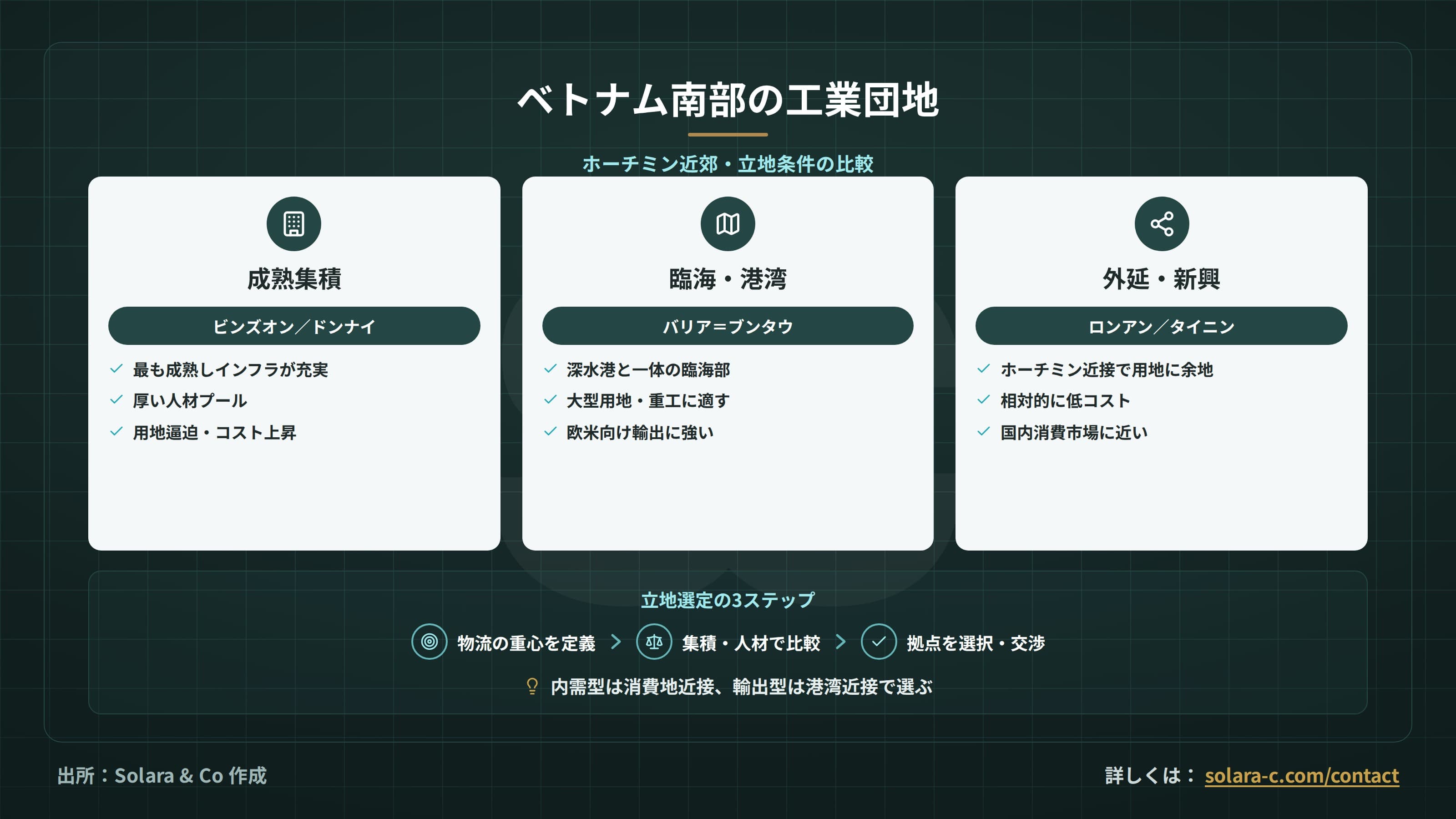
For many Japanese manufacturers, land strategy in essence comes down to "which industrial park to choose." The judgment here governs the stability and cost of operations for a long time.
Checkpoints for assessing an industrial park
When choosing an industrial park, what matters is not only the merits of rent or location but also checking the nature of the land-use right that underlies the park. Whether the lease of the whole park is the upfront-payment type or the annual-payment type, how many years remain, whether the capacity and reliability of the infrastructure (power, water supply, wastewater treatment, telecommunications) are sufficient, whether there is a track record of obtaining environmental permits and fire-safety approvals, and what the financial soundness and operating record of the park's operating company are—these bear directly on the stability of the right and the cost for the subleasing company. If you choose merely on the cheapness of the surface plot price, it will rebound later in the form of weak infrastructure or an unstable right.
Due diligence on the LURC and the land
When acquiring land, or acquiring a company holding land, in addition to scrutinizing the land-use-right certificate (LURC), you also check the inquiry of public land records, the presence of disputes or mortgages, the conformity to planning such as purpose and building coverage ratio, and the history of recovery and compensation. In particular, land that was prepared in the past while compensation and residents' consent remained incomplete may harbor a risk of later disputes. Land due diligence must be conducted together with the factory's construction and operation plan, and verifying both sides—the right to the land and its physical usability—is indispensable.
Forms of acquiring a land-use right: comparison table
Organizing the main forms of securing land available to foreign companies by the nature of the right, consideration, freedom of disposal, and suitable situations gives the following.
Form | Consideration method | Transfer / mortgage | Speed of securing land | Suitable situation |
|---|---|---|---|---|
State lease (upfront one-time) | Lump sum for the term | Relatively free | Medium | Large-scale in-house site preparation |
State lease (annual) | Each year | Restricted | Medium | Holding down initial investment |
Industrial-park sublease | Paid to the park | Per the park's conditions | Fast | Standard manufacturing base |
Acquisition presupposing purpose change | Case by case | After permission | Slow | Cost-focused, permit required |
Practical points Japanese companies should grasp
First, take the overarching principle that "you cannot buy land, you obtain a use right for a fixed term" as the starting point, and always check the alignment between the remaining years and the investment-recovery period. Second, the choice of consideration method (upfront one-time or annual) governs not only cash flow but also the future freedom of financing through transfer or mortgage, so it should be decided together with the capital plan. Third, checking the holder, purpose, term, mortgage, and disputes on the LURC is the lifeline of due diligence in land acquisition and M&A. Fourth, because the change of valuation and compensation rules under the Land Law 2024 is updating the premise of land cost, you should not take the figures of past acquisition cases at face value but rather recalculate with the latest land price table and lease conditions.
Vietnam's Land Law 2024 was a major revision pulling the premise of land strategy closer to actual market conditions. If you misdesign the rights to the foundation that is land, it will rebound as a delayed operational start, unexpected costs, and financing constraints. Solara & Co provides integrated support from the selection of location and land form, scrutiny of the LURC, and negotiation of conditions with industrial parks, through to due diligence in land acquisition and M&A, with a team versed in practice on both the Japanese and Vietnamese sides. We propose the design of the "rights to land" best suited to your company's investment-recovery plan, right from the entrance of market entry.