
Market research starts with designing the "question"
A request we often hear from Japanese companies considering entry into Vietnam is, "First, we'd like to do some market research." Yet when a project gets underway without clarity on what decision the research is meant to inform, the result tends to be an impressive report that is nonetheless useless for an investment decision. The success or failure of market research is largely determined at the stage of "designing the question (the research question)" — before any data is even collected.
Vietnamese market research is difficult because: (1) official statistics are limited in accuracy, update frequency, and granularity; (2) industry data is fragmented and untranslated into English or Japanese; and (3) the informal economy (unregistered economic activity) accounts for a high share, so the figures that surface do not reflect reality. For exactly these reasons, it is essential to design an approach that combines secondary research (desk research) and primary research (on-the-ground interviews and field surveys) to verify what lies behind the numbers.
This article organizes how to conduct Vietnamese market research as a process running from scope design, to method selection, to field research, to analysis and decision-making, and explains the practical points that keep you from taking the numbers at face value.
Step 1: Designing the research scope and hypotheses
Define "what decision the research is for"
The starting point of any research is clarifying its purpose. Is it to grasp market size, to judge whether to enter, or to decide on pricing and location? Different types of decisions call for different data and different research methods. A vague request along the lines of "just give me the big picture" produces an unfocused report.
Form a hypothesis before you investigate
Excellent market research does not gather data from a blank slate; it proceeds by forming a hypothesis — "this market has such-and-such structure, and there is an opening in this segment" — and then verifying or disproving it. Precisely because there is a hypothesis, you can narrow down the data you need and reach a conclusion that informs the decision within limited time and budget. It is fine if the hypothesis turns out wrong. Indeed, there is value in "being disproven," and the very points where your initial assumptions diverge from the on-the-ground reality become the most important findings for the decision.
Deliberately narrow the research scope
Vietnam has large regional differences: the South, centered on Ho Chi Minh City, and the North, centered on Hanoi, differ in income levels, consumption tendencies, distribution structures, and business customs. Trying to study the whole country uniformly tends to yield an average conclusion that lands nowhere. Deliberately narrowing the initial target region and segment and digging deep is the shortest path to obtaining reliable decision-making material with limited resources.
Step 2: Secondary research (desk research)
Leveraging official statistics and industry data
In secondary research, you draw on population, income, and consumption statistics from the General Statistics Office (GSO), customs trade statistics, materials from ministries and industry associations, and reports from research firms. These are effective for quickly grasping the overall picture, but you must watch for differences in update frequency, granularity, and definitions. In addition, specialist industry media, disclosures from listed companies, local news, and competitors' public information can become valuable clues when the fragments are pieced together. The cardinal rule is that wherever you can reach the primary source, you trace back to the original to verify it, rather than relying on second-hand reports that quote others.
Overcoming the language barrier
Much of Vietnam's useful data is in Vietnamese and untranslated into English or Japanese. Relying on machine translation alone carries the risk of misreading definitions and context. Whether or not you have a research team member who understands the local language and can consult the originals largely determines the quality of your secondary research.
Understanding the limits of secondary data
Vietnam's official statistics may have coarse granularity by region or income tier, or the most recent year of data may be several years old. Moreover, because of the informal economy, registration-based figures can underestimate the actual state of the market. You should bear in mind that secondary data is a "starting point," not a "conclusion." The pitfalls commonly encountered in market research are detailed in Pitfalls of Vietnamese market research.
Step 3: Primary research (on-the-ground fieldwork)
The hypotheses formed in secondary research are verified through on-the-ground primary research. Primary research is the very core of Vietnamese market research.
Qualitative research: depth interviews and FGIs
Depth interviews with industry experts, distribution insiders, and prospective customers, as well as focus group interviews (FGIs), are effective for grasping the purchasing motives, channel structures, and competitive realities that do not show up in the numbers. In Vietnam, candid information is often obtained only within trusting relationships built through introductions, so the quality of your local network determines the quality of the research.
Quantitative research: surveys and store checks
To back up market size and consumer preferences with numbers, surveys (face-to-face or online) and store checks (on-site surveys of retailers' assortment, prices, and displays) are effective. Design them with attention to the representativeness of the sample (skews in region, income, and age).
Mystery shopping and competitor field checks
Research that actually experiences competitors' stores, products, prices, and services reveals realities that published information cannot show. Walking the distribution and retail frontline is especially important in Vietnam. Distribution channel structures are covered in Vietnam's distribution channels and winning at retail.
Step 4: Connecting analysis to decision-making
Triangulation: verifying with multiple sources
The most important technique in Vietnamese market research is triangulation. Rather than taking a single figure at face value, you cross-check multiple sources — official statistics, industry data, on-the-ground interviews, and field checks — and draw conclusions within the range where they align. When sources conflict, you clarify the reason (differences in definition, the informal economy, the point in time of the survey).
Estimating market size: top-down and bottom-up
Market size should be estimated both top-down — narrowing down from macro statistics — and bottom-up — building up from unit price × quantity — and then the two should be cross-checked to verify plausibility. Relying on only one leaves a risk of over- or under-estimation.
Translating research into decisions
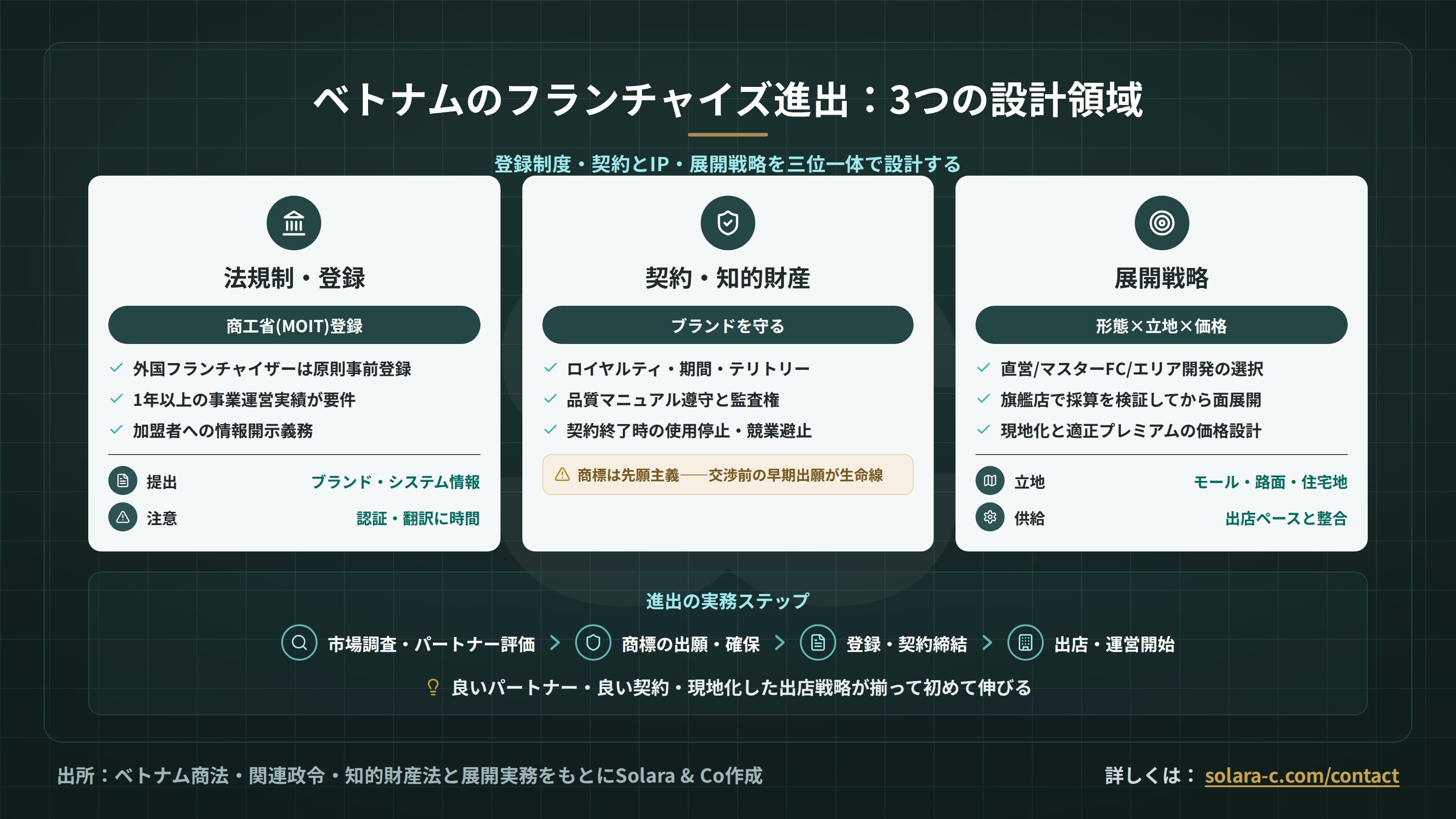
Ultimately, research results have value only once they are translated into decisions: "enter or not," "in what order and at what scale," and "through which channel and at what price." It is important not to stop at the report but to connect it to the strategic issues of the entry plan. For the overall strategic issues of market entry, please refer to Five strategic issues that lead Japanese companies to successful entry into Vietnam.
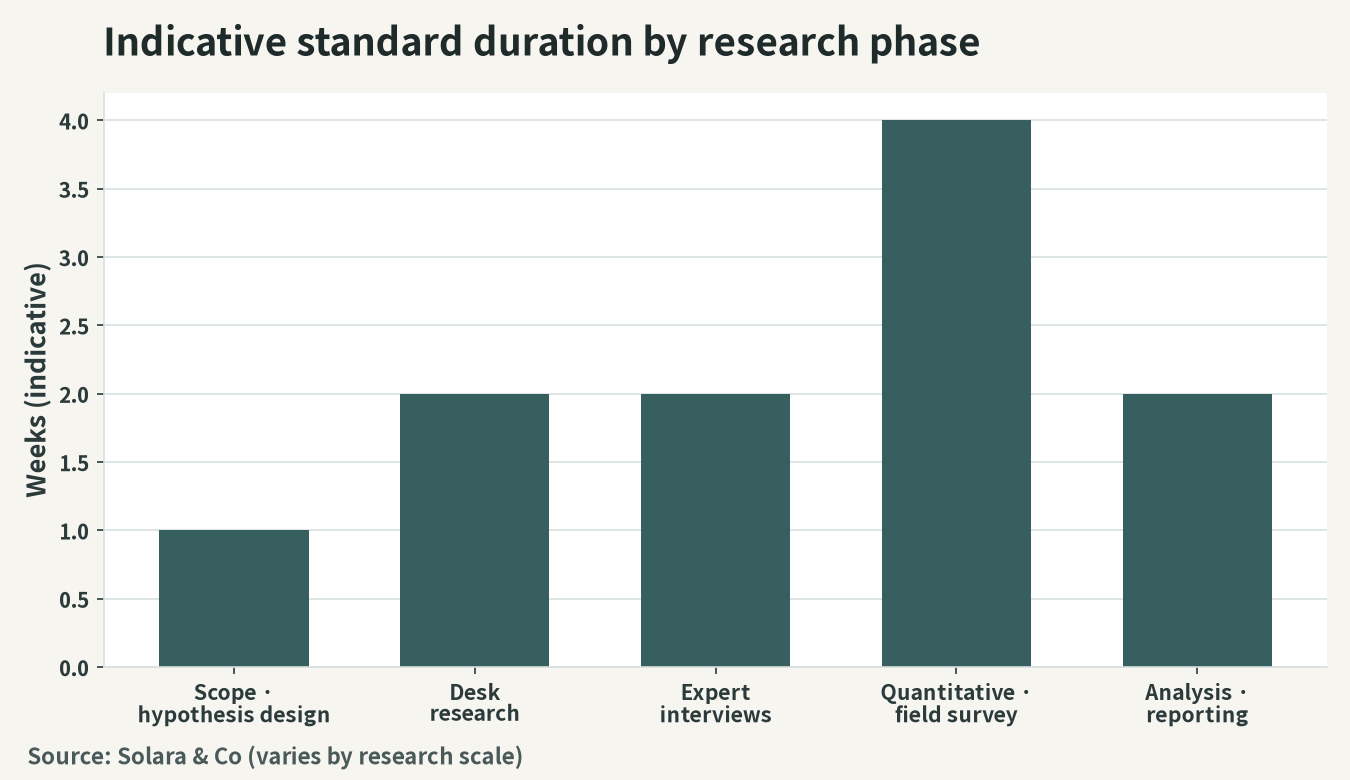
How to estimate the research timeline and budget
The more you raise the depth and comprehensiveness of market research, the more the timeline and cost balloon. It is important to design an investment level commensurate with the importance of the decision.
Invest in stages
Rather than commissioning a large-scale study all at once, a staged approach — first using low-cost desk research and expert interviews to test the direction of your hypothesis, then expanding the investment into quantitative research and full-fledged field surveys once you judge it promising — both curbs wasted research spend and raises the certainty of your judgment. Learning from a small initial study that "this doesn't look viable" is itself a perfectly worthy decision.
Positioning it within the overall entry cost
Market research cost is one part of the initial cost that accompanies entry. It is important to consider budget allocation within the overall picture, including research, incorporation, personnel costs, and working capital; an overall sense of entry costs is covered in A complete guide to the cost of entering Vietnam.
Choosing among research methods
Each research method has its own strengths and weaknesses. Combine them according to your purpose, budget, and timeline.
Method | Main use | Strength | Caveat |
|---|---|---|---|
Desk research | Grasping the big picture | Fast, low cost | Limits in accuracy and freshness |
Depth interview | Understanding structure and motives | Deep insight | Does not ensure representativeness |
Survey | Quantifying preferences and size | Quantitative backing | Sample design is key |
Store and competitor checks | Realities of distribution and competition | Primary information | Limited in scope |
Expert interview | Interpreting regulation and industry | Contextual understanding | Watch for bias |
Design research as a "combination"
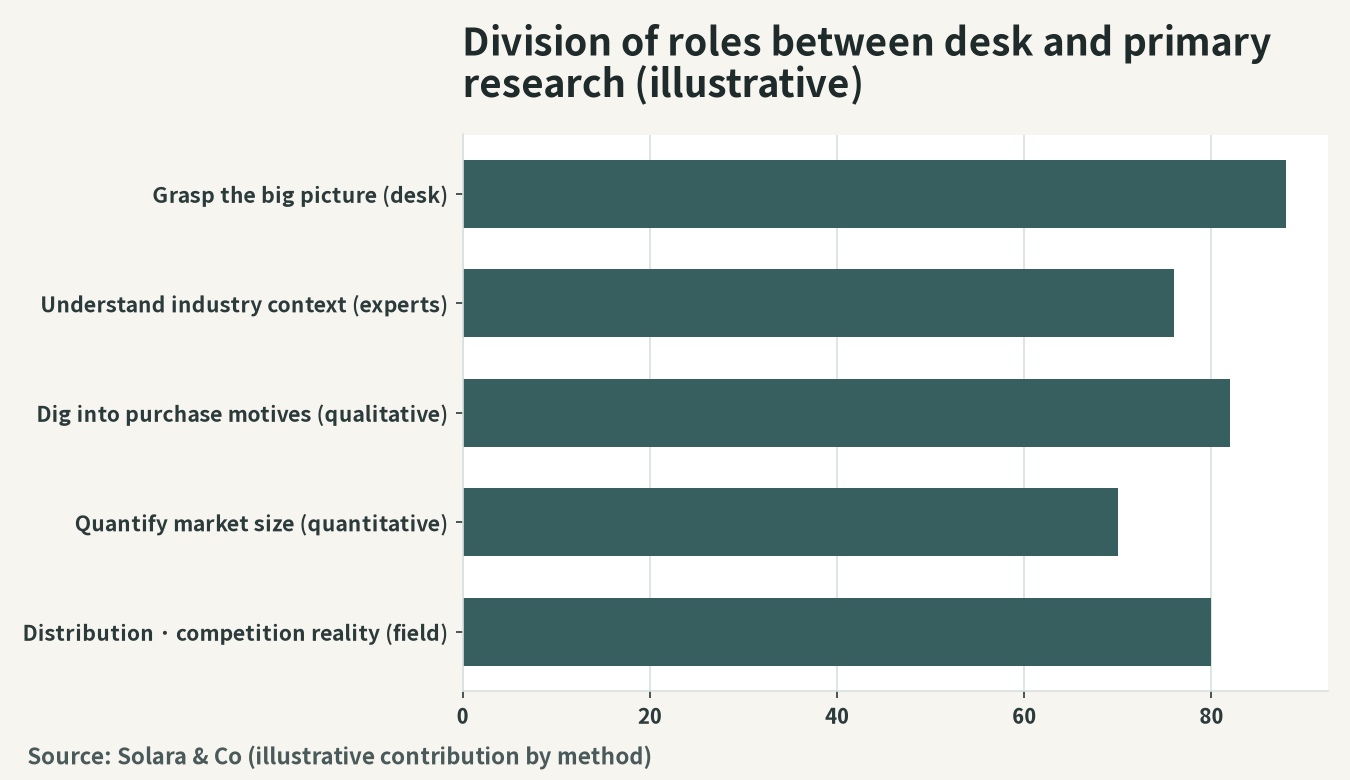
No single method can cover everything. The royal road to reaching a reliable conclusion with limited resources is a combination: use desk research to form hypotheses, expert interviews to grasp industry context, quantitative research to back up size, and field checks to confirm reality.
Common failure patterns
Taking the numbers at face value
The biggest failure is believing figures from reports or the internet as they are. In Vietnam, figures that differ in origin, definition, and timing are jumbled together, so a conclusion that lacks triangulation is dangerous.
Reaching conclusions without going on the ground
Reaching conclusions from secondary research alone causes you to overlook the informal economy, regional differences, and the realities of distribution. You cannot understand the Vietnamese market without on-the-ground fieldwork.
Applying Japanese common sense
The analogy "it's like this in Japan, so it must be like this in Vietnam too" is dangerous. Income structure, the family/community unit of consumption, payment methods (the penetration of cash versus mobile payment), the multilayered nature of distribution — the market's underlying premises differ greatly from Japan's. The attitude of holding a hypothesis while flexibly repainting it according to on-the-ground reality determines the quality of the research.
A mismatch between research purpose and sample
If the target tier needed for the decision is misaligned with the sample actually studied, then no matter how meticulously you tabulate, the conclusion is unusable. Designing "whom, where, and what to ask" by working backwards from the decision's question is the key to not wasting a limited budget.
Solara & Co's market research support
Vietnamese market research has its success or failure determined at the stage of "designing the question," before any data is collected. Setting scope and hypotheses according to the type of decision, grasping the overall picture through secondary research, verifying what lies behind the numbers through primary research, and drawing conclusions through triangulation — connecting this entire flow into a single, unbroken line is the condition for research that can be used in an investment decision.
Solara & Co leverages its networks in both Japan and Vietnam to provide end-to-end support, from designing the research scope, to desk research, on-the-ground expert interviews, consumer surveys, and distribution field checks, to estimating market size, and finally to connecting it all to the entry strategy. To avoid the situation of "an impressive report that can't be used for decisions," we begin our support with the very step of defining, together with you, "what decision the research is for."