Why Internal Fraud Is Prone to Occur at Vietnamese Subsidiaries
Among the challenges that Japanese companies entering Vietnam face in operating a local subsidiary, the one most capable of shaking the business is "internal fraud." Misconduct such as embezzlement, kickbacks (rebates), fictitious expenses, pilfering of inventory, and inflating purchase unit prices is by no means a matter for only certain special companies—it can occur at any subsidiary whose governance is not in order. While the Japanese head office relies on the optimistic assumption that "local staff are diligent, so it will be fine," losses quietly accumulate—this is the typical pattern.
Behind the proneness to fraud at Vietnamese subsidiaries lie several structural factors. First is the barrier of language and physical distance. Much of the accounting records, contracts, and administrative procedures are conducted in Vietnamese, and because the Japanese head office and Japanese expatriates cannot verify each detail, a "black box" left to the locals is born. Second is the shortage of personnel in the start-up phase. Because the business is run with few people, a state in which a single accounting staffer holds all of cash handling, bookkeeping, banking transactions, and payment approval—where the separation of duties cannot be established—tends to become the norm.
Third are local business customs and opaque practices. In an environment where rebates from suppliers and unofficial expenditures to smooth administrative procedures are not unusual, the line between what counts as a legitimate expense and what counts as fraud tends to become blurred, becoming a breeding ground for fraud. These factors are rooted less in the ethics of individual people than in flaws of the mechanism that allow fraud "if one intends to commit it." Precisely for that reason, countermeasures must be addressed not with appeals to the spirit, but with the prescription called governance (corporate governance).
Patterns of Fraud That Frequently Occur at Vietnamese Subsidiaries
Before designing countermeasures, it is important first to grasp concretely "what kinds of fraud actually occur." The fraud typically seen at Vietnamese subsidiaries can be organized into several patterns. Simply knowing these patterns gives a sense of where to apply checks.
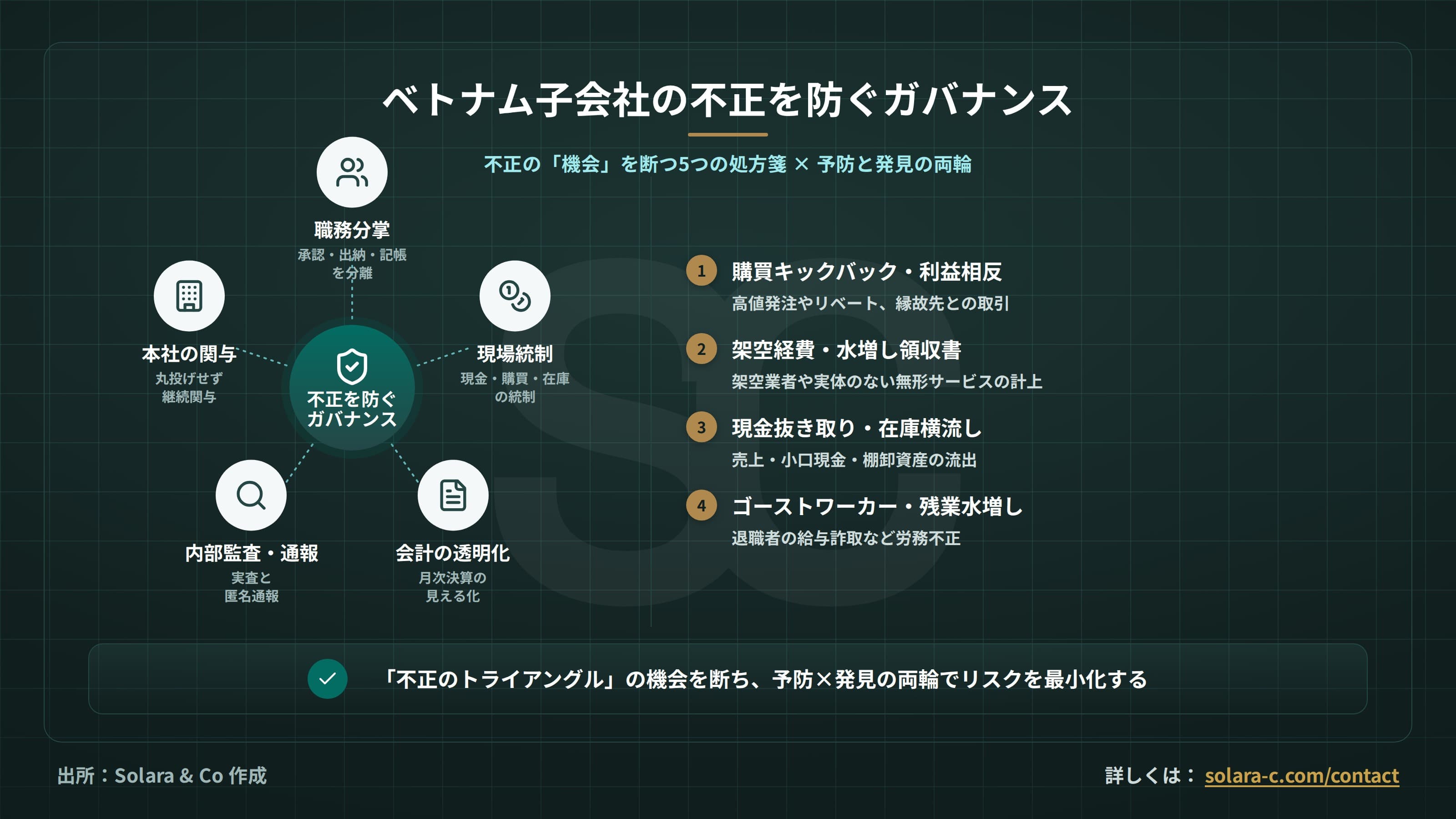
The most common is fraud surrounding purchasing and procurement. This includes a purchasing officer colluding with a particular supplier to place orders at unit prices higher than the market and receiving part of the difference as a kickback, or "conflict-of-interest transactions" in which a company run by family or acquaintances is slipped in as a business partner. Next most common is fraud in expenses and payments, such as payments to fictitious vendors, settlement using inflated receipts, and booking consulting fees or service fees with no substance. In Vietnam, official red-seal receipts (VAT invoices) are institutionalized, yet even so they do not guarantee the reality of the content.
At sites that handle cash and inventory, there occur the skimming of sales proceeds (especially in cash businesses), misappropriation of petty cash, the diversion of raw materials or product inventory, and pilfering disguised as the disposal of defective goods. In the HR and labor area, typical cases include "ghost workers"—keeping former employees on the rolls to defraud wages—inflated overtime pay, and kickbacks on recruitment placement fees. Furthermore, at the executive level, harder-to-detect fraud can also occur, such as taking sales off the books through double bookkeeping, and the outflow of profit through related-party transactions. These patterns occur not only singly but, not infrequently, in concert with one another.
The "Governance Vacuum" That Breeds Fraud
Subsidiaries where fraud occurs have a commonality: the existence of a "governance vacuum." Fraud is said to occur when three elements come together—motive (pressure), opportunity, and rationalization (the fraud triangle)—but what a company can mainly control is "opportunity." The very mechanism that denies opportunity is governance, and filling that vacuum is the heart of the prescription.
One typical vacuum is the concentration of authority in a single point. When the authority to conclude contracts, manage bank accounts, approve payments, and even personnel authority are concentrated in a local representative or accounting head in whom absolute trust was placed at the start-up phase, no one can check that person. In Vietnam in particular, the authority related to the corporate representative's seal, banking transactions, and tax filings is extremely strong in practice, and entrusting this to a single person means taking on a structural risk.
Another vacuum is the absence of effective monitoring by the head office. If one merely gazes at the monthly financial figures without a mechanism to verify the supporting documents and actual transactions behind them, the numbers can be fabricated to any degree. Furthermore, the absence of internal audit, the lack of a whistleblowing system (hotline), and a closed organizational culture in which mutual checks among local staff do not function also widen the vacuum. These vacuums make the loss amount larger the more the business gets on track and grows in scale. It is essential to regard governance development not as a "cost" but as "insurance," and to factor it in from the early stage of entry.
Prescription 1: Designing Separation of Duties and Internal Checks
The most basic and most powerful prescription for preventing fraud is the separation of duties (segregation of duties). This is the principle that "a single person should not be able to complete a transaction from start to finish alone," and it forms the core of internal control. Specifically, divide among different people: (1) the person who approves a transaction, (2) the person who manages assets (cash, inventory), (3) the person who records in the books, and (4) the person who actually reconciles and verifies.
At Vietnamese subsidiaries, because personnel are limited, one often hears the circumstance of "wanting to divide but being unable to," but compromising here leaves the door to fraud open. Even when complete separation is difficult, at minimum the "authority to move money" and the "authority to keep the books" must be separated. For example, while the accounting staffer does the bookkeeping, the final approval of bank transfers is held by a Japanese expatriate or the head office; the person who handles cash and the person who records it are made different—these are ways to apply checks.
In addition, effective measures are multi-tier approval with monetary thresholds for payment approval (for instance, making head-office approval mandatory above a certain amount), the separation of the authority to vet and to approve at the time of registering a new supplier, and the introduction of dual authorization that divides online approval authority for bank accounts among multiple people. Digitizing approvals to leave a log of who approved what and when also enhances the deterrent effect. Separation of duties is not designed once and then done; it must be reviewed whenever personnel increase or decrease or the organization changes, and periodically inspecting whether authority has again concentrated in a single point is indispensable.
Prescription 2: Tightening the Management of Cash, Purchasing, and Inventory
The "front lines" where fraud actually occurs are concentrated in three areas: cash, purchasing, and inventory. Applying concrete controls here is the practical essence of preventing damage before it happens.
In cash management, switch cash transactions to bank transfers to the greatest extent possible, and set an upper limit on the amount of cash held. Petty cash is managed under a fixed-advance system (imprest system), with the balance and supporting documents periodically reconciled. In business types centered on cash sales, thoroughly operate a process of matching daily sales reports and deposited amounts via POS every day, and always tracking discrepancies. In purchasing and procurement, introduce the mandatory obtaining of quotations from multiple companies (competitive quotation), confirmation of a supplier's actual existence (address visits, registration checks), and three-way matching among the purchase order, receiving report, and invoice, and separate the purchasing officer from the receiving officer. Periodic monitoring of whether a single supplier has been fixed in place for a long period, and whether the unit price has diverged from the market, is also effective.
In inventory management, conduct periodic physical stocktaking with the involvement of personnel outside the accounting department as well, and analyze discrepancies with the book inventory. Monitor whether the yield or defect rate of raw materials shows unnatural fluctuations, and require approval and records for disposal. In addition to these controls, as a measure to prevent conflicts of interest, obligating employees and executives to declare ties of kinship with business partners or side jobs and obtaining written pledges is also realistically effective in Vietnam. What matters is to document these rules, disseminate them to all staff in the local language, and leave records of their operation. Rules do not function by merely existing; only with operation and verification do they have deterrent power.
Prescription 3: The Transparency of Accounting and Signs of Kickbacks
Ensuring the transparency of financial reporting is directly linked to the early detection of fraud. If the head office cannot "make visible" the local accounting, then however splendid the regulations created, they are a picture of a rice cake. First, ensure the consistency between the local accounting records (books based on Vietnamese Accounting Standards = VAS) and the figures for head-office reporting, and establish the discipline of closing the monthly accounts by a set deadline. Desirable are a system in which the head office can view transaction details at the general-ledger level, and a mechanism that can check the supporting documents of major journal entries by sampling.
Kickbacks and fictitious transactions have signs that appear in the numbers. For example, orders concentrating on a particular supplier without rational reason; procurement unit prices continuously rising; intangible expenditures whose substance is hard to confirm, such as consulting fees and service fees, increasing; and unnaturally low profit margins on transactions approved by a particular employee. By making a habit of "analytical procedures"—monthly analyzing the trends in gross margin, expense ratio, and transaction amounts by supplier, and digging deeper when an anomaly is detected—one can nip the buds of fraud early.
A point peculiar to Vietnam is the handling of VAT invoices (red receipts). There are reported cases where, even with an official invoice, the transaction itself is fictitious, or where a "trade in invoices" purchased from a third party is mixed in. One must recognize that an invoice being complete in form and a transaction actually existing are separate matters, and for large expenditures and new business partners, it is essential not to neglect confirmation of substance. The transparency of accounting is also the foundation of the relationship of trust between the head office and the local operation.
Prescription 4: Building an Internal Audit and Monitoring Framework
If separation of duties and front-line controls are mechanisms of "prevention," internal audit and monitoring are mechanisms of "detection." Governance is completed only when both wheels are in place. At small subsidiaries it is difficult to place a dedicated internal auditor, so supplement it by combining periodic reviews by the head office's management department, internal-control reviews by external accounting firms or experts, and on-site audits by the group internal-audit department.
In the practice of monitoring, it is important to focus on high-risk areas. Make areas prone to fraud—cash, purchasing, inventory, and labor costs—the focus, and periodically conduct surprise cash counts, the sending of confirmation letters to suppliers, the reconciliation of bank balance certificates with the books, and the matching of the payroll register against the list of social-insurance enrollees (detection of ghost workers). Utilizing data analysis to mechanically pick up signs of fraud—such as duplicate payments, transactions on holidays or late at night, and split orders just under a threshold—is also effective.
At the same time, as a mechanism that makes it possible to "speak up" about fraud, developing an internal whistleblowing system (hotline) is extremely important. In Vietnam, there is a climate in which front-line employees, even when they notice fraud, find it hard to raise their voices for fear of damaging relationships or of retaliation. By designing it to guarantee anonymity, allow reporting in Vietnamese, and have the reported content reach the head office or an independent contact directly without passing through local management, an early warning from within can function. Showing a clear policy of protecting whistleblowers is also indispensable so that the system does not become a mere formality.
Prescription 5: Head-Office Involvement and the Governance of "People"
However well the mechanisms are put in place, it is people who operate them. The ultimate effectiveness of governance depends on how much the head office continues to be involved with the local operation, and on how the management of "people" is designed. A common failure is to "throw everything" at a trusted local representative. Delegation of authority and laissez-faire are entirely different things; delegated authority must always be accompanied by a set of monitoring and reporting.
On the personnel side, background checks at hiring (reference checks on previous employers, anti-social ties, kinship), periodic job rotation in key positions, and the encouragement of continuous leave are effective in deterring fraud. Because keeping the same person in charge advances collusion and over-reliance on individuals, intentionally moving people—especially in key posts such as accounting, purchasing, and cash handling—becomes a check. The point that, if there is a person in charge who has never once taken leave over a long period, one should suspect the possibility that fraud is continuing behind the scenes, is a classic lesson of internal control.
In addition, establish a code of conduct, clearly prohibit bribery, conflicts of interest, and kickbacks, and disseminate it to all employees in the local language—including the policy for sanctions upon violation—and have them pledge to it. "Tone at the top"—the top management itself showing an attitude of not tolerating fraud—governs the organizational culture even more than the rules. Having the Japanese head office, Japanese expatriates, and local management divide their roles and, while checking one another, continuously maintain a governance framework with a healthy sense of tension, is the best prescription for preventing fraud at Vietnamese subsidiaries.
Initial Response When Fraud Is Discovered, and Preventing Recurrence
Even when all preventive measures are exhausted, there is no guarantee that fraud will become completely zero. Precisely for that reason, anticipating the initial response upon discovery from peacetime is decisively important in minimizing damage and cutting off recurrence. When grasping a sign of fraud or a report, the most forbidden thing is to interrogate the party emotionally or to declare dismissal on the spot. Not only does this invite the destruction of evidence, making later legal procedures and recovery difficult, but there is even a risk of being judged an unjust dismissal under Vietnam's Labor Law, with the company side instead bearing liability for compensation.
The correct initial response, first, is the preservation of evidence. Secure the related books, supporting documents, emails, system logs, and bank records in a form not noticed by the party. On that basis, coordinate with the head-office and local legal functions, external lawyers, and fraud-investigation experts (forensics), and draw up an investigation plan that objectively establishes the facts. Interviews with the party should be conducted carefully after the evidence is firmed up, in the presence of multiple people and with records. The calculation of damages, examination of recoverability, and the judgment on discipline, dismissal, and prosecution in line with Vietnam's Labor Law and criminal procedure should always be advanced while obtaining the advice of experts.
And after the case settles down, the most important thing is preventing recurrence. Analyze thoroughly why that fraud was possible and which governance vacuum was exploited, and concretely plug the holes in separation of duties, the approval flow, and monitoring. A single instance of fraud is a sign that similar risks lie latent elsewhere too. Not disposing of the discovery as "an individual's problem," but reframing it as a problem of the mechanism, and making it an opportunity to update governance as a whole, becomes a turning point toward strong subsidiary management.