
Why "Credit Check First" — the sequence changes the outcome
When Japanese companies considering M&A in Vietnam find a target, many of them want to move straight into financial due diligence (DD) or legal DD. They engage accountants and lawyers, have a data room opened, and spend sums running into millions of yen on detailed scrutiny. At first glance this looks like the correct order. Yet what happens again and again on the ground is a particular kind of failure: "pouring time and money into a deal that should never have gone that far in the first place."
The first gate that prevents this problem is the "credit check (credit investigation / company-reality investigation)." A credit check refers to the work of confirming from the outside, before entering full-scale DD, whether the target company or the selling owner is in fact "a counterparty that exists, is sound, and is worth negotiating with." By securing information up front — the genuineness of the registration, the validity of licenses, any history of trouble with the tax authorities, records of litigation and default, and the owner's background and reputation — dangerous deals can be screened out early.
Why "first"? The reason is simple: DD is an internal examination predicated on the counterparty's cooperation, whereas a credit check is external confirmation that does not depend on the counterparty's cooperation. Verifying a counterparty's identity before obtaining their cooperation is common sense in business, and it becomes especially important in Vietnam, a market with large information asymmetry.
The risk of information asymmetry specific to the Vietnamese market
For M&A within Japan, you can obtain reports from credit investigation firms such as Teikoku Databank or Tokyo Shoko Research and grasp the counterparty's creditworthiness to a reasonable degree. In Vietnam, however, this credit-information infrastructure is not developed to the same level as in Japan. Whether in the reliability of financial statements, the comprehensiveness of disclosed information, or the update frequency of databases, applying a Japanese mindset wholesale will lead to misjudgment.
It is not unusual for Vietnamese companies' financial statements to involve "multiple sets of books" — one for tax filing, one for bank lending, and one reflecting actual operations. This is the problem of double or triple bookkeeping. Even if the financial statement presented shows a profit, there is no guarantee it matches the real figures submitted to the tax office; conversely, the company may be making itself look smaller than reality for tax-saving purposes. Spotting this divergence from the data the counterparty discloses alone is difficult.
Furthermore, the validity of licenses (business licenses, the Investment Registration Certificate IRC, the Enterprise Registration Certificate ERC, and conditional licenses for each industry) and consistency with foreign-investment regulations are confirmation points specific to Vietnam. Even something that appears valid on paper may in fact carry revocation risk because conditions have not been met, or the registered name and the de facto controller may differ. The credit check plays the role of shining external information onto "the back side of the disclosed documents."
Typical failures that occur when a credit check is not done first
Here we organize the failure patterns commonly seen on the ground when a credit check is skipped and a company plunges straight into full-scale DD. First is "wasting time on zombie deals." A company spends half a year conducting DD on a target that is in reality close to insolvency, or has already lost its key customers, only for the deal to collapse — with nothing left but consumed internal resources and external expert fees. With an early credit check, a decision to withdraw could have been made within the first few weeks.
Second is "overlooking the seller's credit risk." In Vietnam, it is common for the individual owner to bear joint-and-several guarantees for the company, or for affiliated companies to lend funds back and forth, so looking at the target company's standalone financials does not reveal the whole picture. If the owner is carrying large debts in another business, this can lead to a change of heart just before closing, or to disputes over how the transfer consideration is used.
Third is "hidden liabilities in licenses and taxes." These are cases where past tax handling was flawed and back taxes and penalties surface after acquisition, or where unpaid labor and social insurance has accumulated. These are hard to see in surface-level DD, and grasping the relationship with the authorities and signs of disputes at the credit-check stage becomes a guide for deciding which directions the subsequent DD should dig into.
Specific investigation items to confirm in a credit check
Here we present the items to secure in a credit check as a practical checklist. First, "company existence and registration information." Confirm, from primary sources such as the National Business Registration Portal, the issuance status of the Enterprise Registration Certificate (ERC) and Investment Registration Certificate (IRC), the gap between registered capital and paid-in capital, the scope of business under the charter, and the name and authority of the legal representative.
Next, "external financial indicators." Estimate from the outside, to the extent possible, the scale of revenue, tax-payment track record, banking relationships, and holdings of real estate and equipment. Cross-check the presented financial statements against the figures intended for the tax authorities and the scale of personnel costs back-calculated from the number of social-insurance enrollees, and run a rough consistency check.
Next, "disputes, debts, and reputation." Collect court litigation records, rumors of default or dishonored bills, the reputation held by business partners and former employees, and negative information on media and social networks. Further, for "the background of the owner and de facto controller," confirm past business history, affiliated companies, political connections (whether they qualify as PEPs), and the existence of any ties to anti-social forces. Finally, for "licenses and compliance," inspect the validity of industry-specific licenses and any history of administrative guidance regarding the environment, fire safety, and labor. These become a map for narrowing down the areas to dig into in the subsequent DD.
From credit check to DD — how to proceed in practice and the timeline
A credit check functions when positioned as the gate (checkpoint) for the deal as a whole. The standard flow is as follows. The first stage (1–2 weeks) is a "preliminary credit check" based on basic information obtainable after signing an NDA together with publicly available information. If there are no serious red flags here, you obtain the target company's cooperation to circulate a simple questionnaire (a Q&A list) and examine the consistency of the answers.
The second stage (2–4 weeks) is a "full-scale credit check" using local investigation firms and experts. Here you carry out primary-source inquiries on registration, tax, and disputes, interviews with relevant parties, and on-site inspection of local premises (whether the office or factory is genuinely operating). Based on the results of this stage, you decide whether to conclude a letter of intent (LOI/MOU) and which reservations to attach to the price and conditions.
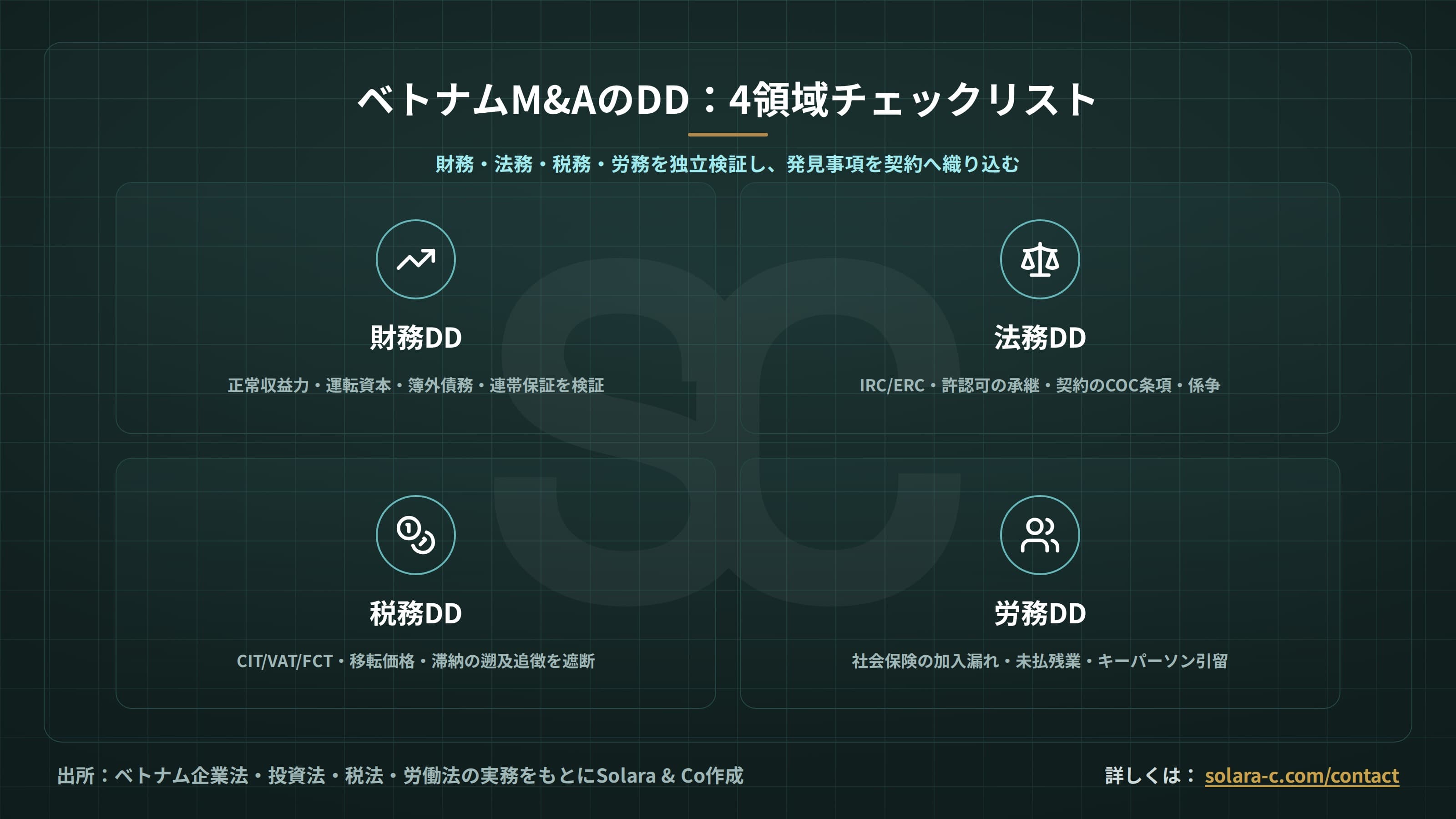
Only at the third stage do you proceed to full-scale DD on finance, legal, tax, and labor. What matters is reflecting the concerns found in the credit check into the scope of the DD. For example, if "signs of a dispute with the tax authorities" have emerged, increase the workload for tax DD. If "suspicion of double bookkeeping" is strong, focus on bank statements and physical cash verification. By using the credit check as the blueprint for the DD in this way, you can concentrate limited funds on the areas with the highest impact.
Cost-effectiveness — cheap pre-screening prevents expensive regret
Quite a few executives harbor the concern that a credit check is "just an additional cost." Yet if you compare the cost structures, you will find that perception is reversed. A full set of formal DD, depending on the deal size, can start from several million yen and, for complex deals, exceed ten million yen. A preliminary credit check, by contrast, can be carried out for a fraction of that cost, and moreover reaches a conclusion within a few weeks.
In other words, a credit check is the "insurance" and "filter" for the high-cost investment that is DD. Of 100 deals under consideration, if you can remove early the clearly unqualified ones at the credit-check stage, you can concentrate the funds invested in full-scale DD only on the truly promising deals. This raises the quality of investment decisions while at the same time lowering total cost.
What is also easily overlooked is "the cost called time." M&A consumes a great deal of the precious time of top management and corporate planning. The opportunity loss of top leadership being involved for half a year in a deal that ends in collapse can, in some cases, be greater than the external fees. Conducting a credit check first is an investment that protects not only finances but also the organization's decision-making resources.
The effect of "credit check first" seen through real examples — two anonymized cases
Let us make the discussion so far concrete by applying it to two anonymized cases commonly seen on the ground. Both have been altered so that no individual company can be identified, but the underlying structure itself is one that recurs in Vietnamese deals.
The first case is the consideration of acquiring a manufacturer (about 120 employees) on the outskirts of Hanoi. The financial statements presented showed three consecutive periods of profit, and the names of major Japanese corporations were even lined up among the key customers. The Japanese side trusted these figures and had begun obtaining quotes for financial DD, but when a preliminary credit check was inserted before the full-scale DD, it emerged that the number of social-insurance enrollees diverged greatly from the headcount scale shown on the financial statements. Furthermore, the legal representative personally bore large joint-and-several guarantees in a separate real-estate business, and there were signs that the target company's key equipment had been doubly pledged as collateral for it. The profit on the financial statements also diverged from the version submitted to the tax office — it was the classic "figures for bank lending." For this deal, a decision to withdraw could be made at the preliminary-investigation stage, at a cost of about three weeks and on the order of several hundred thousand yen, preserving several million yen of DD fees and half a year of the corporate planning department's time.
The second case, conversely, is an example where a credit check moved a deal forward. It was a distribution business in Ho Chi Minh City whose profit margin on the financial statements was lower than the industry average, and the Japanese side initially viewed it as having "an issue with profitability." However, when interviews with business partners and former employees were conducted in the credit check, it was corroborated that the low margin was a deliberate compression for tax-saving purposes, and that the actual cash flow was substantially better than the financial statements. Because it was also confirmed that the owner had neither a litigation history nor ties to anti-social forces, the Japanese side proceeded to full-scale DD with peace of mind and was able to bring it to a proper price negotiation premised on adjusting for the double bookkeeping. A credit check not only "removes dangerous deals" but also plays the role of "correctly picking up undervalued, excellent deals."
How to choose a trustworthy partner and the importance of a local network
A credit check in Vietnam varies greatly in accuracy depending on who conducts it. A remote investigation relying only on public databases cannot fully close the information asymmetry described above. This is because the truly valuable information can, in many cases, only be obtained through a "network of people" — the local registration offices, tax authorities, industry insiders, and business partners.
When choosing a partner, look first at whether they "understand the context of both Japan and Vietnam." It is important that, beyond being well-versed in Vietnam's business customs and administrative procedures, they understand Japanese companies' decision-making processes and ringi (internal approval) culture and have a structure that can organize the issues in Japanese. Second is "independence and neutrality." If the intermediary firm also has an interest on the seller's side, the objectivity of the credit check is compromised. Third is "connectivity to DD." If there is a structure that can provide seamless support all the way from the credit check through DD, contract negotiation, and PMI (post-merger integration), the concerns obtained will be reliably carried over to the next process.
Solara & Co holds bases and a human network on both the Japanese and Vietnamese sides, and provides consistent support from credit-check pre-screening through full-scale DD, closing, and on to PMI. Taking the first step of "first, get to know the counterparty correctly" in a form grounded in the local reality greatly raises the probability of success in Vietnamese M&A.