
A Credit Check and Due Diligence Are Not "the Same Investigation"
One of the most common misconceptions among Japanese companies considering M&A in Vietnam is the belief that "a credit check and due diligence (DD) are essentially investigations of the same counterparty, so surely doing just one or the other is enough." To put the conclusion first: these are entirely distinct exercises with different purposes, different depths, and different legal standing, and conflating them as a deal proceeds leads to the classic failure pattern in which fatal risks erupt only after the preliminary agreement (MOU/LOI) has been signed. This article explains, in line with the actual flow of practice and against the backdrop of Vietnam's distinctive business environment, the decisive difference between the credit check performed before the preliminary agreement and the DD performed after it.
Screening at the Gate, Versus a Precision Inspection Just Before Signing
A credit check is a primary screening that determines whether the counterparty is "a real, sound company worth bringing to the negotiating table." DD, by contrast, is a precision inspection that pins down "at what price, on what terms, and with what risks to assume" you will acquire a counterparty in whom you have already resolved to invest or which you have already resolved to buy. Screening at the gate, versus a precision inspection just before signing. If you proceed without grasping this difference in roles — simply thinking "let's just ask an accounting firm to do DD" — you waste cost and time while letting the very risks you should have guarded against slip through. Because the information asymmetry in Vietnam is even greater than in Japan, it is no exaggeration to say that whether you can correctly design this two-stage approach determines whether the deal succeeds or fails.
Timeline, Depth, and Cost — Three Decisive Differences
A credit check and DD stand in a before-and-after relationship, and each addresses a different question. Let us first take in the overall picture at a glance, then dig into the individual differences.
Aspect | Credit check (before the preliminary agreement) | DD (after the preliminary agreement) |
|---|---|---|
Purpose | Screening whether the counterparty is worth advancing to full negotiation | Fixing and substantiating the price and contract terms |
Timing | From no-name approach to before the preliminary agreement | After securing the preliminary agreement and exclusivity |
Depth and sources | External information (registration, public DBs, on-the-ground interviews) | Primary materials (ledgers, tax filings, original contracts) |
Main target areas | Existence, the representative, financial overview, litigation | Finance, tax, legal, labor, business, IT |
Cost and duration | In the order of hundreds of thousands of yen / a few weeks | In the order of millions of yen / a few weeks to two months |
Who performs it | Credit-check firms and local advisors | A team of specialists (accounting, tax, legal) |
Output | Material for the decision to continue or break off negotiation | Representations and warranties, price adjustment, and indemnity clauses in the SPA |
The Difference in Timeline — "Before" or "After"
A credit check is conducted before concluding the preliminary agreement, after a no-name approach and an initial meeting. At this stage you are not yet demanding the kind of full information disclosure that DD requires; instead, drawing mainly on information obtainable from external sources and within limited time and cost, you judge "whether it is acceptable to advance to full negotiation with this counterparty." DD, by contrast, is conducted after the preliminary agreement has settled matters such as exclusivity, confidentiality, and the schedule, and — premised on the counterparty's cooperation (the opening of a data room) — it digs deeply into each area: finance, tax, legal, labor, business, and IT.
The Difference in Depth and Sources — "External Form" or "Substance"
A credit check confirms "external soundness" such as registration information, the broad state of the financial statements, the presence or absence of litigation and administrative sanctions, the attributes of management and shareholders, and the company's reputation in its industry. Its sources are chiefly public databases, reports from commercial credit-check firms, and interviews via local networks. DD examines the "substance" of the figures and rights relationships by working through primary materials that the counterparty discloses — the general ledger, tax returns, original contracts, the employee roster, the Land Use Right Certificate (the so-called "red book"), and so on. The difference is that the former asks "is this a counterparty I can trust?" while the latter asks "how should the contract terms be designed?"
The Difference in Cost and Output — A Light Sieve, or a Precision Inspection
A credit check is a light investigation completed in the order of hundreds of thousands of yen over a few weeks, and its output is decision-making material for "whether to continue or break off negotiation." DD mobilizes a team of specialists, takes from a few weeks to roughly two months in the order of millions of yen, and produces a detailed report that feeds all the way into the representations and warranties clauses, price adjustment, indemnity, and conditions precedent to closing of the final contract (SPA). If you get the order wrong and skip the credit check to jump straight into DD, you may end up pouring expensive specialist fees into an unqualified counterparty that you could have excluded at the gate in the first place.
The Pre-Agreement Credit Check: Items You Must Always Confirm in Vietnam
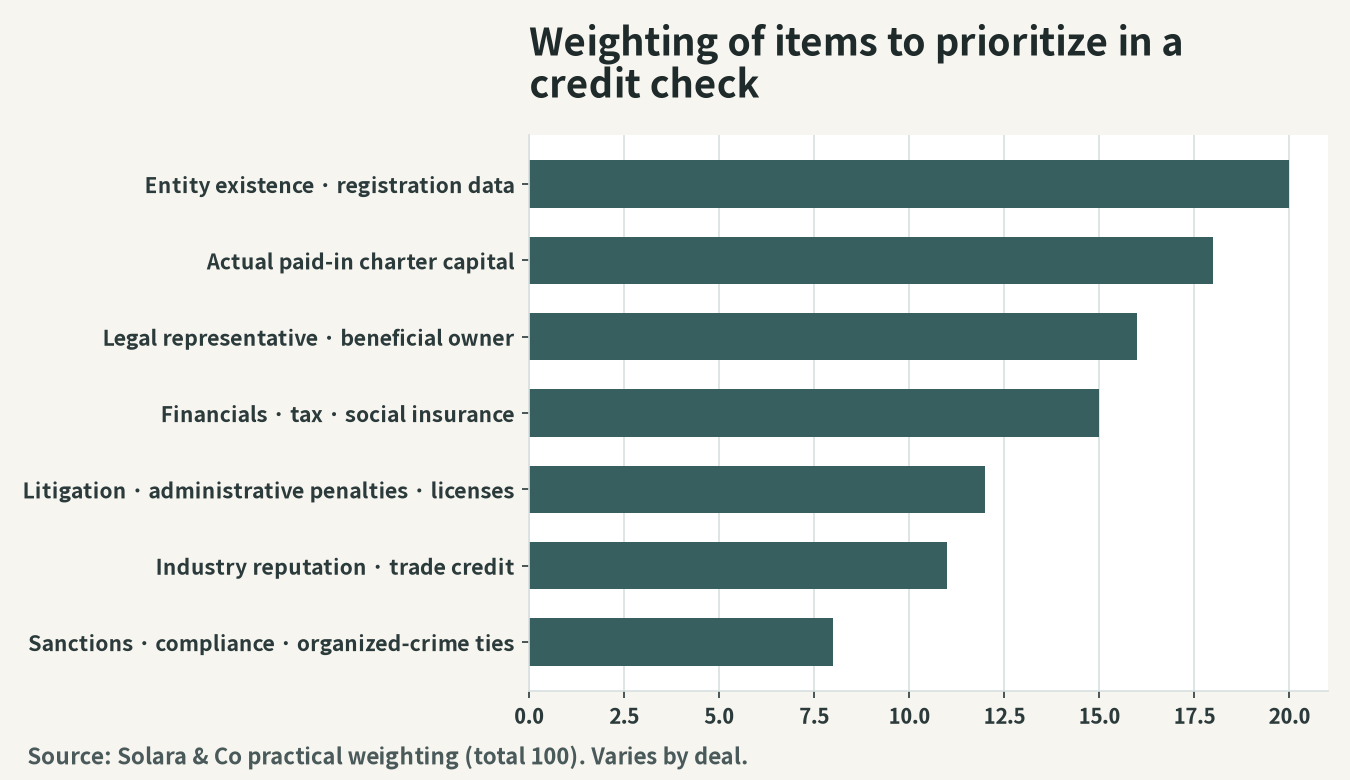
In Vietnam, the precision of the credit check performed before the preliminary agreement governs everything that follows. In practice, the key is where to concentrate your limited time and budget. The chart below gives a rough guide to the "weighting" of the items that warrant priority confirmation in a credit check.
The Entity's Existence and Registration Information
The first thing to confirm is the entity's existence and registration information. Every company in Vietnam is registered on the National Business Registration Portal, and you cross-check the company code, registered (charter) capital, legal representative, and field of business (the registered industry code) stated on the Enterprise Registration Certificate (ERC). A major difference from Japan emerges here: "the registered (charter) capital is merely the declared amount and is not necessarily actually paid in." Because there are cases where the capital looks large but is not backed by actual payment, you must not take the face value at its word.
The Legal Representative and the Ultimate Beneficial Owner
Second is confirming the legal representative and the ultimate beneficial owner (UBO). In Vietnamese companies the authority of the legal representative is extremely strong and directly bears on the validity of contracts. You confirm whether the representative on the registration matches the person who actually appears at negotiations and makes decisions, and, where there are multiple representatives, how authority is allocated among them. Family management and the use of nominee shareholders are not uncommon, and discerning at the gate "with whom an agreement becomes legally binding" prevents the later trouble of "the counterparty I thought I had agreed with had no authority."
The Financial Overview and Credit Information
Third is the financial overview and credit information. Since full disclosure of audited financial statements cannot be expected at the pre-agreement stage, you grasp the settlement information available, the tax-payment status, the presence or absence of bank borrowings, and the transaction structure with affiliated companies. Reports from commercial credit-check firms and the reputation (payment history) gathered from local business partners and financial institutions are also strong clues. In addition, you confirm whether there is any delinquency action by the tax authorities or any unpaid social insurance premiums. In Vietnam, unpaid social insurance is a classic off-balance-sheet liability risk that surfaces later in DD and triggers a large back-assessment reaching into the past, so it is worth catching the signs at the gate stage.
Litigation, Administrative Sanctions, and Compliance
Fourth is screening on litigation, administrative sanctions, and compliance. You confirm ongoing litigation, labor disputes, the history of administrative guidance regarding environmental, fire-safety, and construction permits, and customs troubles relating to import and export. Furthermore, the question of whether management or group companies have any connection to international sanctions lists or to antisocial forces is one that cannot be omitted amid the recent trend toward stronger compliance. Because these surface only through a combination of external information and on-the-ground interviews, the involvement of an advisor with the local language and a local network proves decisively effective.
Post-Agreement DD: A Precision Inspection That Substantiates Price and Contract Terms
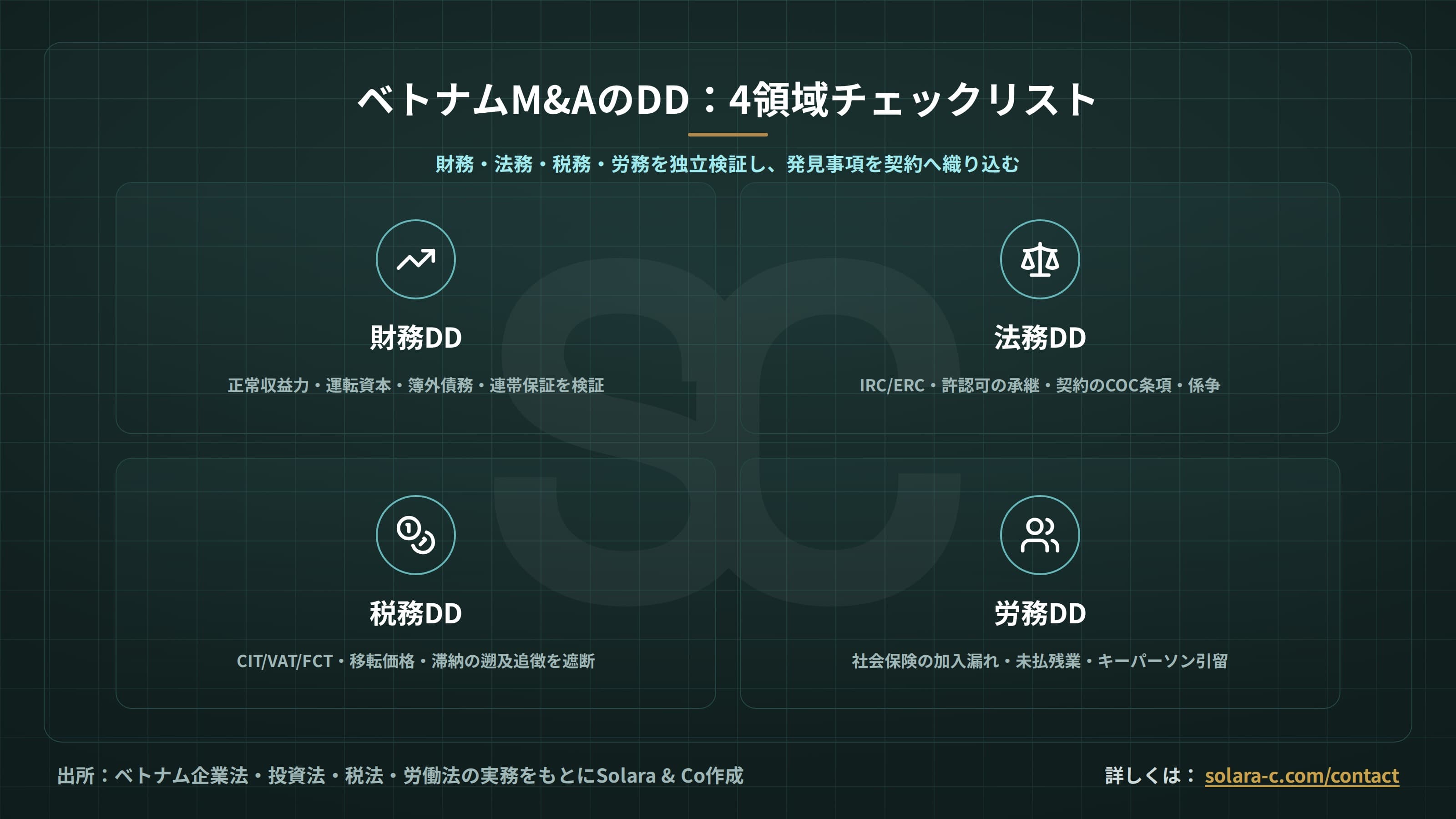
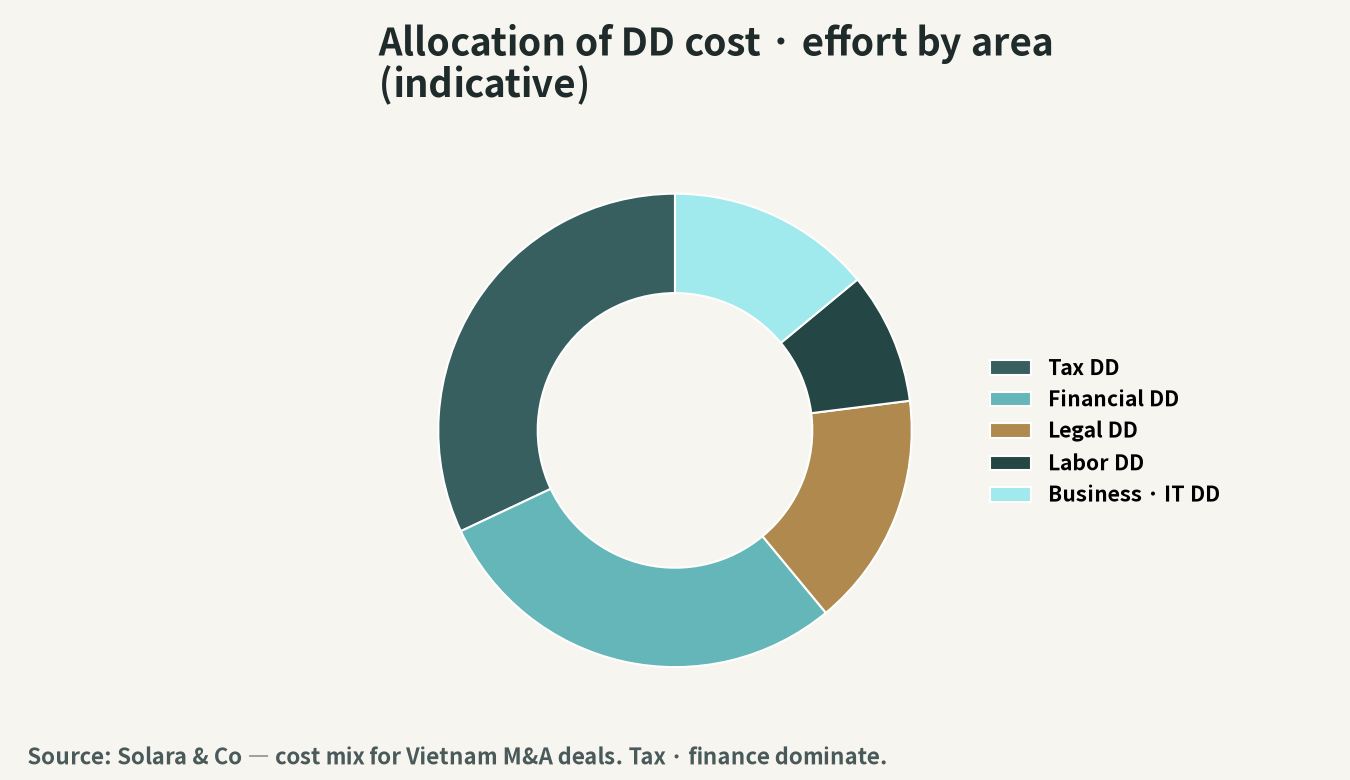
Once the credit check lets you judge that the counterparty is "worth advancing to full negotiation," you conclude the preliminary agreement and finally enter DD. It is important to think of DD not as the task of ticking checkboxes but as an investigation that substantiates the acquisition price and contract terms. Cost and effort are unevenly distributed across areas, and in Vietnam particular weight falls on tax and finance.
Financial DD — The Quality of Earnings and Off-Balance-Sheet Liabilities
First, in financial DD you scrutinize the reality of recorded sales, the quality of earnings (removing one-time factors), the level of working capital, and the shifting of profits through related-party transactions. In Vietnam's mid-sized companies, the proportion of cash-based business is high and it is not uncommon for double books (one for tax and one for actual operations) to exist, so the central task is to bridge the gap between the disclosed figures and the actual situation.
Tax DD — The Area with the Greatest Monetary Impact
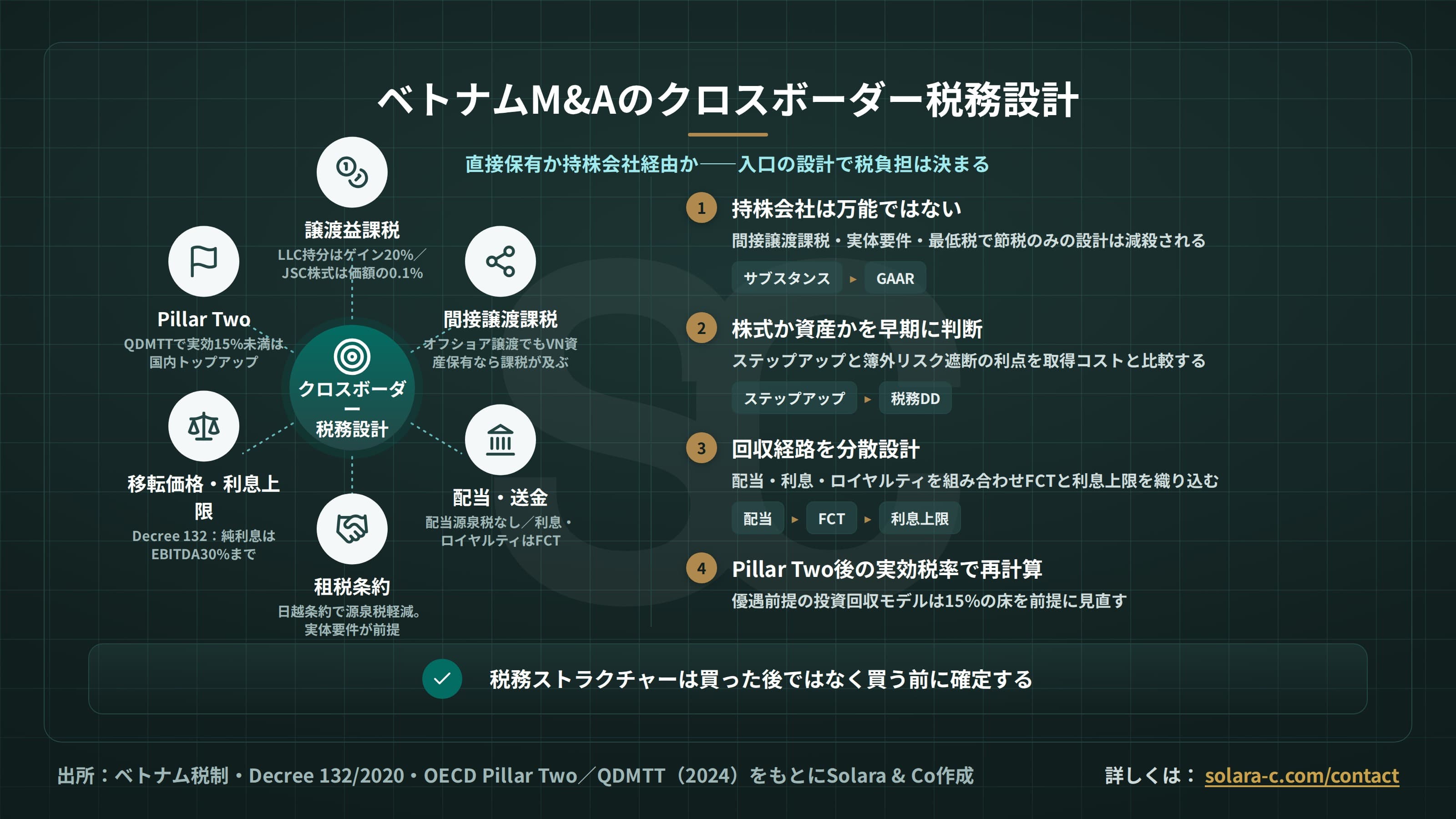
Tax DD is the area with the greatest "monetary impact" in Vietnamese M&A. You verify corporate income tax, value-added tax (VAT), foreign contractor tax (FCT), withholding of personal income tax, and the state of transfer-pricing documentation. Whether VAT refunds and deductions are appropriate, whether the company continues to meet the requirements for preferential tax treatment (reductions and exemptions for encouraged investment fields and regions), and whether there are errors in past filings — these become direct losses for the buyer if back-assessed in a post-acquisition tax audit. Because Vietnamese tax audits go back as far as roughly five years, the estimation of potential tax liabilities becomes the crux of price negotiation.
Legal, Labor, Business, and IT DD
In legal DD, you confirm the validity and remaining term of the certificate for land use rights (in Vietnam, land is owned by the state, and what a company holds is the use right), the construction permit and completion inspection for factories and buildings, business licenses (permits for conditional business fields), and the change-of-control clauses in key contracts. In labor DD, you look at the soundness of labor contracts, social insurance and labor-union matters, severance pay (the issue of duplicate benefits), and the presence or absence of work permits for foreign workers. In business DD, you examine the concentration of customers and suppliers and dependence on permits and licenses; in IT DD, you confirm the existence of systems and license compliance. These findings are then translated into the final contract in the form of representations and warranties, price adjustment, and indemnity clauses.
What Happens When You Mistake the Order: Two Classic Failures
Here we show concretely what happens when the two are mistaken for each other.
Failure Case 1: Rushing the Preliminary Agreement While Skipping the Credit Check
In one case, a Japanese company believed a local intermediary's words that the target was "an excellent company," omitted the credit check, and concluded the preliminary agreement straight away. After signing exclusivity and a high break-fee clause, the company set about DD — only to find that the registered (charter) capital had not been paid in, that there was long-term non-payment of social insurance, and that an ongoing labor lawsuit existed. Wanting to withdraw, it found the break fee a wall; the counterparty refused renegotiation to substantially lower the price; and in the end it was driven to a choice between holding the deal on unfavorable terms or crystallizing a loss and withdrawing. This is a classic case in which a credit check at the gate would have allowed the company to keep its distance before concluding the preliminary agreement.
Failure Case 2: Pressing Too Far at the Credit-Check Stage
There is also the opposite failure. This is the case where you demand DD-level detailed materials at the credit-check stage and, with neither a relationship of trust nor exclusivity yet in place, the counterparty grows wary and the negotiation itself collapses. Vietnamese owner-managers are sensitive about disclosing their company's information, and they take it as "how dare you demand to see the books when there is neither a confidentiality agreement nor a preliminary agreement." Keeping the credit check strictly to external information and limited interviews, and deferring deeper verification to the DD phase — this restraint is indispensable to moving the negotiation forward. Observing the order and the depth is the key to managing risk without damaging the counterparty's trust.
A Phase-by-Phase Practical Checklist
We organize a checklist for putting this into practice, divided into the two phases.
Pre-Agreement, Credit-Check Phase
(1) Cross-checking the Enterprise Registration Certificate and the company code, (2) confirming the registered (charter) capital and the actual state of payment, (3) confirming the legal representative, the ultimate beneficial owner, and the shareholding structure, (4) the most recent financial overview and the status of tax payment and social insurance, (5) the presence or absence of litigation, administrative sanctions, and permit-related trouble, (6) industry reputation and credit information from business partners, and (7) screening on sanctions, compliance, and reputation. Only when these are satisfied do you have the material to judge whether to sign a preliminary agreement that includes exclusivity and a break fee.
Post-Agreement, DD Phase
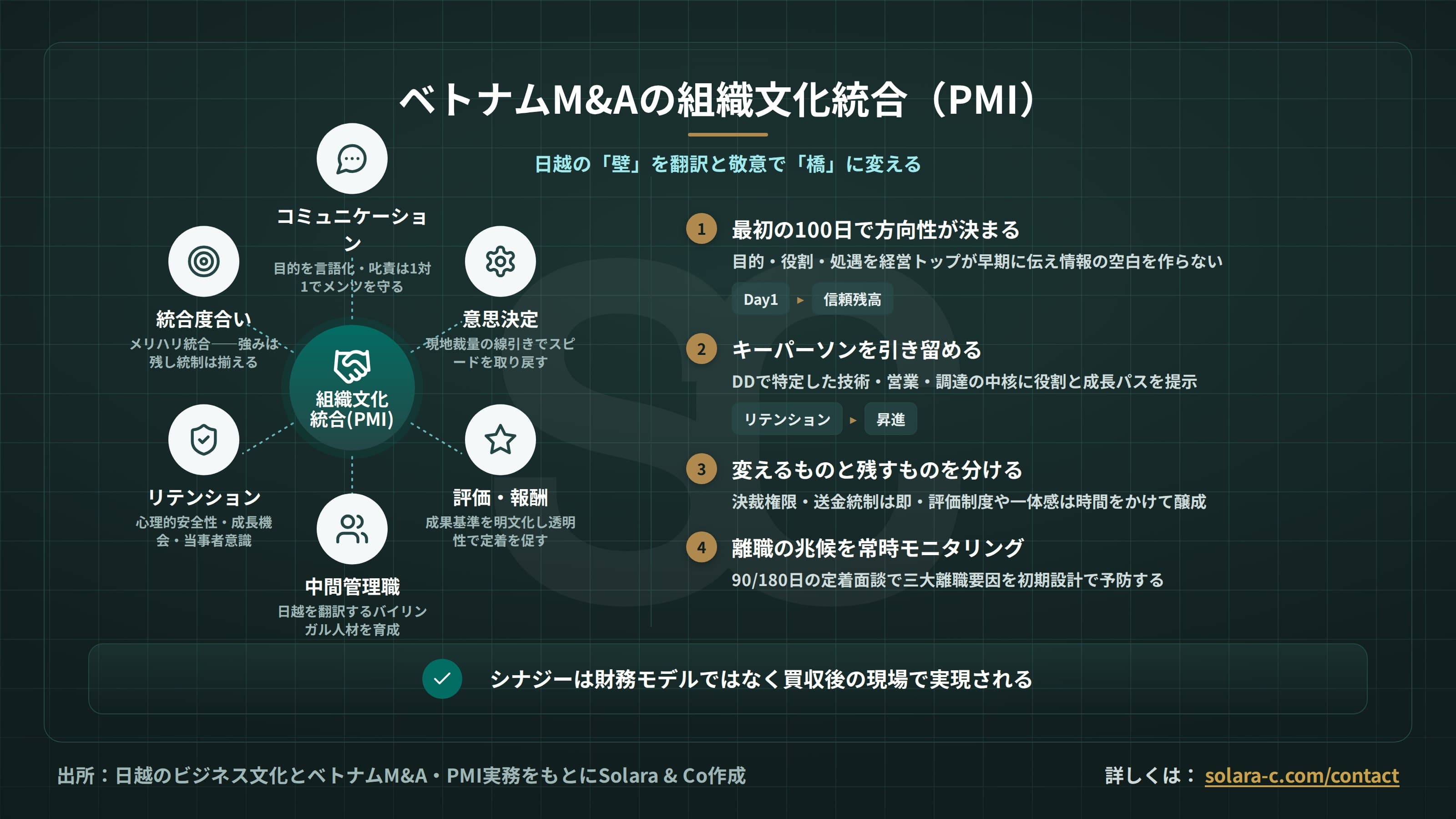
(1) Designing confidentiality and the data room, (2) financial DD (quality of earnings, off-balance-sheet liabilities, working capital), (3) tax DD (the retroactive risk of FCT, VAT, transfer pricing, and preferential tax treatment), (4) legal DD (land use rights, permits, key contracts), (5) labor DD (social insurance, severance pay, work permits), (6) business and IT DD, (7) reflecting the findings in representations and warranties, price adjustment, and indemnity clauses, and (8) setting the conditions precedent to closing. What matters is "not letting the DD findings end as a report." The risks flagged must without fail be reflected in the contract clauses or in the choice of deal structure (share transfer versus business transfer, and so on), and carried over into the initial issue list for post-acquisition PMI.
Why Locally Rooted Specialists Are Indispensable
Finally, we explain why the involvement of locally rooted specialists is indispensable to this two-stage approach. In Vietnam, the development of public information is not as advanced as in Japan, and the surface information of registration and finance alone does not reveal the actual situation. Reading primary materials in the local language, understanding the operational practice of the tax and labor authorities, reputation research through local networks, and accurate translation and advice for the decision-makers on the Japanese side — whether you can provide all of these end to end determines the precision of the credit check and the DD.
Solara & Co, with advisors well versed in the practice on both the Japanese and Vietnamese sides, provides consistent support from the credit check at the gate through the preliminary agreement, the various forms of due diligence, and on to post-acquisition PMI. Observing the order, and designing the investigation at the depth suited to each phase — that is the surest path to maximizing the probability of success in Vietnamese M&A. Before rushing the preliminary agreement, please feel free to consult us first about the design of the credit check at the gate.