
Design Vietnam M&A as a "line," not a series of "dots"
Japanese companies considering the acquisition of a Vietnamese business tend to fire off a stream of individual questions: "Where do good targets come from?" "What should we look at in due diligence (DD)?" "How long does regulatory approval take?" But handling each of these as a separate "dot" sends the whole deal off course. The hypothesis you draw up in sourcing, the facts uncovered in DD, the assumptions behind the valuation, the contract terms, and the post-merger integration (PMI) after closing are all, in truth, connected as a single continuous "line."
What sets Vietnam M&A decisively apart from a domestic Japanese deal is that Vietnam-specific issues — land use rights (LURC), licenses (IRC/ERC), social insurance, competition-law filings — heavily shape both the duration and the outcome of each phase. The regulatory approval procedures at the closing stage in particular slip by months when estimated on Japanese assumptions, draining the momentum of the entire deal.
This article organizes the standard deal lifecycle, from sourcing to PMI, into seven phases, and explains the key deliverables, participants and Vietnam-specific points of each — as well as the places where Japanese deals typically stall — from a practitioner's viewpoint.
Phase 1: Strategy and sourcing
M&A begins not with "finding a company to buy" but with settling "why we are buying." Is it to accelerate market entry, to secure a manufacturing base, or to acquire a distribution network or licenses? If you go looking for targets while the deal rationale remains vague, you will lose your decision-making compass in the later negotiations and PMI.
Origination: via intermediaries and direct approaches
Origination in Vietnam comes in two forms: deals brought in through a financial advisor (FA) or brokerage, and the buyer narrowing the industry and approaching candidate targets directly. Brought-in deals get moving quickly, but watch for a rushed sale or skewed information. A direct approach takes time, but offers a chance to find a strong target with little competition.
From long list to short list
Candidates are long-listed against criteria such as sector, scale, region and the presence of licenses, then narrowed to a short list of a few companies by strategic fit and feasibility. Running a quick credit check on the candidates at this stage prevents the nightmare of finding a serious red flag later and having to go back to square one.
Phase 2: Initial review, NDA and LOI/MOU
From the short list you select a priority counterparty, sign a non-disclosure agreement (NDA), and begin an initial review on the basis of limited disclosure.
NDA and initial disclosure
The NDA is not only about preventing information leaks; it is the practical starting point that sets out the purpose, period and return obligations for the disclosed information. Vietnamese companies are strongly owner-controlled and often release only fragmentary information early on, so it is important to pin down in writing what will be disclosed and by when.
Non-binding LOI/MOU and indicative valuation
The initial review concludes with a letter of intent or memorandum of understanding (LOI/MOU) setting out the intent to acquire, an indicative price range, exclusivity, and a schedule. The price at this stage is purely indicative (a level based on, say, an EBITDA multiple), with legal binding effect kept limited. Whether you can secure a period of exclusivity here determines whether you can conduct the subsequent DD with composure.
Phase 3: Due diligence (DD)
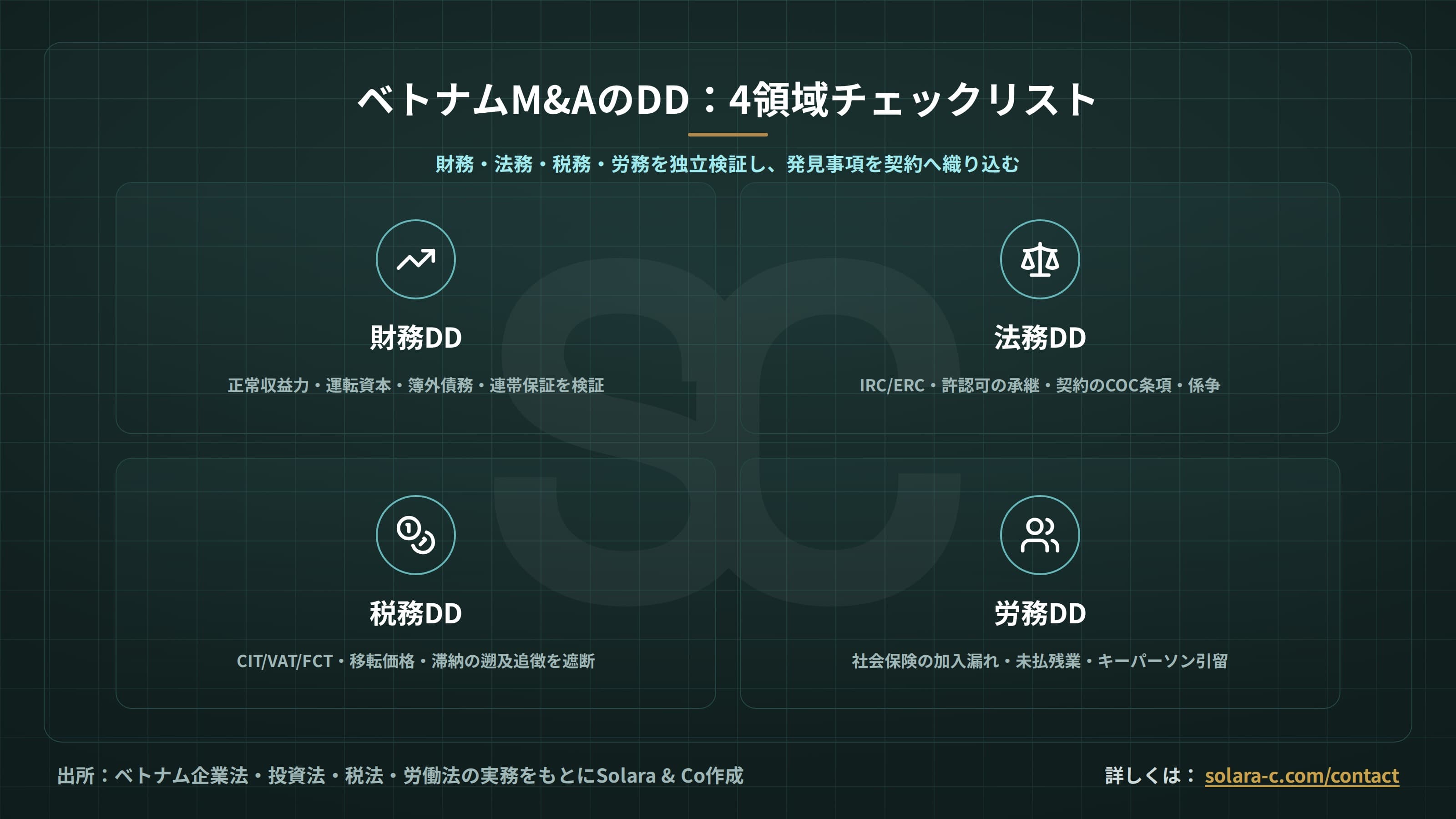
DD is the core of the deal and the phase where Vietnam-specific issues appear most densely. A specialist team investigates the financial, legal, tax, labor, commercial (business) and environmental workstreams in an integrated way.
Financial, tax and legal priorities
Financial DD pins down normalized earnings power (normalized EBITDA), working capital and off-balance-sheet liabilities. Tax DD scrutinizes past filing errors and transfer-pricing issues; legal DD examines the shareholding structure, contracts, litigation and compliance. The detailed focus of the financial and legal workstreams is covered in our guides to financial due diligence and legal due diligence in Vietnam M&A.
Vietnam-specific checkpoints
In Vietnam the classic traps are the Land Use Right Certificate (LURC, the "red book") — its registered holder, remaining term, transfer restrictions and mortgages — the business scope on the Investment Registration Certificate (IRC) and Enterprise Registration Certificate (ERC), the actual state of social-insurance payments, and off-balance-sheet liabilities (arrears, joint guarantees, litigation). These cannot be detected by reading the target's data room from the inside alone; they require combining primary-source checks of public records with on-site inspection.
Phases 4 and 5: From fixing the valuation to the contract (SPA)
The facts uncovered in DD only acquire meaning once they are translated into the three things: "price," "contract terms" and "structure." The terms hammered out in negotiation are then written straight into the share purchase agreement (SPA), which ultimately demarcates the buyer's risk.
Building DD findings into the price
Off-balance-sheet liabilities, impairment risks and adjustments to normalized earnings power are brought into negotiation as reductions from the indicative price. The choice among valuation methods (DCF, comparable companies, net assets) and the Vietnam-specific discount factors are covered in our guide to valuation in Vietnam M&A.
A framework for price adjustment and risk sharing
Risks that cannot be pinned down are shared not by fixing the price but through mechanisms such as an earn-out (deferred, performance-linked payment), an escrow (retention of part of the consideration) and indemnity clauses. What you agree at this stage becomes the skeleton of the SPA that follows.
Key SPA provisions
The price and price-adjustment mechanism (adjustment by closing working capital and net interest-bearing debt), the seller's representations and warranties, the indemnity clauses, and the conditions precedent (CP) to closing are the core. Because the representations and warranties become the basis for an indemnity claim should an undisclosed risk later surface, it is important to have them specifically cover the Vietnam-specific issues (land, licenses, social insurance). The practical focus of the SPA is addressed in our guide to the SPA in Vietnam M&A.
Designing the conditions precedent (CP)
The CP set out the obtaining of regulatory approvals, the consent of counterparties to key contracts (handling change-of-control clauses), the maintenance of licenses, and so on. The construct that there is no closing unless the CP are met becomes the buyer's final safety valve.
Phase 6: Closing (regulatory approvals)
The administrative procedures at this closing stage are where Japanese companies most often misjudge the timing. Acquisition of shares by a foreign investor requires procedures under the Law on Investment 2020 and the Law on Enterprises 2020, and depending on the sector and ownership ratio, M&A approval (approval by the investment registration authority) becomes necessary.
M&A approval and the competition-law filing
For certain sectors and ownership ratios, M&A approval (registration/approval of the investment) must be obtained before the capital injection. Furthermore, where the transaction size exceeds a certain threshold, an economic-concentration (merger) filing under the Competition Law to the National Competition Commission becomes necessary, adding a review period. These approvals readily drag on through document deficiencies and follow-up queries.
The capital account (DICA) and re-registration
Capital injections and dividend remittances by a foreign investor are, in principle, made through a Direct Investment Capital Account (DICA). Closing is reached only once the shareholder and legal-representative details on the Enterprise Registration Certificate (ERC) are finally amended, the consideration is settled and the re-registration is complete. Getting the order of these procedures wrong stalls remittances and registrations and pushes closing back by weeks or months.
Phase 7: PMI (post-merger integration)
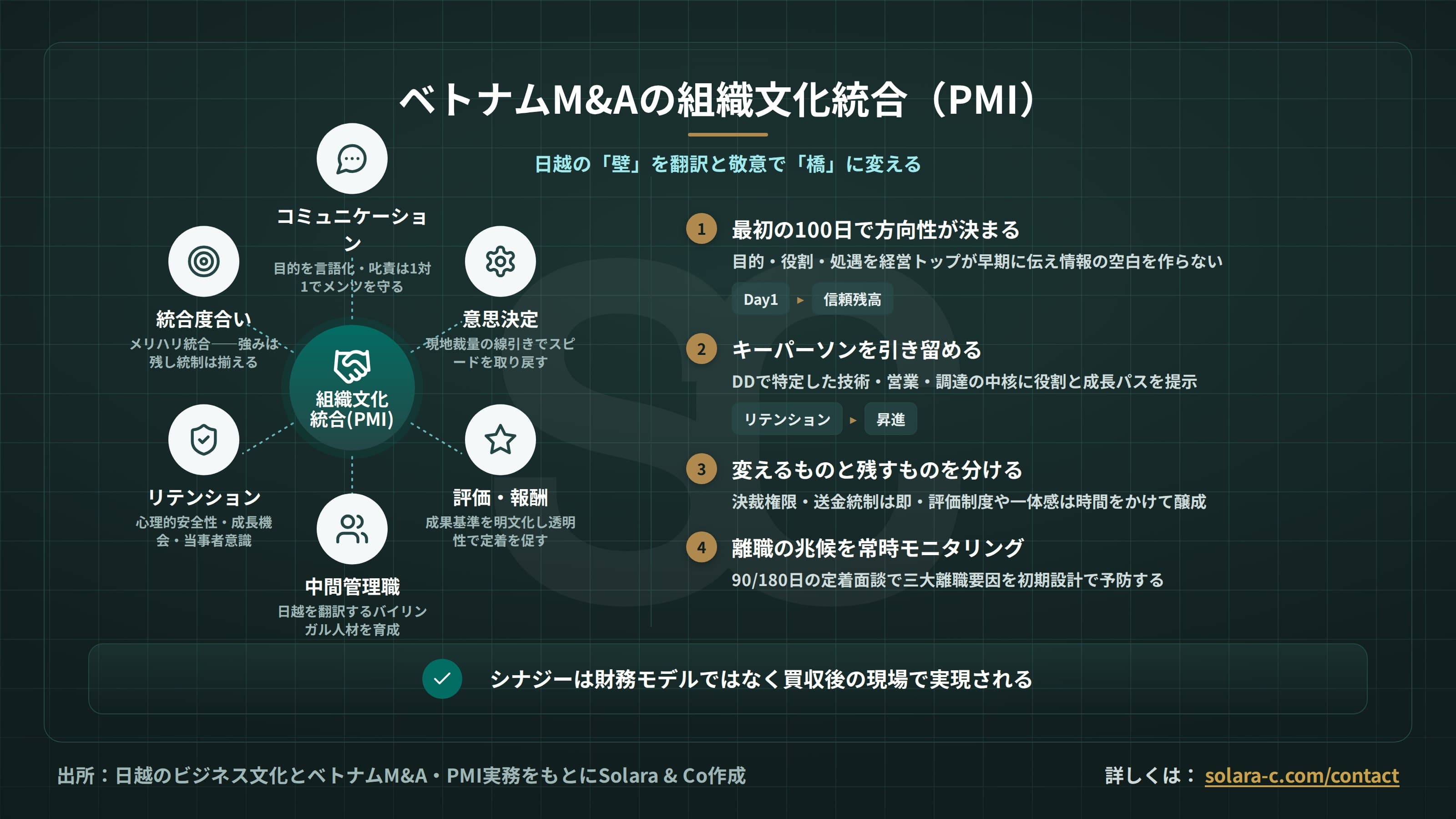
Closing is not the goal but the start. The synergies built into the acquisition price can only be realized through PMI (Post-Merger Integration).
The 100-day plan and governance
In the first 100 days you redesign decision-making authority (the board and the legal representative), the reporting lines, and the control rights over cash, seals and bank accounts. In Vietnam, control of the legal representative and the company seal is directly tied to real management control, so securing this early is essential to preventing fraud and capital leakage.
Talent retention and accounting integration
You advance the retention of key people, the alignment of evaluation and compensation systems, and the integration of accounting and internal controls onto group standards. The practicalities of talent risk are covered in detail in our guide to PMI and talent risk after Vietnam M&A. Many of these integration difficulties can be mitigated by running a credit check at the very entrance of the deal and grasping the target's true nature early.
Where do deals fall apart?
The causes of a Vietnam M&A deal collapsing or dragging on appear concentrated in particular phases. When we classify the cases Solara & Co has been involved in across Japan–Vietnam M&A, the principal causes of breakdown show a clear distribution.
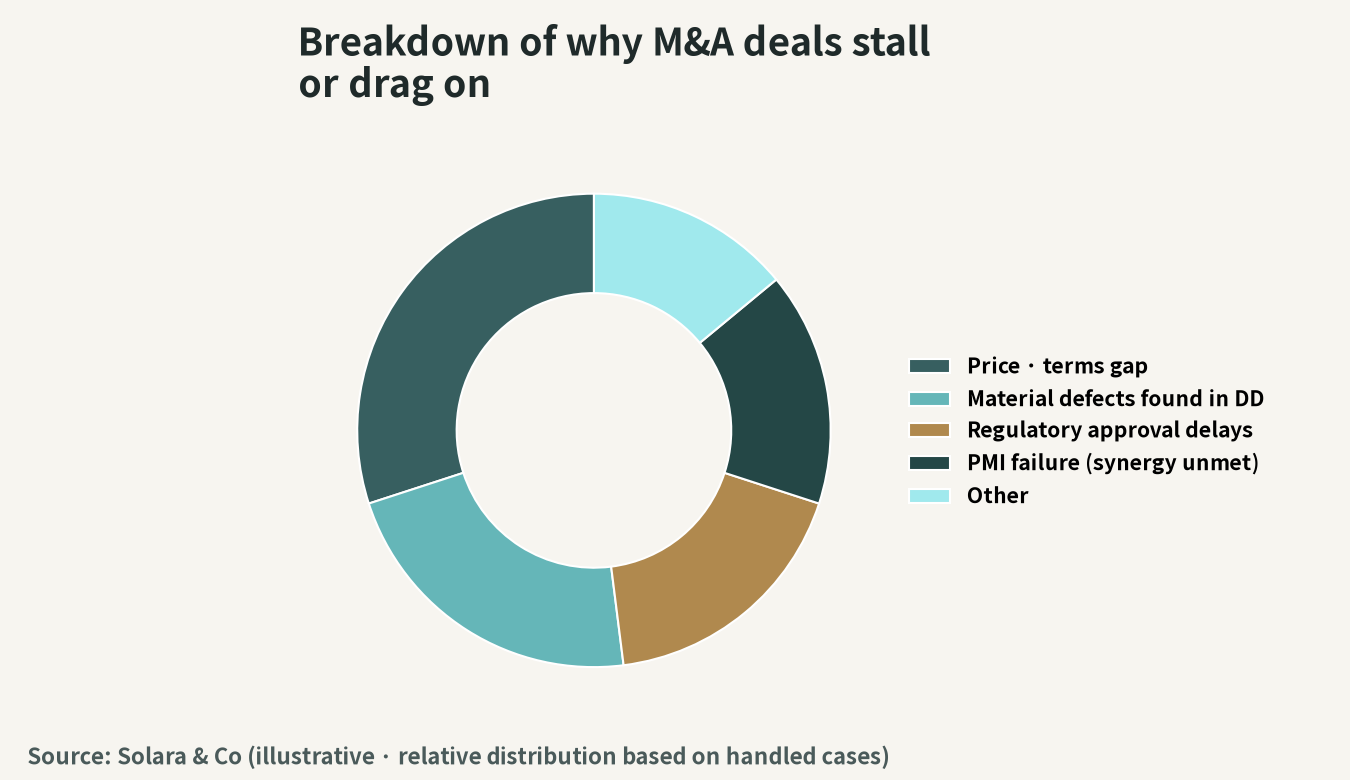
Alongside price gaps and the material defects uncovered in DD, regulatory-approval delay looms large in Vietnam as a distinctive factor that saps a deal's momentum, while failed PMI after closing produces "de-facto breakdown" in the form of unmet synergies. Mapping out each phase's duration, deliverables and participants in advance is the first step to preventing such loss of momentum.
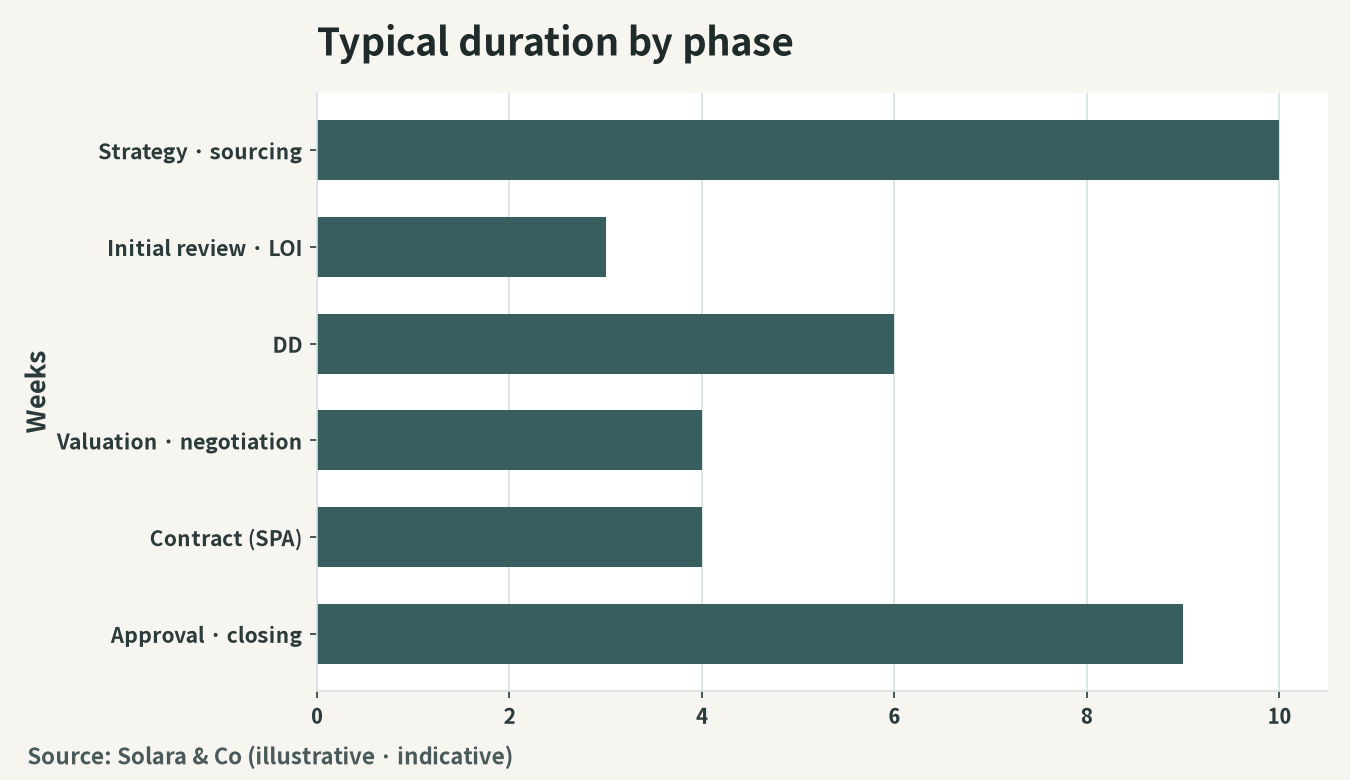
Phase | Indicative duration | Key deliverables | Main participants |
|---|---|---|---|
Strategy and sourcing | 1–3 months | Long list / short list | Buyer, FA, broker |
Initial review, LOI/MOU | 2–4 weeks | NDA, LOI/MOU, indicative valuation | Buyer, FA, seller |
Due diligence | 1–2 months | DD report (financial, legal, tax, etc.) | FA, accountants, lawyers |
Valuation and negotiation | 2–6 weeks | Final valuation, term sheet | Buyer, seller, FA |
Contract (SPA) | 3–6 weeks | SPA, indemnity / CP clauses | Lawyers, buyer, seller |
Closing (approvals) | 1–3 months+ | M&A approval, competition filing, ERC amendment | Lawyers, authorities, bank |
PMI | 6–12 months | 100-day plan, integration results | Buyer, local management |
Solara & Co's end-to-end support — sourcing to PMI as a single line
Success in Vietnam M&A rests on whether you can design the whole journey from sourcing to PMI coherently, as a "line." Test in DD the hypothesis you drew in sourcing; translate those findings into price, contract terms and structure; carry the deal to closing on a schedule that anticipates Vietnam-specific regulatory approvals; and realize the synergies in PMI — if any one link in this chain breaks, the whole deal loses momentum.
Solara & Co holds bases and a human network in both Japan and Vietnam, and supports the entire arc — origination and credit checks; financial, legal and tax DD; valuation and negotiation; SPA design; closing including dealings with the authorities; and PMI — as one continuous engagement. Connecting each phase along the single axis of the acquisition purpose, rather than fragmenting them across separate specialists, is the key to a successful Vietnam M&A. We start by helping you organize, together, "for what purpose, and which company, to buy."