
Why Vietnam M&A Deals Fail at the PMI Stage
In acquisitions of Vietnamese companies, more than a few Japanese firms assume "the deal is done" the moment they complete due diligence (DD) and sign the share purchase agreement (SPA). Yet what actually determines the success or failure of an M&A deal is the PMI (Post Merger Integration) that follows signing — and integration in the HR and organizational domain in particular is the hardest hurdle of all. While financial and tax risks are easy to make visible as numbers, the risks tied to people and organization appear on neither the contract nor the balance sheet.
The classic failure pattern in Vietnam is one in which, after signing, core local managers and skilled workers resign one after another, and relationships with customers and suppliers along with on-the-ground know-how leak out all at once. In Vietnam's small- and mid-sized and owner-led companies, much of the work depends on the personal networks and tacit knowledge of specific individuals, so the organization is hollowed out the instant the founding owner steps down. It is not unusual for the substance of what the acquirer thought it was buying as an "asset" to in fact exist only inside the heads of a handful of key people.
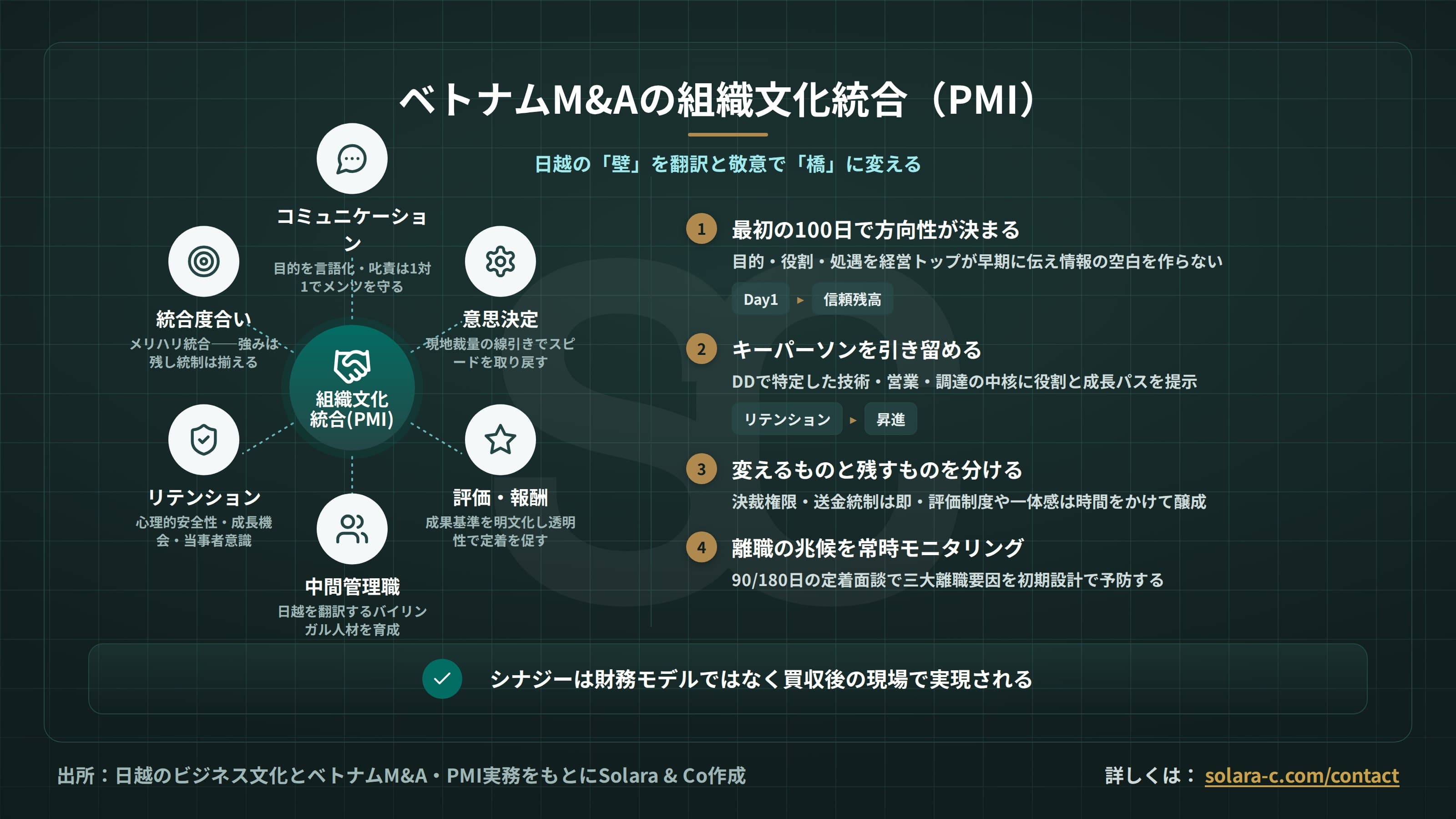
Another deep-rooted factor is that the Japanese head office tacitly assumes that "if we bring in Japanese-style management, the front line will fall in line." The chain of command, evaluation systems, the culture of reporting–contacting–consulting (hou-ren-sou), and attitudes toward overtime and job-hopping differ greatly between Japan and Vietnam. If management changes systems top-down without weaving this gap in assumptions into the integration plan, it invites front-line resistance, outward compliance masking inner defiance, and mass resignations — and the acquisition synergy becomes pie in the sky. PMI failure is not "a problem at the execution stage"; in many cases it stems from overlooking HR and organizational risk back at the DD stage.
A Perspective for "Identifying" HR and Organizational Risk at the DD Stage
HR and organizational risk tends to be treated as an optional add-on to financial DD or legal DD, but in Vietnamese deals it should be handled as an independent, critical issue. The purpose of HR due diligence is not merely to check the employee roster and payroll ledger, but to determine in advance "whether the organization will keep functioning after the acquisition" and "which risks will materialize and how much they could cost."
Organizing the risks to be identified into three broad layers leaves no gaps. First, talent-attrition risk (dependence on key persons, likelihood of resignation, defection to competitors). Second, compliance and labor risk (non-enrollment or under-reporting of social insurance, unpaid overtime, deficient labor contracts, lack of work permits for foreign nationals). Third, cultural and organizational risk (decision-making structure, family-management practices, wage levels diverging from the market, and the fit between organizational culture and the Japanese head office). These are interlinked: a labor risk such as "unpaid social insurance" spills over into "talent-attrition risk" during the process of revising the wage structure to remedy it.
The practical key is to build a dedicated HR perspective into the DD scope from the very beginning. If the person in charge of financial DD merely glances at payroll data on the side, they will fail to see through Vietnam's characteristic dual-ledger style of payroll operation or the existence of allowances and bonuses promised only verbally. You should design — at the memorandum of understanding (MOU) stage — a structure that verifies from three directions: documents, data, and on-site interviews, engaging advisors and lawyers well-versed in local labor practice.
How to Spot Key-Person Dependence and Talent-Attrition Risk
The reality at Vietnam's owner-led companies is that the foundations of the business — sales, procurement, licenses and permits, and dealings with the authorities — are very often tied to the personal relationships of the owner themselves or a few executives. The first thing to do, therefore, is to "not trust the org chart." Rather than the official org chart, trace the actual flows of decisions, money, and information, and identify key persons from the standpoint of: whose departure would bring the business to a halt.
As for concrete verification steps: first, verify — from both the contracts and commercial customs — whether transactions with major customers and suppliers are "company-to-company" or "individual-to-individual." Second, confirm on-site whether technical, production, and quality-control know-how has been documented (turned into SOPs) or still depends on the rules of thumb of specific skilled workers. Third, grasp the turnover rate and reasons for departures over the past two to three years, a market comparison of wage levels, and executives' length of tenure along with whether they hold equity or incentives.
Vietnam's labor market is highly fluid; core talent in particular — white-collar staff, engineers, and accounting and sales personnel in Ho Chi Minh City and Hanoi — will switch jobs in short order if better terms appear. Because anxiety over a change in management direction due to the acquisition and wariness of falling under foreign ownership can easily become triggers for resignation, it is essential to be prepared to present key persons concretely with their "post-acquisition treatment, role, and compensation" right from the DD stage. Advancing the design of retention measures in parallel with contract negotiations is the single greatest line of defense for minimizing attrition risk.
Off-Balance-Sheet Liabilities Lurking in Social Insurance, Overtime, and Labor Contracts
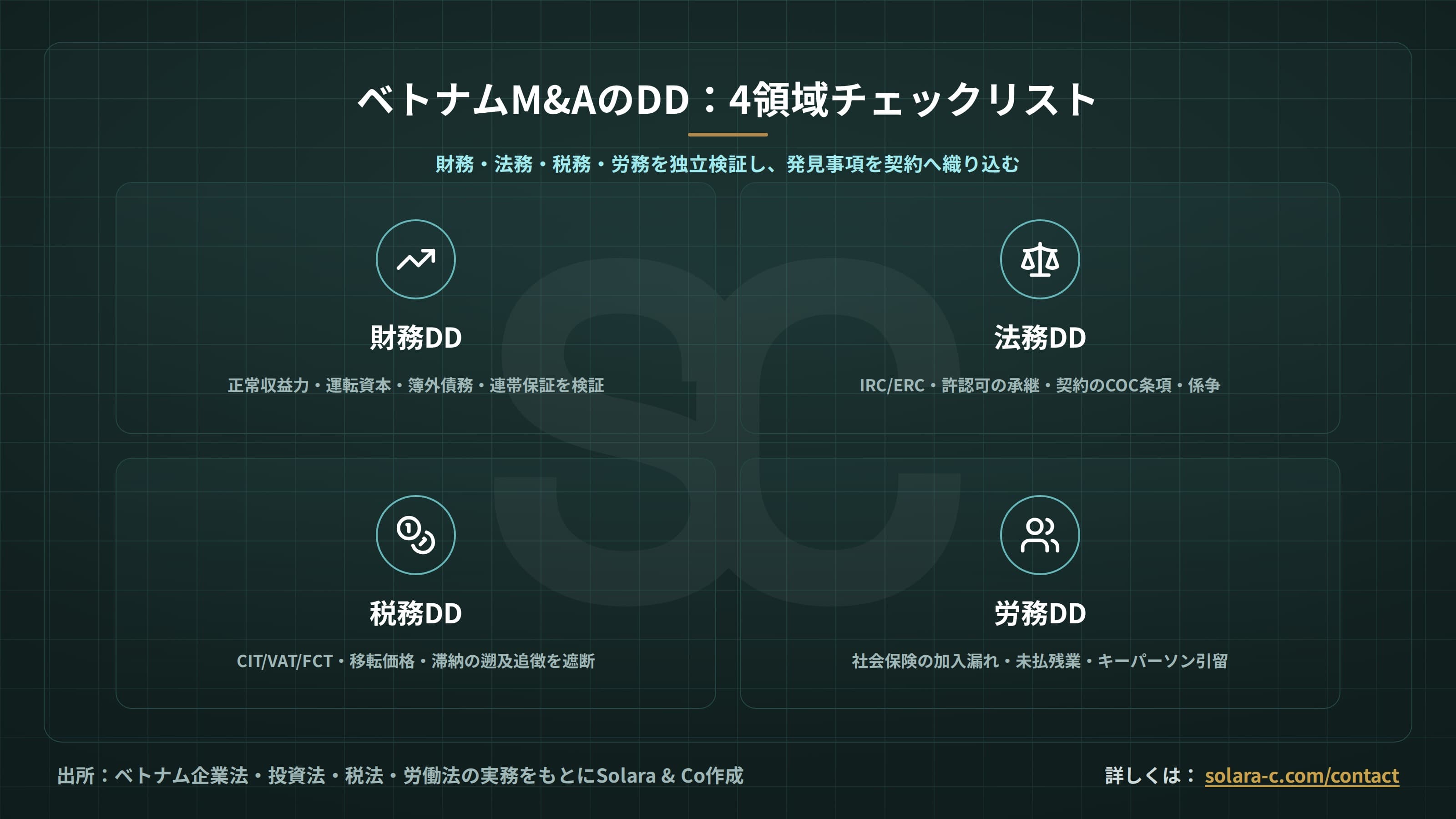
The factor with the greatest monetary impact in the HR DD of a Vietnam M&A deal is the off-balance-sheet liability arising from labor compliance. A prime example is the under-reporting of social insurance (health insurance, social insurance, and unemployment insurance). In Vietnam, many companies calculate social insurance contributions based on a "declared salary" lower than the actual total paid out, and this constitutes a violation of underpaying compulsory insurance. If the authorities conduct an investigation after the acquisition, back-payments, late charges, and fines are imposed — and the buyer could end up inheriting that burden.
Next is unpaid overtime. Vietnam's Labor Code finely stipulates caps on overtime hours (on monthly and annual bases) as well as premium rates that differ for weekdays, days off, public holidays, and night work. There are many cases in which overtime exceeding the cap becomes routine during peak periods at production sites, or in which it is handled as fixed overtime but diverges from reality, and remediation can give rise to retroactive payments covering several years. Deficiencies in the labor contracts themselves (the distinction between indefinite-term and fixed-term, the handling of probationary periods, and whether work rules are registered with the labor authority) must also be surfaced as risks of later disputes.
Where foreign nationals are employed, the consistency of the work permit with the visa and temporary residence permit, as well as the fulfillment of localization requirements, are also subject to inspection. For these risks, you combine three moves according to the characteristics of the deal: (1) quantify them in DD and reflect them in the acquisition price, (2) cover them with representations and warranties or special indemnity, and (3) require remediation as a condition precedent to closing. What matters is to design the whole thing through to the end — namely "how to translate the risks you find into the terms of the contract."
Decoding the Organizational-Culture Risk Peculiar to Vietnam
What systems and numbers cannot fully capture is organizational-culture risk. At Vietnamese companies, family businesses especially, important decisions are made at the owner-family dinner table or in informal settings, and the approval workflows and meeting bodies may be mere formalities. After the acquisition, when the Japanese head office tries to introduce a process of "building consensus in meetings and approving in writing," the front line outwardly complies while in reality continuing to operate by the practices of the owner's era, leaving a dual decision-making structure intact.
Wage and HR practices also have their own distinctive issues. The bonus around Lunar New Year (Tet) — the 13th-month salary — is, in effect, strongly expected as a vested right, and cutting or changing it sends morale plummeting all at once. Sensitivity to the pace of raises and to titles is also high, so a nominal job title has a major influence on retention and resignation. Moreover, because there is a tendency to avoid expressing direct dissent to superiors, front-line discontent is slow to surface and one day erupts in the form of a wave of resignations.
Decoding all this requires not only financial data but also the gathering of qualitative information. Where possible, pick up "the unspoken discontent and expectations" through employee surveys, interviews with executives and mid-level staff, and on-site visits. Only when you can concretely depict how the post-integration organization will run — including the fit between Japanese expatriate candidates and local executives, the operating policy on communication languages (Japanese, English, Vietnamese), and the securing of interpreter and bridge personnel — can you say you have "identified" cultural risk.
A Practical Checklist to Use in HR DD
So that identifying HR and organizational risk does not rely on individual intuition, we turn it into a checklist to ensure comprehensiveness. The following are the minimum verification items to nail down in a Vietnamese deal.
【Talent and Organization】(1) A roster of all employees (name, position, department, hire date, salary, contract type), (2) the turnover rate over the past three years and the reasons of major departing staff, (3) a list of key persons and the business's degree of dependence on each, (4) the discrepancy between the org chart and the actual decision-making flow, (5) executives' employment contracts, non-compete clauses, and whether incentives exist.
【Labor Compliance】(6) Consistency between the social-insurance declared salary and the actual amount paid, (7) the reality of overtime hours and the status of premium-wage payments, (8) the completeness of labor contracts and work rules and their registration with the labor authority, (9) whether a labor union exists and the state of labor-management consultation, (10) the legality of foreign workers' work permits and visas, (11) the history of past labor disputes, strikes, and administrative sanctions.
【Compensation and Culture】(12) A market comparison of wage levels and the handling of the Tet bonus (13th month), (13) whether various allowances, in-kind benefits, and informal promises exist, (14) the reality of the evaluation system and raise rules, (15) the targets for retention after the acquisition and an estimate of the required cost. If you color-code these items into three stages — "verified / requires further investigation / serious risk" — and link each risk to its monetary impact and its contractual treatment (price adjustment, representations and warranties, conditions precedent, indemnification) in a single list, you obtain a practical risk map that connects directly to both management decisions and negotiations.
Risk Measures to Execute Around Closing and PMI Design
The risks identified in DD only take on meaning once they are reliably bridged to contract negotiations and the PMI plan. As for pre-closing actions: first, for serious labor violations, set remediation as a condition precedent (CP) to closing and have the seller resolve it under its own responsibility. Second, handle risks that cannot be fully quantified with representations and warranties and special indemnity, and where necessary with escrow (withholding part of the transfer consideration). Third, conclude retention agreements or new employment terms with key persons simultaneously with closing to prevent their departure.
In the initial phase of PMI (the first 90 to 100 days), place the stabilization of HR and the organization as the top-priority theme. The period right after the acquisition is when employees' anxiety over employment, treatment, and management direction peaks. By carefully explaining the change of management and the vision, and by sending out reassuring messages early — such as "wages, bonuses, and employment will be maintained for the time being" — you prevent the initial chain of resignations. The standard playbook is not to push through system changes all at once, and to proceed with measures that touch vested rights such as the Tet bonus especially carefully and in stages.
Over the medium term, plan and carry out, in a deliberate way, the conversion of personalized know-how into SOPs and documentation, the alignment of the evaluation and compensation systems, the establishment of reporting lines with the Japanese head office, and the development of bridge personnel. What matters is to position PMI not as "one-way assimilation into the Japanese style" but as "an integration that preserves the good parts of both companies." If you can design things so that you raise only governance and quality control without destroying local strengths such as agility and closeness to customers, the talent stays and the synergy becomes reality.
How to Build a Risk-Identification Structure Leveraging Specialists
Because HR and organizational risk in Vietnam intricately entangles language, commercial custom, law, and administrative practice, completing it with the Japanese head office alone is not realistic. Forming a team that combines specialists in finance, tax, legal, and labor with a bridge role versed in local practice is what determines the precision of risk identification. In the labor domain especially, the involvement of local lawyers and labor consultants well-versed in Vietnam's Labor Code and social-insurance system is indispensable.
There are three points in building the structure. First, spell out HR and organization in the DD scope at the memorandum of understanding (MOU) stage, and secure a person in charge and a budget. Second, share information among the financial, legal, and HR DD teams so that, for example, the "gap between declared and actual salary" can be evaluated simultaneously from the three perspectives of finance, tax, and labor. Third, so that the conclusions of DD can be seamlessly connected to contract terms and the PMI plan, seat the negotiation lead and the integration lead at the same table from an early stage.
Engaging an advisor who understands both the Japanese and Vietnamese contexts and can accompany you consistently from investigation through negotiation to integration is not a cost but an insurance policy. Overlooking HR and organizational risk leads directly to losses exceeding the acquisition price or to the functional breakdown of the business. From its position connecting the decisions of the Japanese head office with the practice on the ground in Vietnam, Solara & Co provides end-to-end support from identifying risks, through translating them into the contract, to designing the initial phase of PMI. Setting the goal not as "concluding the contract" but as "the business you bought keeps running the next day and the next year" is the essence of success in Vietnam M&A.