

Why earn-outs are used in Vietnam M&A
In negotiations to acquire Vietnamese companies, it is not unusual for the seller and the buyer to envision sharply different futures. The owner-manager is convinced that "next year's revenue will double" and asks for that growth assumption to be built into the price. The buyer, by contrast, weighing the reliability of the disclosed materials and the uncertainty of the market, hesitates to reflect that assumption into the price as is. The representative mechanism for bridging this valuation gap is the earn-out clause.
An earn-out is an arrangement in which part of the acquisition consideration is paid as a fixed amount, while the remainder is paid on a deferred basis, linked to the degree to which performance targets are met over a set period after the acquisition. From the seller's perspective, it means "if the growth I promised is real, I receive more"; from the buyer's perspective, it means "I do not pay up front for growth that exists only on paper — I pay only for what is actually realized." It is a device that creates agreement on both sides. The general thinking behind the mechanism itself is laid out in What is an earn-out: the basics of performance-linked consideration in M&A; this article translates that into Vietnam's specific accounting, regulatory and practical environment, focusing on the points to watch in design and operation.
There are three typical situations in which an earn-out works in Vietnam M&A. First, when future projections are uncertain and the parties cannot agree on a fixed price. Second, when the source of the business's value lies in the owner-manager's human capital or in relationships with customers and licenses, and the buyer wants the owner to stay on for a period after the acquisition. Third, when the buyer wants to take time to verify the volatility in the numbers revealed during DD (due diligence), rather than gambling everything on a single price decision. All three are issues that go to the very way the price is set, and they are designed as an extension of Valuation in Vietnam M&A.
Earn-out design parameters
An earn-out cannot withstand real-world practice if it is reduced to a single sentence such as "pay more if performance grows." Only by precisely combining multiple parameters — what to measure, until when, at what level, and how to measure it — does the clause become robust against disputes.
Choosing the performance metric
The first branching point is which performance metric will trigger payment. Representative candidates are EBITDA (earnings before interest, taxes, depreciation and amortization), revenue, net income, and non-financial KPIs such as store count, number of contracts, or retention of key customers. Each carries trade-offs in "how hard it is for the seller to manipulate," "how easy it is to measure," and "how much the seller can control it," so the choice depends on the nature of the deal. The details are organized in the comparison table further below.
The measurement period (earn-out period)
The measurement period is usually set at one to three years. The shorter the period, the sooner the seller can lock in the consideration and the faster the buyer can proceed with integration — but it also more easily induces temporary inflation of the numbers (such as pulling forward revenue recognition). The longer the period, the more clearly the true earning power can be assessed — but it constrains the buyer's management decisions and heightens tension with PMI (post-merger integration). For many mid-cap deals, the landing point is around two years, excluding the first ramp-up year.
Threshold / cap and the slope of the payout ratio
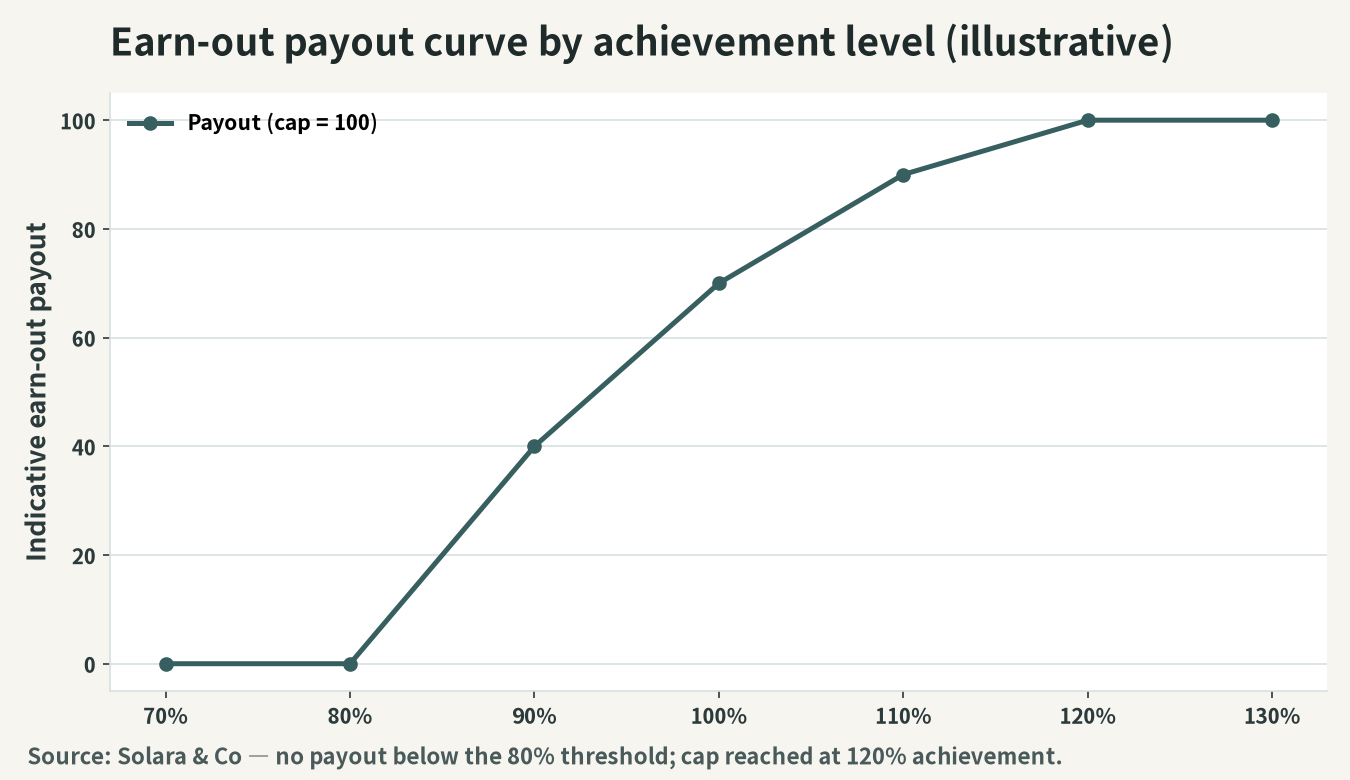
In designing the payout, it is standard practice to set a threshold (hurdle) as the floor and a cap as the ceiling. The threshold is the line meaning "no additional payment arises unless this level is exceeded," prompting the seller to achieve a minimum. The cap fixes the buyer's total payment, preventing an excessive deferred payout caused by unexpectedly strong performance. How to slope the curve between the threshold and the cap — whether to make it linearly proportional, or to design it in tiers that raise the payout ratio in higher-achievement zones — is also an important variable that governs the seller's incentives.
How to choose the performance metric
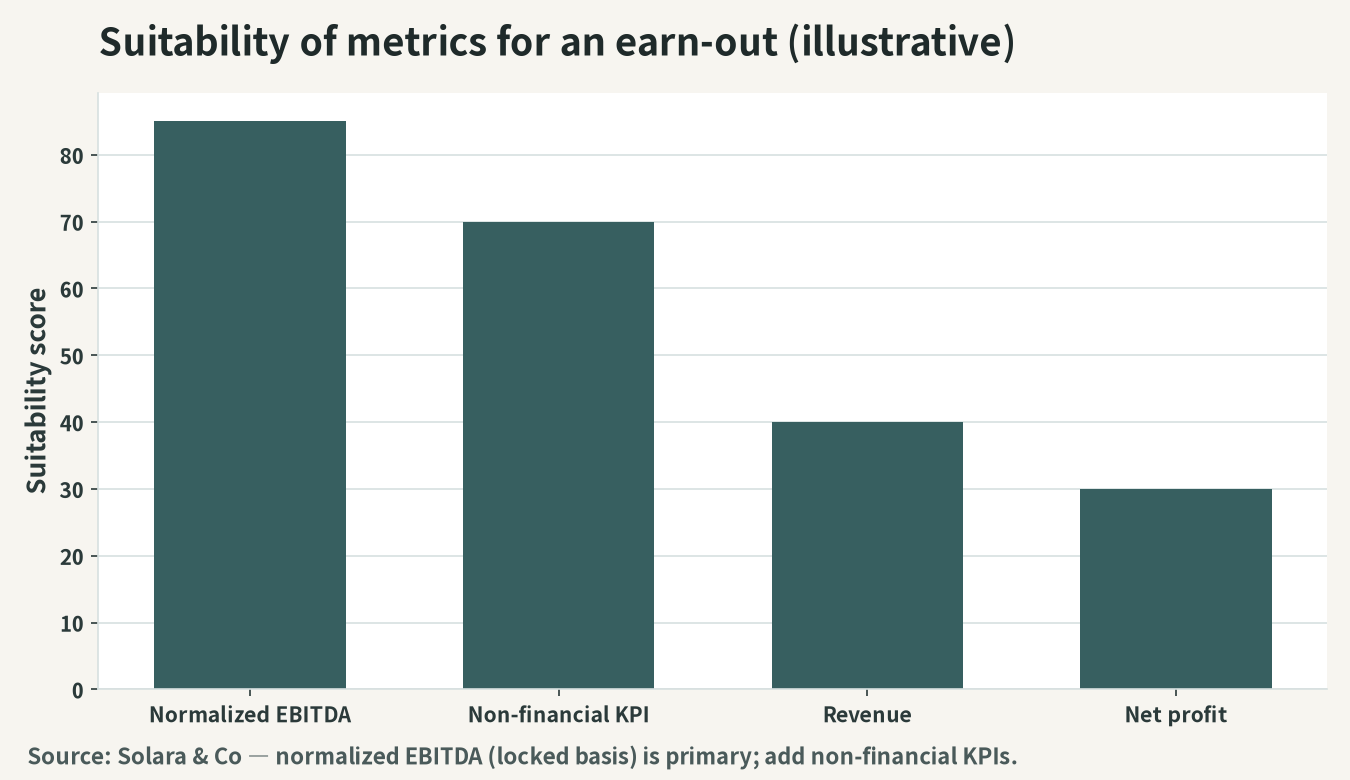
The choice of metric must be made within the inherent constraint of the reliability of Vietnam's accounting practice. The principle is to choose a metric that is hard to manipulate and yet linked to business value, but the ease of measurement and the seller's controllability cannot be ignored either.
Metric | Hard to manipulate | Ease of measurement | Seller's control | Recommendation |
|---|---|---|---|---|
EBITDA | Medium (varies with accounting policy) | Medium | High (can compress discretionary expenses) | ◎ (the front-runner if accounting standards are fixed) |
Revenue | Low (easy to recognize early) | High | High | △ (dangerous on its own) |
Net income | Low (swings with tax and extraordinary items) | Medium | Medium | △ (unsuitable in Vietnam) |
Non-financial KPIs | High (robust if objective metrics are chosen) | High | Medium | ○ (effective as a supplementary metric) |
EBITDA tends to be the front-runner because it reflects the business's intrinsic earning power, but there is room to manipulate it through depreciation policy, capitalization of expenses, or reallocation of related-party transactions, so it functions only in combination with the fixing of accounting standards discussed later. Revenue is easy to measure and the seller can control it, but it is easily inflated through early shipping or channel stuffing, so making it a sole metric is dangerous. Net income in Vietnam swings widely due to tax adjustments and one-off gains and losses, making it unsuitable as an earn-out benchmark. Non-financial KPIs such as contract retention rate or maintenance of key customers, if chosen to be objectively observable, are hard to manipulate, and designing them to supplement the financial metrics is effective.
Fixing the accounting standards — the single most important Vietnam-specific issue
In designing an earn-out in Vietnam, the element that differs most in character from deals in Japan or other developed countries is the issue of accounting reliability. Neglect this point, and a painstakingly precise clause turns into a quagmire of disputes over "which number do we measure by."
The opacity of VAS accounting and the risk of double books
Vietnamese Accounting Standards (VAS) are not fully aligned with International Financial Reporting Standards (IFRS), and idiosyncratic practices remain in the application of revenue recognition, impairment and provisioning. Moreover, at small and mid-sized owner-run companies, cases genuinely exist where the books are effectively split in two — one for tax filing and one for internal management — or where part of a cash-based business is kept off the books. If EBITDA, the benchmark for the earn-out, is adopted as is on the basis of "VAS-based published financial statements," then the moment the accounting policy is corrected after the acquisition, the numbers move, leaving room for the seller to claim that "the buyer arbitrarily compressed profits." Grasping the reality of the accounting is an issue to be probed already at the Financial due diligence in Vietnam M&A stage.
Normalization and locking the accounting policy
The countermeasure has two layers. First, define normalized EBITDA — reflecting the normalization adjustments grasped during DD (excluding the owner's personal expenses, restating related-party transactions to market prices, removing one-off gains and losses, and so on) — as the benchmark. Second, fix (lock) the accounting policy to be applied during the earn-out period to the policy as of the time of contract, neutralizing it so that the buyer's switch to the group's unified standards does not affect the payment amount. Specifically, attach to the contract — as a calculation schedule — the treatment of depreciation methods and useful lives, provisioning policy, revenue recognition standards, and the handling of allocated head-office costs and management fees. The precision of this definition directly determines the rate of disputes that arise later.
Management control during the measurement period and protective clauses
An earn-out is also a tug-of-war over the initiative in running the business after the acquisition. After closing, it is the buyer who operates the business, but the payment amount is directly tied to the seller's take. How to reconcile the two parties' interests must be decided in the contract in advance.
The seller's operational latitude
Once performance-linked consideration is promised, the seller will demand "an environment in which I can achieve it." During the earn-out period, it is common to leave the former owner — the key person — a certain discretion in operating the business and to avoid abrupt changes of policy. However, leaving discretion too broad risks the seller running after short-term cosmetic numbers and damaging long-term corporate value.
Constraints on operating policy (protective covenants)
Hence, protective covenants are put in place to bind both sides. On the buyer's side, duties of good-faith operation are imposed, such as "not unduly shrinking the business during the earn-out period," "not arbitrarily transferring key customers or business lines," and "operating the business with reasonable effort." On the seller's side, duties to maintain soundness are imposed, such as "not unreasonably loosening price and credit terms to pull forward revenue" and "not unduly cutting capital investment or R&D." These are the very dynamics of negotiation, and the issues should be surfaced early from the Letter of intent (LOI) and negotiation stage, then translated into concrete obligations in the SPA (share purchase agreement) in Vietnam M&A.
Vietnam-specific practical pitfalls
Even with the design in place, Vietnam's particular practical environment makes operating an earn-out difficult. The following three points are risks that must always be anticipated at the entrance to a deal.
The difficulty of verifying KPIs (weak audit trail)
An earn-out presupposes that things "can be measured," but at Vietnamese small and mid-sized companies the audit trail is weak, and the primary source materials backing the KPIs may be scattered. There are no few sites where the sales-management system is undeveloped and the reconciliation of shipping, billing and collection depends on manual work. As a countermeasure, it is effective to promptly standardize the format of accounting and sales records after closing, and to build into the contract a procedure for an independent auditor to verify the earn-out calculation statement.
The risk of the owner's departure
When the business value depends strongly on the owner's personal network and credibility, then even if you think you have tied the owner down with the earn-out, there is a risk that the business will falter due to departure after the consideration is fixed, or a drop in motivation during the period. The design of key-person retention and delegation of authority must be thought of together with the earn-out, and it is closely intertwined with the issues handled in PMI and HR risk after Vietnam M&A.
Remitting the deferred consideration (DICA)
Easily overlooked is the foreign-exchange and capital-regulation issue of how to remit the fixed earn-out consideration to an overseas seller, or to handle it as a capital transaction of the buyer in its capacity as a foreign investor. Settlement of contributions and consideration involving foreign investors must, in principle, be made through a direct investment capital account (DICA), and unless the payment of deferred consideration is made consistent with the original deal structure, it will stall at the remittance stage. Designing, already at the time of closing, even "from which account and how the additional payment two years later will be sent" connects to the thinking behind The full Vietnam M&A process, which ties the entire deal into a single thread.
Dispute-resolution mechanisms and translating them into the contract
By its very structure, an earn-out places the interests of the seller and the buyer in head-on conflict at the time of payment. That is precisely why designing the resolution mechanism on the premise that a dispute will occur secures the clause's effectiveness.
Advance agreement on the calculation method and expert determination
The greatest preventive measure is to make the calculation definition precise. Fix the definition of the benchmark metric, the adjustment items, the target period, and the timing and procedure of the calculation as a calculation schedule, thereby physically reducing the room for dispute. On that basis, in case the seller's and buyer's views diverge on the calculation result, provide in advance a procedure to submit the matter to the determination of an independent accounting expert and to treat that determination as final. This prevents trivial discrepancies in the numbers from escalating into litigation.
Arbitration, governing law and enforcement
As the ultimate means of dispute resolution, many deals choose international arbitration (such as the Vietnam International Arbitration Centre, VIAC, or SIAC in Singapore) over Vietnamese courts, and clearly stipulate the governing law, seat of arbitration and language in the SPA. Making it consistent with escrow (retention of part of the consideration) and the payment flow through the DICA, with an eye to the very enforceability of the arbitral award, is the key to turning a clause on paper into actual recovery.
The tension between earn-out and PMI
The final point worth emphasizing is that an earn-out is inherently in tension with PMI. The buyer wants, immediately after closing, to push ahead with synergy measures such as system integration, procurement integration and brand unification — yet these often temporarily depress the target company's standalone short-term performance, obstructing the seller's achievement of the earn-out. Rush the integration and you clash with the seller; defer the integration out of deference to the seller and synergy realization is pushed back. The practical knack is to mitigate this dilemma at the design stage — by how the earn-out metric is chosen (selecting a metric less affected by integration) or by an adjustment clause that excludes from the calculation the one-off costs accompanying integration measures.
Solara & Co's end-to-end support — from design to verification, remittance and integration
The earn-out in Vietnam M&A is an advanced design domain where multiple issues intersect: accounting reliability, regulation (remittance, capital accounts), human resources, and PMI. Not only deciding the metric, the period and the threshold, but only when the fixing of accounting standards based on the reality of VAS, the building of a system that can verify KPIs, the remittance flow of deferred consideration, and compatibility with integration are all hammered out as one — only then does the earn-out function as a "bridge over the price."
Solara & Co has bases and networks in both Japan and Vietnam, and supports clients end-to-end: from assessing normalization through financial DD, to designing the earn-out clause, translating it into the SPA, the practicalities of closing and remittance, and PMI. Negotiations deadlocked before a valuation gap, or wanting to structure the price on the premise of the owner-manager staying on — it is precisely in such situations that the skill of the design divides the outcome. Please consult us, starting with a single step of sorting out the issues of your deal together.