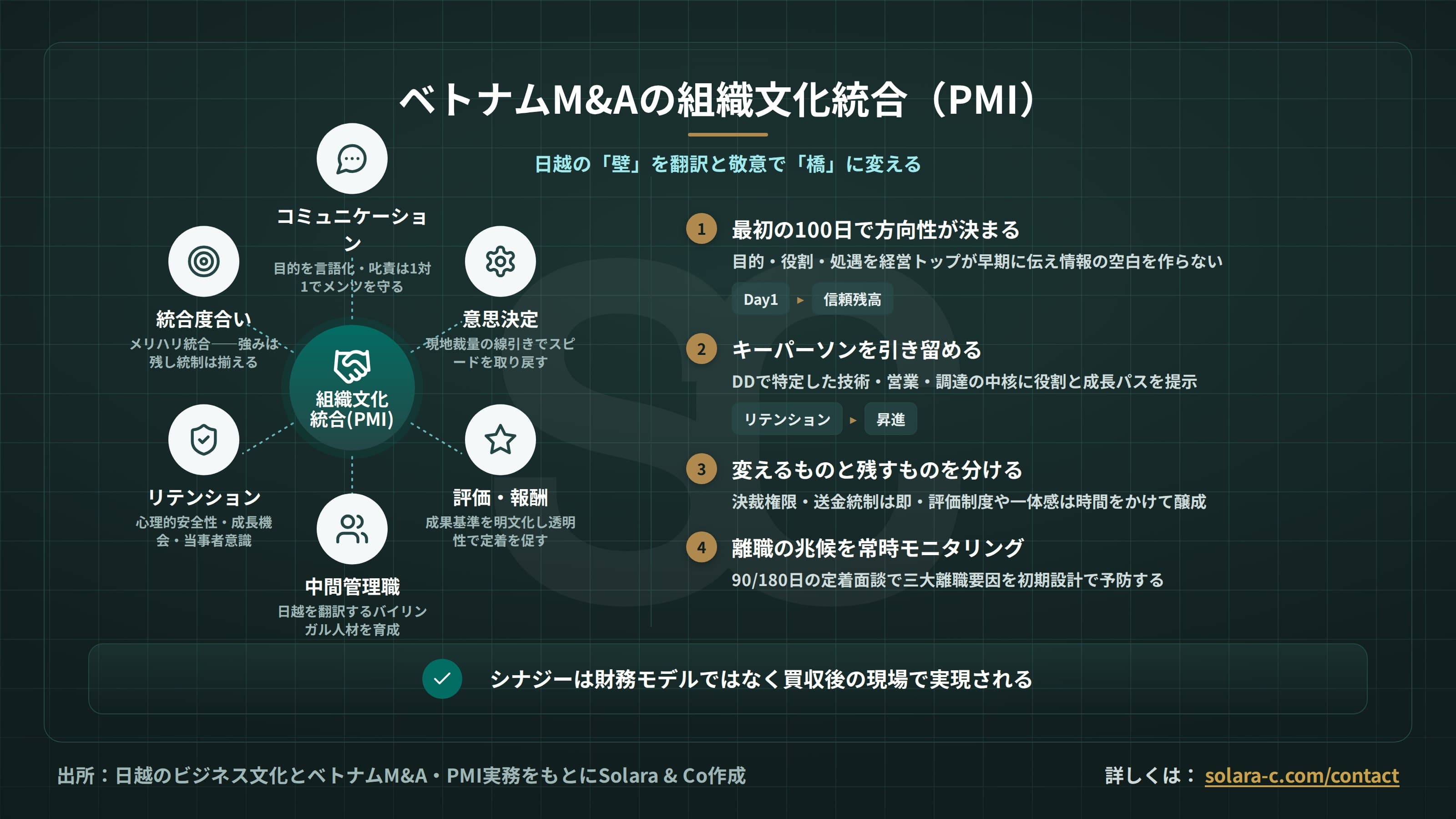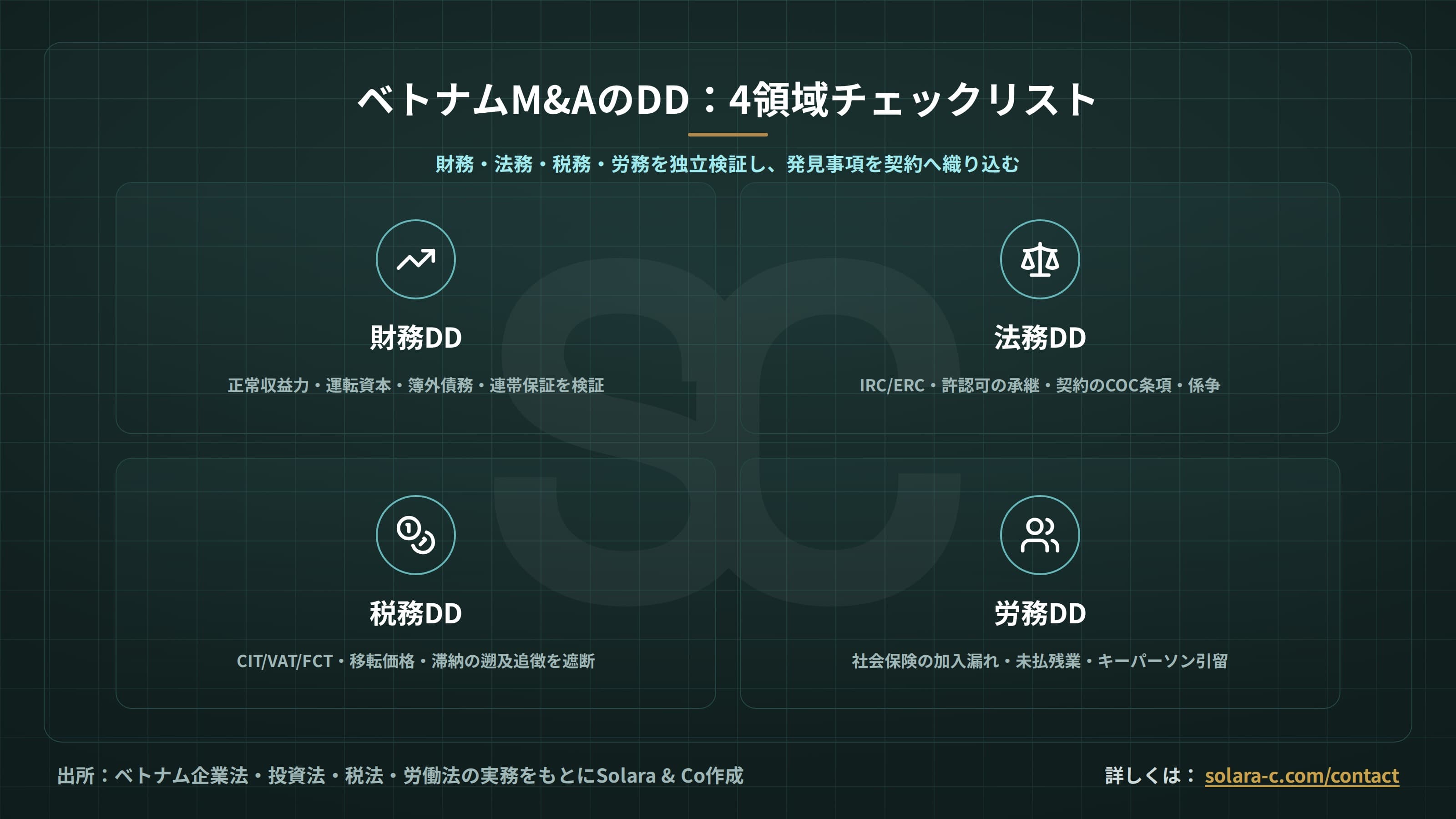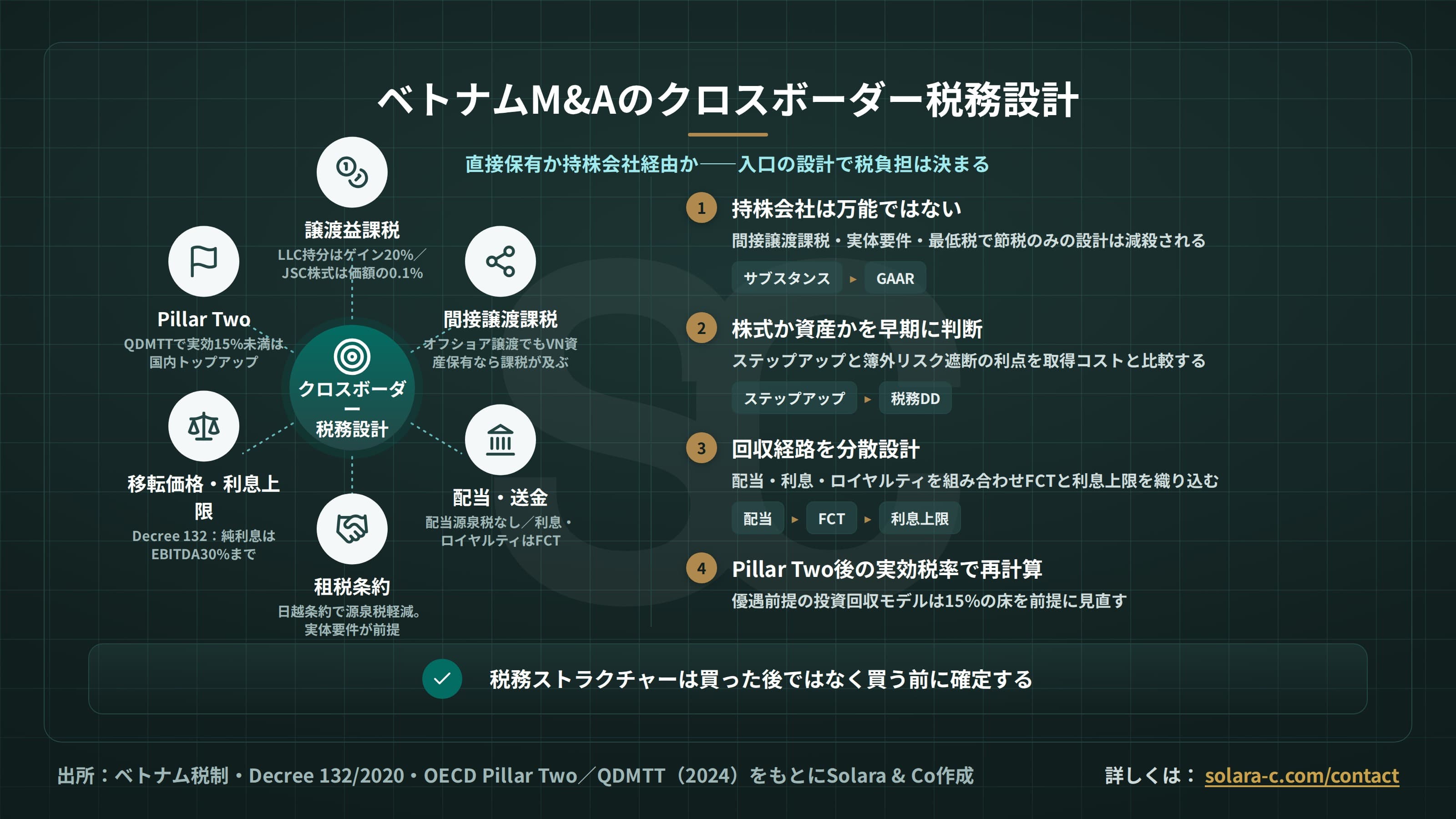

"The Last Line of Defense Is the SPA" — Where the Contract Takes On the Risk
When acquiring a Vietnamese company, no matter how carefully you surface risks in due diligence (DD), not every risk can be resolved beforehand. Deficiencies in land-use right registration, unpaid social insurance, ambiguities in past tax treatment, the seeds of disputes—the Share Purchase Agreement (SPA) is what ultimately takes on these "residual risks" and determines whether the buyer or the seller bears them. The SPA is not an administrative document signed at the end of a transaction; it is the very backbone of the deal, translating the conclusions of DD into price, indemnity, and conditions precedent.
In Vietnamese deals especially, it is dangerous to design an SPA with the same instincts as a domestic Japanese M&A. Whether to choose Vietnamese law or Singaporean law as the governing law, whether to resolve disputes in court or by SIAC arbitration, and through which account and how the consideration is remitted—these choices determine whether, when a breach of representations and warranties occurs, you can "actually realize your contractual rights." An SPA that does not anticipate enforceability, however meticulous its clauses, is merely paper-thin reassurance. This article explains the whole picture—overall structure, governing law, price clauses, representations and warranties, indemnity, credit support, conditions precedent and closing, and remedies—centered on the issues specific to Vietnam.
The Overall Structure of the SPA and Designing Governing Law and Dispute Resolution
Broadly speaking, an SPA consists of: ①the subject of the transaction and the consideration, ②representations and warranties (R&W), ③covenants (restrictions on conduct from signing to closing), ④conditions precedent (CP), ⑤indemnity, and ⑥general provisions (governing law, dispute resolution, etc.). The first thing to decide in a Vietnamese deal is the governing law and dispute resolution framework placed in these general provisions.
Governing Law: Vietnamese Law or Singaporean Law
In cross-border share transfers where a foreign investor is a party, there is room for the parties to choose foreign law as the governing law by agreement, and Singaporean or English law is often chosen for predictability in contract interpretation. However, since the subject of the transfer is shares in a Vietnamese legal entity, Vietnam's mandatory provisions apply—no matter which governing law you choose—to "matters relating to the target company itself," such as the validity of the share transfer, corporate procedures under company law (Law on Enterprises 2020), land-use rights, and licenses. It is important not to misread the premise: governing law is merely the rule for interpreting and performing the contract; it does not allow you to circumvent Vietnamese law.
Dispute Resolution: Vietnamese Courts or International Arbitration
Dispute resolution is chosen from Vietnamese courts, domestic arbitration (VIAC), or foreign arbitration (such as SIAC). Foreign investors frequently designate Singapore (SIAC) as the seat of arbitration, citing the neutrality and confidentiality of the procedure and the international enforceability of arbitral awards. Vietnam is a party to the New York Convention, so the recognition and enforcement of foreign arbitral awards can be sought, but the risk remains that recognition may be refused on grounds such as a violation of public policy, or that the procedure may become prolonged. Specify the seat, institution, language, and number of arbitrators, and design with an eye all the way to the enforcement stage.
Designing the Price Clauses — Fixed Price, Locked Box, and Completion Accounts
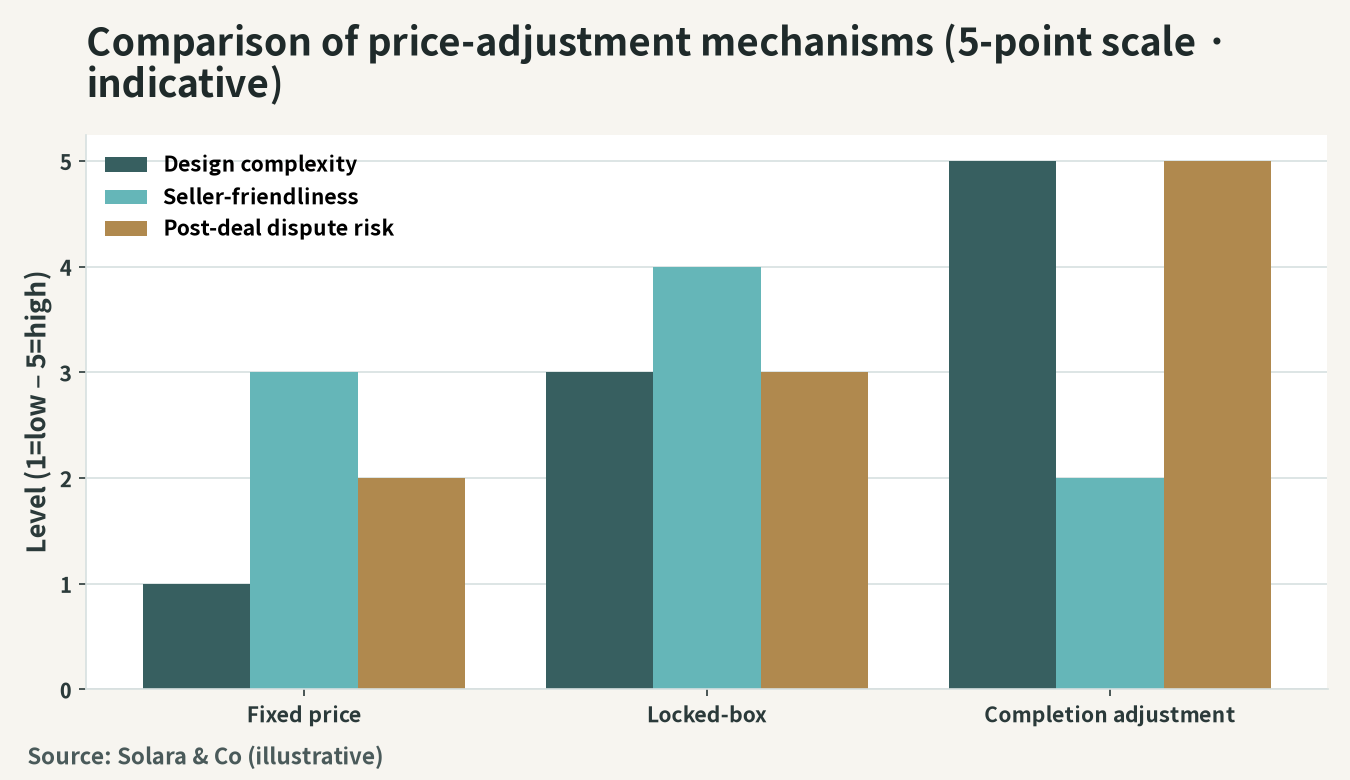
How to fix the transfer consideration is the most heatedly negotiated area in an SPA. The representative methods can be organized into three: fixed price, locked box, and completion accounts.
The Thinking Behind the Three Methods and Points to Note in Vietnam
Fixed price is the simplest method—paying the agreed amount as is, with no post-closing adjustment. Locked box fixes the price using completed financial statements as of a past reference date (the Locked Box Date), and thereafter restrains only the outflow of value (Leakage) through prohibition and indemnity. Completion accounts fix the net interest-bearing debt (Net Debt) and working capital as of the closing on an actual basis, and adjust the consideration afterward by the difference from the reference values.
In Vietnam, due to concerns about the reliability of monthly financial information and double bookkeeping, there are situations that call for caution with the locked box, which relies on financial statements as of the reference date. Completion accounts have the advantage of being able to verify actual amounts, but disputes readily arise over the application of accounting standards (VAS) and the accuracy of accounts, so the definition of the adjustment calculation must be set out extremely precisely in the contract.
Method | Price-fixing mechanism | Risk bearing (reference date to closing) | Suitable situations |
|---|---|---|---|
Fixed price | Pay the agreed amount as is, no post-closing adjustment | Buyer bears it (fluctuations are the buyer's burden too) | Small-scale deals with simple, easy-to-read finances |
Locked box | Fixed by completed finances at a past reference date; only Leakage regulated | Seller bears it (after the reference date it belongs to the buyer) | Deals with reliable financial information where you want to fix the price early |
Completion accounts | Adjusted afterward by Net Debt and working capital at closing | Settled on actual amounts (both parties share the burden) | Deals with large financial fluctuations requiring verification of actual amounts |
The Net Debt and Working Capital Adjustment Mechanism
In completion accounts, the buyer starts from "cash-free, debt-free," deducts net interest-bearing debt from enterprise value, and adds or subtracts the difference from target working capital to calculate the equity value. In Vietnamese deals, whether to include unpaid social insurance and taxes, loans to and from related parties, and off-balance-sheet lease obligations in Net Debt becomes a point of contention, and a single word in the definition can create a difference of tens of billions of dong. Specify the entire process—who prepares the calculation statement, the review period, the right to object, and adjudication by an independent accountant—as procedure.
The Subject and Scope of Representations and Warranties (R&W)
Representations and warranties are clauses in which the seller represents and warrants the facts about the target company as "true and accurate," and they function in tandem with indemnity. In addition to the general subjects (lawful incorporation, valid and unencumbered issuance of shares, propriety of financial statements, validity of contracts, legal compliance, labor, intellectual property, tax, and the absence of litigation), Vietnamese deals require a thick design of items specific to the locale.
Representation and Warranty Items Specific to Vietnam
The most important is the validity of licenses. Have the seller represent that the Investment Registration Certificate (IRC), the Enterprise Registration Certificate (ERC), industry-specific sub-licenses, and satisfaction of the conditions for conditional business lines are valid and free of grounds for revocation. Next are land-use rights—covering the holder's name, use, remaining term, transfer restrictions, and the absence of mortgages on the Land Use Right Certificate (LURC, the "red book").
Furthermore, as points specific to Vietnam, include in the explicit representations and warranties: ①full payment of social insurance and labor insurance (no arrears due to a gap between the declared headcount and the actual headcount), ②the absence of double bookkeeping (the records used for tax filing and for internal management match, with no off-book transactions), ③tax propriety (no material errors in past filings and payments that would give rise to additional assessments), and ④the absence of disputes and administrative penalties (including remediation orders relating to fire prevention (PCCC) and environmental impact assessment (EIA)). These are the areas that become the principal causes of post-acquisition trouble in Vietnam, and pinning them down through representations and warranties is the gateway to indemnity.
Disclosure and Representation and Warranty Insurance
The seller discloses exceptions to the representations and warranties in a disclosure letter, and disclosed matters are in principle excluded from indemnity. The buyer needs to scrutinize the sufficiency of the disclosure and negotiate so as not to accept vague blanket disclosures. In cross-border deals, the use of representation and warranty insurance (W&I insurance) is also advancing, but risks specific to Vietnam (land, licenses, social insurance) tend to be excluded, so in the end the design of indemnity between the parties is the linchpin.
Designing Indemnity — Cap, De Minimis, Basket, and Survival
The indemnity clause sets out the monetary remedy when the buyer suffers loss from a breach of representations and warranties and the like; it is the final adjustment valve that allocates risk between the parties. Design the various limitations that determine "how it works" with precision.
General Indemnity and Specific Indemnity
General indemnity is indemnity for breaches of representations and warranties generally, to which the caps and floors described below apply. Specific indemnity addresses specific risks identified in DD (an ongoing tax audit, an unremedied building permit, a particular instance of unpaid social insurance, etc.) by removing or raising the cap and floor. In Vietnamese deals, carving out the areas where DD flashed a red light into specific indemnity is the decisive factor in protecting the buyer.
Cap, De Minimis, Basket, and Survival
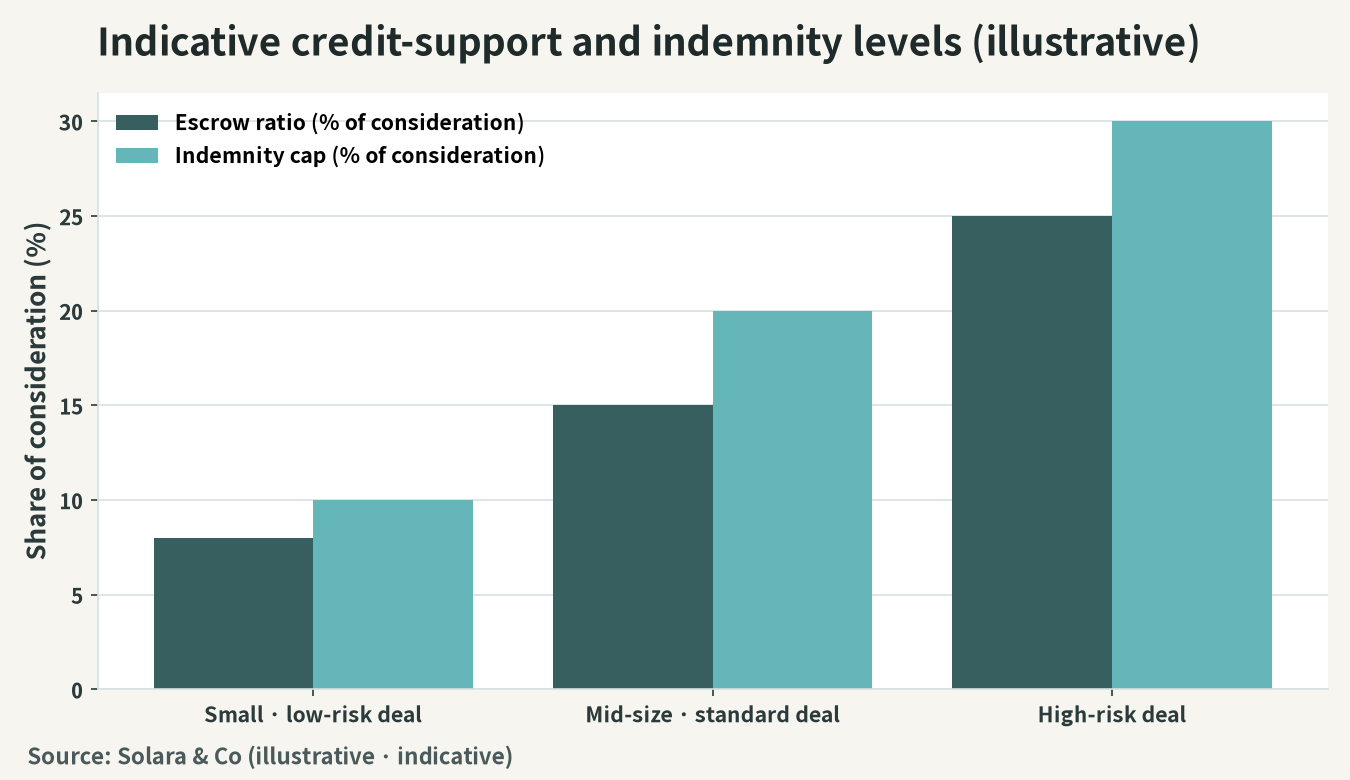
There are four main limitations. The cap is the ceiling on the seller's total indemnity, set at a certain percentage of the transfer price (e.g., 10–30% is one rule of thumb). De minimis is a threshold that disregards individually small claims. The basket is the threshold at which only when cumulative loss exceeds it can a claim be made; there is a deductible type that indemnifies only the excess and a first-dollar type that indemnifies the full amount. Survival sets out how long after closing the representations and warranties and the right to claim indemnity remain valid.
In Vietnam, because the tax reassessment period (the period during which additional assessment is possible) extends over the long term, the practical approach is to set the survival period for tax-related representations, warranties, and indemnity longer than for general items (with tax treated separately), designing it so that coverage extends until the additional assessment is finalized.
Credit Support for the Seller — Escrow, Holdback, and Earn-out
Even if the indemnity clause imposes a payment obligation on the seller, if the seller has lost the funds from its hands after closing, recovery becomes difficult. Particularly in cross-border deals, the effectiveness of claims and recovery is a challenge, so use credit support that "backs up" the indemnity alongside it.
Escrow and Holdback
Escrow is a mechanism whereby a portion of the consideration is deposited in a neutral third party's account for a certain period, and if an indemnity claim arises, it is applied from there. Holdback is a method of withholding payment of a portion of the consideration and, after a certain period, paying the remainder net of indemnity deductions; it is simple but depends on the buyer's creditworthiness. The ratio and period of the deposit or withholding should be aligned with the magnitude of the risks grasped in DD and the survival period.
Earn-out
Earn-out is a mechanism for paying additional consideration in installments according to post-closing performance (revenue, EBITDA, etc.), serving both to bridge a price gap and to give the seller an incentive to continue the business. The crux of the design is defining the metrics, the calculation period, and the cap, and preventing disputes over the objectivity of the calculation.
Conditions Precedent (CP) and Closing
Conditions precedent (CP) are the gateway at which the obligation to close arises only once they are satisfied. The CP in Vietnamese deals are designed to reflect local regulatory procedures.
Regulatory Approvals, Competition Law Filings, and Third-Party Consents
In a share acquisition by foreign capital, depending on the business line and the equity ratio, an M&A approval procedure (registration of capital contribution or share acquisition by a foreign investor, Law on Investment 2020) may be required. Transactions exceeding a certain scale are subject to economic concentration notification under competition law (Law on Competition 2018). Furthermore, if important contracts contain change-of-control provisions, add the obtaining of third-party consents from business partners, financial institutions, and licensors to the CP. Since these take several weeks to several months, set the period from signing to closing and the long stop date (final deadline) realistically.
Points to Note on Closing and Remittance (the DICA Account)
At closing, confirmation of CP satisfaction, the exchange of share transfer documents, changes to the shareholder register and the ERC, and payment of the consideration are performed concurrently. A key issue specific to Vietnam is the remittance route. The consideration for a share acquisition by a foreign investor must, in principle, be remitted and settled through a Direct Investment Capital Account (DICA) opened by the target company, and even when a locked box or escrow is adopted, a fund flow consistent with this foreign exchange control (State Bank of Vietnam regulations) must be designed in advance. However precise you make the price clauses, if the money cannot be moved, it is meaningless.
Remedies for Breach and the Put Option
The remedy when a breach of representations and warranties or a breach of covenant comes to light after closing is, in principle, indemnity (monetary compensation). The buyer should clarify the scope of loss, the method of calculation (whether limited to direct loss or including indirect loss), and the mitigation obligation. For material breaches, combine measures: termination of the transaction if before closing, or specific indemnity or adjustment if after closing.
When acquiring only a portion as a minority shareholder, or when wishing to secure the seller's commitments, a put option (the right for the buyer to sell back the shares it holds to the seller if a certain event occurs) or a call option may be established. However, in Vietnam, the validity of a forced transfer of shares and of price determination, consistency with foreign investment regulations, and the enforceability of arbitral awards become points of contention, so option clauses must be designed on the premise of "whether they can truly be executed in Vietnam." A remedy clause functions only in conjunction with the dispute resolution clause and the remittance regulations.
Solara & Co's Integrated Support — Turning DD Conclusions into an "SPA That Works"
The SPA for acquiring a Vietnamese company is a precise piece of design in which everything is interlinked: from the choice of governing law and dispute resolution, to the price-adjustment mechanism, the Vietnam-specific representations and warranties, the limitations on indemnity, credit support, regulatory CP, and the remittance route. Overlook even one of these regarding local enforceability or foreign exchange regulations, and the contract ends as paper-thin reassurance.
With a Japan–Vietnam dual structure, Solara & Co provides integrated support in translating the risks surfaced in DD into "price, representations and warranties, indemnity, and structure" and in designing an SPA grounded in local law and enforceability. We coordinate with lawyers and accounting experts from the financial and legal DD stage, and accompany you through negotiation, signing, regulatory handling, closing, and the execution of remittance. Turning the SPA—the place where risk is taken on—reliably into a "contract that works": from that very first step, we work alongside you.