
The Business You Want to Run Is Not Always the Business You Can Run
A wall that Japanese companies considering entry into Vietnam often run into after they have firmed up their business plan is licensing. The assumption that "this is a business we run without any trouble in Japan, so we should be able to run it in Vietnam too" is dangerous. In Vietnam, the sectors foreign investors may enter, the equity ratios permitted, and the operating conditions are laid down in detail by industry, so the business you want to run is not necessarily the business you can run.
Vietnam's framework for accepting investment is, broadly speaking, structured into: (1) sectors that foreign capital can enter freely, (2) conditional investment sectors (conditional sectors) that can be entered if certain conditions are met, and (3) sectors closed to foreign capital. Of particular importance are the conditional investment sectors, where conditions such as a cap on the foreign equity ratio, a minimum charter capital, and the acquisition of an industry-specific specialist license (sub-license) are imposed.
This article organizes the practicalities of licensing and conditional investment sectors in Vietnam—from judging whether entry is possible, to the framework of required licenses, to the acquisition process and lead times—as perspectives to grasp at the very gateway of an entry plan. For the overall picture of foreign-investment regulation, please also refer to Vietnam's Foreign-Investment Regulation and Conditional Investment Sectors.
Understanding the Three Categories of Investment Sectors
Liberalized Sectors, Conditional Sectors, and Prohibited Sectors
Vietnam's Law on Investment and its WTO commitments classify the sectors in which foreign investors may participate. While much of manufacturing can be entered relatively freely, distribution, logistics, education, finance, real estate, transport, advertising, and information & communications tend to fall under conditional or restricted treatment. The ironclad rule is to confirm which category your own business falls into at the very start of the entry plan.
The Relationship Between WTO Commitments and Domestic Law
The conditions for foreign entry in Vietnam are determined by the multilayered interplay of commitments made at WTO accession (reservations on market access and national treatment in service sectors), domestic law, and various FTAs. For sectors where the WTO commitments do not expressly provide for foreign entry, much is left to the discretion of the authorities, and whether entry is possible is sometimes not determined unambiguously. Newer agreements such as the CPTPP and the EVFTA sometimes include liberalization that goes further than the WTO commitments, so which agreement can be cited as the basis for asserting a right of entry becomes a practical key point.
Examples of Major Conditional and Restricted Sectors
Representative sectors in which conditions or restrictions tend to be imposed on foreign capital include distribution and retail (where opening retail outlets involves an economic needs test), logistics and transport, advertising, education and training, finance, securities and insurance, real estate business, information & communications and content, healthcare, and labor dispatch. Conversely, much of manufacturing is a sector that is relatively easy to enter. Depending on whether your business is service-type or manufacturing-type, and consumer-facing or business-facing, the weight of the conditions you face changes significantly.
Conditions Imposed in Conditional Investment Sectors
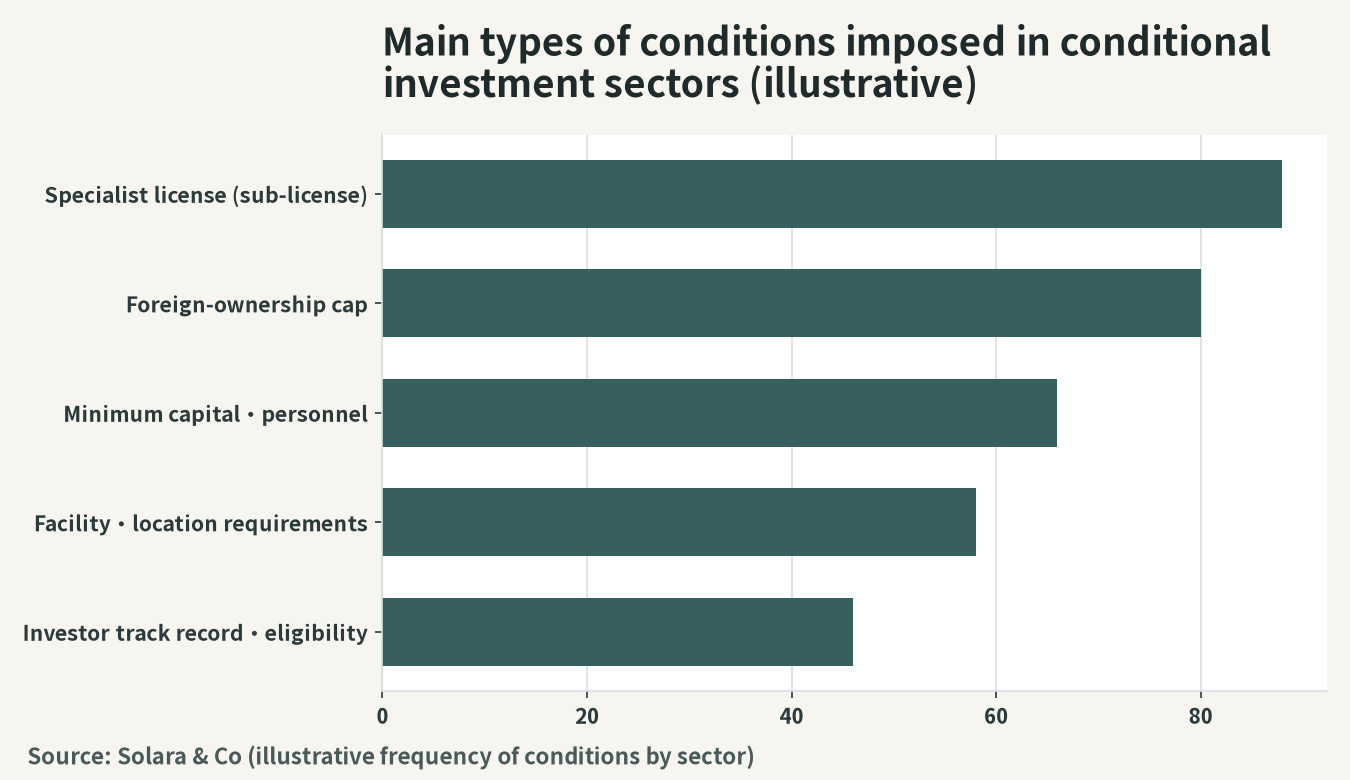
In conditional investment sectors, several types of conditions are imposed in combination.
Cap on the Foreign Equity Ratio
For some industries, a cap is set on the foreign equity ratio. There are also sectors where 100% ownership is not possible and a joint venture with a local partner is, in effect, a precondition. Because the equity ratio is directly tied to leadership in management, it shapes the entry scheme. For the design of a joint venture, please refer to The Practice of Selecting JV Partners in Vietnam.
Specialist Licenses (Sub-licenses)
In addition to the basic establishment approvals—the Investment Registration Certificate (IRC) and the Enterprise Registration Certificate (ERC)—there are sectors that require an industry-specific specialist license (sub-license). Distribution and retail, logistics, education, food & beverage, healthcare, construction, and labor dispatch are typical. Even after basic establishment is complete, actual operations cannot begin unless the specialist license is issued. This gap of "you can establish but you cannot operate" is one of the pitfalls Japanese companies are most likely to fall into. For example, retail requires a commercial-activity license and approval to set up a retail outlet, food & beverage requires food-hygiene-related permits, and education requires an operating license—industry-specific approvals pile up business by business. When drawing up a schedule, the "date operations can begin" should be taken as the completion of the specialist-license acquisition, not the completion of establishment.
Minimum Charter Capital, Personnel Requirements, and Facility Requirements
In some sectors, requirements such as a minimum charter capital, the deployment of qualified personnel, and standards for facilities and equipment are imposed. Because the license will not be issued unless these are met, they need to be factored in at the business-planning stage. For example, certain industries have a statutory minimum charter capital, and the registered capital is also bound by the schedule for paying in contributions. Capital is not a matter of "the more the better"; what matters is designing an appropriate level within the alignment of regulatory requirements with the business plan and the remittance plan.
Conditions Relating to the Investor and Eligibility
Depending on the sector, the investor's own track record, financial base, and experience in related fields may be questioned. There may also be conditions attached relating to land or location (limited to specific zoned-use areas or industrial parks, for instance), so not only the content of the business but also "who does it and where" affects whether a license can be obtained. These conditions need to be understood early, as a premise of the entry plan.
The License-Acquisition Process and Lead Times
The Basic Flow: IRC → ERC → Sub-license
Establishing a foreign-capital local subsidiary generally proceeds in the order of obtaining the Investment Registration Certificate (IRC), obtaining the Enterprise Registration Certificate (ERC), and then obtaining specialist licenses as needed. The establishment flow itself is detailed in The Practice of Incorporating a Local Subsidiary in Vietnam.
Stage | Content | Estimated lead time |
|---|---|---|
Preliminary confirmation | Confirming entry feasibility and conditions | A few weeks |
Obtaining the IRC | Investment Registration Certificate | About 1–2 months |
Obtaining the ERC | Enterprise Registration Certificate | About 1–2 weeks |
Specialist license | Industry-specific operating license | A few weeks to a few months, depending on the industry |
Various registrations | Tax, seal, bank account, etc. | A few weeks |
Lead Times in Conditional Sectors Are Hard to Read
In conditional investment sectors, the lead time swings widely depending on the authorities' review, additional inquiries, and corrections to documents. If you estimate by a Japanese sensibility that "once you apply, it comes through quickly," the schedule for starting operations will go awry. Specialist licenses in particular take time to prepare the documents that prove the requirements are met. Among the documents to be prepared on the Japanese side, some require notarization, consular legalization, and official translation into Vietnamese, and it is not unusual for this preparation alone to take several weeks. It is important to build into the schedule a realistic buffer that includes the time for such document preparation.
What to Confirm at the Gateway of the Entry Plan
Designing the Business Lines
In Vietnam, a company may only conduct business within the scope of the registered business lines. It is important to register the necessary business lines neither too broadly nor too narrowly, with an eye to future business expansion. Adding business lines later requires an amendment procedure and, in some cases, additional licenses. On the other hand, registering unnecessarily broad business lines may pull in conditional sectors and make the procedures heavier, so a design that fits the business plan—neither excessive nor deficient—is required.
Choosing the Scheme
Depending on the entry conditions (the cap on the equity ratio and the sub-licenses), the choice of scheme—a 100% subsidiary, a joint venture, or the acquisition of a local company (M&A)—will change. The optimal form of entry is designed from both the constraints on licensing and the business objectives. For example, in sectors where entry by foreign capital alone is difficult, acquiring a local company that already holds the necessary licenses can sometimes shorten the time to obtain those licenses. Conversely, if you prioritize establishing from scratch and operating under your own policy, you will choose the path of obtaining licenses yourself even if it takes time. Licensing is a factor that governs the very decision on the form of entry. For a comparison of entry forms, please refer to Comparison of Entry Forms in Vietnam.
Keeping an Eye on Regulatory Change
Vietnam's investment- and licensing-related laws are revised frequently, and entry conditions and procedures can change. You need to confirm the latest rules that apply at the time of entry, while also keeping an eye on amendments that are about to take effect. If you apply past precedents or outdated information as-is, you may find that the conditions have already changed.
Dialogue with the Authorities and Practical Operation
In Vietnam, not only the wording of the law but also the practical operation and interpretation of the responsible authority can sway the outcome. Even under the same provision, operation can vary by region or by the department in charge, so conducting a pre-consultation with the authorities before applying, to align on the documents and conditions required, is a practical device for reducing rework. Grasping the undocumented realities of operation through an advisor well-versed in local circumstances leads to smooth acquisition.
Where Does Licensing Trip Up
The typical patterns in which licensing delays or derails an entry concentrate on specific points.
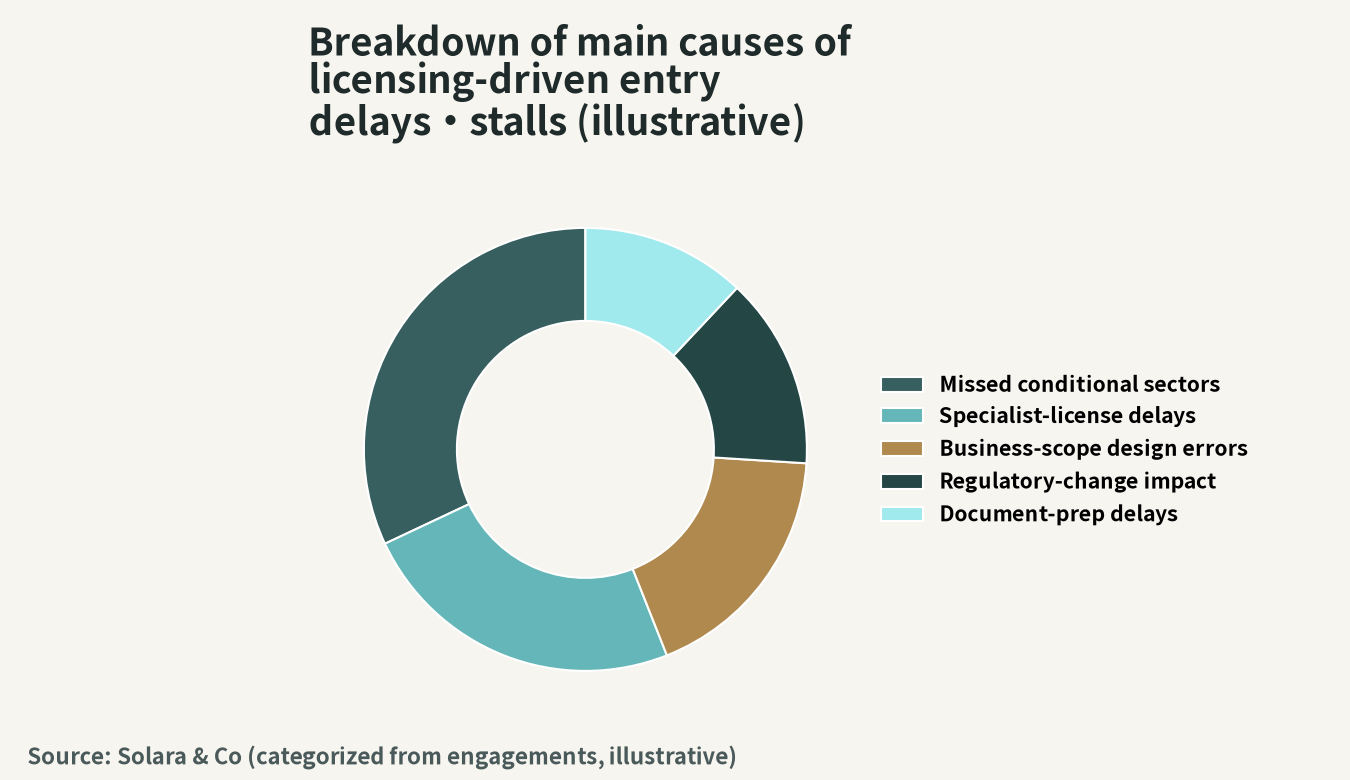
The largest factor is overlooking conditional sectors (insufficient confirmation of entry feasibility and conditions), followed by delays in obtaining specialist licenses, errors in designing the business lines, and then the impact of regulatory change. All of these can be avoided or mitigated if licensing is scrutinized at the gateway of the entry plan. The situation of "you can establish but you cannot operate" arises from overlooking specialist licenses.
Solara & Co's Support for Licensing and Conditional Sectors
Entry into Vietnam begins with confirming at the gateway, from a licensing standpoint, whether the business you want to run is a business you can run. Grasp the classification of investment sectors, assess the cap on the equity ratio, the specialist licenses, and the various requirements imposed in conditional sectors, and then design the entry scheme and business lines accordingly—performing this series of confirmations at the very start of the entry plan prevents later delays and rework.
Drawing on its networks on both the Japanese and Vietnamese sides and its knowledge of local regulation, Solara & Co provides integrated support: from the preliminary confirmation of entry feasibility and conditions, to the design of the entry scheme, support for obtaining the IRC, ERC, and specialist licenses, the design of business lines, and responding to regulatory change. To avoid situations such as "we could establish but cannot operate" or "we were required to enter into an unexpected joint venture," we are ready to support you, starting with the step of confirming the entry conditions for your own business together.