
Graduating from the "nothing runs without our expats" company — localization as a management challenge
A common wall that Japanese companies in Vietnam hit after a few years is "localization." In the start-up phase, Japanese expatriates keep an eye on every corner of the shop floor and transplant the head office's way of doing things wholesale, thereby preserving quality and control. This structure, however, carries three problems: the personnel cost of expatriates is heavy, decision-making is tied to Japan's timeline, and the motivation of local talent hits a ceiling. As long as you remain a "company that nothing runs without expats," none of cost, speed, or talent retention is sustainable.
Localization is not simply about reducing the number of Japanese staff. It is the transition toward a state in which local national staff make autonomous judgments, build quality into the work, and run the organization themselves. What matters is balance. Rush localization and let control slacken, and the risk of quality incidents and fraud rises; conversely, impose the Japanese way too forcefully and it fails to take root locally, with your best talent being the first to leave. This article frames localization along three axes — "people," "procurement," and "management/decision-making" — and lays out, from a practitioner's perspective, the building-in of quality control that underpins it, the issues specific to Vietnam, progress management via KPIs, and a phased roadmap.
Framing localization along three axes
If you think of localization vaguely as "leaving everything to the local side," control will inevitably collapse. Localization is something to be advanced by separating its targets and defining a destination and KPIs for each axis.
Localizing people: delegation of authority and successor development
The most essential is the localization of people. The pillars are the appointment of local managers, clear delegation of authority, elevating national staff into the executive ranks, and developing successors who will carry the next generation. The crux is to shift the approval authority that Japanese staff have held — gradually and in line with regulations — to local managers, and to design a process of "delegating in order to develop." In parallel, building a fair evaluation and compensation system and showing a clear path to promotion is the strongest countermeasure to the high turnover rate discussed later. On the design of recruitment and retention, please also see The practice of recruitment and talent retention in Vietnam.
Localizing procurement and parts: raising the local content ratio
In manufacturing, the localization of procurement and parts (local content = raising the localization ratio) determines cost competitiveness. Reliance on imported parts means perpetually carrying the risks of exchange-rate fluctuation, tariffs, and lead times. Discovering and developing local suppliers, and raising the in-house and local-procurement ratio while having them build in quality, is what reconciles cost and quality. Concrete measures for supplier selection, audit, and development are detailed in Procurement and supplier management in Vietnam. For supply-chain design in the China Plus One context, China Plus One in the supply chain is also a useful reference.
Localizing management and decision-making: balancing discretion and control
The third is the localization of management and decision-making. Grant the local side discretion while maintaining the control lines the head office must hold. This demarcation is made explicit as a "rules of authority (approval authority matrix)," defining — by monetary threshold and case type — who approves what and what is reported back to the head office. Leave it vague as "we left it to the local side," and you fall into one of two traps: a breakdown of control, or conversely the paralysis of being unable to decide anything.
Grasping the three axes of localization at a glance
The three axes differ in their purpose and the KPIs that should be measured. The table below organizes them along with an image of the destination.
Axis of localization | Main purpose | Key KPIs | Image of the destination |
|---|---|---|---|
Localizing people | Breaking expat dependence · cost optimization | Local-manager ratio · turnover rate | Local executives autonomously run departments |
Localizing procurement and parts | Cost competitiveness · supply stability | Localization ratio · parts defect rate | Stable local procurement of key parts |
Localizing management and decision-making | Speed · immediate on-site response | Local-approval ratio · reporting-compliance rate | Rules-based local discretion functions |
"Building in" quality — mechanisms for standardization and improvement
Localization and quality control are two sides of the same coin. Delegating authority is meaningless if quality collapses. Rather than relying on person-dependent "fine-tuning," embedding in the local site a mechanism whereby "the same quality comes out no matter who does it" is the prerequisite for an autonomous organization.
Standardization (SOPs) and documenting work procedures
First, document work procedures as standard operating procedures (SOPs) and train staff in Vietnamese. In Japan, a culture of "learning by watching" and "teaching with one's back" may work, but on a Vietnamese shop floor where personnel turnover is intense, quality cannot stabilize if knowledge remains tacit. The first step is to make procedures, judgment criteria, and quality checkpoints visible, and to build a training system that lets newcomers reach a certain standard in a short time.
QC circles · 5S · Kaizen · PDCA
On top of standardization, layer a shop-floor culture of improvement. Build the foundation with 5S (Sort, Set in order, Shine, Standardize, Sustain), have the shop floor itself discover and improve problems through QC-circle activities, and turn the PDCA cycle. Whether you can transform Kaizen from "something the Japanese make people do" into "an activity in which local staff are the protagonists" is the dividing line for it taking root. Linking improvement proposals to evaluation and compensation cultivates a sense of ownership.
Developing supervisors and transmitting skills
What sustains quality are on-site supervisors such as line leaders and team leaders. The planned transfer of technology (skill transmission) — of the know-how held by expatriate engineers — to this layer of supervisors decides the success or failure of localization. Only when supervisors can guide their subordinates, analyze the causes of defects, and lead improvement can expatriates take their hands off the shop floor. Once an operation that manages defect rates and yields numerically and links them to improvement activities has taken root, quality ceases to depend on individuals.
Taking into account the issues specific to Vietnam
Applying the Japanese template for localization and quality control wholesale will not work. Adjustments that take into account the issues specific to Vietnam's labor market and culture are indispensable.
High turnover and retention measures
In Vietnam, and especially in the southern industrial belt, talent mobility is high, and changing jobs whenever better conditions appear is common. Even if you invest in training, skills will leak out if people do not stay. Raising the retention rate through fair evaluation and the presentation of a career path, appropriate wage levels, and improvement of the workplace environment is a precondition of localization. The reality of wages and the cost structure is organized in The true picture of labor costs in Vietnam.
Face, peer-conformity awareness, and on-site communication
A culture of "face" that strongly dislikes being reprimanded in front of others, and an awareness that values being on a par with peers, require care in evaluation and guidance settings. Making use of individual praise and one-on-one interviews, and avoiding reprimands in public, directly affects motivation and retention. In addition, the language barrier between Japanese staff and the workforce produces loss in the transmission of quality information. Developing interpreters and bridge personnel, and procedure manuals that make heavy use of diagrams and photographs, are effective.
Trends in a young workforce, education, and rising wages
Vietnam possesses an abundant workforce with a young average age and a high appetite for learning; on the other hand, much of it is a stratum whose accumulation of experience still lies ahead. It is precisely for this reason that investment in a training system pays off. At the same time, wages are on an upward trend, so business models premised on "cheap labor" need to be reconsidered. To absorb rising wages, the keys are productivity gains through education and a transformation of the cost structure through localization.
"Visualizing" progress with KPIs
Localization and quality control do not advance on slogans. Conduct fixed-point monitoring of KPIs such as the local-manager ratio, localization ratio, turnover rate, defect rate, and training hours, set targets, and manage progress. The figure below is an image of how the local-manager ratio and localization ratio trend when localization is advanced according to plan.
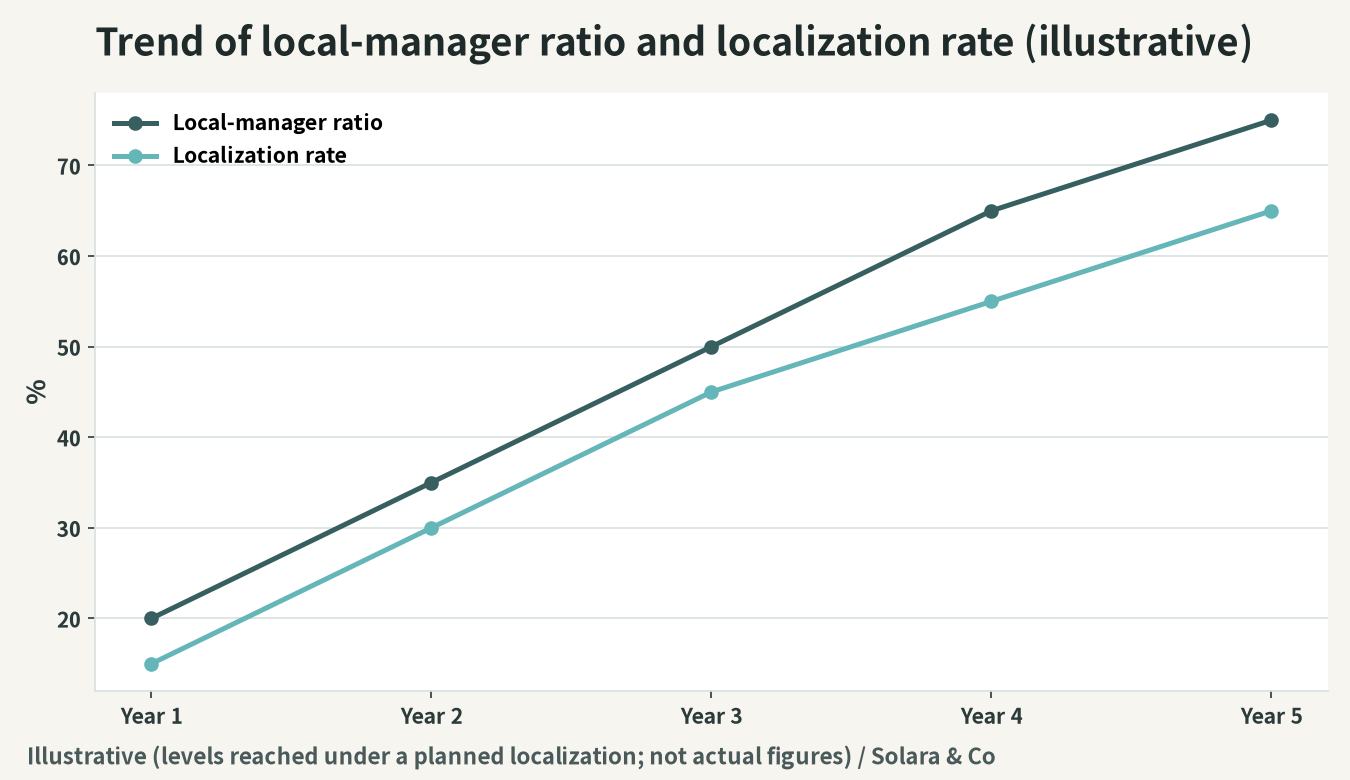
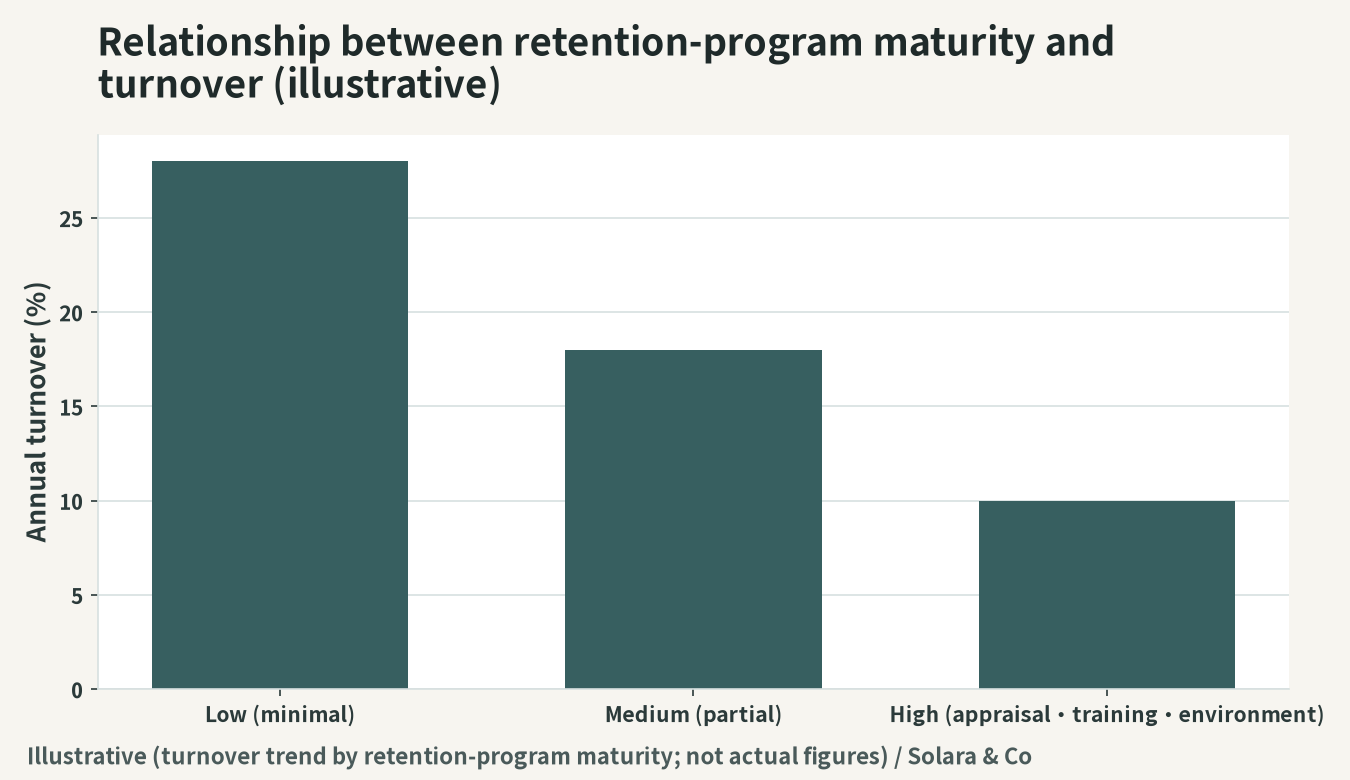
Track the numbers monthly and quarterly, and discuss the variance against targets in management meetings. This discipline turns localization from a "someday" issue into a "by-when" issue. Turnover, in particular, is the thermometer of localization. The figure below is a rough image of the relationship between the level of completeness of retention measures and the turnover rate, showing that investment in evaluation systems, education, and the workplace environment works to lower turnover.
Advancing along a phased roadmap
Localization does not advance in a single leap. The realistic approach is to advance standardization and delegation of authority in parallel, across three stages: "start-up," "transition," and "autonomy."
Start-up stage: standardization and laying the foundation
Under the leadership of expatriates, develop SOPs, embed 5S, and conduct basic education to create a foundation of quality. Building in documentation and a training system at this stage is what makes the later delegation of authority possible.
Transition stage: development and the staged delegation of authority
Develop local supervisors and managers, and delegate approval authority in stages in line with regulations. Expatriates change their role from "executor" to "coach and auditor." Building a system that completes labor operations such as payroll and social insurance locally is also a challenge of this period (The practice of payroll and social insurance).
Autonomy stage: local management and head-office monitoring
Local executives autonomously run their departments, and the head office narrows its role to KPI monitoring and key decisions. Expatriates are reduced to a minimum, and localization heads toward completion. What matters is that, even after entering the autonomy stage, you continue to maintain the control lines and reporting.
Solara & Co's end-to-end support — accompanying you in localization and building in quality
Localizing a Vietnamese subsidiary is a long-term management challenge that requires advancing the three axes of people, procurement, and decision-making in unison with a quality-control mechanism. Where companies tend to stumble is the "building-in tailored to local realities" — drawing the line of delegation, designing the evaluation and compensation system, constructing SOPs and a training system, and coping with the high turnover rate. Merely importing the template will not let it take root on the Vietnamese shop floor.
Solara & Co, with bases and human networks on both the Japanese and Vietnamese sides, provides end-to-end support — from formulating the localization roadmap, to designing rules of authority and evaluation-and-compensation systems, developing SOPs and conducting on-site education, raising the localization ratio through supplier development, and monitoring progress via KPIs. We support the transition from expat dependence to an organization that runs autonomously, advancing it steadily without lowering quality.