
"Which City to Locate In" Shapes Your Profit and Loss
One of the most common questions Japanese companies considering entry into Vietnam raise is the location question: "Should we base ourselves in Hanoi or Ho Chi Minh City?" At first glance this looks like a matter of preference or name recognition, but in reality the choice of location dictates, over the long term, how you can recruit talent, the fixed costs of rent and labor, how readily you can procure raw materials and components, and even the logistics cost of moving products to market and to port. Because a base, once established, cannot easily be moved, the initial location decision is one that determines the very profit-and-loss structure of the business.
In this article, after organizing the basic axes for evaluating a location choice, we compare the character of Vietnam's three major economic zones—the north (Greater Hanoi), the south (Greater Ho Chi Minh City), and the central region (Greater Da Nang)—and explain, from a practical standpoint, how to choose an office format and an industrial park (KCN), as well as the trade-offs among preferential tax treatment, labor costs, and logistics that come with location.
Six Basic Axes for Evaluating a Location Choice
A location should not be decided on a single reason such as "the rent is cheap" or "there are many Japanese companies." The starting point is to weight the following six axes against your own business model.
The Three Foundations of Talent, Cost, and Market
First is the talent pool. Look at how deep the supply is in the roles you need (production workers, engineers, IT talent, management and accounting staff, Japanese-speaking talent) in that region, and at what wage level you can recruit them. Second is cost, centered on rent and labor, since office rents, industrial-park lease rates, and the minimum-wage regional classification differ greatly by area. Third, for consumer-goods or distribution businesses, the distance to the market (the place of consumption) directly drives sales. On regional differences in labor costs, please also see The Reality and Cost Structure of Labor in Vietnam.
The Three Bases of Infrastructure, Procurement, and Administration
Fourth is infrastructure and access to ports and airports. For manufacturing that involves import and export, the lead time and transport cost to the main ports or to the international airports in Hanoi and Ho Chi Minh City determine competitiveness. Fifth is the concentration of suppliers: the more component makers and partner factories there are nearby, the more stable procurement becomes and the more inventory can be compressed. Sixth is the speed of administrative handling and permits, since the one-stop nature of investment procedures and the quality of handling differ by province (province/city) and by industrial-park management board.
The Registered Address Is a Prerequisite for the ERC
A point not to be overlooked when discussing location is the requirement for the registered address. In Vietnam, the fact that the registered address actually exists and is a property usable for business purposes is a prerequisite for obtaining the Enterprise Registration Certificate (ERC). Residential-only apartments and condominiums often cannot be used for corporate registration, and the lease agreement becomes an attachment to the application. From the very stage of selecting candidate locations, you must always confirm whether the property is a registrable business property.
An Overview of the Three Major Economic Zones
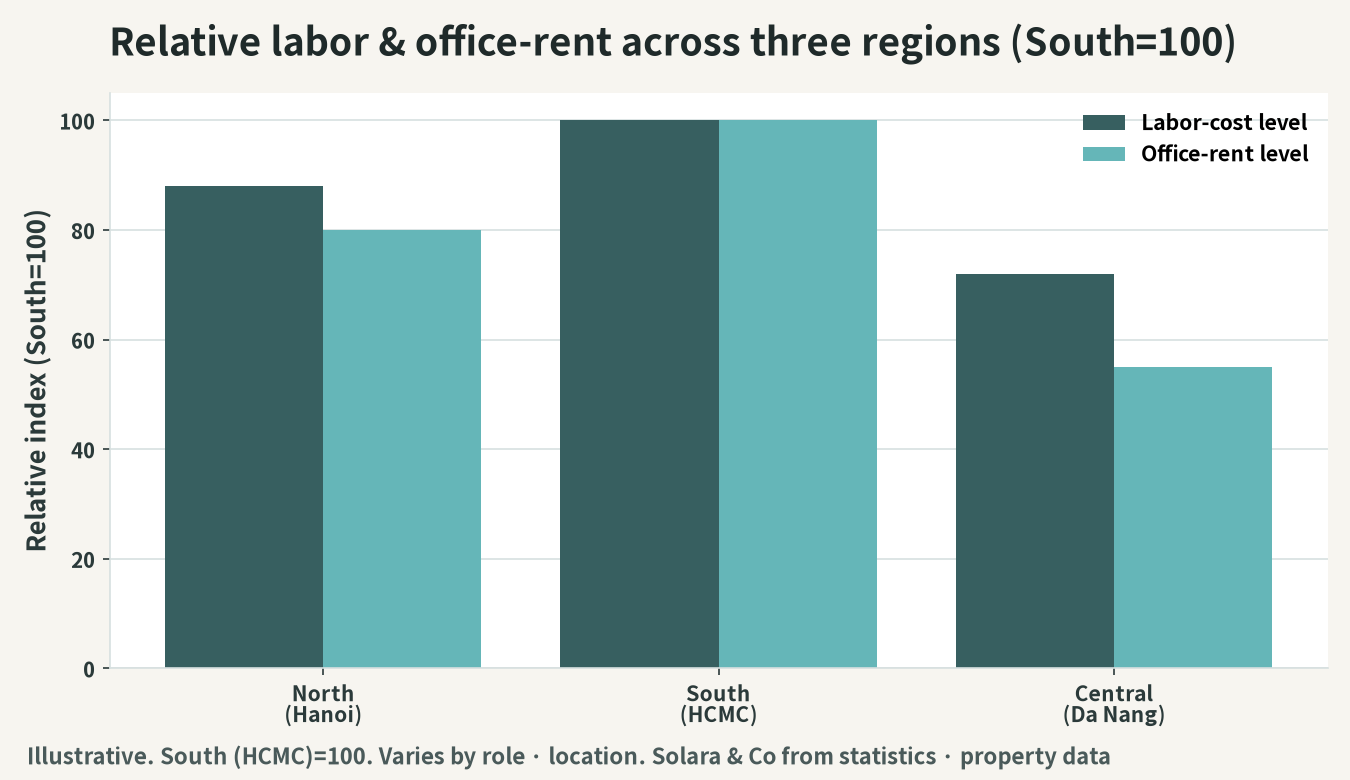
Vietnam is long and narrow from north to south, and its industrial structure and the character of its talent and costs are clearly divided by economic zone. After taking an overview of the differences among the three zones in the table below, we will look at the features of each zone in turn.
Economic zone | Central city / key provinces | Main industries | Labor-cost and rent level | Suited businesses |
|---|---|---|---|---|
North (Greater Hanoi) | Hanoi, Bac Ninh, Hai Phong, Thai Nguyen | Electrical/electronics, precision, components | Medium to somewhat high | Electronics/precision manufacturing, procurement-type production linked to South China |
South (Greater HCMC) | HCMC, Binh Duong, Dong Nai, Long An | Consumer goods, light industry, trading/distribution | High | Consumer-market businesses, light industry, headquarters/sales bases |
Central (Greater Da Nang) | Da Nang, Quang Nam | IT/software development, tourism, light industry | Low to medium | Offshore development, BPO, cost-focused bases |
The North (Greater Hanoi) — Administrative Hub and an Electrical/Electronics Cluster
Hanoi is the capital, where the ministries and licensing authorities gather—the administrative hub. For businesses that involve frequent negotiations with central authorities, or for industries that require heavy permits, there is a location advantage.
The Electronics/Precision Cluster and Proximity to South China
The north's greatest strength is the electrical/electronics and precision-component manufacturing cluster that formed with the entry of major players such as Samsung as the starting point. Supply chains are thickly built up in Bac Ninh Province, Hai Phong City, Thai Nguyen Province, and elsewhere, with large industrial parks such as VSIP Bac Ninh serving as the receiving ground. Its geographic proximity to China's South China region—an advantage in component-procurement lead time and cost—is also a reason the north is chosen as a destination for production transfer under China Plus One.
Features of Ports and Talent
With the development of Hai Phong Port and the Lach Huyen deep-water port, the north's import/export access has improved greatly. On the talent side, the supply of production workers and engineers is stable, while in recent years, as the cluster has developed, competition for skilled talent and wage increases have advanced.
The South (Greater Ho Chi Minh City) — The Largest Consumer Market and Port Access
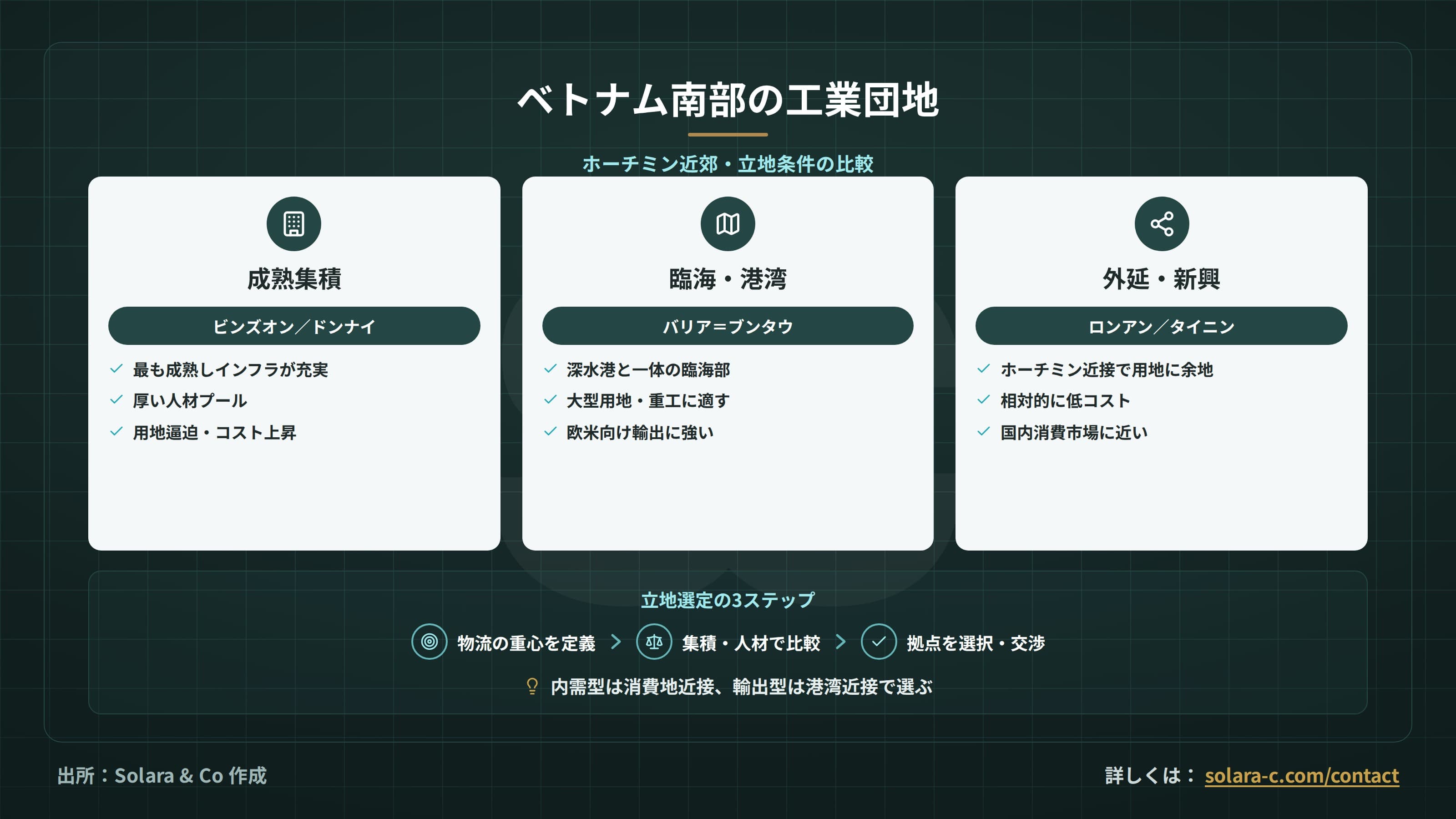
Ho Chi Minh City is Vietnam's largest commercial and consumer city, and together with the surrounding provinces of Binh Duong, Dong Nai, and Long An it forms the country's largest economic zone.
The Depth of the Consumer Market, Light Industry, and Distribution
The south's greatest appeal is having a vast consumer market with high purchasing power right in front of you. For consumer-goods, food, distribution, and light-industry businesses, proximity to the market directly boosts the efficiency of sales and marketing. The concentration of trading, services, and headquarters functions is also thick, and the depth of business infrastructure and Japanese-speaking talent is richer than in other regions.
Ports/Logistics and the Higher Costs
Cat Lai Port plays the central role in the country's container handling, while large vessels are handled by the Cai Mep deep-water port. While the logistics infrastructure is well developed, the high demand for talent puts labor costs and office rents at the highest levels nationwide. For the overall picture of the logistics network, The Logistics and Warehousing Market in Vietnam is a useful reference.
The Central Region (Greater Da Nang) — IT and Cost Advantages and Stable Labor
The central region, centered on Da Nang, is raising its presence as a third option distinct from the north and the south.
A Hub for IT/Offshore Development and Tourism
Da Nang has rapidly grown as a base for IT/software development and BPO (business process outsourcing), with both the supply of IT talent and the administration's investment-attraction stance in place. Its name recognition as a tourist city is also high, and the quality of its living environment contributes to talent retention. Compared with the north and the south, labor costs and rents are lower and the turnover rate is relatively settled, making it a strong candidate for siting a cost-focused development base or back office. The central region also has the geographic advantage of being a relay point that serves a hub function.
How to Choose an Office Format — Grade A/B, Serviced, Virtual
For businesses other than manufacturing, or for the management and sales functions of a manufacturer, the first step is to choose the office format. A choice matched to the business stage and headcount governs the initial cost and speed.
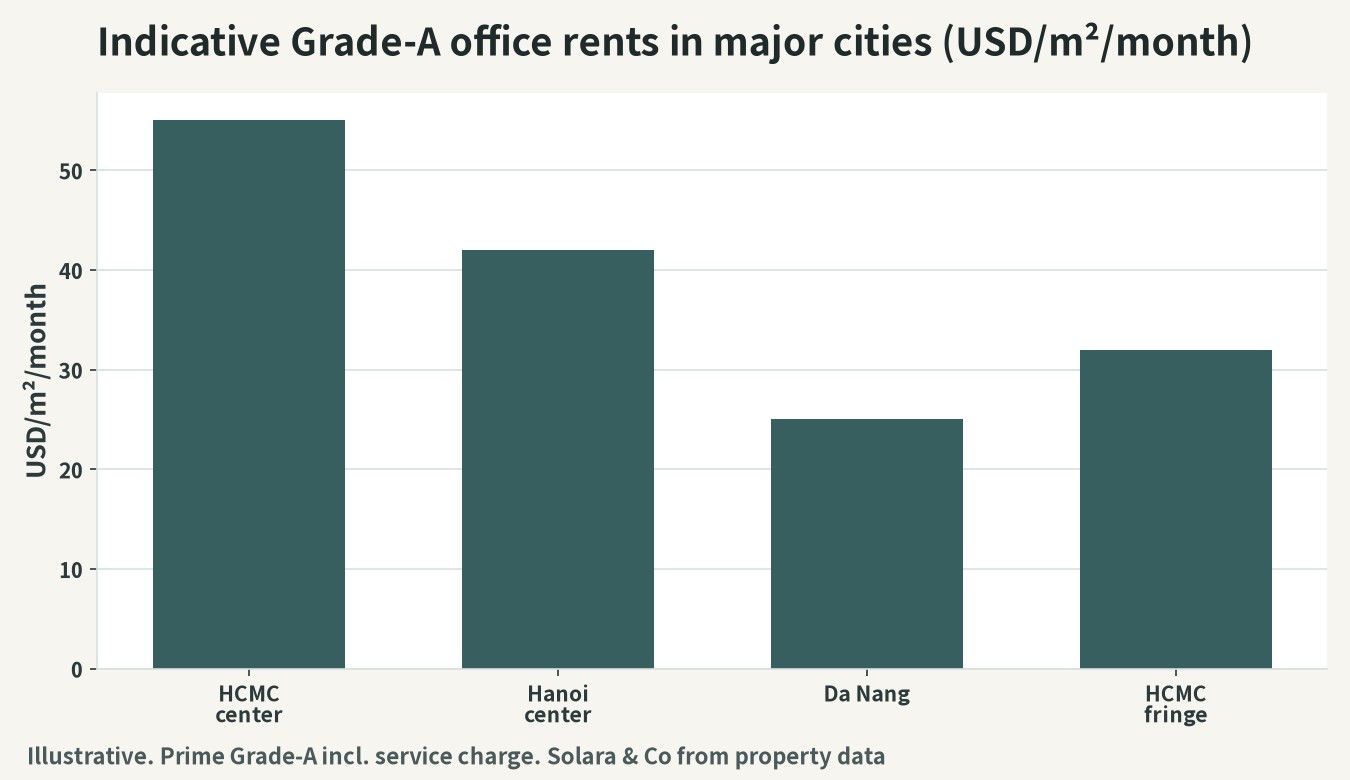
Grade A/B, Serviced Office, and Virtual Office
A Grade A office is a high-grade building in a prime location; in central Ho Chi Minh City, around USD 50–60/㎡ per month is one guide. It suits a headquarters base that emphasizes receiving visitors and recruitment branding. A Grade B office is an option that keeps costs down while being fully adequate for practical work. In the start-up phase or with few people, a serviced office equipped with furniture, reception, and meeting rooms is effective, since it can be put into operation the same day with no interior investment. A virtual office is a format in which you rent only an address, but whether it is recognized as a registered address depends on the authorities' practice, and it carries risk from the standpoint of obtaining the ERC and of substance requirements, so casual use should be avoided.
How to Choose an Industrial Park (KCN) — VSIP, Deep C, Long Duc
The core of location selection for manufacturing is the choice of industrial park (KCN = Khu Cong Nghiep). Each park differs in location, utilities, permit handling, and the lineup of resident companies.
Lease Format and Ready-Built Factories
In an industrial park, land is usually secured through a land lease (up to roughly 50 years, depending on the project period). If you want to avoid the time and investment of building your own structure, renting a ready-built factory (RBF) or a rental factory enables early operation. Parks with a thick concentration of Japanese companies and high operational quality—such as VSIP (Vietnam-Singapore Industrial Park), Deep C in Hai Phong, and Long Duc in Dong Nai Province—offer a different level of reassurance after move-in. For details on factory setup, see The Practice of Establishing a Factory in Vietnam.
One-Stop Permits, Utilities, and Incentives
A good industrial park's management board serves as a one-stop window for the IRC, construction permits, environmental procedures, and the like, and guarantees utilities such as power, water and drainage, and telecommunications, as well as labor supply, at the park level. Further, if you locate in an economic zone (EZ) or an export processing zone (EPZ), you may receive tax benefits such as corporate income tax reductions or import-duty incentives. Consistency with the 1/500 detailed plan (the detailed land-use plan) and whether the necessary permits have already been obtained on the park's side are also important points to confirm.
The Trade-offs of Location and a Practical Way to Proceed
Selecting a location is the work of balancing conflicting factors. There is no optimal solution that satisfies everything: a region with generous tax incentives is far from the city center or the port, raising logistics costs, while a city rich in talent has high labor costs and rents.
Grasp the Cost Trade-offs as a Total
The key is to compare on the total cost of operation rather than looking at rent, labor, logistics, and tax incentives individually. The ease of obtaining work permits and visas also matters in practice, so at a base with many foreign expatriates, factor in the perspective of Work Permits and Visas in Vietnam as well. On the procurement side, the proximity of partner factories discussed in Procurement and Supplier Management in Vietnam is directly linked to inventory and delivery times.
The Practical Flow From Comparing Candidate Sites to Signing a Contract
In practice, you proceed in this order: (1) from the business requirements, weight the evaluation axes and narrow down the candidate sites; (2) confirm the parks, properties, surrounding infrastructure, and labor market through on-site visits; (3) inquire with the authorities, such as the province and the industrial-park management board, about the applicability of permits and incentives; and (4) finalize the terms and conclude the lease agreement. Grasping the overall picture of initial costs in advance through The Overall Picture of Costs for Entering Vietnam makes it easier to estimate for each location.
Solara & Co's Integrated Support — Accompanying You From Location Strategy to Contract
Choosing a base in Vietnam is a strategic decision that optimizes multiple axes—talent, cost, market, logistics, and permits—to fit your own business model. The common pitfall is to decide on a single indicator such as name recognition or rent, only for unexpected costs to surface later in logistics, talent acquisition, or the registered-address requirement.
Solara & Co, with bases and local networks on both the Japanese and Vietnamese sides, provides integrated support—from hearing out the business requirements and designing the evaluation axes, to comparing the three major economic zones, industrial parks, and office properties, arranging on-site visits, inquiring with provinces and management boards about permits and incentives, and securing a registrable business address and negotiating the contract. We work alongside you to make that first decision—location—by reasoning backward from long-term profit and loss.