
Vietnam's VAT Refund "Won't Come If You Just Wait"
For Japanese companies engaged in exports or large new investment in Vietnam, the refund of value added tax (VAT) is a crucial theme that governs cash flow. When the input VAT paid at purchase cannot be fully recovered through output VAT at sale and accumulates, funds that should be refunded stagnate with the authorities and squeeze working capital. Yet Vietnam's VAT refund does not come back automatically unless the requirements are met and an application is filed; moreover, the post-filing examination and inspection are strict, and it is not uncommon for a single defect in documentation to hold things up for months.
If left alone with the thought that "it will come back someday," the accumulated input VAT swells and seriously affects cash flow. This article explains, from a Japanese company's standpoint, the basic structure of Vietnam's VAT, the typical cases in which a refund arises, the main requirements for receiving a refund, the flow from application to payment, and the walls that obstruct refunds in practice and how to overcome them. For corporate tax matters, please also refer to Vietnam's corporate tax and tax incentives; for import-export procedures, please refer to Vietnam's import-export customs practice.
The Basic Structure of VAT and When a Refund Arises
To understand refunds, one must first grasp how VAT works. VAT is a consumption tax under which "input VAT is deducted from output VAT, and the difference is paid."
Tax Rates (0%, 5%, 10%) and Input Tax Credit
The standard rate is 10% (with an intermittently applied measure reducing it to 8% for certain periods), some necessities are at 5%, and exported goods and services are at 0%. A business deducts input VAT from output VAT (the credit method), and when non-credited input VAT accumulates, it can claim a refund under certain requirements. To take the credit, a valid VAT invoice (e-invoice) is essential, and for transactions of 20 million VND or more, bank-transfer payment evidence is mandatory.
What is important here is the difference between "0%" and "non-taxable (exempt)." The 0% rate is a taxable transaction, so even if the output VAT is zero, the credit and refund of input VAT are allowed. A non-taxable transaction, on the other hand, is outside the scope of credit, and the corresponding input VAT is not refunded but becomes a cost. It is precisely because exports are treated as "0%" that exporters can receive refunds; misclassifying this causes a company to miss a refund it could have taken or to count on a refund it cannot take. Accurately grasping which category one's transactions fall into is the premise of a refund strategy.
Typical Cases Where a Refund Arises
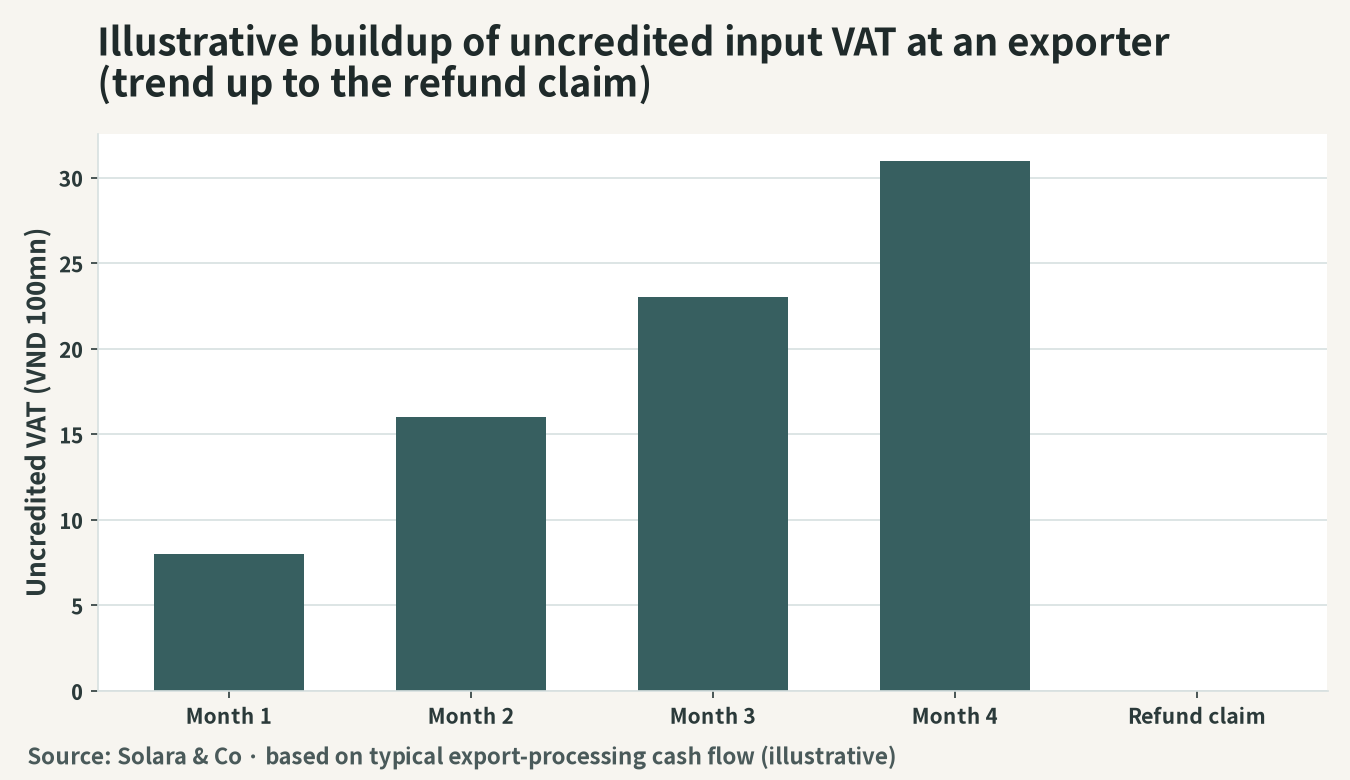
The need for a refund arises in situations where input VAT structurally exceeds output VAT. The representative cases are (1) an exporter whose sales are at the 0% rate (paying 10% on inputs but with zero output VAT), and (2) a new investment project that has no sales yet because it is pre-operational (large input VAT arising in advance from equipment and construction investment). Japanese companies of the export-processing manufacturing type, or in the phase of building a new factory, are precisely the protagonists of refunds. Note that an export-processing enterprise (EPE) under a bonded regime has its purchases themselves treated as non-taxable, so the refund issue is less likely to arise — the refund structure changes by location and scheme, so it is important to factor the VAT treatment into the design from the entry-form stage.
The Main Requirements for a Refund
Not everyone can receive a refund; requirements are set for each category. The starting point is to accurately grasp which category one falls into and what must be satisfied.
Refund Requirements for Exporters
When non-credited input VAT relating to exports accumulates to a certain amount (generally 300 million VND) or more, a refund can be claimed on a monthly or quarterly basis. The requirements are that the customs declaration showing the fact of export (customs clearance), the export contract, the invoice, and the evidence of collecting the payment via a bank (proof of foreign-currency receipt) are all in place. If the evidence of collecting the export proceeds is insufficient, the corresponding refund will not be allowed.
Refund Requirements for New Investment Projects
A new investment project before operations begin can claim a refund if the non-credited input VAT arising during the investment stage reaches a certain amount or more. However, the authorities verify whether the project is lawful and consistent with the Investment Registration Certificate (IRC), whether, in conditional sectors, the necessary business conditions are met, and whether the capital contribution (paid-in capital) has been carried out as planned. The points to note for conditional sectors are organized in Vietnam's conditional investment sectors and licensing.
In a new-investment refund, whether the registered capital has been contributed as planned is scrutinized especially strictly. If investment is advanced through borrowing or advances while the contribution remains unperformed, the refund may not be allowed or may become an issue in inspection. In addition, because the input VAT arising from factory construction and equipment procurement is large in amount, it is almost certain to be subject to pre-inspection. Reliably building up — one by one, in parallel with the progress of the investment — the eligibility of invoices received from construction contractors and suppliers, and the consistency of contracts, acceptance, and remittances, is the foundation for receiving a large lump-sum refund after operations begin.
The Flow from Refund Application to Payment
Once the requirements are met, the application is filed through the prescribed procedure. Understanding the flow and the points that take time at each stage makes it easier to plan cash flow.
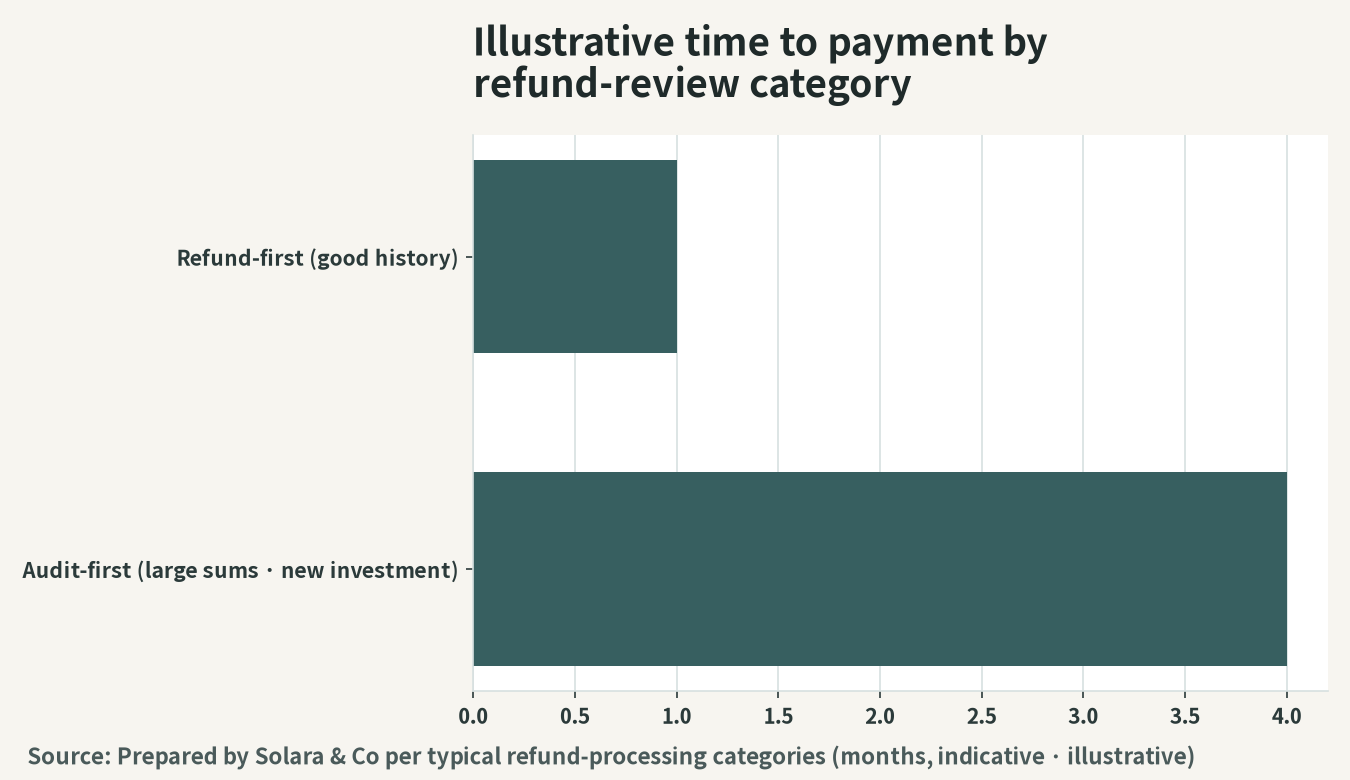
The application generally proceeds through: (1) internal aggregation of non-credited VAT and preparation of documentation, (2) electronic submission of the refund application, (3) the authorities' classification as "refund first, inspect later" or "inspect first, refund later," (4) examination and inspection, and (5) the refund decision and payment. A company with a good compliance history is subject to refund-first and is paid relatively quickly, but one judged to carry risk becomes inspect-first and, going through an inspection close to a tax audit, takes longer to be paid.
This classification of "refund first" versus "inspect first" is decided by the authorities based on the company's risk assessment. The better a company's tax-compliance history, the cleaner its past refunds, and the higher its transaction transparency, the more it is classified as refund-first and paid within the statutory processing period (roughly a few weeks if documentation is complete). Conversely, first-time applicants, large refunds, new investment projects, and companies with a history of findings are routed to inspect-first, and the refund is held until the inspection is complete. Therefore, keeping filing and payment compliance good on a day-to-day basis is itself the best investment for speeding up refunds.
The Practical Walls That Obstruct Refunds
Even when a refund should theoretically come, in practice many companies hit a "wall." Knowing the true nature of the wall and clearing it in advance is the key to making a refund certain.
Defects in Invoices, Bank Transfers, and Documentation
The most common reason for a return of the application is a defect in documentation. Ineligible invoices (missing issuer information, errors in items or tax rate), cash settlement of transactions of 20 million VND or more, and the absence of evidence of collecting export proceeds all result in the corresponding input-VAT credit and refund being denied. Where a supplier has gone out of business or disappeared and the authenticity of the invoice is doubted, the credit may also be denied. Under the e-invoice system, because it is possible to verify whether an issued invoice has been correctly registered and transmitted to the authorities' system, note that even if you hold the paper documentation, the credit may not be allowed if there is a defect in the system registration. Supplier management should include the perspective of "whether the partner can reliably issue eligible invoices," not just price and quality.
The Strictness of Pre-Inspection (Pre-Refund Inspection)
When subject to pre-inspection, the authorities verify in detail the reality of purchases, the fact of export, and the accuracy of the credit calculation. If even one doubt remains here, the refund decision is held, and payment is delayed by months. In practice, new investment projects, large refunds, and first-time applications are prone to being routed to pre-inspection, and the inspection response is contiguous with tax-audit response. For details, please also refer to Vietnam's tax-audit defense. In an inspection, the authorities may trace back to whether the corresponding VAT has been correctly declared and paid on the supplier's side, so the supplier's tax-payment status — a factor that the company itself can hardly control — may also affect whether a refund is granted. This is precisely why choosing a supplier with solid compliance ultimately raises the certainty of one's own refund.
Practice for Receiving Refunds Quickly and Reliably
A refund is not something you "file and wait for" but something you "design and go get." Preparation in normal times greatly changes both speed and certainty.
First, reliably prepare eligible invoices and bank-transfer evidence at the time of the transaction, and also manage the reality and compliance of suppliers. Second, make non-credited VAT visible monthly and apply flexibly the moment the requirements (accumulated amount, period) are met. Third, exporters should prepare customs, contract, and receipt evidence, and new investments should prepare the consistency of capital contribution and the IRC, as a package before applying. Keeping accounting records compliant with Vietnamese Accounting Standards (VAS) and aligning the response to the differences between VAS and IFRS makes the explanation during inspection smoother. Neglecting these leaves funds that should come back frozen with the authorities, continuing to squeeze working capital.
Comparison of Refund Categories
Organizing the targets, main requirements, and points to note for the main refund categories gives the following. The actual application is judged by the latest circulars and individual circumstances.
Refund category | Main target | Main requirements | Points to note |
|---|---|---|---|
Export refund | 0%-rate exporters | Customs, contract, receipt evidence | Payment-collection evidence is mandatory |
New-investment refund | Pre-operational investment projects | IRC consistency, capital contribution | Prone to pre-inspection |
Other excess credit | Accumulated non-credited VAT | Meeting the amount and period | Monthly visibility is the premise |
Conclusion: "Design" the VAT Refund as Part of Cash Flow
Vietnam's VAT refund is realized only by meeting the requirements, preparing the documentation, and applying flexibly. In the protagonist situations of exports and new investment, non-credited VAT easily piles up to the scale of hundreds of millions to tens of billions of VND, and if left alone directly squeezes working capital. Preparing three points from normal times — eligible invoices and bank transfers, the export/investment evidence package, and monthly visibility of non-credited VAT — and building a system that can withstand even pre-inspection is what turns a refund from "uncertain funds that will come back someday" into "cash flow you can plan." Solara & Co provides integrated support from judging refund requirements and preparing documentation, to application and inspection response, with the perspectives of both Japan and Vietnam.