
Why the "VAS Financial Statements" and the "Numbers for Head Office" Diverge
A worry shared by the accounting and finance staff of Japanese companies with subsidiaries in Vietnam is that "the financial statements prepared under the local accounting standards (VAS) and the numbers needed for consolidation at the Japanese head office (J-GAAP or IFRS) simply will not reconcile." This is not a question of the local accounting team's competence; it arises because structural differences exist between Vietnamese Accounting Standards (VAS) and International Financial Reporting Standards (IFRS).
VAS is built around 26 standards that were developed in the early 2000s based on the then-current International Accounting Standards (IAS), and they have since seen almost no full-scale revision. IFRS, by contrast, has continued to evolve significantly in areas such as fair value, impairment, and financial instruments, so the gap between the two has widened year by year. The Vietnamese government has published a roadmap for adopting IFRS, but for the time being the realistic picture is a dual approach: "prepare the statutory financial statements under VAS, and recast them into IFRS/J-GAAP for head-office consolidation." This article organizes the features of VAS, the major differences, and the responses Japanese subsidiaries should adopt.
Features of Vietnamese Accounting Standards (VAS)
VAS consists of the accounting standards set by the Ministry of Finance (MOF) together with the accounting regime that translates them into practice (such as Circular 200/2014/TT-BTC). Companies in Vietnam, including Japanese subsidiaries, must in principle keep their books in accordance with this VAS and prepare statutory financial statements.
Rules for the Statutory Books
A major feature of VAS is that its formal rules are strict. The books must, in principle, be kept in Vietnamese dong (VND), in the Vietnamese language, and in accordance with the unified chart of accounts prescribed by the Ministry of Finance. Foreign-invested enterprises (FDI enterprises) are, in principle, subject to a mandatory annual statutory audit, and audited financial statements are a prerequisite for tax filing and profit remittance. This "the format is fixed" point is the first difference from IFRS, which allows a high degree of latitude. The mandating of electronic invoices (e-invoices) and the shift to electronic record-keeping are also advancing, so local accounting practice is being required to respond on the systems side as well.
Form Over Substance and Integration with Tax
VAS has a strong tendency to align with legal form and tax treatment rather than economic substance, so accounting and tax are operated as an integrated whole. Whereas IFRS emphasizes "usefulness for investors' decision-making," VAS is heavily colored by "reporting to the tax and administrative authorities," so even for the same transaction the conclusion on recognition and measurement can change.
The Roadmap for IFRS Adoption
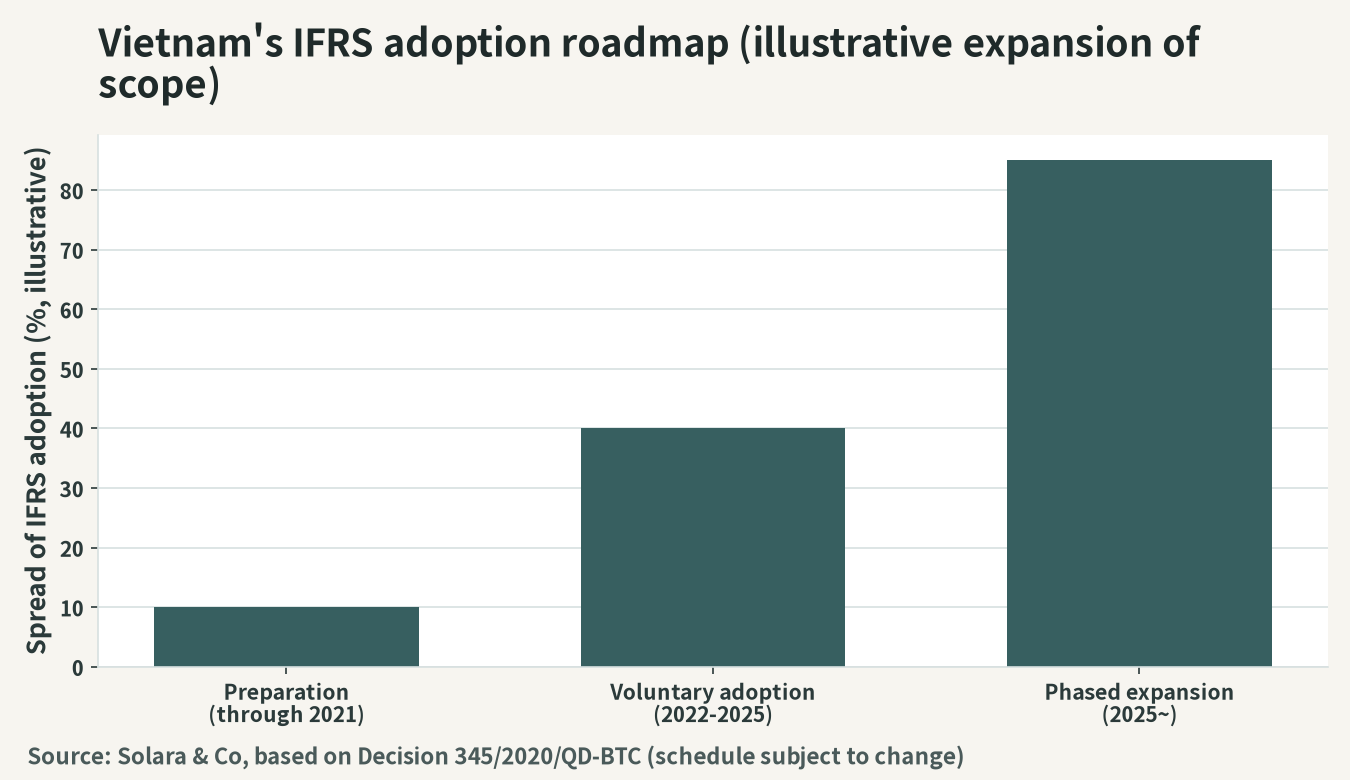
Vietnam set out a roadmap for adopting IFRS through a decision of the Ministry of Finance (Decision 345/2020/QD-BTC). It takes a phased approach.
From a Voluntary-Adoption Period to a Gradual Expansion
In the roadmap, after a preparation period, the years 2022 through 2025 are designated as a period in which certain enterprises—such as listed companies, large public-interest entities, and FDI enterprises—may voluntarily apply IFRS, after which the policy is to widen the scope and proceed with adoption in stages. In parallel, work is under way to develop a new financial reporting framework (VFRS) that is based on IFRS but tailored to Vietnam's circumstances. However, because the actual application schedule and scope remain fluid, checking the latest regulatory developments is indispensable.
The Regime Difference Between Large Enterprises and SMEs
Vietnam's accounting regime also has application categories according to scale. Many Japanese local subsidiaries apply the regime for large enterprises (Circular 200), but a small sales subsidiary, for example, may in some cases elect the simplified regime for small and medium-sized enterprises (Circular 133). Because which one is applied changes the accounts and the level of detail of disclosure, the choice of accounting policy at the time of establishment should be decided with an eye to the future burden of head-office consolidation and audit. Choosing the simplified regime too casually can lead to a situation where the granularity of information later required by head office cannot be obtained.
The Major Differences Between VAS and IFRS
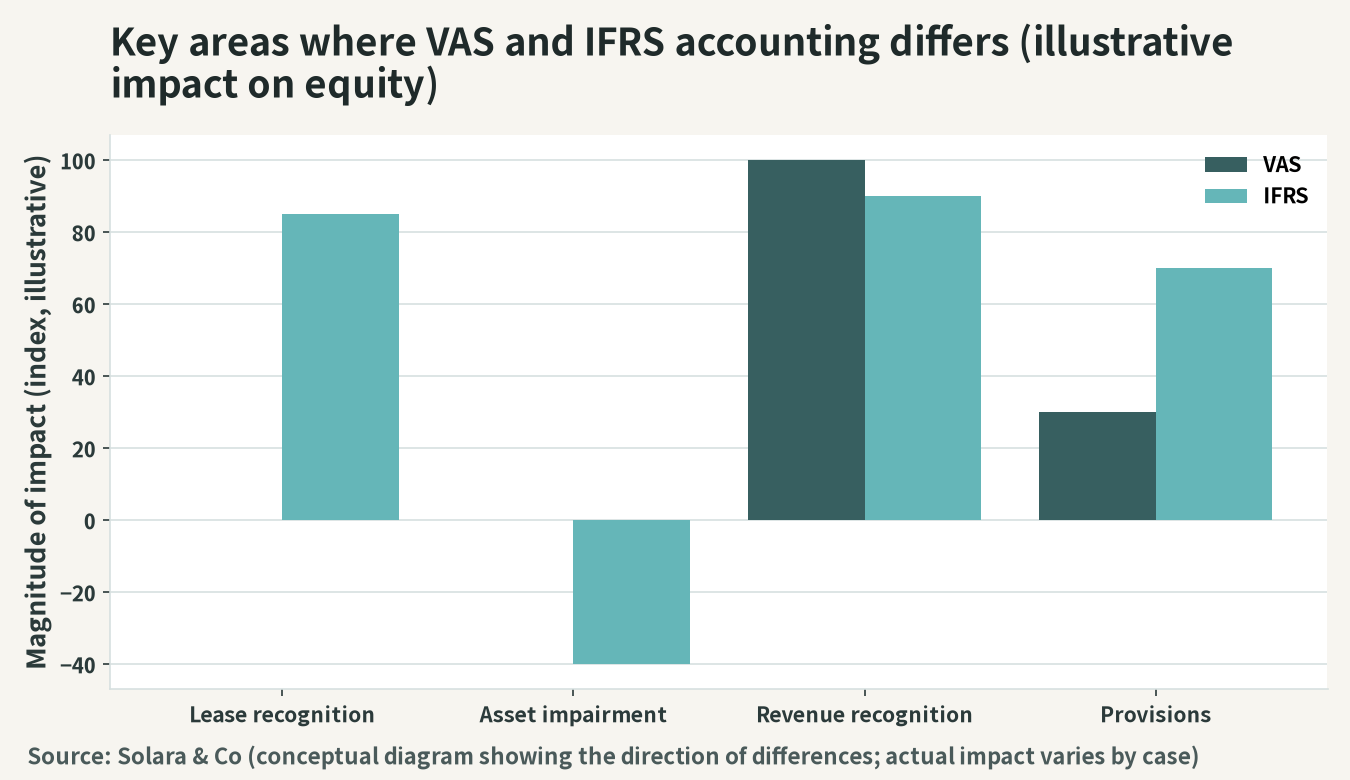
Let us look at the representative differences that become a burden for consolidation adjustments in practice. In every case the direction of the difference is "limited recognition and measurement under VAS, more refined under IFRS."
Fair Value and Impairment of Assets
IFRS requires measurement at fair value for investment property, financial instruments, and the like, whereas VAS is based, in principle, on historical cost. Moreover, regarding the impairment accounting that IFRS (IAS 36) requires, VAS has no systematic impairment standard, so the timing and amount of impairment recognition for fixed assets and goodwill differ substantially.
Lease Accounting (On-Balance-Sheet)
IFRS 16 requires the lessee to recognize almost all leases as assets and liabilities (on-balance-sheet). Under VAS, by contrast, operating leases remain off-balance-sheet and are expensed, so for a subsidiary that leases factories, warehouses, or vehicles, recasting into IFRS surfaces a large amount of right-of-use assets and lease liabilities, changing the financial metrics.
Revenue Recognition and Financial Instruments
VAS has no refined standards corresponding to revenue recognition under the "five steps" of IFRS 15 or to financial instruments under IFRS 9 (the expected-credit-loss model and so on), so the timing of revenue recognition and the thinking on provisions differ. In addition, the fact that VAS has no concept of a functional currency (IFRS measures in the functional currency) and is denominated in VND in principle, the scope of deferred-tax recognition, and the estimation of various provisions are all breeding grounds for differences.
Depreciation and Provisions
Frequently arising in practice are the differences in depreciation and provisions. Under VAS, the useful life of fixed assets is strongly influenced by tax rules (such as Circular 45), and there is a tendency to align depreciation with the range allowed for tax purposes. Because IFRS requires an estimate based on the economic useful life, even for the same equipment the depreciation expense and carrying amount do not match. Likewise, for provisions such as retirement benefits, bad debts, and warranties, VAS tends to be constrained by the requirements for tax deductibility, so recognition tends to be limited, creating a gap with IFRS's estimate-based provisions. These are "standard differences" that appear without fail at every recasting, and they are an area well worth turning into rules from the outset.
The Linkage of Audit, Filing, and Profit Remittance
Complying with VAS does not stop at mere bookkeeping; it is closely linked to a series of procedures—audit, tax filing, and profit remittance.
The Statutory Audit and the Closing Schedule
An FDI enterprise is obligated to prepare and submit financial statements audited by an audit firm licensed in Vietnam within 90 days of the end of the financial year. These audited VAS financial statements become the basis for the corporate income tax return and, further, a prerequisite for remitting profit (dividends) to the Japanese head office. In other words, the structure is such that if the VAS closing is delayed or the audit raises issues, even the flow of funds back to head office is held up. Beyond just the consolidation schedule, building a closing system that works backward from the local audit and filing deadlines is indispensable.
Differences in Goodwill and Consolidation
For a subsidiary acquired through M&A, the treatment of goodwill is also a breeding ground for differences. Whereas VAS amortizes goodwill on a regular basis over a fixed period, IFRS does not amortize goodwill but performs an impairment test each period. In post-acquisition consolidation, this difference in amortization and impairment directly affects profit, so the recasting policy needs to be fixed early, together with the purchase price allocation (PPA) at the time of acquisition.
The Response Japanese Subsidiaries Should Adopt
On the premise of these differences, a Japanese subsidiary needs to build a realistic response framework.
Designing a "Recast" Rather Than a Double Set of Books
The important thing is not to keep, separately from the VAS books, a duplicate set of books for head office, but to standardize a process that keeps VAS as the master record while, at closing, identifying the differing items and "recasting" them into IFRS/J-GAAP. If you list the "differences that always appear"—useful-life gaps in depreciation, on-balance-sheet lease recognition, impairment, provisions, and the timing of revenue recognition—and prepare templates of recasting entries, you can greatly reduce the periodic consolidation burden and errors.
Communication Between Local Accounting and Head Office
Many of the differences arise precisely because local accounting is performing "treatment that is correct under VAS." If head office demands corrections without understanding "why the numbers differ," it invites friction with the local team and errors. A framework that shares the reason for each difference and the basis for the recast—through personnel who understand both VAS and IFRS, or an external specialist—is the key to accurate and timely consolidation. In particular, because reconciling differences from scratch during the busy season at period-end is inefficient, taking stock of the major differences each quarter and leveling out the points at issue greatly lightens the period-end burden. Such alignment of accounting and internal control is also directly connected to the subsidiary's governance and to accounting integration after M&A.
The Main Differences Between VAS and IFRS (Comparison Table)
Organizing the representative points gives the following.
Issue | VAS | IFRS |
|---|---|---|
Measurement basis | Centered on historical cost | Broad use of fair value |
Impairment of assets | Few systematic standards | Recognizes impairment under IAS 36 |
Leases (lessee) | Operating leases off-balance-sheet | On-balance-sheet in principle under IFRS 16 |
Revenue recognition | Limited provisions | The five steps of IFRS 15 |
Currency | VND-denominated in principle | Measured in the functional currency |
The essence of accounting in Vietnam is a two-tier design: "complete the statutory closing under VAS while systematically recasting the differences to load them into head-office consolidation." If you grasp in advance where the differences lie and standardize the recasting process, you will no longer be thrown off balance at every closing. Solara & Co provides support—from the VAS-compliant statutory closing and audit response, to the design of the recast into IFRS/J-GAAP, the building of the local accounting structure, and accounting due diligence in M&A and subsidiary management—with a team versed in accounting practice on both the Japanese and Vietnamese sides. We will accompany you in taking the first step toward resolving "the numbers won't reconcile" at the structural level. Leaving the differences unaddressed turns every closing into a war of attrition, but once you properly set up the recasting rules and structure, you will be able to run both local statutory compliance and head-office consolidation in a stable manner.