
Vietnam's corporate tax cannot be summed up by the "standard 20%" alone
The tax question most frequently raised by Japanese companies considering entry into Vietnam is, "In the end, what percentage of corporate tax will we actually pay?" It is true that the standard rate of Vietnam's corporate income tax (CIT) is 20%, which holds up well even against Japan or Singapore. Yet making an investment decision on the basis of this 20% figure alone misreads the reality in two ways.
First, Vietnam offers a generous set of tax incentives tailored to industry, location, and investment scale; when the conditions are met, the effective rate can be lowered to around 10%, and in some cases to zero for the first several years. Second, conversely, the global minimum tax (Pillar Two) introduced from 2024 has created a structure in which, for multinational enterprise groups above a certain size, hard-won incentives are effectively clawed back by the "minimum 15%" wall.
This article first sets out the basic structure of Vietnam's corporate tax, then explains the three categories of tax incentives (preferential rates, exemptions and reductions, and special incentives), their qualifying conditions, and the pitfalls that Japanese companies tend to fall into in practice, all in light of the latest regulatory developments.
The basic structure of Vietnam's corporate tax
Vietnam's CIT is levied on taxable income arising within Vietnam, whether the taxpayer is a domestic corporation or a foreign-invested (FDI) enterprise. The fiscal year is in principle the calendar year (January to December), though the accounting period can be changed upon application.
Standard rate and industry-specific special rates
The standard rate is 20%. Against this, higher rates apply to resource-related businesses: oil and gas exploration and extraction are taxed at 32–50%, and the extraction of scarce natural resources (gold, silver, rare earths, and the like) at 40–50%.
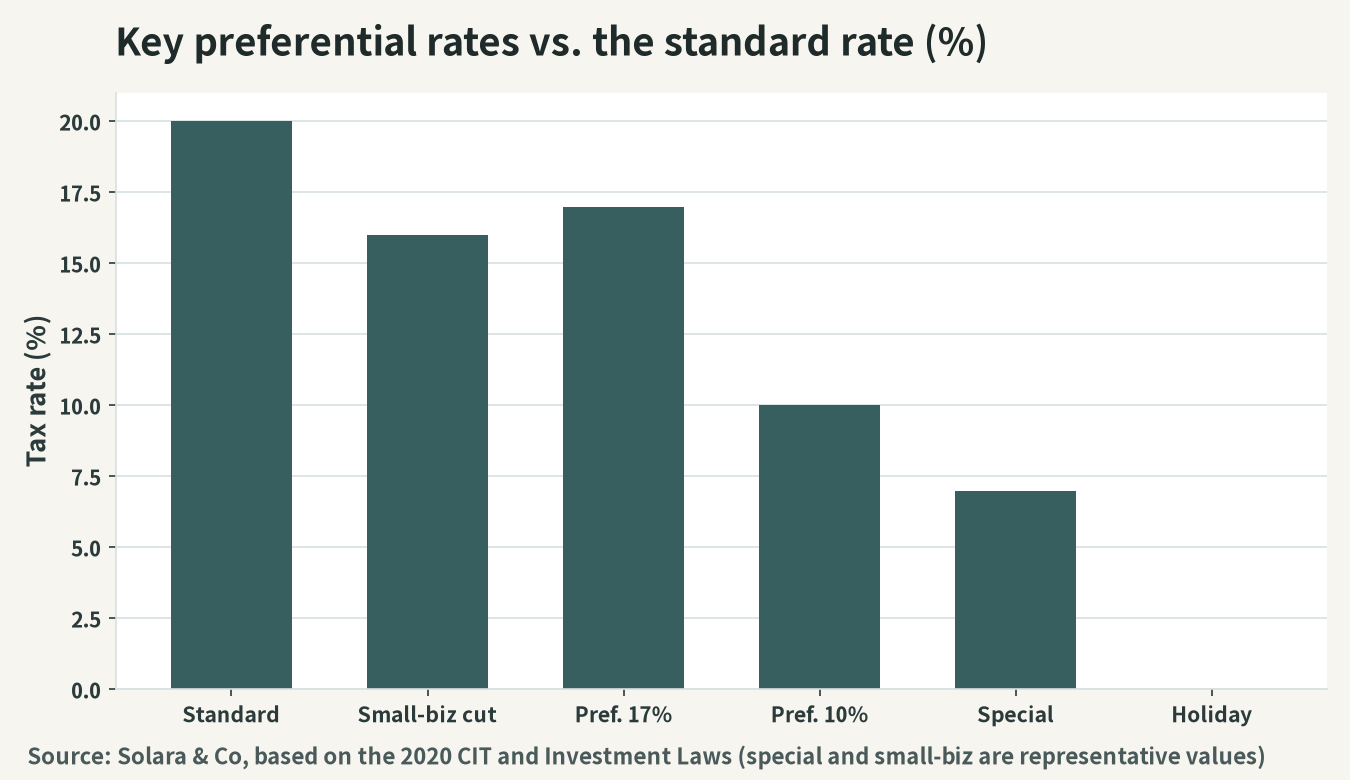
Furthermore, the new corporate tax law effective October 2025 introduced reduced rates for companies with smaller revenue. Micro-enterprises with annual revenue of 3 billion VND or less are subject to 15%, and small and medium-sized enterprises with revenue between 3 billion and 50 billion VND to 17%. Even Japanese local subsidiaries may qualify for these reduced rates in their early-stage or small-scale sales subsidiaries, so the applicable category needs to be confirmed.
Calculating taxable income and the treatment of deductible expenses
Taxable income is calculated as "assessable income minus deductible expenses," but Vietnam imposes strict requirements for deductibility. Expenses not backed by a proper invoice (a VAT-compliant invoice), cash settlements exceeding 20 million VND (payments not made by bank transfer), and excessive interest paid to related parties tend to be treated as non-deductible, and these are areas with a high risk of disallowance at filing. Losses may be carried forward for up to five years, but loss carrybacks for refunds are not permitted.
Tax incentive 1: Preferential rates (10% and 17%)
The pillar of Vietnam's tax incentives is the system that applies a preferential rate below the standard 20% for a defined period. The representative forms are a two-tier structure of 10% (up to 15 years) and 17% (up to 10 years), with eligibility determined by whether the activity falls under an "encouraged industry" or an "encouraged location."
10% and 17% by encouraged industry
High technology, research and development (R&D), software production, renewable energy, environmental protection, education and vocational training, healthcare, and infrastructure development qualify as encouraged industries that the state wishes to attract, and are eligible for the 10% or 17% preferential rate. The software production industry in particular is a leading example, able to receive the 10% rate for 15 years regardless of location, and Japanese IT companies using Vietnam as an offshore development base have long taken advantage of it.
Incentives by encouraged location
New investment projects located in areas with difficult socio-economic conditions, economic zones (EZs), and high-tech parks (such as Hoa Lac and Saigon Hi-Tech Park) are also eligible for preferential rates. Even within the same manufacturing sector, the tax burden differs greatly depending on whether the operation is placed in central Hanoi or Ho Chi Minh City or in a regional industrial park or economic zone, so site selection should be considered as an integral part of tax strategy.
Tax incentive 2: Exemptions and reductions (tax holiday)
Equally important alongside preferential rates is the "tax holiday," under which tax is exempted for a defined period from the first year in which taxable income arises, and then reduced by 50% for a further defined period.
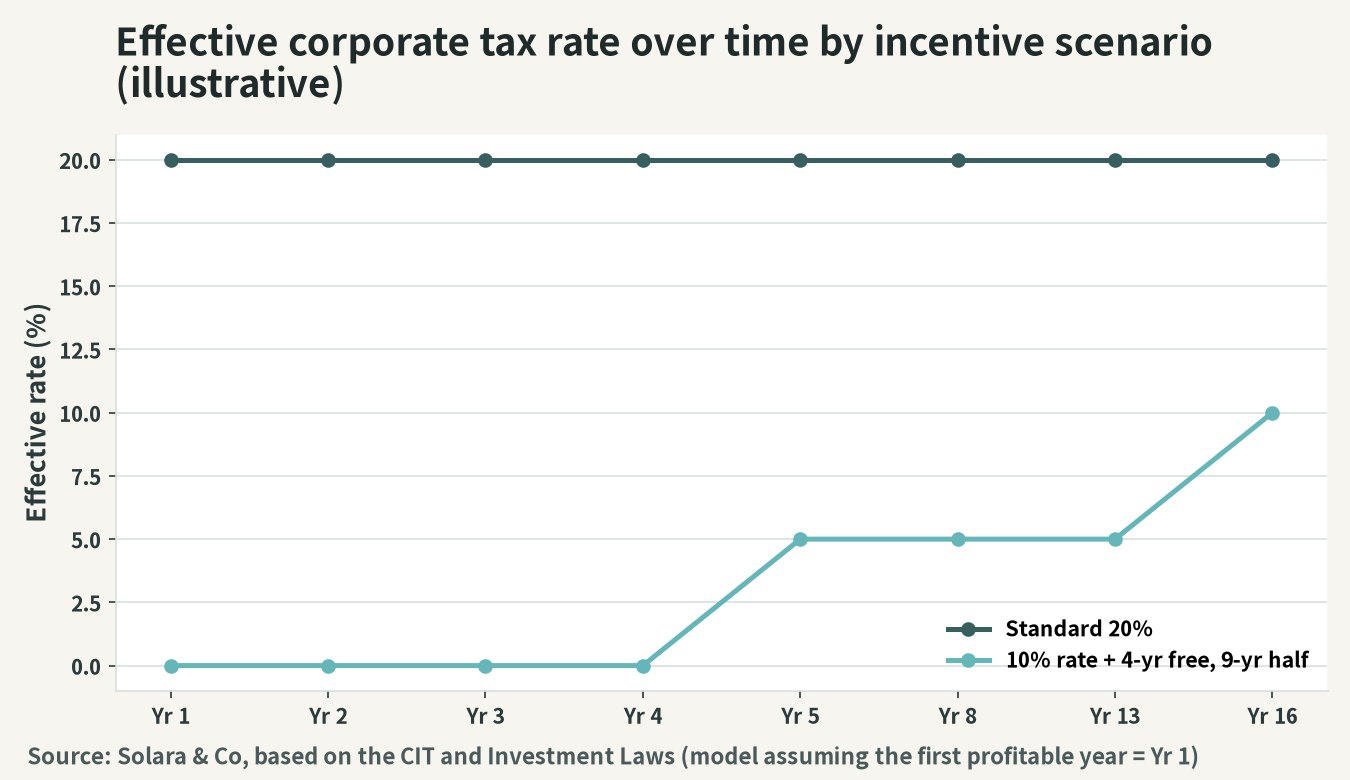
The basic "4 years exempt + 9 years halved" pattern
The most generous is four years of full exemption plus a subsequent nine years at a 50% reduction (the so-called "4+9"). This is often applied in combination with the 10% preferential rate and is aimed at large-scale high-tech or economic-zone projects. A somewhat lighter pattern, "2 years exempt + 4 years halved (2+4)," also exists.
What matters is the starting point of the exemption period. The exemption is counted from "the first year in which taxable income arises," but if the business does not become profitable within three years of commencing operations, the count begins compulsorily from the fourth year of operation. For manufacturing businesses that take time to ramp up, a delay in reaching profitability can mean the exemption period elapses without the benefit being fully used, so aligning the business plan with the exemption schedule is essential.
Reductions apply only to "income from the incentivized project"
A point that is easily overlooked is that the incentive applies not to the company as a whole but only to "income arising from the incentivized project." When an incentivized business and a non-incentivized business are run concurrently, revenues and expenses must be accounted for separately, and the incentivized income must be isolated and calculated on its own. If the separation is inadequate, there is a risk that part or all of the incentive will be disallowed during a tax audit.
Tax incentive 3: Special investment incentives and the investment procedure
The 2020 Investment Law created a new "special investment incentive" for large-scale and cutting-edge projects that are strategically important to the state. Projects with a total investment of around 30 trillion VND or more, as well as national-level R&D centers and the like, are eligible, and conditions exceeding the norm—preferential rates of 5–9%, exemptions of up to 6 years plus reductions of up to 13 years—may be granted on a Prime Minister-approval basis.
The basis for the incentive and the timing of its determination
The incentive is applied through its statement in the Investment Registration Certificate (IRC) and through self-assessment in the first year's finalization return. In Vietnam, the basic framework is not a system of prior case-by-case approval but rather one in which "the enterprise itself judges that it meets the conditions set out in the law, applies the incentive accordingly, and is verified after the fact in a tax audit." For this reason, it is extremely important in practice to assemble materials demonstrating the basis for application (industry code, location, fulfillment of conditions) and to remain ready to explain it to the authorities at any time. The overall procedure for obtaining an investment license is also organized in our explanation of Vietnam's foreign investment regulations and entry procedures.
The global minimum tax as a "ceiling on incentives"
From January 2024, Vietnam introduced the OECD's Pillar Two (global minimum tax). Multinational enterprise groups with consolidated revenue of 750 million euros or more in at least two of the immediately preceding four fiscal years must, if their effective tax rate in Vietnam falls below 15%, pay the difference as a "qualified domestic minimum top-up tax (QDMTT)."
In other words, for a local subsidiary belonging to a large enterprise group, even if a 10% preferential rate or an exemption lowers the effective rate below 15%, that difference is clawed back. As an offsetting measure, Vietnam has put in place a subsidy scheme through an Investment Support Fund (Decree 182/2024), seeking to maintain a substantive attraction effect through cash support for high-tech and R&D investment. Japanese companies whose group revenue is large in aggregate will not obtain the tax savings they envisaged unless they design "tax incentives" and the "minimum tax" together as a set.
Filing and payment schedule and practical considerations
Whether or not incentives apply, Vietnam's CIT has filing and payment conventions that differ from Japan's, and a stumble here can give rise to unexpected back-taxes or cash-flow disruption.
Quarterly provisional payments and the annual finalization return
In Vietnam, since 2014, quarterly filing of returns has no longer been required, but quarterly provisional tax payments remain. The estimated tax amount must be paid by the end of the month following each quarter, and a finalization return is filed and settled within 90 days after the end of the fiscal year. What to watch out for is the "80% rule": if the cumulative provisional payments through the end of the fourth quarter fall below 80% of the annual finalized tax, late-payment interest is charged on the shortfall. When mid-period performance exceeds expectations, the provisional payment amount needs to be topped up flexibly.
Dividend remittance and the adjustment for double taxation
Even if incentives are obtained at the corporate level, a separate analysis is required when profits are remitted as dividends to the Japanese parent. Vietnam does not impose withholding tax on dividends from a corporation to a foreign corporate shareholder, but remittance requires audited financial statements and proof that tax obligations have been settled, and the segregation of incentivized income and the consistency of transfer pricing documentation come into question. On the Japanese side, it is essential to confirm whether the dividend exemption regime for foreign subsidiaries applies and to check whether double taxation arises across the group as a whole.
The overall picture of tax incentives (comparison table)
Organizing the main incentive categories by rate, period, principal targets, and legal basis gives the following. Whether they actually apply must be judged precisely on the basis of the industry code, location, and the content of the investment registration.
Incentive category | Rate | Indicative period | Principal targets | Legal basis |
|---|---|---|---|---|
Standard rate | 20% | Permanent | General businesses | CIT Law |
Small-scale reduction | 15–17% | Permanent | Annual revenue of 50 billion VND or less | New CIT Law (from 2025) |
Preferential rate (mid-tier) | 17% | Up to 10 years | Certain encouraged locations and industries | CIT Law / Investment Law |
Preferential rate (top-tier) | 10% | Up to 15 years | High-tech, software, economic zones, etc. | CIT Law / Investment Law |
Exemption + reduction | 0%→50% | 2+4 / 4+9 | Income of the above incentivized businesses | CIT Law |
Special investment incentive | 5–9% | Exemption up to 6 years + reduction up to 13 years | Strategic large-scale and R&D | Investment Law 2020 |
Points Japanese companies should watch in practice
First, incentives are not "automatically granted" but rather "self-applied + verified after the fact." Keeping the basis for application on record in documents and accounting for incentivized income separately is the lifeline that prevents disallowance during an audit. Second, consistency with transfer pricing (TP). Steering too much profit to a local subsidiary on a preferential rate raises concerns from the standpoint of arm's-length pricing in related-party transactions and runs afoul of the documentation obligations under Vietnam's transfer pricing rules. Third, the treatment of dividends and profit remittance. Even with incentives at the corporate level, dividends to Japan require separate analysis, and on the accounting side there also arises the need to deal with the differences between Vietnamese Accounting Standards (VAS) and IFRS.
Tax incentives are a powerful lever that greatly influences the profitability of investment in Vietnam, but they only function when the fulfillment of conditions and documentation, the relationship with the minimum tax, and consistency with transfer pricing are designed together as a whole. From the structuring stage of market entry, Solara & Co provides consistent support—estimating incentives according to location and industry, building out the basis for application, and handling dealings with the tax authorities—from the perspectives of both Japan and Vietnam. We begin by helping you map out the effective rate that lies beyond the "standard 20%," tailored to your business plan.