
Prepare for a Vietnamese Tax Audit on the Premise That "It Will Surely Come Someday"
For Japanese companies operating in Vietnam, a tax audit (thanh tra/kiểm tra thuế) is not an "exceptional occurrence" but an "event that visits periodically." In particular, foreign-invested enterprises (FDI enterprises) are prone to being designated as a focus by the authorities, and corporations that have been established for several years, corporations applying tax incentives, and corporations with large related-party transactions will almost certainly be audited at some point. The question is not "whether it will come" but "whether there is a structure that can withstand it when it comes."
What decisively distinguishes Vietnamese tax audits from Japanese ones lies in two points: (1) back-assessment reaching into past filings, with surcharges and late-payment interest accumulating on top of the principal tax; and (2) the interpretation of law tending to depend on the officer in charge at the site, so that without documentary backing one is prone to an unfavorable determination. This article organizes, from a practical standpoint, the types of audits and their triggers, the flow of an audit, the points on which Japanese companies are prone to being "hit," and how to prepare "before, during, and after" an audit. For the overall picture of corporate income tax, please refer to Vietnam's Corporate Income Tax and Tax Incentives; for transfer pricing, please refer to Vietnam's Transfer Pricing Taxation.
Types of Tax Audits and Their Triggers
The first step of preparation is to know which type of audit one's own company is prone to becoming the target of. Depending on the nature, the burden and the response to each audit change greatly.
Routine Inspection (kiểm tra) and Special Inspection (thanh tra)
A routine inspection (kiểm tra) is an ordinary, confirmatory inspection that checks the consistency between the filed contents and the books. A special inspection (thanh tra), on the other hand, is a more probing investigation, triggered by serious doubts, a tip-off, dissolution or liquidation, or the end of incentives, with a broad scope and a longer period. An audit at the time of liquidation tends to become an obstacle to exiting the business, and is also a key point in the exit and liquidation practice of M&A.
Characteristics of Companies Prone to Being Selected
Continuing to operate despite consecutive years of losses (suspected of profit shifting through transfer pricing), applying tax incentives, having large related-party transactions or payments of royalties and management-guidance fees, applying for VAT refunds, and a tax payment lower than the industry average relative to revenue—corporations with such characteristics are selected at the top in the authorities' risk assessment. It is essential to grasp which "red flag" one's own company corresponds to, and to be prepared so as to be able to explain it.
In recent years, the digitalization of the authorities has progressed, and with the full mandating of electronic invoices (e-invoices) and the sophistication of data matching, inconsistencies between filings and actual transactions have become easier to detect automatically. The rule of thumb that "it has been fine because I have not been hit before" no longer holds. Management must recognize that even past treatments that passed without issue carry the risk of being pointed out retroactively through the refinement of data analysis.
The Flow of a Tax Audit — Five Stages
An audit proceeds along a set procedure. Understanding what happens and what is demanded at each stage allows one to respond without panicking.
A Vietnamese tax audit generally proceeds in five stages: (1) advance notice and document requests, (2) on-site investigation (field audit), (3) the draft of points raised and rebuttal, (4) the issuance of the audit conclusion document (kết luận), and (5) appeal or litigation if there is dissatisfaction. Particularly important is the third stage; the point at which the authorities present the draft of points raised (the record) is the last substantive opportunity to rebut with documents and logic. If one signs the record here without having presented an effective counter-argument, a subsequent appeal becomes markedly disadvantageous.
The Importance of the Rebuttal Phase (Minutes, Records)
In the course of the on-site investigation, exchanges with the officer in charge are recorded in minutes (biên bản). Because matters carelessly admitted orally, once they remain in the minutes, are difficult to overturn later, the safe attitude is to answer based on facts, together with supporting documents, and, if necessary, to take the matter back and respond in writing. Avoiding ambiguous immediate answers and putting everything on a documentary basis is the basic etiquette of audit response. Signing the minutes is a grave act that finalizes the recorded content, so if there is a description that differs from one's understanding, one must always demand correction before signing, and have a reservation or a dissenting opinion noted alongside. Internally, it is important to decide in advance who will check and sign the minutes, so as to avoid a situation in which a front-line staffer signs alone.
Tax Points on Which Japanese Companies Are Prone to Being Hit
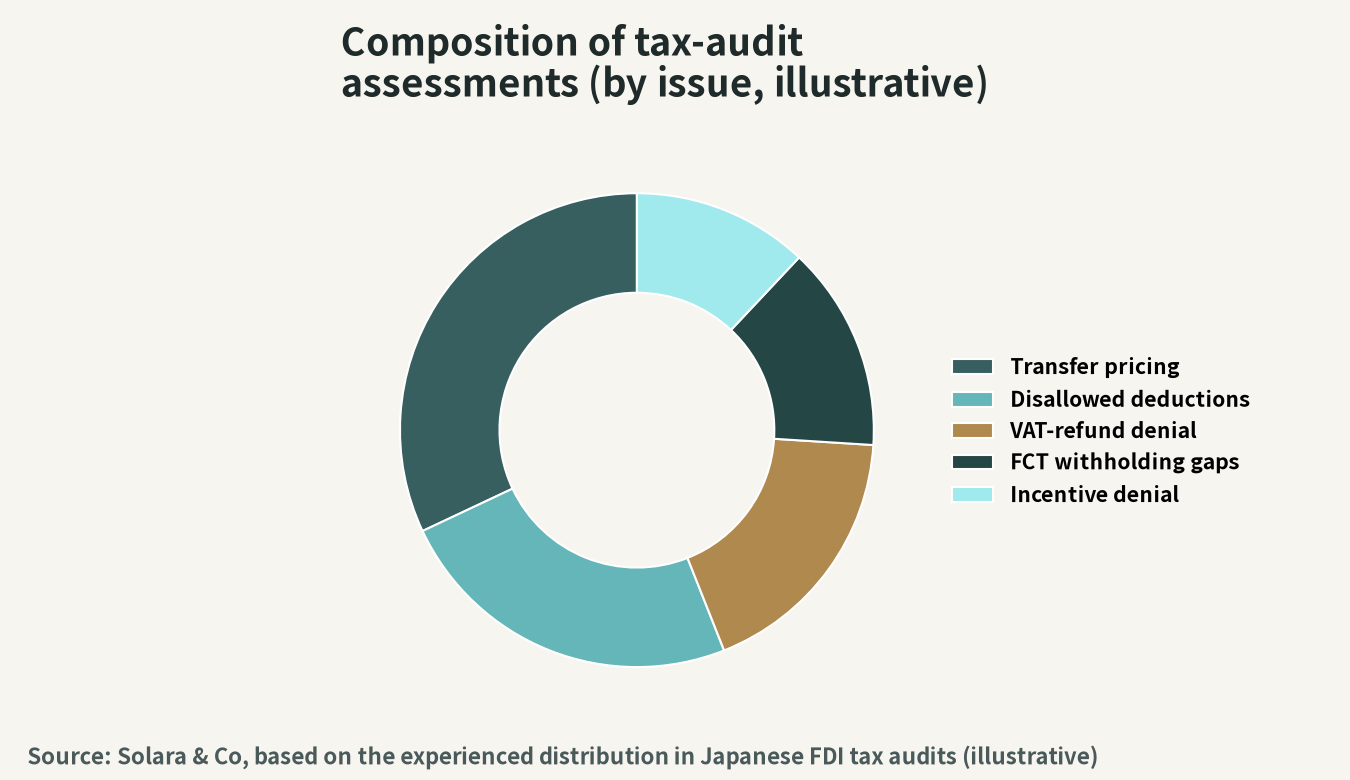
Most back-assessments are concentrated on several classic points. By self-inspecting in advance, one can nip the buds of being hit.
Transfer Pricing (TP) and Related-Party Transactions
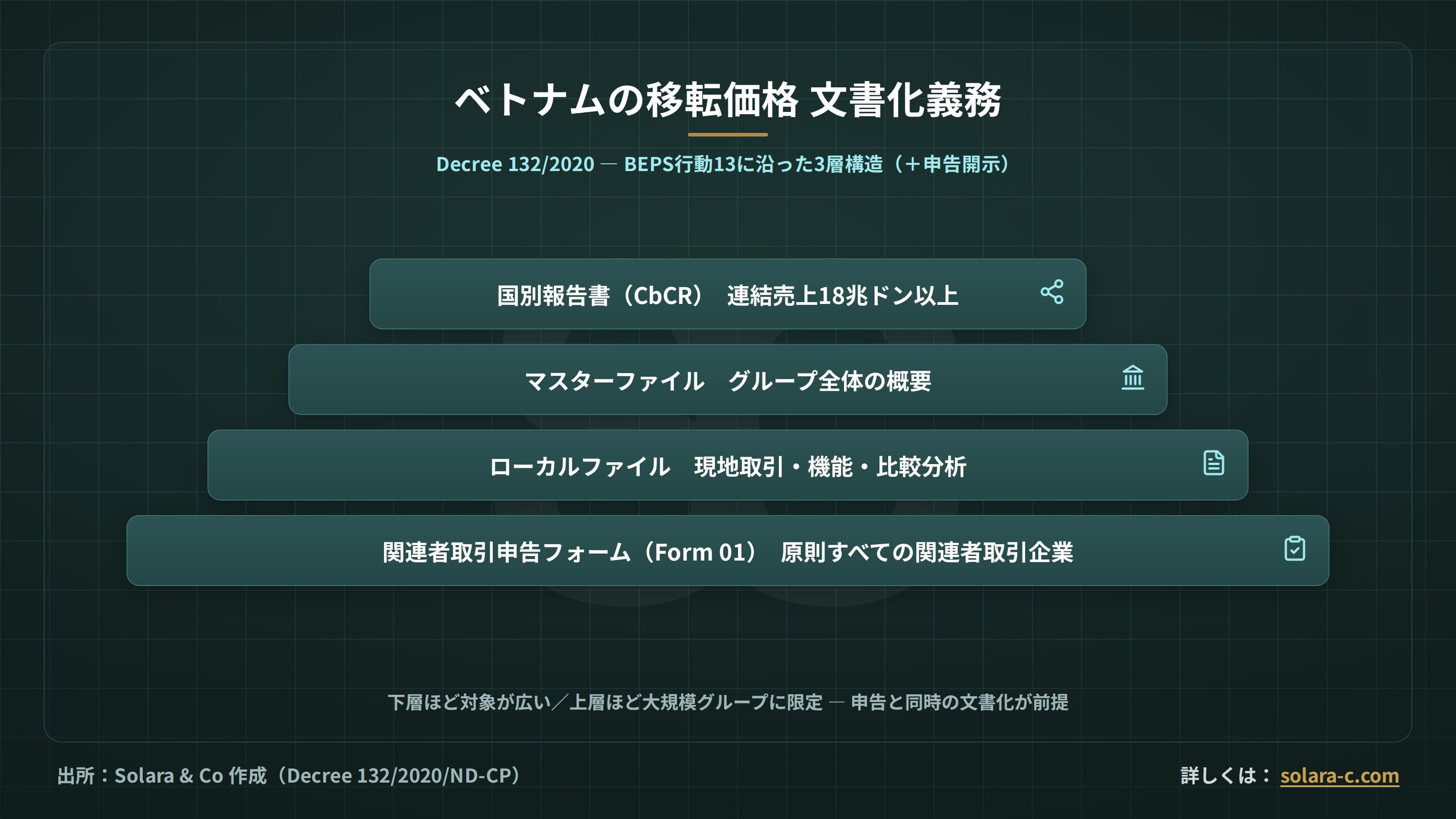
The largest point is transfer pricing. Cases never cease in which a company is suspected of shifting profit to its Japanese head office or regional headquarters and receives a huge back-assessment on the grounds of divergence from the arm's-length price. Typical are deficiencies in contemporaneous documentation (local file, master file), the absence of benchmark analysis, and insufficient proof of the substance of management-guidance fees and royalties. Corporations with consecutive years of losses are especially targeted. The Vietnamese authorities in particular strictly demand proof that, for management-guidance fees, technical-guidance fees, and brand-usage fees paid within the group, "the service was actually provided and brought benefit to the local corporation." Having a contract alone is insufficient; the accumulation of evidence demonstrating the real existence of the benefit—actual deliverables, emails, business-trip records, and the like—is the decisive factor of a rebuttal. If it cannot be proven, one may suffer a double blow: full disallowance as a deductible expense plus a transfer-pricing adjustment.
Disallowance of Deductions, VAT, and Withholding (FCT)
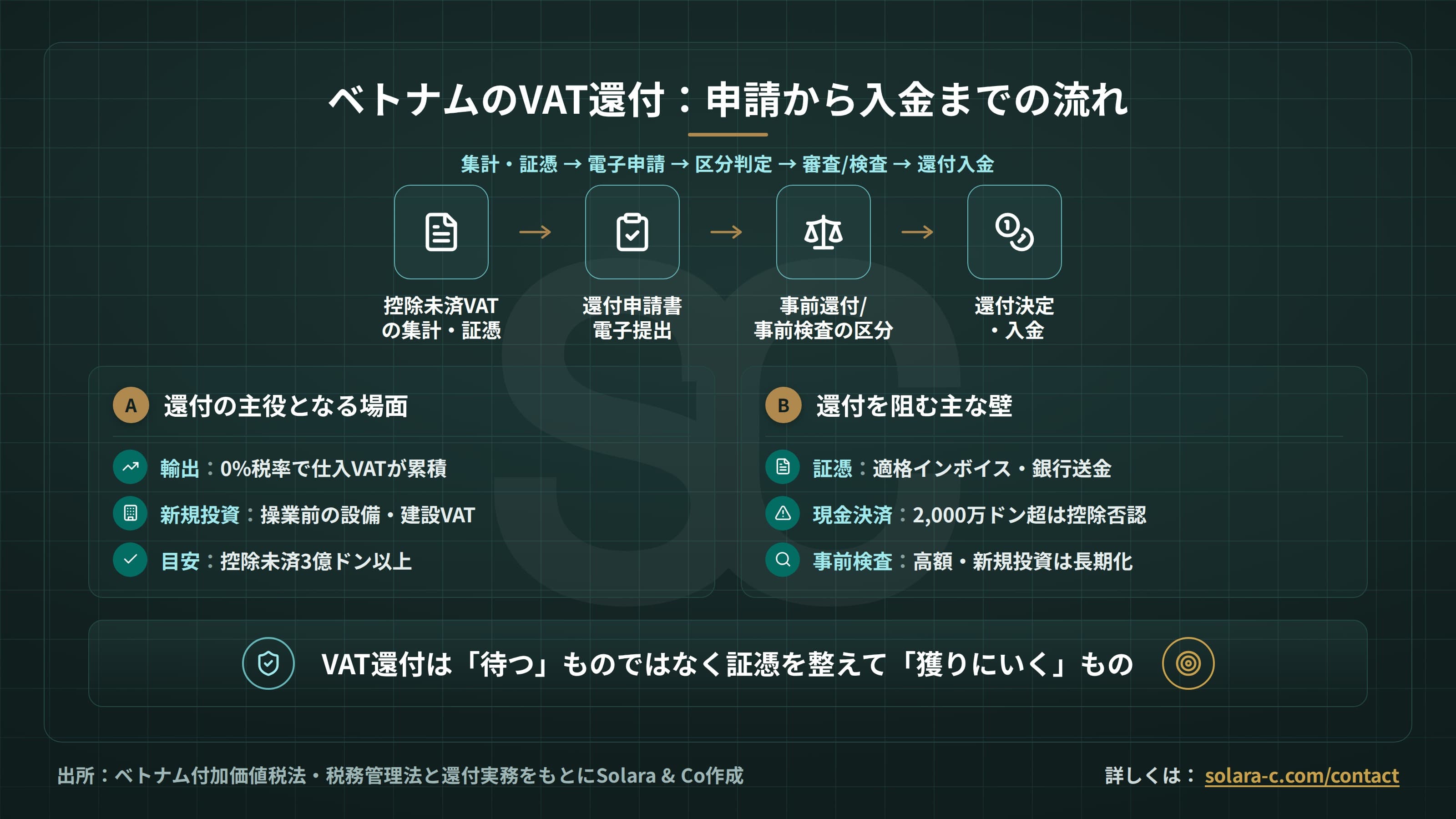
In corporate income tax, expenses without a qualified invoice, cash settlements exceeding VND 20 million, and expenses with deficient contracts or supporting documents are disallowed as deductions. In VAT, typical are deficiencies in the requirements for input-tax credit and the overstatement of refunds; in FCT (Foreign Contractor Tax), typical is the omission of withholding on interest, royalties, and service consideration paid abroad. These are areas that can be prevented by internal control, so the development of internal control and fraud prevention is effective. FCT in particular, despite extending widely to payments to overseas parent companies and suppliers, is prone to being overlooked, so attention is needed to the point that transactions for which withholding is not consciously considered in Japan—software-usage fees, cloud expenses, technical-support fees, interest, and the like—become subject to taxation. Determining the tax classification, tax rate, and the applicability of a tax treaty at the contracting stage, and factoring it into the price including a gross-up clause, prevents subsequent back-assessment and disputes over the burden between the parties.
Pre-Audit Preparation — Documentation and Internal Structure
In tax-audit response, 80% of the outcome is decided before the audit begins. Because documents created after the fact are not trusted, peacetime documentation is everything.
The retention of qualified invoices and contracts and supporting documents, the updating of transfer-pricing documentation every period, the development of the basis for applying tax incentives (industry code, location, fulfillment of conditions), and materials explaining the reasonableness of the pricing of related-party transactions—keep these in a state where they "can be produced immediately whenever an audit comes." Keep the accounting records in compliance with Vietnamese Accounting Standards (VAS), and align the handling of the differences between VAS and IFRS as well. In addition, deciding the point person for the tax audit and documenting the internal flow of authority-response (who answers and who approves) prevents the front line from running wild or carelessly making oral agreements.
Highly effective in practice is a "self-inspection (mock audit)" conducted without waiting for an audit. Commission an external expert to perform a simulated tax audit, and for each of the points of transfer pricing, deductions, VAT, FCT, and incentives, identify in advance the weaknesses the authorities are likely to raise, and reinforce them. If a problem is found, before the audit one can voluntarily correct it through an amended filing, which can lead to a reduction of surcharges. Rather than hurriedly creating documents after something is discovered, crushing weaknesses in peacetime—this is the most reliable method to structurally lower back-assessment risk.
The Etiquette of Response During an Audit
Once an audit begins, the "attitude" of the response itself determines the result. Being sincere and cooperative while firmly rebutting baseless points raised—this balance is the essence.
Submit the requested documents in good order within the deadline, and answer based on facts and supporting documents. Do not make the relationship with the officer in charge unnecessarily adversarial, but counter unjust determinations in writing. Do not hold everything internally; involve tax experts (accounting firms, tax agents) early, and separate the policy of "fight, accept, or negotiate" by point—this leads to the minimization of back-assessment. Because there are barriers of language and business custom, the attendance of an advisor who understands both the Japanese and Vietnamese sides is especially effective.
Back-Assessment, Penalties, and Appeals
When an audit results in a back-assessment, surcharges and late-payment interest are imposed in addition to the principal tax. Understanding the structure of the burden becomes the material for judging whether to fight or accept.
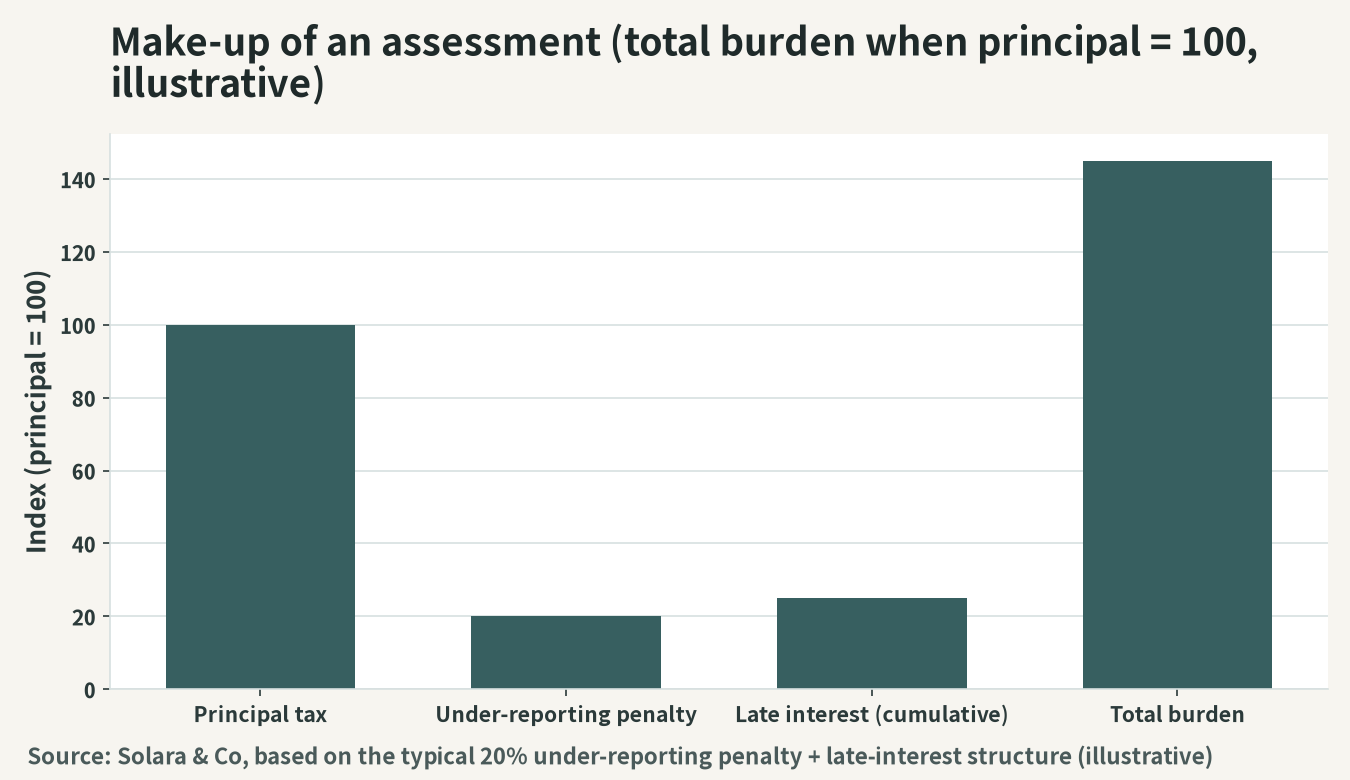
Underdeclaration is in principle subject to a 20% surcharge, late payment is subject to late-payment interest calculated daily (at a correspondingly substantial level on an annualized basis), and in malicious cases there are also heavier penalties and criminal risk. If one is dissatisfied with the audit conclusion document, there is a route of appeal: first a complaint to the authorities, then a request for review to a higher body, and finally administrative litigation. However, to fight, documentary grounds are indispensable, and here too peacetime documentation speaks. Depending on the point, accepting part of it to achieve early settlement may be more rational from the standpoint of time and cost than fighting across the board.
A Correspondence Table of Main Points and Preparation
Organizing the points on which Japanese companies are prone to being hit, together with the preparation to be made in peacetime, is as follows. Please use it as a starting point for inspecting your own company's applicable situation.
Point raised | Main cause | Peacetime preparation | Response during audit |
|---|---|---|---|
Transfer pricing | Documentation deficiency, consecutive losses | Update TP documentation every period | Rebut with benchmarks |
Disallowance of deductions | Deficiency in supporting documents, invoices | Thorough retention of qualified documents | Prove the contract and real existence |
VAT refund denial | Deficiency in requirements, overstatement | Self-inspect the credit requirements | Present the real existence of transactions |
FCT omission | Omission of withholding on overseas remittances | Determine the contract type in advance | Assert treaty application |
Incentive denial | Deficiency in separate accounting | Develop documentation of the application basis | Explain the fulfillment of conditions |
Conclusion: In Tax-Audit Response, "Peacetime Documentation" Is Everything
A Vietnamese tax audit is an unavoidable event, and its outcome is largely decided by the preparation before the audit begins. For each classic point—transfer pricing, deductions, VAT, FCT, and incentives—prepare the basis for application and the real existence of transactions as "documents that can be produced at any time." And during the audit, respond sincerely yet firmly, on a documentary basis throughout. This is the only royal road to minimizing back-assessment. Solara & Co supports the entire process—from building a peacetime documentation framework, to authority-response during an audit, to appeal strategy—from the perspective of both the Japanese and Vietnamese sides.