
An Expatriate's Vietnamese Personal Income Tax Changes Entirely on "Resident or Not"
For Japanese companies sending expatriates to Vietnam, personal income tax (PIT) and social insurance are critical issues that bear directly on both the individual's take-home pay and the company's labor costs. Yet misconceptions remain deeply rooted—"part of the salary is paid in Japan, so it has nothing to do with the local side," or "a short business trip is not taxed"—and cases of being hit later with large back taxes and late-payment interest are endless.
The first thing determined in Vietnam's PIT is whether that expatriate is, for tax purposes, a "resident" or a "non-resident." This single classification entirely changes the scope of income subject to tax, the tax rates applied, and the filing method. This article organizes, from the practical standpoint of managing expatriates, everything from the criteria for determining residency, the progressive tax rates and the various deductions, the in-kind benefits that are taxed, through to the social insurance that has been mandatory for foreigners as well since the end of 2018.
Determining Resident vs. Non-Resident Status
In Vietnam, you become a "resident" for tax purposes if you fall under any one of the following: (1) you stay in Vietnam for a total of 183 days or more within a calendar year or within 12 consecutive months from the date of entry; (2) you have a permanent place of residence in Vietnam (a registered habitual abode); or (3) you stay for a total of 183 days or more in the tax year at a residence held under a lease—any one of these.
What Changes Between Resident and Non-Resident
A resident is taxed on worldwide income, with progressive rates of 5–35% applied. The salary borne by the Japanese head office (so-called home-country pay) is also subject to filing for the portion corresponding to work performed in Vietnam. A non-resident, by contrast, is taxed only on Vietnam-source income, and employment income is subject to a flat proportional rate of 20%. Care is needed because the classification can change across years—a non-resident in the first year of a short assignment that does not reach 183 days, and a resident from the following year.
Progressive Tax Rates and Calculating Taxable Income
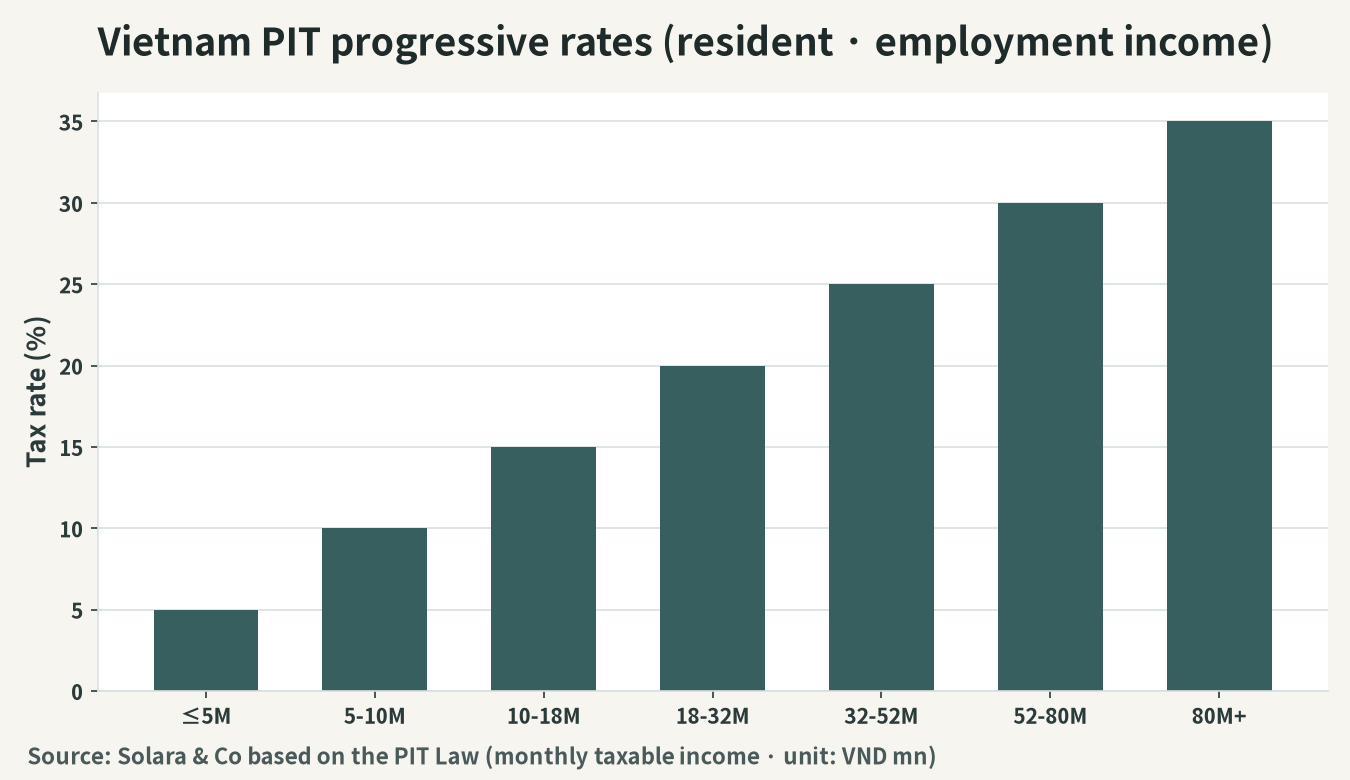
A resident's employment income is subject to a seven-bracket progressive scale according to monthly taxable income.
The Structure of the Tax Brackets
Monthly taxable income up to VND 5 million is taxed at 5%, VND 5–10 million at 10%, VND 10–18 million at 15%, VND 18–32 million at 20%, VND 32–52 million at 25%, VND 52–80 million at 30%, and above VND 80 million at 35%. As with Japan, it is a marginal-progressive method, where the higher rate applies only to the portion exceeding each bracket.
Personal Deduction and Dependent Deduction
When calculating taxable income, a deduction of VND 11 million per month (VND 132 million per year) is allowed for the individual, and VND 4.4 million per month for each dependent. To receive the dependent deduction, you must register the dependents and submit supporting documents, on the condition that the spouse, children, or parents meet certain income requirements. In addition, the individual's portion of mandatory social insurance contributions and certain charitable donations are also eligible for income deductions. Note that discussion continues over revising the amounts of the personal and dependent deductions in line with rising prices and wage levels, and any revision would affect the calculation of an expatriate's take-home pay. Reviewing the deduction assumptions at the timing of a salary revision or a bonus payment leads to accurate withholding with neither excess nor shortfall.
While these deductions apply to employment income and business income, non-salary income such as dividends, interest, real-estate transfers, and capital gains is each subject to its own fixed rate (mostly around 0.1–5%), with no personal deduction applied. If an expatriate earns investment income in Japan or Vietnam, the tax treatment must be examined separately for each income category.
The Treatment of "In-Kind Benefits" Specific to Expatriates
An expatriate's package includes a variety of in-kind benefits (fringe benefits) such as housing, children's education costs, home-leave travel, and a car. The line between what is taxable and non-taxable here greatly affects the estimate of expatriate costs.
What Is Taxed and What Is Not
A company-borne housing allowance is taxable, but there is a special rule capping it at 15% of taxable income (excluding the housing cost). Children's tuition—a certain amount for schooling within Vietnam (or in the home country)—may be treated as non-taxable. An annual home-leave airfare for the individual and family, relocation costs on assignment and repatriation, and certain travel allowances are also typical examples treated as non-taxable. However, the requirements and caps are detailed, and without supporting documents the treatment turns to taxable, so putting in place an expatriate policy and settlement practice is essential.
Tax Equalization and Gross-Up
Many Japanese companies adopt "tax equalization" so that the individual's tax burden does not increase because of the assignment, with the company bearing the Vietnamese PIT on the employee's behalf. In this case, the tax the company bears is itself regarded as additional salary (an economic benefit), so PIT is levied on that portion as well, making a gross-up calculation that builds in the tax amount necessary. A flawed design of the net-pay guarantee generates labor costs beyond what was assumed.
Social Insurance Made Mandatory for Foreigners as Well
Since December 2018, Vietnam's mandatory social insurance (SI) has applied to foreign workers who meet certain requirements as well. The scope covers foreigners who hold a work permit or a practice certificate and who enter into a labor contract of one year or more with a Vietnamese company.
Contribution Rates and Ceilings
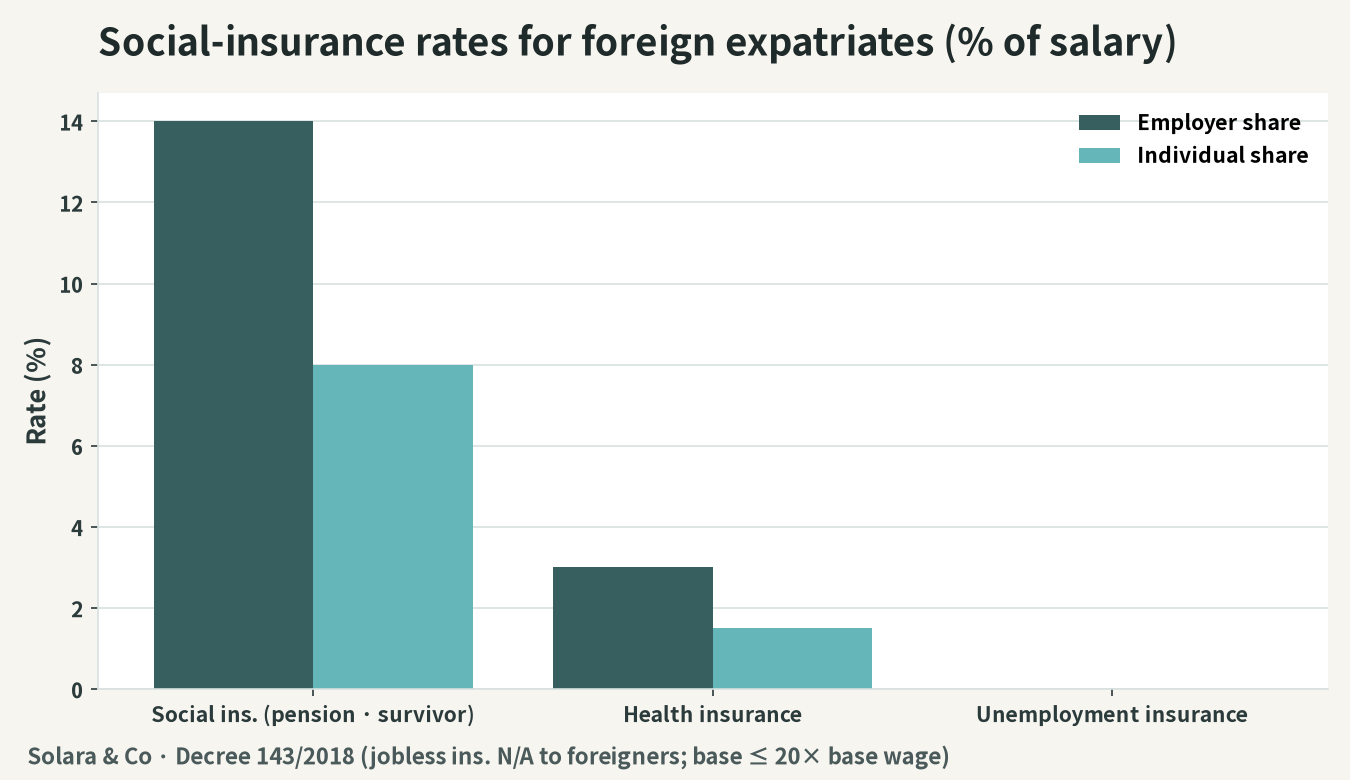
Social insurance (retirement and survivors) is basically 14% for the employer and 8% for the employee, and health insurance (HI) is 3% for the employer and 1.5% for the employee. Unemployment insurance (UI) does not apply to foreigners. The salary used as the basis for calculating contributions has a ceiling, with social and health insurance capped at 20 times the base wage. The new Social Insurance Law enacted in 2024 (effective July 2025) has revised the details of the system, so the latest rates and ceilings need to be confirmed.
The Issue of the Absent Japan–Vietnam Social Security Agreement
As of 2024, no social security agreement is in force between Japan and Vietnam. As a result, a structure can arise in which an expatriate is enrolled in both Japan's pension and Vietnam's social insurance, leading to a double burden of contributions. This is a factor that inflates assignment costs compared with countries that have an agreement, and it is a point that cannot be overlooked when designing the assignment package.
The Practice of Filing and Payment, and Adjusting Double Taxation
The company withholds from salary and remits each month (or quarterly). A resident performs an annual finalization after the year ends and, in principle, settles by the end of March of the following year (or within 12 months of the date of entry). Payment presupposes obtaining an individual tax code (MST).
Japan and Vietnam have a tax treaty, and double taxation on the same income is adjusted through the foreign tax credit and other mechanisms. For short-term business travelers, if the requirements for the treaty's "short-stay exemption (the 183-day rule and so on)" are met, taxation in Vietnam may be exempted; however, the conclusion changes depending on who bears the salary cost and on the presence of a PE, so a case-by-case examination is necessary.
The PE Risk Lurking in Short Business Trips
You cannot relax just because it is a short business trip. If a traveler repeatedly and continuously conducts contract negotiations or provides services in Vietnam, the head office may be deemed to have a permanent establishment (PE) in Vietnam, and corporate taxation may reach the head-office level. If a PE is recognized, the premise for the short-stay exemption also collapses, and the traveler's individual salary, too, can become taxable. In a phase of expanding the local business on a travel basis, considering early on a switch to assignment or local incorporation—and organizing the structure together with the practice of establishing a local entity in Vietnam and the foreign-investment regulations—leads to containing tax risk.
The Social Insurance Benefits Foreigners Can Receive
The double burden of contributions tends to be a source of dissatisfaction on the expatriate's side, but foreigners, too, can receive certain benefits. A representative one is the lump-sum retirement benefit that can be claimed when leaving Vietnam (end of the labor contract, repatriation), received as a single payment in an amount corresponding to the contribution record. Besides this, occupational accident benefits for work-related injury or illness, and benefits related to maternity and sickness, are also covered under the system. Because the lump-sum claim on repatriation is not paid unless claimed, performing it without fail as part of the resignation procedure adds to the expatriate's own sense of fairness.
Common Mistakes in Withholding and Annual Finalization
Back taxes on expatriates mostly arise not from bad faith but from "not knowing." Grasping the typical errors that recur in practice is the greatest preventive measure.
Failure to Report Salary Paid in Japan
The most common is failure to report the salary that the Japanese head office pays in Japan (split payroll). For a resident, the Japan-paid portion corresponding to work in Vietnam must also be reported in Vietnam as worldwide income. A state of "reporting only the locally paid portion" is a point that is invariably raised in an audit.
Misvaluing In-Kind Benefits and Lacking Supporting Documents
The non-taxable allowances for housing, tuition, home-leave travel, and the like have detailed requirements and caps, and without supporting documents (contracts, receipts, boarding passes, and so on) the treatment turns to taxable. A failure to gross up the tax the company has borne (tax equalization) is also raised later as an understatement of the tax base. A framework that spells out the taxable and non-taxable treatment in the expatriate policy and centrally manages the settlement documents is effective.
Checkpoints for Expatriate Taxation (Comparison Table)
Organizing the main differences between residents and non-residents gives the following.
Item | Resident | Non-Resident |
|---|---|---|
Days of stay | 183 days or more | Fewer than 183 days |
Subject to tax | Worldwide income | Vietnam-source income |
Rate on salary | Progressive 5–35% | Flat 20% |
Various deductions | Available | None in principle |
Final return | Required (annual finalization) | Often completed by withholding |
An expatriate's PIT and social insurance form an area where three things intertwine: the individual's take-home pay, the company's burden, and compliance. Unless you design as one whole the assessment of residency classification, the taxability determination of in-kind benefits, the gross-up calculation, and the application of social insurance, you will invite unexpected costs and back taxes. Solara & Co supports everything from the tax simulation of the assignment package, the practice of monthly withholding and annual finalization, through to putting the expatriate policy in order—from the perspectives of both the Japanese and Vietnamese sides. We also recommend designing the local entity's overall labor costs to be consistent with the practical points of Vietnamese labor law and with taxation at the corporate level.