
Why Transfer Pricing in Vietnam Becomes a Risk for Japanese Companies
Transfer pricing (TP) rules are designed to restate transaction prices between group companies at "the price that would have been formed in a transaction with a third party (the arm's-length price)," in order to allocate taxable income appropriately across borders. In Vietnam, the very typical transaction structure of a Japanese subsidiary — buying raw materials from the Japanese parent, selling products to the parent, paying technology royalties and management fees, and funding working capital through intercompany loans — all becomes subject to transfer-pricing scrutiny.
In recent years, Vietnam's General Department of Taxation (GDT) has positioned transfer-pricing audits as a top revenue-raising item and has stepped up audits, centered on foreign-invested manufacturers. In particular, "manufacturing subsidiaries that continue to post thin profits or losses for years after establishment" are easily suspected of shifting profit abroad and are a classic example of receiving large back-tax assessments through deemed (estimated) taxation. This article organizes, from a practical standpoint, the overall picture of the documentation obligations under the current Decree 132/2020/ND-CP, along with the risks Japanese companies are prone to fall into.
The Legal Framework of Vietnam's Transfer-Pricing Rules
At the core of Vietnam's transfer-pricing regulation is Decree 132 (Decree 132/2020/ND-CP), which took effect in 2020. It incorporates the OECD Transfer Pricing Guidelines and the recommendations of the BEPS (Base Erosion and Profit Shifting) project into domestic law, replacing the earlier Decree 20.
Definition of Related Parties (the 25% Ownership Threshold)
The starting point of transfer pricing is determining "who is a related party." In Vietnam, a relationship in which one party directly or indirectly holds 25% or more of the other's capital, a relationship in which a common third party holds 25% or more of both, and further a borrowing relationship depending on 50% or more of funds or a relationship controlling the appointment and dismissal of board members are also treated as related parties. Because the scope is understood more broadly than the typical Japanese sense, the first step is to confirm whether a "business partner substantially under control" falls within the related-party category.
Arm's-Length Price and Valuation Methods
Transactions between related parties must compute taxable income based on the arm's-length price. There are five methods — the comparable uncontrolled price method (CUP), the resale price method (RPM), the cost plus method (CPM), the transactional net margin method (TNMM), and the profit split method (PSM) — and the optimal method is chosen in light of a functional and risk analysis. In practice, TNMM — which tests whether one's own profit margin falls within the profit-margin range (full range or interquartile) of comparable companies — is the most frequently used.
The Difficulty of Comparable Data Particular to Vietnam
The quality of a transfer-pricing analysis depends greatly on the selection of comparable companies (comparables). Yet Vietnam has its own particular circumstances: listed companies are limited and financial disclosure is insufficient, making it difficult to gather enough reliable comparables domestically alone. In practice, when Vietnam alone is insufficient, regional comparables that include companies from neighboring ASEAN countries are sometimes used, but the point of contention becomes whether one can explain to the authorities the validity of adjustments for differences in market and function. Spelling out in the documentation the comparable-selection criteria (screening by industry, scale, function, and independence) and the reasons for inclusion and exclusion determines the strength of rebuttal in later audits.
The Three-Tier Structure of Documentation Obligations
The greatest feature of Decree 132 is the three-tier documentation obligation aligned with BEPS Action 13. The lower the tier, the broader the scope; the higher the tier, the more it is limited to large groups.
The Related-Party Transaction Declaration Form (Form 01)
The most basic is Forms 01 to 04 attached to the annual CIT finalization return. They disclose the list of related parties, the type and amount of transactions, the transfer-pricing method adopted, and profit margins. This is required of essentially all companies with related-party transactions, and a failure to submit or a defective entry is itself subject to a penalty.
The Local File and Master File
The Local File (local transactions, functions, and comparative analysis) and the Master File (an overview of the entire group's business, intangible assets, and finances) must be prepared and retained by the finalization-return deadline, and submitted within, in principle, 30 working days upon the authorities' request. "Preparing them only after an audit arrives" is not permitted; contemporaneous documentation at the time of filing is the premise.
The Country-by-Country Report (CbCR)
The Country-by-Country Report (CbCR) is required of multinational groups whose ultimate parent's consolidated revenue is 18 trillion VND or more (where the ultimate parent is in Vietnam). Where the ultimate parent is in Japan, if the CbCR has been filed in Japan, the Vietnamese subsidiary, in principle, only needs to notify and secure an access route, but a response check is necessary depending on the status of tax treaties and information exchange.
Intercompany Loans and the Cap on Interest Deductibility
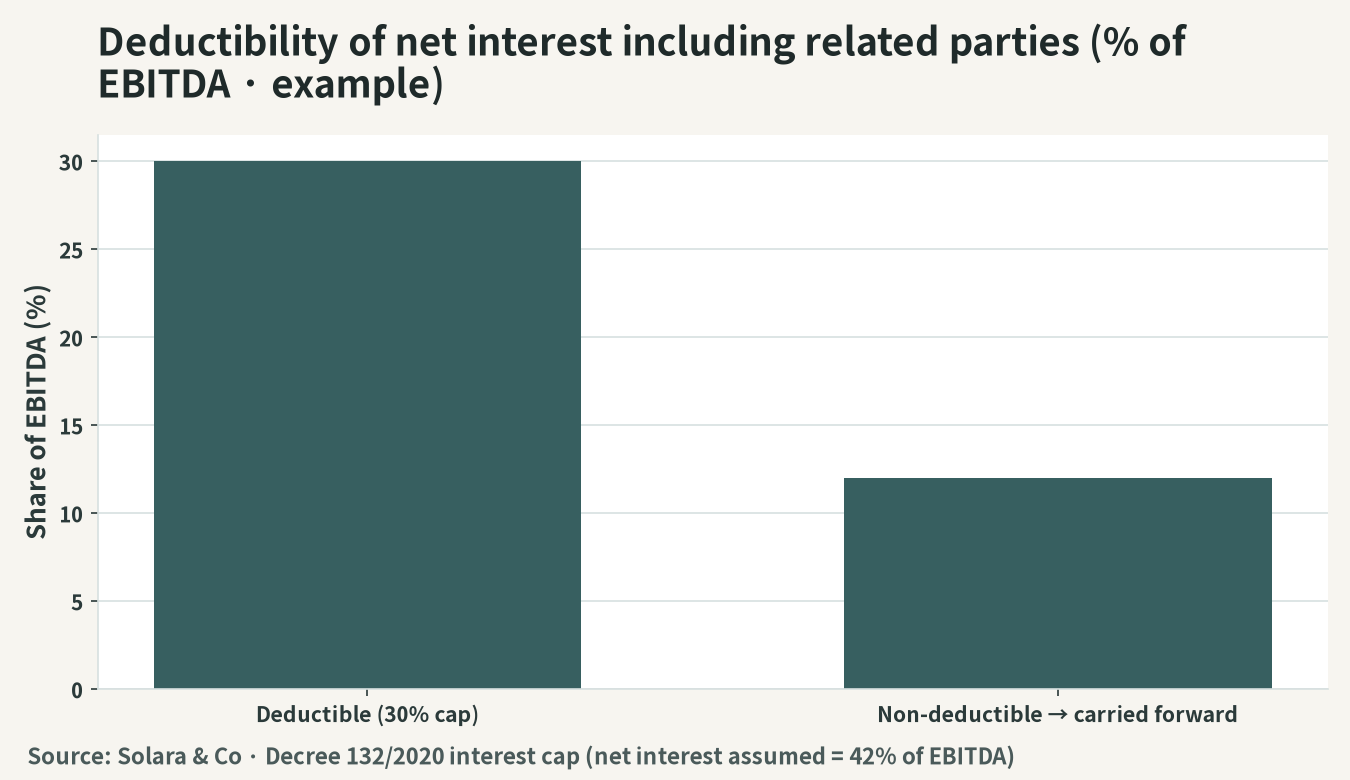
Closely tied to transfer pricing is the limit on deducting interest expense, including borrowings from related parties. Decree 132 limits the deductible amount of net interest expense (interest paid minus interest received) to 30% of EBITDA.
Carryforward of the Excess Over the Cap
Interest exceeding the cap is non-deductible in the current year, but it can be carried forward for up to five subsequent years to be deducted in a year with headroom. Where a subsidiary is designed thinly on the capital side through an intercompany loan from the Japanese head office, it is prone to hit this 30% cap and incur unexpected taxation, so the balance of capital and loans (thin capitalization) should be considered from the design stage.
Exemptions from Documentation Obligations and Simplified Rules
Not all companies are subject to heavy documentation; certain small-scale, simple-function companies have exemption provisions. A company with annual revenue under 50 billion VND and related-party transactions under 30 billion VND is exempt from preparing the Local/Master File (though Form 01 must still be submitted).
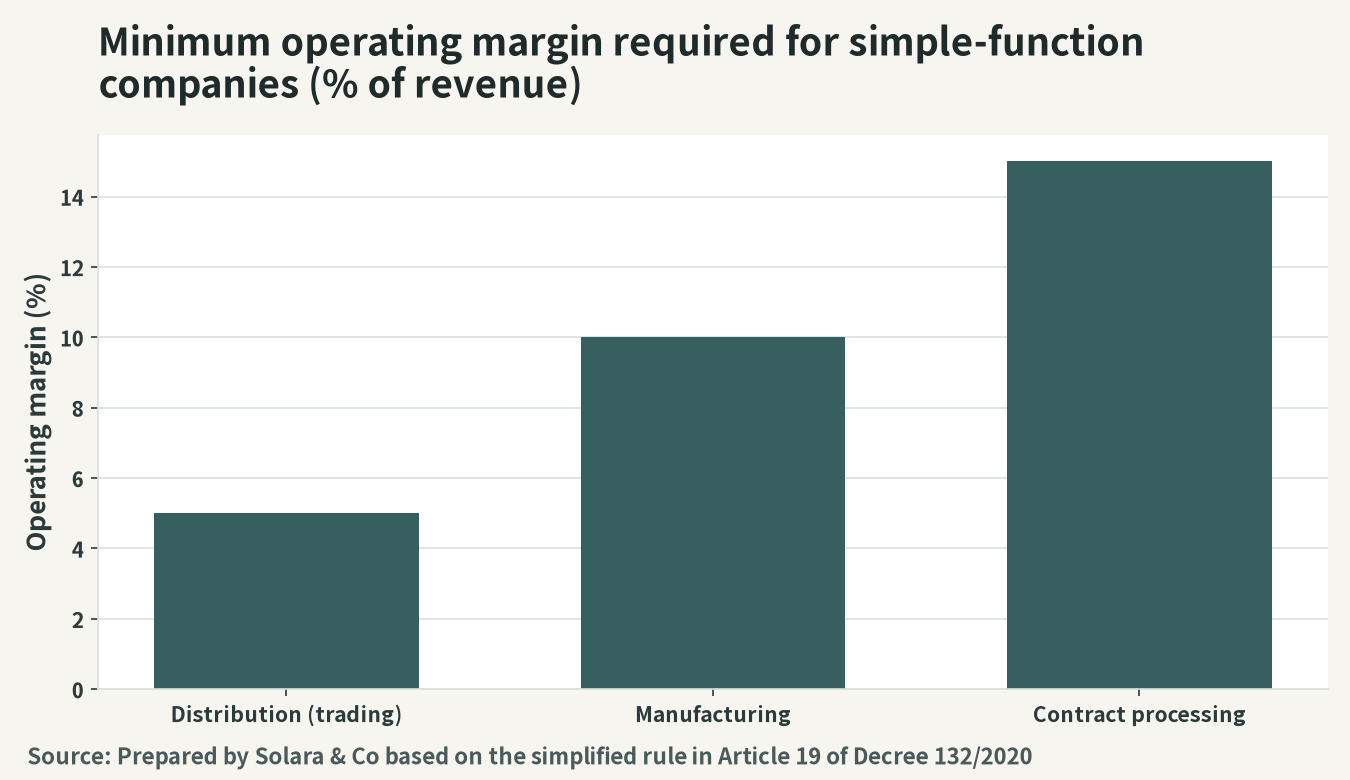
In addition, a company engaged in simple functions (holding no intangible assets and not undertaking R&D or sales strategy) with revenue under 200 billion VND is exempt from documentation if its pre-tax operating margin (relative to revenue) is 5% or more for distribution, 10% for manufacturing, and 15% for contract processing. Conversely, this means that thin-margin manufacturing subsidiaries below these levels will be strictly questioned about the validity of their profit margins in an audit.
Typical Risks Japanese Companies Face (Comparison Table)
Organizing the issues most prone to becoming problems in an audit, by the location of risk and the direction of response, gives the following.
Issue | Typical risk | Practical response |
|---|---|---|
Thin margin/losses at a manufacturing subsidiary | Deemed profit shifting and estimated taxation | Prove the profit-margin range with TNMM |
Technology royalties | Reality of the benefit, validity of the rate | Benefit test and benchmarking |
Management fees/administrative fees | Denied due to insufficient substance of services | Build evidence of services and allocation basis |
Intercompany loan interest | Non-deductible above 30% of EBITDA | Design the capital/debt structure in advance |
Defects in Form 01 | An omission itself draws a penalty | Prepare contemporaneously with the return |
How a Transfer-Pricing Audit Is Conducted
A transfer-pricing audit in Vietnam is carried out as part of a routine tax audit, or as a specialized audit focused on transfer pricing. The auditor first cross-checks the submitted Form 01 against the financial statements, confirming the scale of related-party transactions, the trend in profit margins, and the period over which losses or thin margins have continued.
The "Red Flags" Most Likely to Draw Attention
The companies most likely to be targeted in an audit are those with continued losses or thin margins years after establishment, a profit margin clearly below the industry average, royalties or management fees recorded that are excessive relative to revenue, or borrowings from related parties that are large relative to equity. These are regarded as circumstantial evidence backing the hypothesis that "profit is being shifted abroad," and the company is required to rebut with documentation and benchmarks.
The Burden of Proof Lies with the Company
In Vietnam, the burden of proving that a transaction is at arm's length substantially lies with the taxpayer. If documentation cannot be submitted within the deadline, or the basis for selecting comparables is thin, the authorities can apply the median profit margin and the like from their own database to estimate income. Therefore, the greatest defense is not to panic once an audit begins, but to keep documentation that was prepared contemporaneously with the return in a state where it "can be produced at any time."
Advance Pricing Agreements (APA) as an Option
For large, continuous related-party transactions with high uncertainty, there is the option of using an Advance Pricing Agreement (APA). An APA is a mechanism for agreeing in advance with the tax authorities on the transfer-pricing method to be adopted and the profit-margin range.
The Benefits and Points to Note of an APA
If an APA is concluded, taxation under that method is guaranteed during the agreement period, greatly reducing the risk of it being reopened in a later-year audit. With a bilateral Japan-Vietnam APA, taxation in the two countries is aligned, and the risk of double taxation is also contained. On the other hand, negotiating an APA entails a fair amount of time and a burden of document preparation, so cost-effectiveness must be assessed in light of the transaction's scale, continuity, and audit risk. The choice of structure at the establishment stage is effectively considered from the tax angle together with the practice of establishing a subsidiary in Vietnam.
The Impact of Estimated Taxation and Penalties
If documentation is lacking, or the arm's-length price cannot be proven, the authorities can estimate the profit margin based on a database of comparables, raise income, and tax it. Because this is accompanied by an underdeclaration penalty (20% of the back tax) and late-payment interest, having several years assessed together greatly saps a company's strength. Transfer pricing is also an off-balance-sheet risk lurking in an acquisition target, an area to be examined as a priority in financial due diligence and tax-side verification for M&A in Vietnam.
The best way to contain the risk is to define an arm's-length pricing policy in advance, prepare documentation each period contemporaneously with the return, and, as needed, consider using an Advance Pricing Agreement (APA). Solara & Co provides integrated support from functional and risk analysis of group transactions, benchmark analysis, and Decree 132-compliant documentation, to audit response, with a team versed in the tax practice of both Japan and Vietnam. We recommend consulting from the design stage on how to explain and defend the structure most likely to be targeted — the "thin-margin manufacturing subsidiary."