
The "We Have Assets, So We're Safe" Misconception — Real Estate and Factories Are the Real Breeding Ground of Credit Risk
When Japanese companies consider acquiring a Vietnamese business and see that the target owns a large factory site or impressive production equipment, they tend to feel reassured for that reason alone, thinking "there is collateral value, and at worst the assets remain." In practice, however, it is far from rare for these very "visible assets" to harbor the most serious credit risk. Land, buildings, and equipment carry large amounts, and the moment a single valuation premise collapses, the reasonableness of the acquisition price is shaken to its foundations.
The credit risk referred to here is not merely a question of creditworthiness. It denotes the totality of risks surrounding the existence, the rights relationships, and the attached liabilities of an asset—namely, "does the asset the target presents truly belong to that company," "is it truly worth that much," and "is there a hidden liability tied to it." In Vietnam, rights to real estate differ greatly from Japan, and factories are entangled in a complex web of permits and environmental regulations. With only superficial financial due diligence (DD), one can easily step right through these pitfalls.
This article organizes, by category, the credit risks lurking in real estate and factories in Vietnamese company acquisitions, and explains from a practical standpoint both the investigations needed to spot them before acquisition and the measures for cutting them off through deal structure.
Credit Risk Hidden in Real Estate — The Pitfall of Land Use Rights
In Vietnam, land belongs to the State, and what companies and individuals can hold is only the "Land Use Right (LUR)." If you appraise the target's "land assets" with the sense of ownership registration as in Japan, a fatal misunderstanding arises. It is not unusual for land you thought the acquisition target owned to in fact be no more than a short-term use right.
Types of Land Use Rights (LUR) and Remaining Term
Land use rights come in the form of State allocation (grant) and lease, and within leases there is a distinction between lump-sum prepayment and annual payment. Furthermore, the remaining term and transferability differ according to the purpose of use (industrial land, commercial land, residential land). An annual-payment lease land use right is, in principle, subject to restrictions on transfer to third parties and on being pledged as collateral, which leads directly to the post-acquisition problem of "being unable to realize the asset value you assumed." Confirming, with primary-source information, the name of the holder, the purpose of use, the remaining years, and the transfer-restriction clauses on the Land Use Right Certificate (LURC, the so-called "red book") is the starting point.
Collateral, Double Pledging, and Mortgages
In Vietnam, it is common for land use rights or buildings to be mortgaged as collateral for bank loans. The problem lies in cases where that mortgage is not accurately reflected in the financial statements or disclosed materials, or where it has been pledged as collateral for borrowings of the owner's separate, personal business. In the worst case, it later emerges that the same asset has been pledged redundantly to multiple creditors—"double pledging." If you neglect to search the registered mortgages (security interests), there is a danger that, after acquisition, the mortgagee enforces its rights and you lose a core asset.
In addition, the consistency between foreign-investment regulations and the purpose of use cannot be overlooked. When a foreign investor indirectly acquires a land use right, there are restrictions depending on industry and region; if the purpose of use of the land the target holds does not match its licensed scope of business, you may be forced into a change of use or rectification after the acquisition. A state of "there is land, but it cannot be used freely or sold" significantly impairs asset value.
Credit Risk Hidden in Factories and Production Equipment
In the acquisition of a manufacturer that owns a factory, the appraisal of buildings and production equipment, in addition to land, becomes a point of contention. Here too, the premise of "book value equals market value" does not hold.
Overvaluation of Equipment and the Mixing of Lease and Ownership
In the fixed-asset ledger presented, equipment that is already obsolete may be recorded on an acquisition-cost basis, or equipment that is in fact only being used under a lease (finance lease / operating lease) may be explained as if it were the company's own asset. Lines with low utilization, aged equipment with no maintenance history, and jigs dedicated to a specific customer that cannot be repurposed do not hold realizable value anywhere near their book value. To believe in the asset value of equipment without physical inspection and confirmation of actual operating conditions is dangerous.
Unrectified Environmental, Fire-Safety, and Construction Permits
Factories come with administrative requirements such as the environmental impact assessment (EIA), permits for wastewater and waste treatment, the fire-prevention (PCCC) inspection certificate, and the construction permit. In Vietnam, a factory can harbor "unrectified administrative risks" such as an unpermitted extension, failure to meet wastewater standards with a rectification order already issued, or not having passed fire inspection. After acquisition, these surface as suspension-of-operations orders or substantial rectification costs and penalties, breaking down the business plan itself.
Off-Balance-Sheet Liabilities — The Invisible Bomb
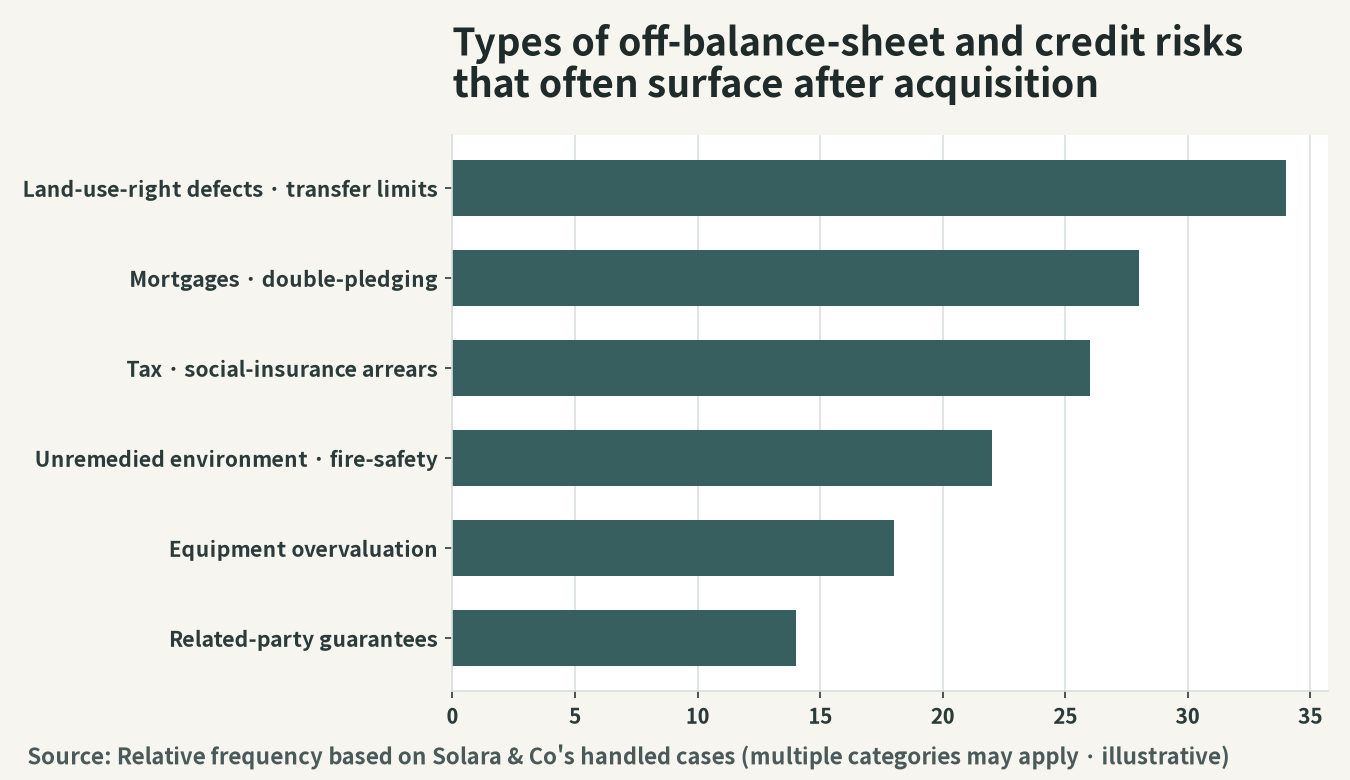
Much of the credit risk tied to real estate and factories lies latent as "off-balance-sheet liabilities" that do not appear on the balance sheet. When the cases Solara & Co has encountered in supporting Japan–Vietnam M&A are categorized, the off-balance-sheet and credit risks that tend to surface after acquisition show a clear skew.
Arrears of Taxes and Social Insurance
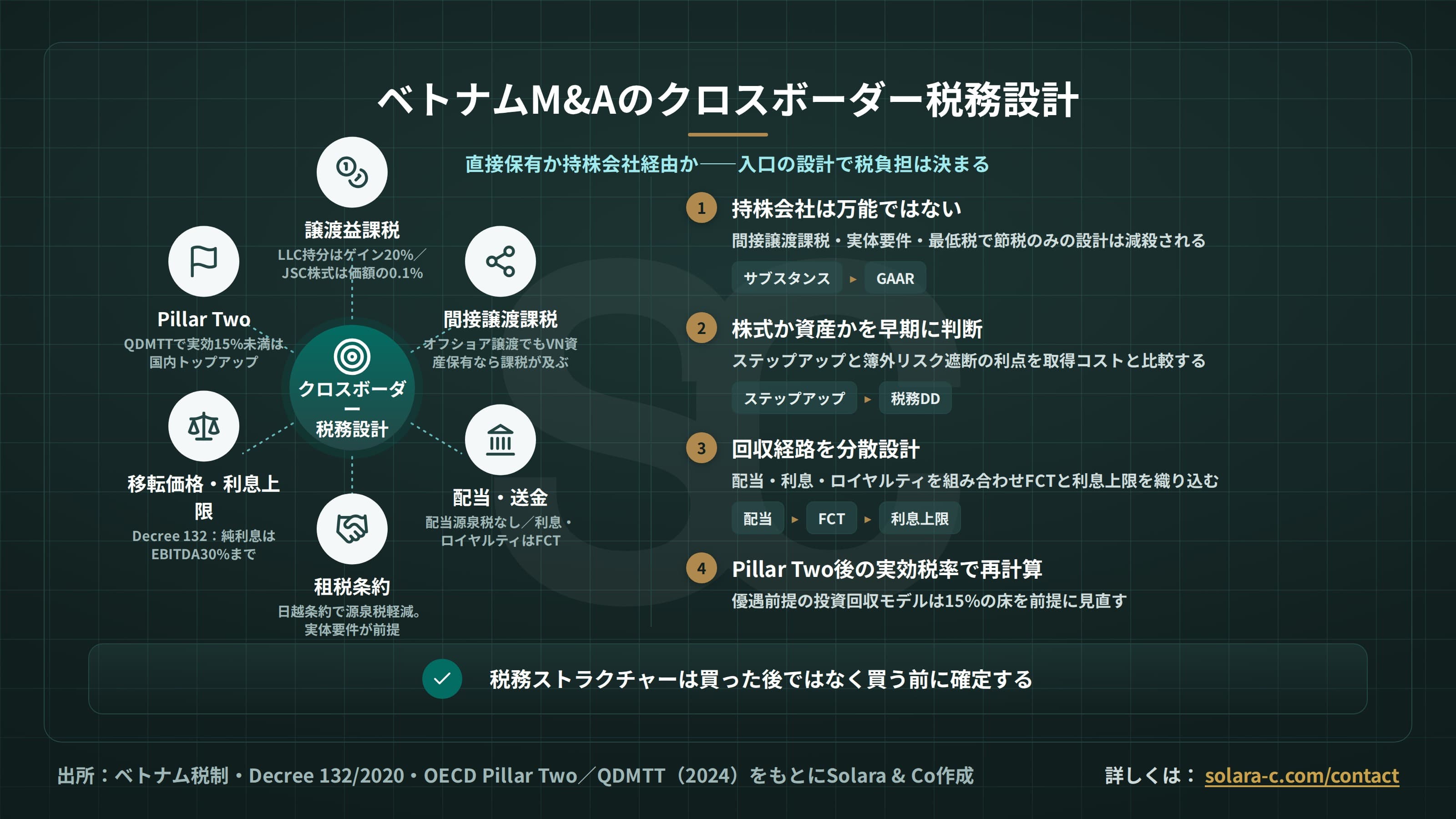
Past errors in tax treatment, or underpayment of social insurance and labor insurance, surface all at once after acquisition as back taxes and late-payment charges. Particularly in Vietnam, there are cases where unpaid social insurance has piled up due to the gap between the headcount on filings and the actual number of employees; when the whole company is taken over through a share transfer, this becomes the buyer's burden.
Related-Party Transactions and Guarantees
There are cases where rents, purchases, and loans deviating from market rates are conducted between the target and an affiliate controlled by the owner. Moreover, if the target has provided a joint guarantee for the borrowings of an affiliate or the owner personally, that guarantee obligation is off-balance-sheet, and its existence only becomes apparent when a creditor makes a claim after the acquisition.
The Gap Between Book Value and Realizable Value
The key to grasping the credit risk of real estate and factories in monetary terms is the gap between "book value" and "realizable value (the value that can be converted into cash on the market)." The illustration below shows how greatly book value and a third-party appraisal diverged in a certain manufacturing deal.
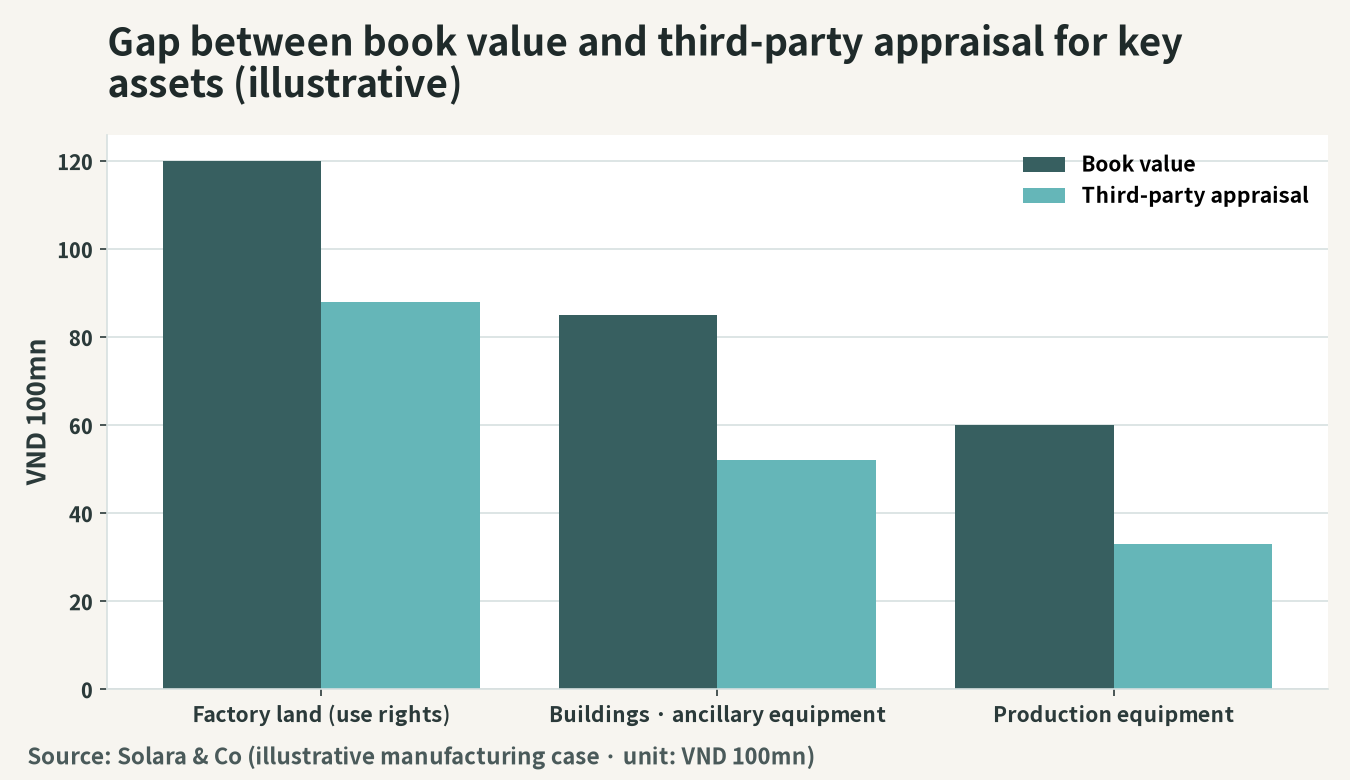
This gap is directly connected not only to negotiating the acquisition price but also to post-acquisition impairment risk and the re-appraisal of collateral value. Below is an organized summary of the asset categories that warrant particular attention, together with the points to confirm.
Asset category | Common book-value premise | Credit risk (the pitfall) | Primary-source information to confirm |
|---|---|---|---|
Factory land (land use right) | Recorded at full value as an owned asset | Annual-payment lease, remaining years, transfer restrictions, mortgage | LURC ("red book"), mortgage-registration search |
Buildings and ancillary facilities | On an acquisition-cost basis | Unpermitted extension, unrectified fire-safety/construction | Construction permit, PCCC inspection certificate, EIA |
Production equipment | Book value in the fixed-asset ledger | Obsolescence, lease mixing, non-repurposable | Physical inspection, lease contracts, operating records |
Receivables, inventory | At face value | Bad debts, latent losses on stagnant inventory | Aging schedule, physical stocktaking |
Off-balance-sheet items | Not recorded | Arrears, guarantees, disputes | Tax inquiry, guarantee contracts, court records |
How to Conduct Investigations That Spot Risk Early
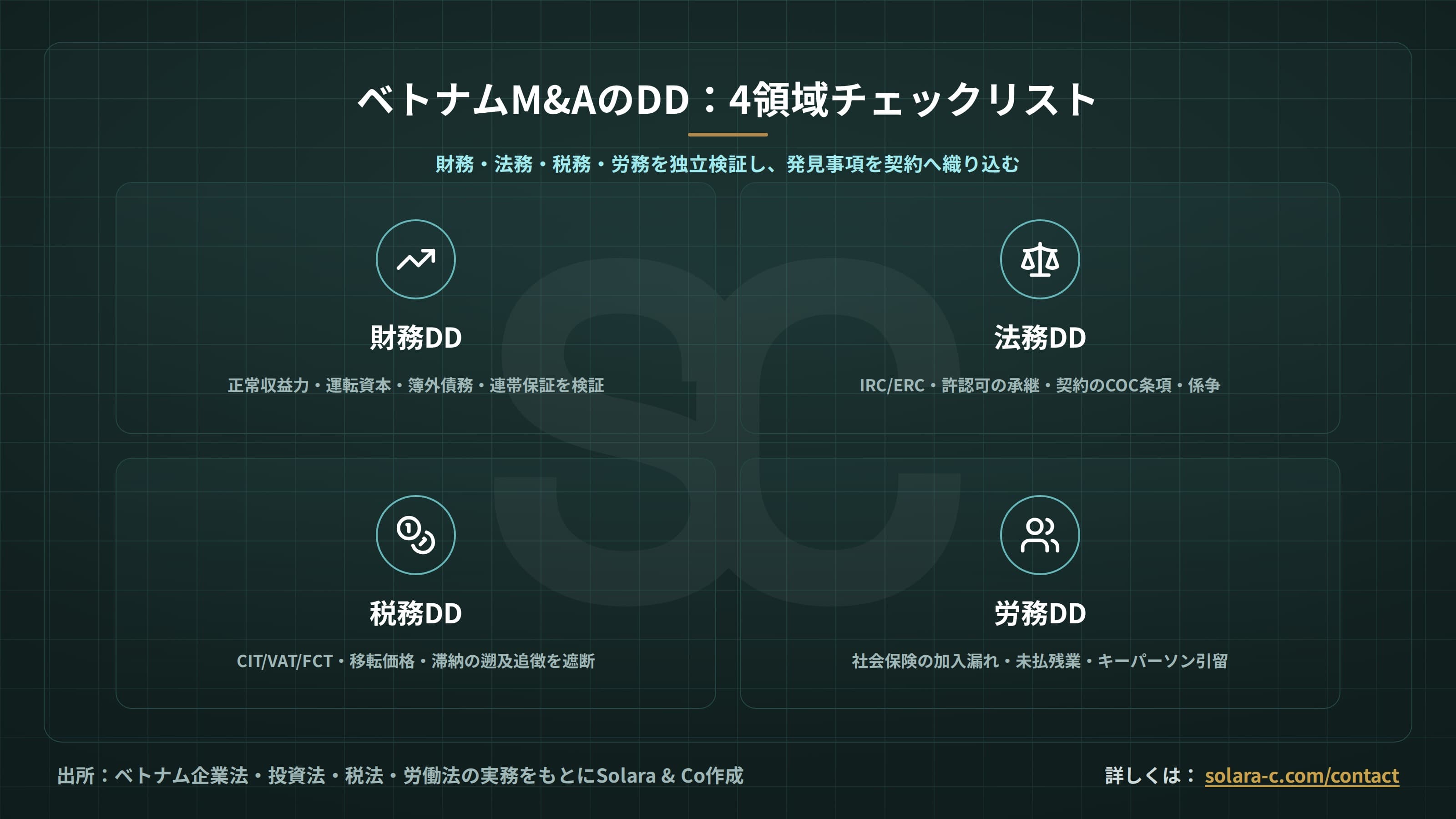
These risks cannot be spotted merely by reading, from the inside, the materials in the data room that the target discloses. Confirmation from the outside that does not depend on the counterparty's cooperation—that is, combining credit investigation with on-site physical inspection—is indispensable.
Primary-Source Inquiry of Public Records
Directly inquire, without going through the target's filter, into public and quasi-public records such as the Enterprise Registration Certificate (ERC), the Investment Registration Certificate (IRC), the Land Use Right Certificate (LURC), mortgage registrations, records of disputes with the tax authorities, and court litigation records. Pinning down the rights relationships and existing collateral and disputes here becomes the foundation for designing the scope of the subsequent DD.
On-Site Inspection and Interviews
Actually set foot in the factory and offices, and confirm with your own eyes the actual operating conditions, the operating status of equipment, the presence or absence of extensions, and the state of fire-safety and wastewater facilities. At the same time, through interviews with business partners, former employees, and neighboring operators, pick up signs of arrears, disputes, and reputation. It is not unusual for a company that looks sound on paper to be painted in a different light by raw on-site information.
The order of investigation also determines success or failure. First, use a preliminary credit investigation based on public information and primary records to confirm within one to two weeks whether there are any serious red flags, and only then proceed to on-site inspection and full investigation by specialists—this is the efficient approach. If you have first gauged the rights relationships and off-balance-sheet risks, you can concentrate the costly financial and legal DD on the areas that truly warrant deep digging. Conversely, if you mistake the order and dive straight into expensive DD from the outset, you end up spending half a year and several million yen only to discover "risks you should have known at the entrance," such as defects in the land use right or collateral problems.
Cutting Off Risk Through Deal Structure
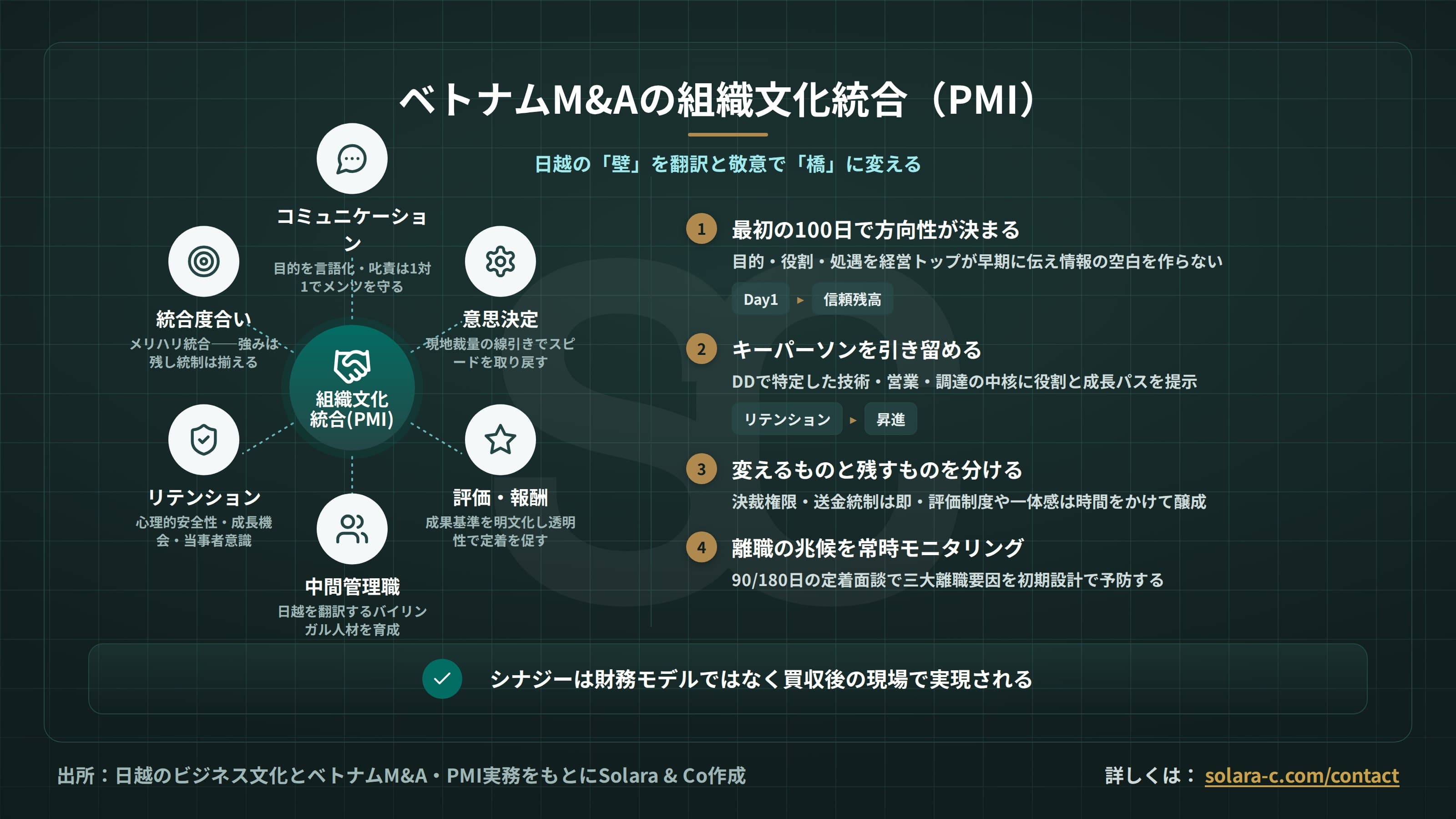
It is not always possible to reduce every credit risk found to zero. What therefore becomes important is the mindset of controlling the scope of risk succession through the deal structure (the form of acquisition). Between a share transfer and a business transfer (asset transfer), the way off-balance-sheet liabilities and permits are carried over differs greatly.
Aspect | Share transfer | Business transfer (asset transfer) |
|---|---|---|
Succession of off-balance-sheet liabilities | In principle, all is succeeded (taxes, guarantees, disputes too) | The objects of succession can be selected, making it easy to cut off |
Permits and contracts | Easy to continue as is | Re-obtaining or re-contracting may be needed |
Weight of procedures | Relatively light | Heavy, due to transfer procedures for each asset |
Suitable situation | Risk is limited, succession of permits is important | Off-balance-sheet risk is large, only specific assets are wanted |
In deals with large off-balance-sheet risk, a design that deliberately uses a business transfer to acquire only the necessary assets and contracts and leaves past liabilities with the seller is effective. On the other hand, when the succession of permits is the lifeline of business continuity, choose a share transfer while sharing the risk through contractual measures such as representations and warranties, indemnity clauses, escrow, and earn-outs. The results of a credit investigation acquire meaning only when translated into these three points: "price," "contract conditions," and "structure."
Solara & Co's End-to-End Support — Seeing Through to the Back Side of Assets
The credit risks of real estate and factories in Vietnamese company acquisitions arise from structures unique to Vietnam: the institutional difference of land use rights, the complexity of permits, and the invisibility of off-balance-sheet liabilities. Carrying over the Japanese sense of ownership and registration and judging "we have assets, so we're safe" is the greatest pitfall.
Solara & Co, with bases and human networks on both the Japanese and Vietnamese sides, provides end-to-end support, from primary-source inquiry into land use rights, mortgages, and permits, to on-site factory inspection, the rooting out of off-balance-sheet liabilities, and translation into deal structure and contract conditions. Seeing through not the surface but the back side of assets is what determines success or failure in Vietnamese M&A. We will accompany you from the very first step: verifying "is that asset truly worth it."