
Contracts and Dispute Resolution in Vietnam Are Decided by "Design in Advance"
As transactions, M&A, and joint ventures in Vietnam expand, how to prepare for contractual disputes has become an important management challenge for Japanese companies. Vietnam's legal system has been built up rapidly in recent years, but the operation of litigation and the enforcement of judgments follow practices that differ from Japan's, so an approach of "thinking it over only once trouble arises" tends to be too late. The success or failure of dispute resolution is greatly influenced by how the governing law and dispute-resolution clauses were designed at the contracting stage.
This article organizes the points Japanese companies should grasp—from the basics of Vietnam's contract-law framework, to the characteristics of the four means of dispute resolution (negotiation, mediation, arbitration, and litigation), in particular the practice of VIAC arbitration that has become mainstream in international transactions, and through to the perspective of enforcing foreign arbitral awards and judgments.
The Basics of Vietnam's Contract-Law Framework
Contracts in Vietnam are formed on the basis of the Civil Code 2015, the general law, and the Commercial Law 2005, which governs commercial acts. Under the principle of freedom of contract, the parties may determine the governing law, contract terms, and method of dispute resolution with a considerable degree of freedom; however, clauses that violate mandatory provisions (labor, land, competition, consumer protection, and the like) are void.
Choice of Governing Law and Its Limits
In international commercial transactions, the parties are permitted to choose a foreign law as the governing law. Note, however, that for matters concerning real property located within Vietnam (including land-use rights), and for portions touching on Vietnam's public order and good morals or its mandatory provisions, Vietnamese law applies preferentially even if a foreign law has been chosen. The governing-law clause should be designed as a set together with the clauses on the place of dispute resolution and language.
Practice on Written Contracts and Language
Under Vietnamese law, many contracts are formed even orally, but transactions involving real property, certain guarantees, and those requiring registration must be in writing. In practice, making the contract bilingual in Vietnamese and a foreign language (Japanese or English) and stating clearly which language prevails in the event of a discrepancy prevents later disputes over interpretation.
The Four Means of Dispute Resolution
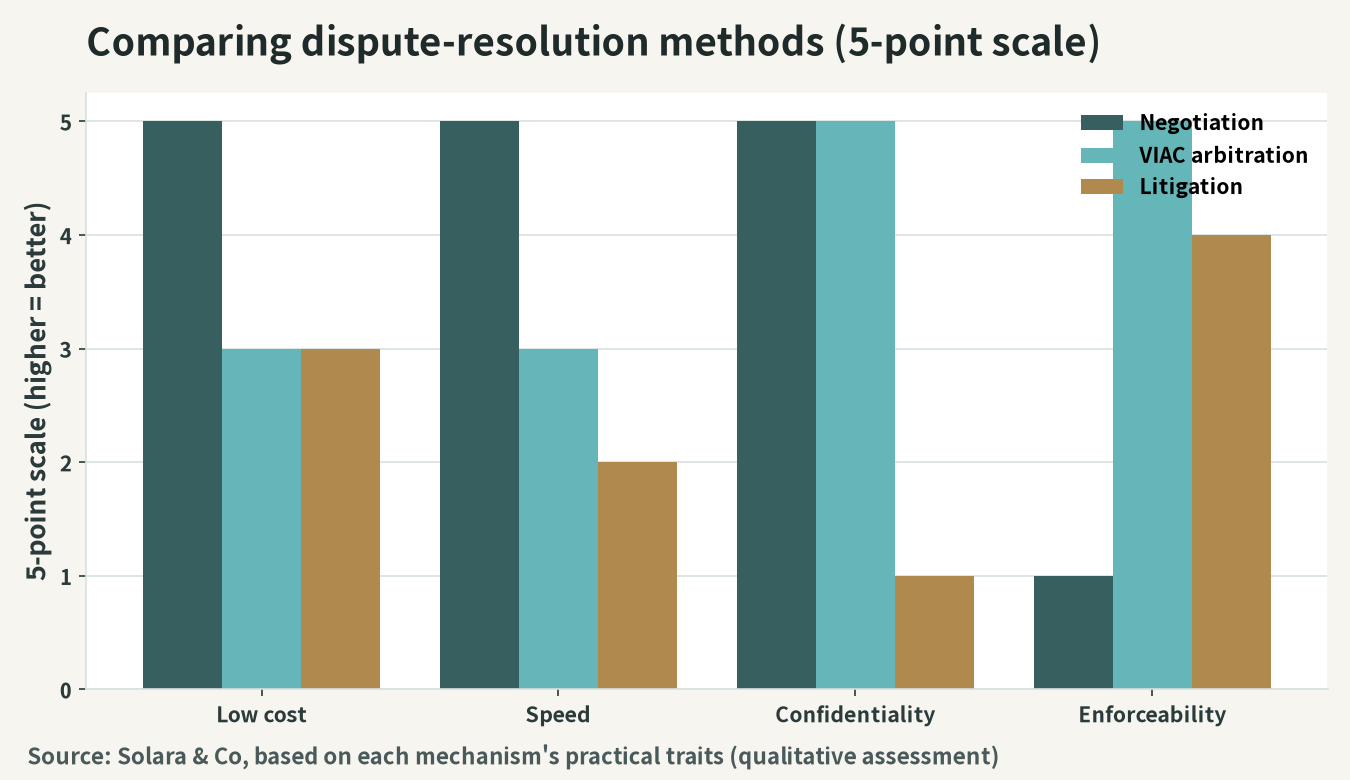
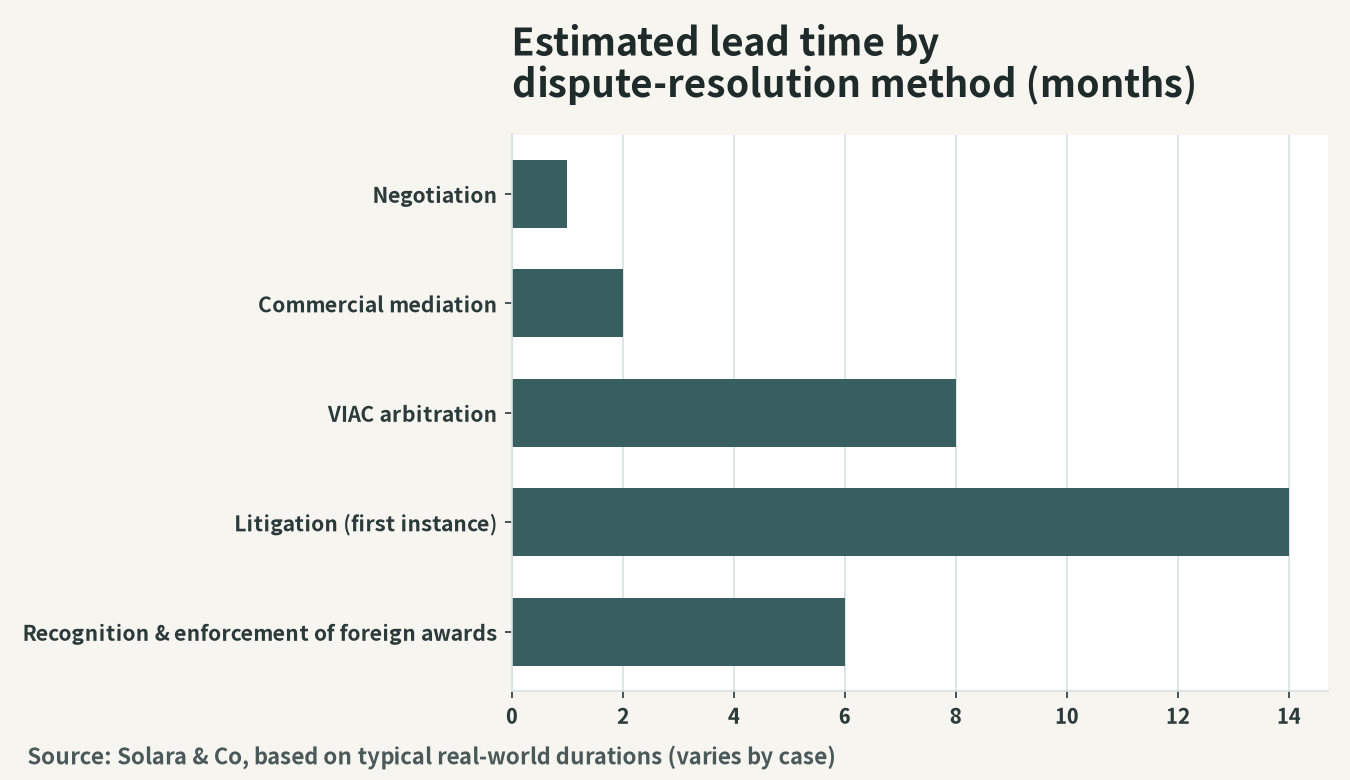
The means of resolving commercial disputes in Vietnam can be broadly organized into four: negotiation, mediation, arbitration, and litigation. The choice is made according to the case, balancing cost, speed, expertise, enforceability, and confidentiality.
Negotiation and Mediation (ADR)
The lowest-cost option, and the one that most easily preserves the relationship, is negotiation between the parties. Where this cannot be settled, there is commercial mediation, in which a third-party mediator brokers a settlement (Decree 22/2017/ND-CP institutionalized commercial mediation). Mediation is flexible and excellent for confidentiality, but it must be understood that to give an executed settlement compulsory enforceability, a separate court-recognition procedure is required.
Arbitration
Arbitration is a system in which an arbitral institution and arbitrators chosen by the parties render a final decision (an arbitral award) through a non-public procedure. In terms of expertise, confidentiality, and international enforceability, it has become mainstream for international commercial transactions. In Vietnam, the Law on Commercial Arbitration 2010 is the governing law, and the VIAC discussed below is the representative institution.
Litigation
Litigation before the People's Courts has public, compulsory force, but the procedure is open, the language is Vietnamese, the hearing takes time, and for foreign companies there can remain unease about predictability. It becomes the option for small-value or domestic transactions, or where the counterparty has no arbitration agreement.
The Practice of VIAC Arbitration
When designing dispute resolution with a Vietnamese counterparty in an international commercial transaction, the practical first choice is the Vietnam International Arbitration Centre (VIAC).
Why VIAC Is Chosen
VIAC is Vietnam's largest commercial arbitration institution, outstanding in both the number of cases handled and its international character. The procedure can be conducted in the language agreed by the parties—Vietnamese, English, and so on—and arbitrators can be appointed from both within and outside Vietnam. By setting the seat of arbitration within Vietnam, the award is treated, at the enforcement stage discussed below, as a domestic arbitral award, which carries the advantage of a lower hurdle for enforcement than a foreign arbitral award. Even in an M&A SPA (share purchase agreement), a VIAC arbitration clause is one of the standard options. For details, please also refer to our explanation of the SPA in Vietnam M&A.
Designing the Arbitration Clause
The effectiveness of arbitration is decided by the quality of the contract's arbitration clause. It is important to clearly specify the arbitral institution (VIAC, etc.), the seat of arbitration, the language of arbitration, the number of arbitrators (one or three), the applicable procedural rules, and the applicable substantive law. If the clause is ambiguous, the very validity of the arbitration agreement is contested, wasting time at the entrance. In M&A and joint ventures, building dispute-resolution clauses into the contracts and charter from the establishment stage is the starting point of risk management throughout the entire Vietnam M&A process.
The Risk of an Award Being Set Aside
An arbitral award is final, but it must be borne in mind that there were a certain number of cases in which Vietnamese courts set awards aside on grounds of violation of public order and good morals or procedural defect. In recent years, under guidance from the Supreme People's Court, the practice of setting aside has become limited; nevertheless, carefully observing due process and ensuring consistency with Vietnam's mandatory provisions are important in practice for protecting an award.
Enforcement of Arbitral Awards and Judgments
Dispute resolution is not only about "winning" but runs through to "collecting." Understanding the system at the enforcement stage is indispensable.
Recognition and Enforcement of Foreign Arbitral Awards
Vietnam acceded to the New York Convention (the Convention on the Recognition and Enforcement of Foreign Arbitral Awards) in 1995, so foreign arbitral awards rendered in Singapore, Hong Kong, Japan, and elsewhere can be enforced after passing through the recognition procedure of the Vietnamese courts. However, because there were cases in which recognition was refused on grounds falling under the refusal grounds, such as violation of public order and good morals, it is important to design the seat of arbitration and the governing law with enforceability in view. In general, domestic VIAC arbitration in Vietnam is said to be enforced more smoothly than a foreign arbitral award.
Enforcement of Foreign Judgments
A judgment of a foreign court may be recognized and enforced where there is reciprocity or a bilateral treaty, but the current situation is that there is no treaty directly guaranteeing the mutual enforcement of judgments between Vietnam and Japan. For that reason, in transactions where the counterparty's assets are in Vietnam, the prospect of collection through a foreign judgment is uncertain, and on this point, too, arbitration (in particular VIAC arbitration) is regarded as practically superior.
Key Points of Dispute Prevention by Contract Type
The seeds of disputes differ by contract type. For the main contracts in which Japanese companies are involved, we organize the points to grasp at the design stage.
Sale, Agency, and Distribution Agreements
In agreements for the sale of goods, or agency and distribution agreements that handle sales in the Vietnamese market, defining quality standards, acceptance conditions, payment terms, and grounds for termination concretely prevents later disputes. Agency and distribution agreements in particular are prone to disputes over compensation at termination and the treatment of inventory; starting the relationship with the termination clause left vague becomes a shackle in the phase of withdrawal or switching. The safe approach is to steer the governing law and dispute resolution toward VIAC arbitration while expressly setting out the rules on termination and compensation.
Joint-Venture and Shareholders' Agreements
In a joint venture, matters such as the equity ratio, management rights, dividend policy, deadlock resolution, restrictions on transfer of interests, and non-competition are written into the shareholders' agreement and the charter. Unless you design in advance how to settle matters when opinions clash (the scope of veto rights, buy-out demands, sale to a third party), the company falls into paralysis when the relationship deteriorates. It is important that the dispute-resolution clauses be made consistent across the shareholders' agreement and the charter so that no contradiction arises. This is inseparable from the very design of the company form and governance.
Intellectual Property and License Agreements
In license agreements for the supply of technology, trademarks, and know-how, clarify the scope of the license, the consideration (royalties), confidentiality, and the rights relationship after the agreement ends. Because in Vietnam there are hurdles in the practice of proving infringement and obtaining injunctions, it is effective to set up preventive lines in the contract while also using rights registration in combination. For the protection of intellectual property in general, please also refer to the protection of intellectual property rights in Vietnam.
Employment and Service Outsourcing Agreements
Labor-related disputes are numerous, and the handling of dismissal, overtime, and social insurance tends to be the point of contention. Preparing the employment contract and work rules in line with the mandatory provisions of labor law, and strictly observing the procedural requirements for discipline and dismissal, prevents claims of unfair dismissal. Even where the form of a service outsourcing (service contract) is adopted, if the reality is judged to be employment accompanied by direction and command, labor law applies; a design true to the reality rather than the name of the contract is therefore necessary. Grasping labor issues together with Vietnam's labor law allows the seeds of disputes to be nipped early.
Comparison Table of Dispute-Resolution Means
Organizing the main means of dispute resolution by cost, speed, confidentiality, enforceability, and suitable situations gives the following.
Means | Cost | Speed | Confidentiality | Enforceability | Suitable Situation |
|---|---|---|---|---|---|
Negotiation | Low | Fast | High | None | Maintaining the relationship, initial response |
Mediation | Low–medium | Fast | High | Court recognition required | Flexible settlement |
VIAC arbitration | Medium–high | Medium | High | Smooth domestically | International transactions, M&A |
Litigation | Medium | Slow | Low (public) | Strong (domestic) | No arbitration agreement, small value |
Practical Points Japanese Companies Should Grasp
First, dispute resolution is a "design problem" at the contracting stage. Equipping every important contract (sale, agency, joint venture, SPA, license) as standard with a clause that clearly sets the governing law, the dispute-resolution institution, the seat of arbitration, and the language is the greatest preventive measure. Second, work backward all the way to enforceability. As long as there is no mutual judgment-enforcement treaty between Japan and Vietnam, to make collection certain, arbitration backed by the New York Convention—above all VIAC arbitration, which is enforced smoothly domestically—becomes a strong option. Third, nip the seeds of disputes at the stage of contract management and evidence preservation. It is important to organize the prevailing language of bilingual contracts, signing authority, and the management of the corporate seal, and to address matters before they become points of contention.
In Vietnam, contracts and dispute resolution are decided not merely by "knowing" the system but by whether it has been "designed in" at the contracting stage. Solara & Co provides seamless support—from contract design for transactions, joint ventures, and M&A, to the optimization of dispute-resolution clauses, practical handling of VIAC arbitration and mediation, and the examination of enforceability—through a team versed in the legal practice of both Japan and Vietnam. Not after a dispute has occurred, but from the very moment you conclude a contract, we propose a design that minimizes your company's risk.