
"We've reviewed the financial statements" is not enough — the starting point of Vietnam financial DD
We often hear Japanese companies pursuing the acquisition of a Vietnamese business say, "We've obtained the audited financial statements, so there's no problem on the financial side." But the role of financial due diligence (financial DD) is not to recompute whether the financial statements provided are correct. Its purpose is to determine how much earning power the company truly has (the quality of earnings), how much hidden liability lies behind the book value, and how to translate those findings into the purchase price and contract terms.
In Vietnam in particular, the proportion of cash-based business is high, keeping two sets of books (double books) for the purpose of tax optimization is not uncommon, and unpaid social insurance often builds up quietly. If you judge with the Japanese mindset that "audited means safe," then after the acquisition the normalized earnings may fall far short of expectations, or unpaid taxes and social insurance arrears may surface all at once, causing the investment recovery plan to collapse.
This article organizes, from a practical perspective, the points that must always be addressed in financial DD targeting Vietnamese companies and the pitfalls specific to Vietnam, and explains how to translate the findings obtained through the investigation into price adjustments, Net Debt, and reps & warranties.
Fix the purpose and scope first
Financial DD is not a task of "digging equally deep into everything." To concentrate limited time and budget on the areas that bear directly on price and deal feasibility, you must first define the purpose and scope. Agreeing in advance on the acquisition structure (share transfer or business/asset transfer), the target period (typically the most recent three fiscal years plus recent monthly figures), the materiality threshold, and "the points that could become deal-breakers" is the premise for achieving both efficiency and comprehensiveness.
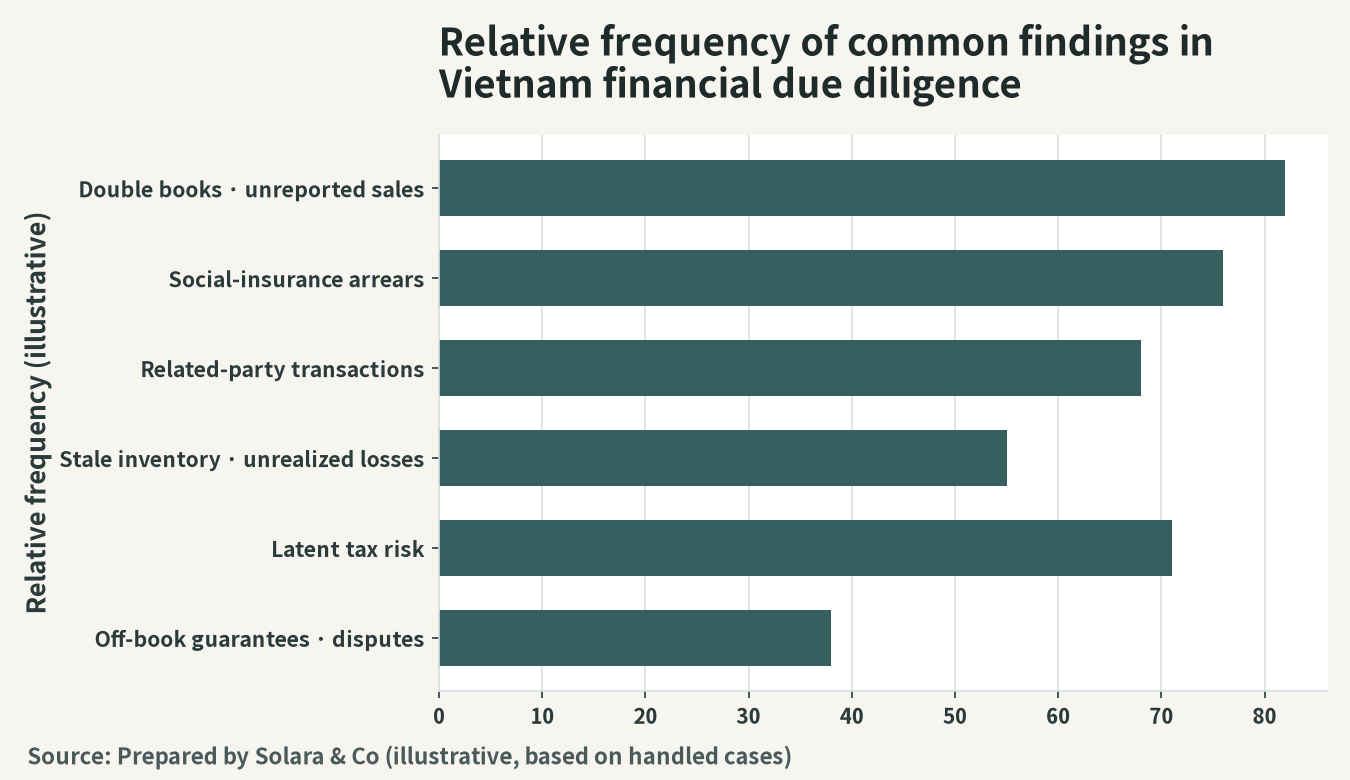
In Vietnamese deals, the three points discussed later — double books, social insurance, and tax — have a high probability of becoming issues. When we categorize the cases Solara & Co has handled, the findings that surface in financial DD show a clear bias.
Quality of Earnings (QoE) and EBITDA normalization adjustments
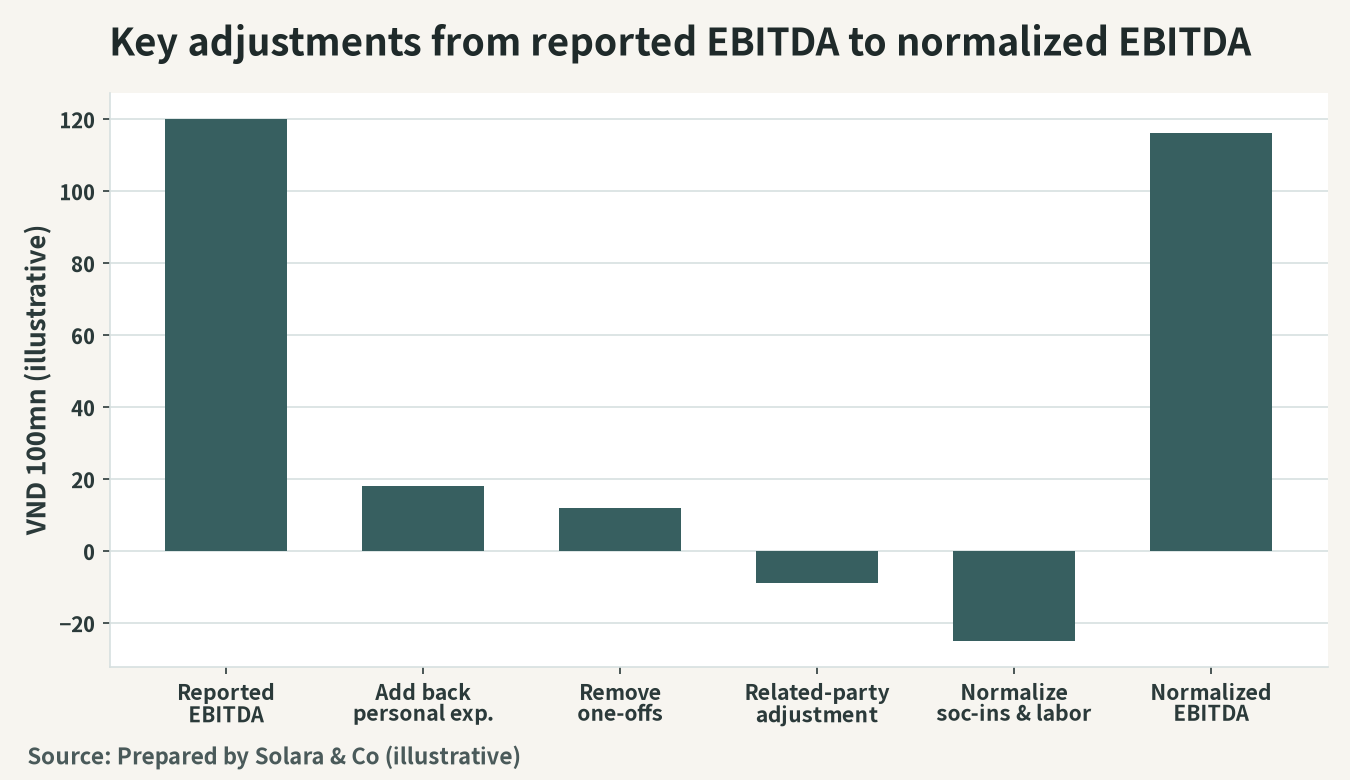
The core of financial DD is the Quality of Earnings (QoE) analysis, which rebuilds reported earnings into "normal earning power that can be sustained over time." Since the purchase price is determined by an EBITDA multiple, what figure you set as normalized EBITDA governs the price itself.
Removing one-time items and related-party transactions
First, remove the special factors that occurred only in the current period. One-time items such as gains on the sale of fixed assets, subsidies, foreign exchange gains/losses, one-off Covid-related expenses, and litigation settlements are not included in future earning power. Next, restate transactions with affiliates controlled by the owner (related-party transactions) on a fair-value basis. Transactions such as renting the head office building at below-market rent, purchasing from the owner's personal company at inflated prices, or lending funds at no interest must be corrected to arm's-length prices before normal earnings can be seen.
Owner's personal expenses and underreported labor costs and social insurance
At owner-operated Vietnamese companies, the owner's personal expenses — company cars, entertainment, salaries of family members, private travel — are sometimes mixed into company expenses. These are costs that disappear after the acquisition and are subject to being added back to earnings (add-back). On the other hand, adjustments in the opposite direction are also important. Where overtime pay, bonuses, and social insurance premiums that should actually be paid are underreported, the normalization process must instead add costs and revise earnings downward. With social insurance in particular, if a gap between the declared headcount and the actual headcount has become routine, labor costs will jump the moment compliance is rectified after the acquisition. The rule of thumb for adjusting from reported EBITDA to normalized EBITDA is to build it on both sides — add-backs and deductions.
Revenue recognition and cash business — verifying the double books
The single biggest issue specific to Vietnam is cash business and double books. In retail, food service, services, and parts of manufacturing, a portion of revenue moves in cash, and it is sometimes split into an "external book" declared to the tax authorities and an "internal book" by which the owner grasps the real situation.
Which to believe — declared revenue or actual revenue
When double books exist, the buyer is placed in a difficult position. If actual revenue (the internal book) is larger, it looks like "they're actually earning more," but that difference carries the risk of undeclared income = tax evasion, and after the acquisition the buyer could inherit back-taxes and penalties. Conversely, if you take only declared revenue as the premise, you underestimate earning power and cannot reach agreement on price with the seller. In financial DD, we cross-check indirect evidence — bank deposit records, POS data, quantity consistency between purchases and sales, electricity consumption, customer counts — to verify which is closer to reality.
Timing of revenue recognition and invoices (red invoices)
In Vietnam, the issuance of a proper tax invoice (commonly called a hóa đơn) is closely tied to revenue recognition. Pulling revenue forward or pushing it back across the period-end (cut-off), the state of compliance with the e-invoice system (after the transition under Decree 123/2020), and the presence of unissued or fictitious invoices all directly affect the reliability of revenue. Confirm whether the revenue recognition policy is consistent on both the accounting-standards side and the tax side.
Quality of working capital — receivables, inventory, advances received
The purchase price is normally adjusted on the premise of a level of "normalized working capital." If working capital is overstated, cash melts away faster than expected after closing.
Aging of receivables and stagnant inventory
Accounts receivable are valued by collectibility, not by face value. Use an aging schedule to identify long-stagnant receivables, and inspect concentration on specific customers, receivables from related parties, and the adequacy of bad-debt provisions. Inventory is the same — confirm stagnant inventory, obsolete inventory, and discrepancies against physical counts, and check whether the book value contains latent losses. In Vietnam, provisioning is sometimes not conservative or merely formal, so the reality is that latent losses tend to lie dormant here.
Setting advances received, seasonality, and the normal level
Working capital swings widely month to month due to advances received and seasonal factors. The standard design is to set the benchmark (peg) for "normalized working capital" from monthly movements over 12–18 months rather than a single-month snapshot, and to adjust the price by the difference against the actuals at closing.
Net Debt and debt-like items
To derive equity value from enterprise value, you subtract Net Debt (interest-bearing debt minus cash and deposits). What makes Vietnamese deals difficult here is the abundance of debt-like items that do not appear on the balance sheet, or that do not look like debt.
Identifying off-balance-sheet and quasi-liability items
Unpaid taxes, arrears of social insurance and labor insurance, unpaid bonuses and severance, joint guarantees on borrowings by the owner or affiliates (off-balance-sheet guarantees), damages under dispute, and equipment lease obligations are, in substance, items that should be deducted from Net Debt or the price as liabilities. Social insurance arrears and unpaid taxes in particular are the leading examples of "invisible liabilities" that surface repeatedly in Vietnamese deals. If they are inherited through a share transfer, they translate directly into the buyer's burden.
Quality of cash — restricted deposits and circular transactions
There are quality issues on the cash side as well. Deposits restricted by being pledged as collateral, funds circulated between affiliates only at period-end, and uncollectible loans are not "usable cash." In calculating Net Debt, we exclude such low-quality assets to arrive at the substantive figure.
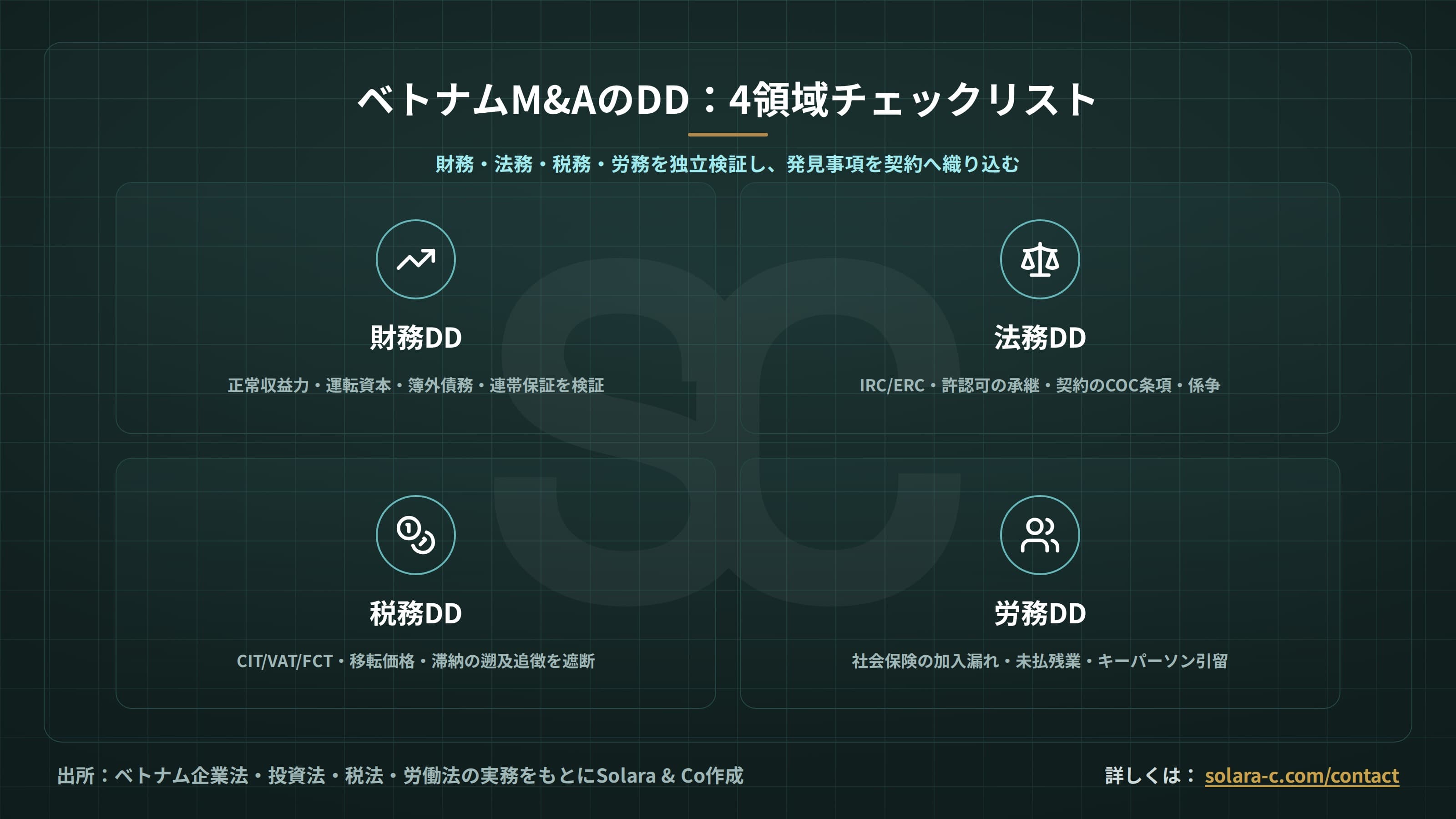
Tax risk — VAT, corporate income tax, transfer pricing, PIT withholding
Tax is a boundary area between financial DD and tax DD, but because it bears directly on the purchase price and indemnity clauses, financial DD must always cover it. In Vietnam, tax audits are conducted retroactively, and errors in past treatment are later billed together with late-payment interest and penalties.
Typical issues by major tax type
For VAT (value-added tax), the issues are deficiencies in the invoices that support input tax credits and failure to meet the requirements for export exemption/refunds. For corporate income tax (CIT), the typical issues are expenses that fail the deductibility requirements and failure to meet the requirements for continuing to apply tax incentives (investment-incentivized sectors, industrial parks). For personal income tax (PIT), the frequent issues are omissions in withholding from salaries and omissions in taxing in-kind salaries and allowances. For transfer pricing (Decree 132/2020), violations of the documentation obligation for related-party transactions and income shifting via non-arm's-length prices are a breeding ground for back-taxes. Because these can be taxed retroactively, they must be quantified as contingent tax liabilities and covered by Net Debt or indemnity.
The foundation: accounting standards and audit quality
Before reading the numbers, you must confirm under which standards and with what degree of reliability those numbers were produced.
Divergence between VAS and IFRS / management accounts
The statutory financial statements of Vietnamese companies are based on Vietnamese Accounting Standards (VAS). VAS differs from IFRS — its treatment of impairment, fair value, leases, and provisions is sometimes not conservative or is simplified — so it diverges from the economic reality the buyer assumes. Furthermore, the VAS books for tax purposes and the management accounts for the owner are sometimes entirely different, so judgment is needed on which figures to use as the foundation for valuation.
Audit quality and unaudited financials
Even "audited" is no cause for relief. In formal audits by small local audit firms, double books, related-party transactions, and underprovisioning may be overlooked. There are also many cases where the most recent period is unaudited (management accounts only), in which case the financial DD side must reconstruct the reality. Confirming the size and reputation of the auditor, the presence of restatements in prior years, and any qualifications in the audit opinion is the starting point for gauging the reliability of the numbers.
Translating findings into price and contract
Financial DD only acquires meaning once the issues discovered are translated into three points — "price, Net Debt, and contract terms." Below, for each major issue, we organize the typical findings and how they are reflected in price and contract.
Major DD issue | Typical finding (Vietnam) | Reflection in price / contract |
|---|---|---|
Quality of earnings (QoE) | Mixing of one-time items, related-party transactions, personal expenses | Recompute normalized EBITDA → adjust price by multiple |
Revenue, double books | Divergence between declared and actual, undeclared revenue | Value on a declared basis + handle tax-evasion risk via reps & warranties, indemnity |
Working capital | Stagnant receivables, latent-loss inventory, swings in advances received | Set normalized working-capital peg → adjust the difference at closing |
Net Debt, off-balance-sheet | Unpaid taxes, social insurance arrears, off-balance-sheet guarantees | Deduct from price as debt-like, or use escrow |
Tax risk | Contingent back-taxes for VAT/CIT/PIT/transfer pricing | Quantify contingent tax liability → special indemnity (specific indemnity) |
Accounting, audit | VAS divergence, unaudited, underprovisioning | Reconstruct reality + expand the scope of reps & warranties |
Building it into the Net Debt and price-adjustment mechanism
Determined liabilities (unpaid taxes, social insurance arrears — those whose amounts are fixed) are in principle included in Net Debt and deducted from enterprise value. Working capital, whose amount fluctuates, is settled by the difference at closing against the normal level. Depending on whether the completion-accounts method or the locked-box method is used, the reference date and procedure for adjustment change — this point too should be decided at the design stage.
Translating into reps & warranties, indemnity, and escrow
Risks that are uncertain as to whether they will arise or as to amount (tax-evasion risk, contingent back-taxes, off-balance-sheet guarantees, litigation) cannot be fully priced in. These are covered by the seller's reps & warranties and indemnity clauses, and for specific risks such as tax, a special indemnity (specific indemnity) capped by amount and period is set. To secure collectibility, it is effective to design retaining part of the purchase price in escrow, or linking it to future performance via an earnout. The precision of the financial DD findings determines how thick these contractual safeguards become.
Solara & Co's end-to-end support — reading behind the numbers
Financial DD of a Vietnamese company only acquires meaning once you understand Vietnam's distinctive structure — a cash economy, double books, unpaid social insurance, the divergence between VAS and reality. If you keep the Japanese mindset that "audited means safe," you can see through neither the normalized earning power nor the liabilities lurking off the books.
Solara & Co has bases and expert personnel in accounting and tax in both Japan and Vietnam, and provides end-to-end support — from recomputing normalized EBITDA through QoE analysis, verifying double books, grasping the substantive values of working capital and Net Debt, and quantifying contingent tax risk, through to the contract design that translates those into price adjustments, reps & warranties, and escrow. Reading not just the surface but behind the numbers is what separates success from failure in Vietnamese M&A. We will accompany you from the very first step of confirming "is that profit real, and does that book value hide any liabilities."